
Walk-in freezer troubleshooting, symptom by symptom
By Vimal Bhaya, Founder and Lead Systems Architect · Last reviewed 4 October 2026
This is a continuation of How walk-ins work, and how they fail, a 4-part tutorial. You are on part 4 of 4.
Ice on the coil is the most reported walk-in freezer problem, and a defrost that has stopped doing its job is behind most of it.
First check: at the next scheduled defrost time, do the fans stop, and does the box air rise a few degrees and come back down within about two hours? If not, start with defrost.
If anything has started to soften, or the box will not get back below 0°F (-18°C), call a technician today. If the box is nearing 32°F (0°C), move the food to another freezer now.
Seven symptoms cover most walk-in freezer problems
Find what you are seeing, then jump to its section. Each section lists its reasons most reported first: most reported in the public threads we read and in the technicians' answers to them. That is not the same as how often each fault happens in the field, which nobody publishes.
| # | What you see | What it usually is | Parts to suspect | Can you check it yourself? | How urgent |
|---|---|---|---|---|---|
| 1 | Defrost is not keeping up | Defrost timer, defrost heaters, termination switch, door, drain line | Partly. Look at where the ice is, and whether the timer dial moves | Within a day | |
| 2 | An iced coil, or lost capacity | Refrigerant, evaporator fans, condenser, expansion valve, compressor | Partly. Look at the coil, the fans and the condenser | Today if still climbing | |
| 3 | A stuck switch, or a timer on the wrong time | Termination and fan delay switch, defrost timer | Partly. Watch one defrost, and check the timer's clock | Today if the fans stay off | |
| 4 | Meltwater not getting out | Drain line, trap and drain heater | Yes. Look under the unit and follow the drain line | Within a few days | |
| 5 | Warm, wet air getting in | Door gasket, closer, door heaters | Yes. Look at the gasket, feel the frame, let the door close itself | This week | |
| 6 | Lost winter controls | Winter controls | No. A technician's job | Before the next cold night | |
| 7 | A condenser that cannot shed heat | Condenser, pressure switches, refrigerant | Partly. Look at the condenser coil and fan | Today: a tripped unit is not cooling |
Here is a list of seven things you can check to assess your walk-in's health
None of these needs a tool or an open panel.
- Is the condensing unit running? Listen at the outdoor or back-room cabinet. Silence with a warm box points to the next check.
- Is a switch off or a breaker tripped? Look at the disconnect switch beside the unit and at the breaker panel. Tell the technician what you find. Do not keep resetting a breaker that trips again.
- Are the fans in the box turning? Outside a defrost they should all run. A still fan, or one iced in, is a clue.
- Is the condenser coil furred with dust or grease? Look through the guard. Do not reach in. A coil you cannot see through cannot get rid of heat.
- Does the door close and seal by itself? Open it a few inches and let go. It should swing shut and seal all the way round.
- Has someone moved the thermostat? Check the setting against what it should be.
- Is product blocking the coil? Boxes stacked against the unit, or in front of its fans, starve it of air.
Leave gauges, refrigerant and anything inside an electrical panel to a technician. Never chip or pick ice off the coil. The tubes are thin, and one hole turns a defrost problem into a refrigerant leak.
1. Ice on a walk-in freezer coil means defrost is losing
A light, even frost that clears at every defrost is normal. A coil that has turned into a white block, with the fans iced in and the box slowly warming, is not. It is the biggest single cluster of questions in our research, from owners and technicians alike.
"My walk-in freezer right now. Anything I can do?"
r/refrigeration, thread title
Where the ice sits is the first clue, so look before you call. The evaporator coil page shows each pattern side by side.
Reason 1: A defrost timer that has stopped means defrost never starts
- Parts: defrost timer.
- What happens: If the timer stops turning, the freezer never stops to melt its frost. A little more builds every day until the coil chokes.
- The proof: ice spread evenly across the whole coil, and no warm-up at the usual defrost times.
- Check: most mechanical timers have a dial that shows the time of day. Note where it points, and look again an hour later. If it has not moved, or shows the wrong time, tell the technician.
The Philadelphia freezer on this page shows it. Its scheduled warm-ups faded out from about 19 April, its floor climbed faster from then on, and on 22 April a technician found a failed defrost timer and an iced coil.
Reason 2: A defrost that starts but does not finish leaves ice behind
- Parts: defrost heaters; defrost termination and fan delay switch.
- What happens: A heater element that has burned out leaves part of the coil cold during defrost. A switch that ends defrost too early cuts the heat before the ice is gone.
- The proof: patchy ice, clear in some rows and solid in others, that grows a little every day.
- Check: this needs a meter, so it is a technician's job. Tell them where the ice is thickest.
Reason 3: Wet air getting in can beat a healthy defrost
- Parts: door gasket, closer, strip curtain and door heaters.
- What happens: Every time warm, damp air gets in, it leaves frost on the coil. A propped door, a torn gasket or a humid summer can add frost faster than defrost can clear it.
- The proof: frost on the ceiling, walls and boxes near the door, not only on the coil. It gets worse in humid weather and after busy days.
- Check: look round the door frame and the gasket. A failed door heater starts a chain that ends here, set out under symptom 5.
Reason 4: A frozen drain makes ice grow from the bottom up
- Parts: drain line, trap and drain heater.
- What happens: Meltwater has to leave the box. If the drain heater has failed or the line is blocked, the water refreezes in the pan, and the ice climbs back into the coil.
- The proof: ice thickest at the bottom of the coil and in the pan, often with icicles hanging under the unit.
- Check: look under the unit for icicles. The details are under symptom 4.
Reason 5: Too little refrigerant frosts only part of the coil
- Parts: refrigerant leaks and charge.
- What happens: With too little refrigerant, only the first part of the coil gets cold enough to frost. The rest stays bare, and the box struggles to hold temperature.
- The proof: frost on one end or one section of the coil only, and a box that runs a little warmer each week.
- Check: a technician's job. It needs gauges.
Less often: a stopped evaporator fan, so no air crosses the coil and it ices in place. Or product stacked against the unit.
Before you call, check these five things
- Where is the ice: even all over, patchy, or thickest at the bottom?
- At the usual defrost times, do the fans stop and does the box warm a little?
- Is the timer dial turning, and does it show the right time?
- Are there icicles under the unit, or ice on the floor?
- Is there frost round the door or on the ceiling?
- When to call a technician: within a day. Icing from a defrost fault builds over days, not hours. On the Philadelphia freezer it was eight days from the first sign to the peak. But each day costs margin, and an iced coil also stops the box recovering after deliveries.
- What to tell them: where the ice is, when you first saw it, whether the box still warms at its defrost times, and what you have already checked.
2. A walk-in freezer stuck at 10°F to 20°F (-12°C to -7°C) has lost capacity
The unit runs and runs, but the box will not pull down. Sometimes it settles near 10°F (-12°C), sometimes near 20°F (-7°C), and stays there.
"Walk-in Freezer Not Cold Enough?"
r/refrigeration, thread title
Reason 1: An iced coil is the first thing to rule out
- Parts: evaporator coil.
- What happens: A coil packed with ice cannot move heat, however hard the rest of the system works. In that case warm is the result, and defrost is the problem.
- The proof: frost or ice across the coil face, and fans struggling to push air through it.
- Check: look at the coil. If it is iced, go to symptom 1.
Reason 2: A refrigerant leak makes the freezer lose ground week by week
- Parts: refrigerant leaks and charge.
- What happens: Less refrigerant moves less heat. The box holds on cool days, then slips a little further every week.
- The proof: a slow slide over weeks, not days, and a unit that runs longer and longer.
- Check: a technician's job. Tell them how long the slide has been going on.
The second Philadelphia freezer we have readings from shows this. One of its two refrigeration systems had a leak, and the other a broken fan blade, motor and bracket. Each system was there to cover for the other, so with both weakened the room lost its margin. The first warning came on 10 June 2025, nearly 30 days before repairs began. The full record is in the dual-system case study.
Reason 3: A stopped evaporator fan can warm the box within hours
- Parts: evaporator fans.
- What happens: With a fan out, less air crosses the coil. The box warms unevenly, and the coil often ices because the air is not there to carry its cold away.
- The proof: one fan still while the others turn, outside a defrost.
- Check: from the floor, look at each fan in turn.
Reason 4: A dirty condenser or a dead condenser fan cuts capacity on warm days
- Parts: condenser coil and fan.
- What happens: If the coil outside cannot shed heat, the whole loop slows down. The box holds overnight and slips on hot afternoons.
- The proof: worse in the afternoon than at night, and a condenser coil you cannot see through, or a fan that is not turning while the compressor runs.
- Check: look at the condenser coil and fan through the guard.
Reason 5: A blocked expansion valve starves the coil
- Parts: expansion valve.
- What happens: On a TXV, a fine screen at the inlet can plug with debris, or moisture can freeze inside the valve. Too little refrigerant then reaches the coil. From outside it looks a lot like a leak.
- The proof: for the technician, readings that look like a leak but no leak found. Only the first part of the coil frosts.
- Check: a technician's job.
Less often: a compressor, contactor and starting parts that has worn and pumps less than it did. Or a system that was too small for the box from the start, which shows up in the first hot week or after the first heavy delivery.
Before you call, check these five things
- Is the coil iced?
- Are all the evaporator fans turning?
- Is the condenser coil clean, and its fan turning?
- Is it worse in the afternoon than overnight?
- Has the box been slipping for days, or weeks?
- When to call a technician: today if the box is still climbing. A stopped fan can warm a box within hours. A leak or a dirty condenser works over weeks, so a box that has settled warm can wait for a morning visit.
- What to tell them: the temperature it is stuck at, since when, whether it is worse in the afternoon, which fans are turning, and whether the coil is iced.
3. Defrost faults show up as fans that stay off, defrosts at odd hours, or bigger bumps
The defrost parts are a cluster of their own in our research. Owners notice the fans have not come back on, or the box warms in the middle of lunch, or each defrost seems to leave it warmer than the last.
"Need help with walk in defrost timer keeps going bad"
r/refrigeration, thread title
Reason 1: A stuck fan delay leaves the fans off after defrost
- Parts: defrost termination and fan delay switch.
- What happens: After a defrost, the fans wait for the coil to get cold again. If the switch that lets them restart sticks, they never do. The coil is cold, but no air crosses it.
- The proof: the compressor running, the coil clear and cold, and the fans still, long after the defrost should have ended.
- Check: look at the fans an hour after a scheduled defrost starts. They should be turning.
Reason 2: A termination switch that sticks makes defrost too short or too long
- Parts: defrost termination and fan delay switch.
- What happens: Stuck one way, defrost ends before the coil is clear, and ice builds. Stuck the other way, defrost runs to its time limit every time, and the box warms more than it needs to.
- The proof: defrost bumps that are taller and longer than they used to be, at the same times of day. Or ice that survives every defrost.
- Check: a technician's job. Tell them what the bumps look like.
Reason 3: A power cut can move defrost into the lunch rush
- Parts: defrost timer.
- What happens: A mechanical defrost timer is a clock. When the power goes off, it stops, and when the power returns it carries on from where it stopped. It no longer knows the real time, so defrosts land at the wrong hours.
- The proof: the time on the timer's dial does not match the real time, and the box has warmed at new times since an outage.
- Check: compare the dial with a clock. A technician can reset it in a minute.
Reason 4: A timer that keeps failing may not be the timer's fault
- Parts: defrost timer.
- What happens: If a new timer fails again, ask the technician to check what is feeding it. The thread quoted above turns on exactly that: the supply voltage reaching the clock.
- The proof: the second or third timer in a short time.
Less often: a heater circuit with no working termination or high-limit switch, which keeps heating. That is a safety question for a technician, today.
Before you call, check these four things
- An hour after a scheduled defrost starts, are the fans turning?
- Does the timer's dial show the right time of day?
- Have the box's warm-ups moved to new times since a power cut?
- Is the timer new, or the second one this year?
- When to call a technician: today if the fans stay off, because the box warms within hours. Otherwise within a day.
- What to tell them: the times the box warms, how long each warm-up lasts, whether the fans restart, and any power cuts since it started.
4. Ice under the unit or on the floor means meltwater is not leaving the box
Every defrost makes water. In a freezer, that water has a short time to get out before it refreezes. When it cannot, you see icicles under the unit, ice on the floor, or water dripping inside the box.
"Walk-in Freezer Dripping Inside"
r/refrigeration, thread title
Reason 1: A failed drain heater lets the line freeze shut
- Parts: drain line, trap and drain heater.
- What happens: The drain line inside a freezer is wrapped with a heater so the water cannot refreeze on its way out. When the heater fails, the line freezes, and the next defrost's water has nowhere to go.
- The proof: the drain line frozen solid where it runs through the cold box, and ice building up in the pan.
- Check: look along the line inside the box for ice. Do not cut or chip it.
Reason 2: A blocked drain backs water up even when it is warm
- Parts: drain line.
- What happens: Dust, mould or food debris can block the line or the pan outlet. Water pools in the pan and freezes there.
- The proof: water or ice in the pan, while the heated part of the line is not frozen.
- Check: a technician or maintenance person can clear it.
Reason 3: A trap inside the box freezes every time
- Parts: drain trap.
- What happens: A trap holds water by design, and inside a freezer that water freezes. Heatcraft's manual says traps on freezer drains must sit outside the box, with the line falling at least a quarter of an inch per foot.
- The proof: you can see the trap inside the box, or the line runs flat or uphill.
- Check: follow the line from the unit to where it leaves the box.
Reason 4: Too little drip time refreezes the last of the water
- Parts: defrost timer.
- What happens: After the heaters stop, water needs a few minutes to drain before cooling starts again. If the timer or controller allows too little, the last of it freezes in the pan.
- The proof: a thin layer of ice in the pan after every defrost, even though the drain is clear.
- Check: a technician's job.
Before you call, check these four things
- Are there icicles under the unit?
- Is the drain line frozen where it runs inside the box?
- Where is the trap: inside the box, or outside?
- Does the line fall steadily toward the outside?
- When to call a technician: within a few days. Each defrost adds to the ice, and it grows back toward the coil. Ice on the floor is also a slip hazard today.
- What to tell them: where the ice is, whether the line feels frozen, and where the trap sits.
5. Frost round a walk-in freezer door means warm, wet air is getting in
You see a ring of frost round the frame, a door that sticks, or a door that will not close on its own. Door faults rarely warm the box by themselves. They feed the coil ice instead.
"Frost in a walk in freezer"
r/refrigeration, thread title
Reason 1: A gasket gone hard or torn lets air in all day
- Parts: door gasket, closer, strip curtain and door heaters.
- What happens: Freezer gaskets have to stay soft at freezer temperatures. Generic ones can go hard in the cold, and any gasket tears in time.
- The proof: gaps, tears or flattened sections, often with a line of frost along them.
- Check: look all the way round, including the sweep along the bottom.
Reason 2: A failed door-frame heater starts a chain that ends in an iced coil
- Parts: door-frame heater.
- What happens: A heater wire runs round the frame, under the trim, to stop the gasket freezing to the metal. Bally's service manual names ice round a door as a sign of heater failure.
- The proof: frost or ice on the frame, and trim that feels cold. Thermo-Kool's manual says a working heater leaves the trim warm to the touch.
- Check: run your hand along the frame next to the gasket. It should feel warm.
One failure feeds the next:
- The door-frame heater fails.
- The gasket freezes to the frame.
- It tears when someone pulls the door open.
- Warm, wet air gets in all day.
- The coil ices faster than defrost can clear it. See symptom 1.
Reason 3: A sagging hinge or a failed closer leaves the door ajar
- Parts: door closer and hinges.
- What happens: US federal rules require walk-in doors to have closers that pull them firmly shut from within an inch of closed. A closer that has failed, or a door that has dropped on its hinges, leaves a gap.
- The proof: the door does not swing shut and seal by itself.
- Check: open it a few inches and let go.
Reason 4: An iced relief port makes the door hard to reopen
- Parts: pressure relief port.
- What happens: Shutting a freezer door traps warm air, which cools and shrinks and pulls the door in. A small heated port in the wall lets air through to balance it. If the port ices, the door is hard to open just after it shuts.
- The proof: hard to open right after closing, easier a minute later.
- Check: look at the port beside the door for ice. Thermo-Kool's manual says the vent must be connected.
Less often: a door that staff prop open, or air leaking through joints between the wall panels.
Before you call, check these four things
- Is the gasket whole all the way round?
- Does the frame by the gasket feel warm?
- Does the door close and seal on its own?
- Is the door hard to open just after it shuts?
- When to call a technician: this week, or sooner if the door no longer seals.
- What to tell them: where the frost is, whether the frame is warm, and whether the door closes by itself.
6. A walk-in freezer that warms on cold nights has lost its winter controls
It sounds backwards. The box is fine on a hot afternoon, and warm at 6 AM after a freezing night. It happens to outdoor units in a cold North American winter, and to indoor units in a room that is not heated.
"Walk-in freezer cold weather problem"
r/refrigeration, thread title
Head pressure, in plain words. The refrigerant only moves because the compressor squeezes it. How hard it is squeezed, on the hot side of the system, is the head pressure. That pressure is what pushes liquid through the expansion valve into the coil, the way water pressure pushes water through a garden sprinkler.
On a hot day the condenser runs warm, the pressure stays high, and plenty of liquid gets through. On a freezing night, an outdoor condenser gets so cold that the pressure collapses. It is like turning the tap nearly off: the sprinkler dribbles. The coil inside gets too little refrigerant, so the box warms up even though the machine is running.
Winter controls fix this by making the condenser worse at its job, on purpose. They switch its fan off, or back some liquid up inside it so less of it can cool the refrigerant. The pressure stays up, and the box stays cold.
Reason 1: Failed or missing head-pressure control starves the box in the cold
- Parts: winter controls: head-pressure control and crankcase heater.
- What happens: Without working winter controls, the pressure collapses on cold nights, as above. Heatcraft's manual describes both kinds: a fan control that shuts the condenser fan off, and a valve that floods the condenser with liquid to hold the pressure.
- The proof: warm overnight and early in the morning on the coldest nights, recovered by the afternoon.
- Check: a technician's job. Write down the nights it happened and how cold it was outside.
Reason 2: A dead crankcase heater can stop the compressor after a cold night
- Parts: crankcase heater.
- What happens: Outdoor units carry a small heater on the compressor. It stops liquid refrigerant settling in the oil while the unit is off in the cold. Heatcraft's manual says a crankcase heater is required on its condensing units.
- The proof: a compressor that struggles or will not start after a cold night.
- Check: a technician's job.
Reason 3: An indoor unit in an unheated room fails the same way
- Parts: none. The room is the problem, not a part.
- What happens: Indoor units usually have no winter controls. In a storage room or garage that gets cold, they behave like an outdoor unit without them.
- The proof: the room the unit sits in gets cold at night.
- Check: check how cold that room gets.
- When to call a technician: before the next cold snap. The related search people type is exactly this one: walk-in freezer not cold enough in winter.
- What to tell them: the dates, the times of day and the outdoor temperatures when it ran warm.
7. A condensing unit that trips on hot days is choking on its own heat
On the hottest afternoons, the outdoor or back-room unit stops. Sometimes it starts again by itself. Sometimes it stays off until someone resets it, and the box warms for hours. This is the opposite of symptom 6: now the head pressure climbs too high.
Reason 1: A dirty condenser trips the high-pressure switch in a heat wave
- Parts: condenser coil and fan; thermostat, controller and pressure switches.
- What happens: The condenser has to shed heat into air that is already hot. Coated in dust, grease or seed fluff, it cannot. Pressure climbs until a safety switch stops the compressor. Some of these switches reset themselves. Others stay off until a person resets them.
- The proof: trips in the afternoon heat, and a condenser coil you cannot see through.
- Check: look at the coil through the guard, and ask for it to be cleaned.
Reason 2: A dead condenser fan trips it faster
- Parts: condenser fan.
- What happens: Same coil, no air across it. Pressure climbs within minutes of the compressor starting.
- The proof: the compressor running while the condenser fan sits still.
- Check: look at the fan when the unit starts.
Reason 3: Too much refrigerant, or air in the system after a repair, raises pressure
- Parts: refrigerant leaks and charge.
- What happens: Too much refrigerant, or air let in during a repair, leaves the system running at higher pressure than it should. A hot day then pushes it over the limit.
- The proof: the trips started soon after a service visit.
- Check: tell the technician when the last repair was.
Reason 4: Hot air round an indoor unit has the same effect
- Parts: none. The room round the unit is the problem.
- What happens: An indoor unit breathes the room's air. In a closet, a hot kitchen or a ceiling space, it can end up breathing its own exhaust. Heatcraft's manual says units must not sit near hot air exhausts and need free access to supply air.
- The proof: trips that follow kitchen hours rather than the weather.
- Check: feel the air round the unit while it runs.
- When to call a technician: today. A tripped unit is not cooling at all.
- What to tell them: the time of day, the outdoor temperature, whether it reset by itself, and when it was last serviced.
Here's how TemperatureWise caught an iced coil in time to save $150,000 of a customer's inventory
This is a walk-in freezer at a Philadelphia distribution centre in April 2025, holding about $150,000 of frozen product. Its defrost timer failed and the coil iced. The readings come from the export we publish with its case study.
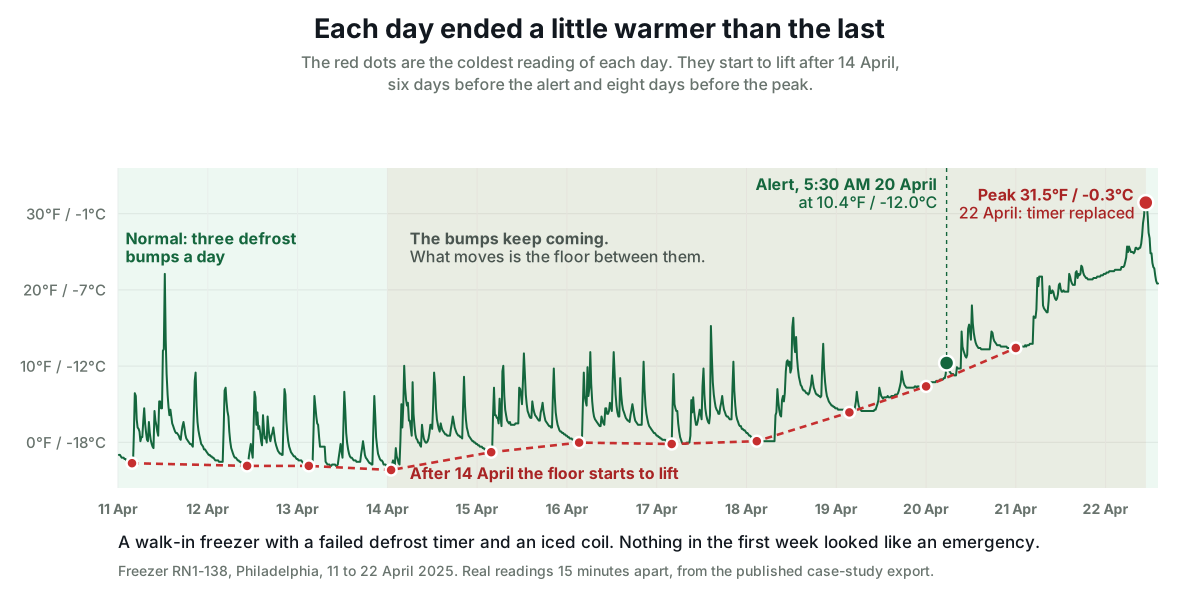
The red dots are the coldest reading of each day. They sat flat for three days, then started lifting after 14 April, eight days before the peak. The defrost bumps kept coming for days after that, and on 18 April the coldest the box managed was still about 0°F (-18°C). Nothing looked like an emergency. From about 19 April the bumps faded out and the floor climbed faster.
TemperatureWise flagged a likely fault on the evaporator side at 5:30 AM on 20 April, at 10.4°F (-12°C), 53 hours before the box peaked at 31.5°F (-0.3°C). One technician visit found the failed defrost timer and the iced coil, and the timer was replaced on 22 April. No product was lost. The full record is in the Philadelphia freezer case study.
This is where TemperatureWise is different: it is not just a threshold alarm
A threshold alarm asks one question: is it too warm right now? On the freezer above, the floor had been lifting for four days by 18 April, and the warmest readings still looked like ordinary defrosts.
TemperatureWise uses machine learning on the full temperature history of each box. It learns that box's own pattern: when it defrosts, how high each bump goes, how fast it recovers, and where the floor sits between bumps. When the pattern changes, TemperatureWise tells you what has changed and where to look.
On the Philadelphia freezer, that meant pointing the team to the evaporator side rather than just sending a number. The technician found the failed defrost timer on the first visit.
It does not replace your technician. It tells you which one to call, and when, so you can sleep through the night. See how TemperatureWise works.