
TemperatureWise for humidity
Temperature and humidity monitoring for food that damp air ruins
Some food is spoiled by damp air, not warm air. Cured garlic roots and molds when the air is too damp, green coffee grows mold above about 70% humidity, and tea goes flat as it takes up water. TemperatureWise is a temperature and humidity monitoring system: one wireless sensor reads both every 15 minutes, keeps the record, and alerts you when a room leaves its range.
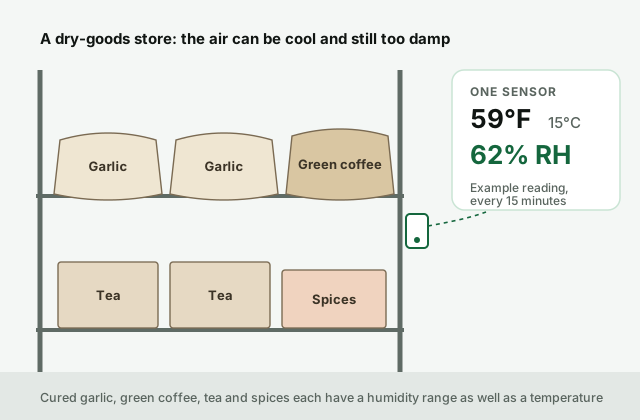
The ranges
What each one needs, temperature and humidity
Published storage ranges for some goods that damp air spoils. Your supplier's or buyer's specification comes first.
| Food | Temperature | Relative humidity | What goes wrong |
|---|---|---|---|
| Garlic, cured | 32°F (0°C) | 65 to 70% | Kept 6 to 7 months at these settings. Damper air makes it root and mold |
| Onions, dry | 32°F (0°C) | 65 to 70% | Also kept drier than most vegetables, which want 90% or more |
| Dried chili peppers | 32 to 50°F (0 to 10°C) | 60 to 70% | Humidity control matters more than the exact temperature |
| Green coffee | Moderate and stable, about 50 to 75°F (10 to 24°C) | About 50 to 70% | Mold is held back at 60% and below. Above about 70% the risk rises, and above 80% sharply |
| Black tea | Cool and dry | As low as you can keep it | In one study it kept 300 days at 32% with no loss, and went flat in 15 days at 100% |
| Spices | Cool and dry | Dry | All spices take up moisture from the air, so they cake and can mold |
Sources at the foot of the page: FAO storage tables (garlic, onions), the WFLO Commodity Storage Manual (chili peppers), the International Coffee Organization's figures as summarised by Royal Coffee, the Tea Research Institute of Sri Lanka, and the GDV Container Handbook (spices).
Why humidity needs its own reading
Three ways a room goes damp while the temperature looks fine
Cooling raises the humidity
Cold air holds less water. Cool a room without taking the water out, and its humidity climbs, though nothing came in. A thermometer alone never shows it.
Doors and weather bring water in
Every open door lets in outside air, and on a wet day that air carries more water. A dock door held open for a delivery can lift a dry store's humidity for hours.
Too dry is a fault too
Green coffee loses moisture in air that is too dry, and dried peppers have a lower limit as well as an upper one. A range has two ends.
What you get
Four things TemperatureWise does as a temperature and humidity monitoring system
Both readings, one sensor
Each LoRa sensor reads temperature and humidity at once, so a dry store, a cooler and a freezer each need one sensor, not two.
Alerts on either one
Set a humidity range as well as a temperature range for each room. Alerts go by email, then text, then a call, to up to three people for each sensor, until someone answers.
A record for your buyer and your auditor
Every reading is kept for good, with the fix staff record against each alert, so you can show how a lot was kept.
An early sign in cold rooms
In a freezer or cooler, rising humidity shows a failing door seal or an icing coil before the temperature moves.
Door gaskets, closers and heatersHow it works
Three steps, nothing drilled
We plan it from your floor plan
We mark where each sensor and the gateway go before anything ships: at the height the goods sit, away from doors and coils.
You place the sensors and plug in the gateway
Magnet, adhesive pad or one screw. LoRa reaches through racking and walls to one gateway for the site.
You set each room's ranges
A temperature range and a humidity range for each room, from your supplier's or buyer's specification. TemperatureWise learns the room's normal day around them.
Pricing
A dry store with four sensors costs $1,050 up front and $1,000 a year
| Item | Once | Per year |
|---|---|---|
| 4 LoRa sensors at $200, temperature and humidity | $800 | |
| Gateway for a mid-sized site | $250 | |
| Monitoring, 4 sensors at $250 | $1,000 | |
| Total | $1,050 | $1,000 |
On your own internet, so connectivity is free. Cellular is $125 once and $50 a year. Price list of 1 September 2026. All prices, and examples for many sites.
Common questions
65 to 70% humidity at 32°F (0°C), where cured garlic keeps for 6 to 7 months, says the FAO's storage table. That is drier than most vegetables, because damper air makes garlic root and mold.
About 50 to 70% humidity, kept steady and not too warm. Mold is held back at 60% and below, the risk rises above about 70%, and above 80% it rises sharply. Those are the coffee trade's own figures.
Yes. Each TemperatureWise LoRa sensor reports temperature and humidity together, every 15 minutes, and both go into the same record.
±2% humidity at 77°F (25°C) on the freezer version of the sensor, and ±0.3°C (±0.54°F) for temperature. Ask us for the cooler version's humidity figure before you rely on it.
Yes. Each room can have a humidity range as well as a temperature range, and leaving it raises an alert with the same steps: email, then a text, then a call, until someone answers.
$200 a sensor once and $250 a sensor a year, plus one gateway per site at $100 to $450. A dry store with four sensors is $1,050 up front and $1,000 a year. The dashboard, alerts and setup cost nothing extra.
See what your store's air has been doing
Send us 30 days of readings from one room, or let us put a sensor in it. We will show you what its temperature and humidity were doing. No purchase needed.