
Your freezer fails weeks before it fails.
AI that catches walk-in cooler and freezer faults at least 4-5 days before failure, with the root cause, not just an alarm.
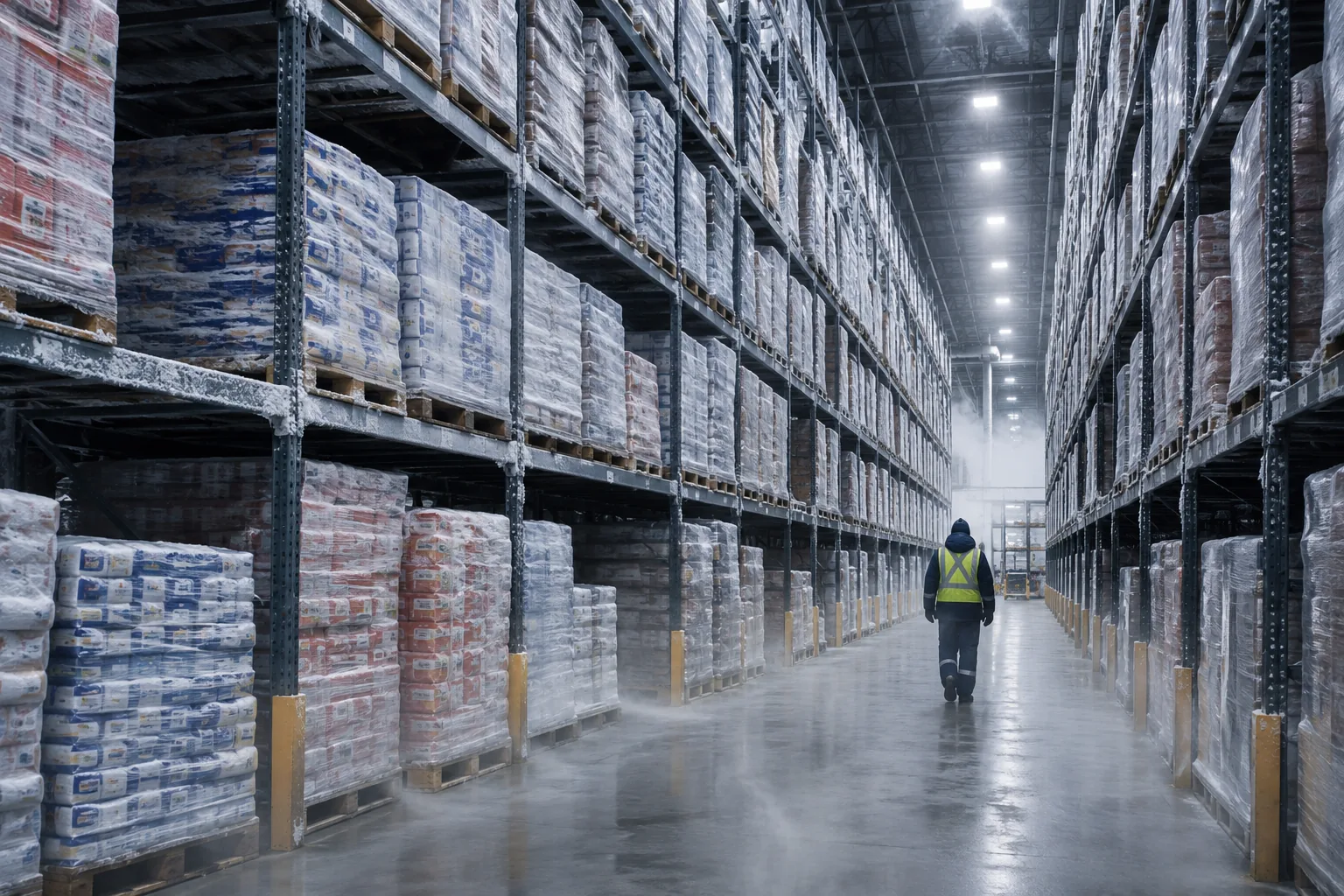
of the world’s fruit and vegetables are lost before they reach retail.
Cold chain failure is a leading cause.
UN Food & Agriculture Organization, 2023
Threshold alarms versus pattern detection
Reactive. Too late.
- Timer fails Friday night and nobody knows
- Temperature climbs silently through the weekend
- Monday morning: product destroyed
- Deductible now, cheque in three to six months
- No usable data trail for the adjuster
Proactive. Days to months early.
- AI flags the drift before the unit goes down
- Root cause identified, so the tech fixes it right the first time
- Escalating alerts: email, SMS, WhatsApp, phone call
- Product ships, no claim filed
- 15 minute audit trail, kept forever
A $250,000 loss. Here is the real bill.
A defrost timer fails over a long weekend and you lose a full chamber: $250,000 of finished goods. You are fully insured. This is what still comes out of your pocket.
| Line item | Who absorbs it | Amount |
|---|---|---|
| Inventory destroyed | $250,000 | |
| Your deductible, paid immediately | You | $5,000 to $10,000 |
| Insurer pays the balance | In 3 to 6 months | $240,000 to $245,000 |
| Cost of capital while you wait | You | $6,000 to $12,000 * |
| Disposal and cleanup | You, up front | Varies |
| Lost margin on product you cannot sell | You, insurance covers cost not profit | Your gross margin |
| Premium impact at renewal | You, every year after | Varies ** |
The cheque eventually arrives. The quarter does not come back.
* $245,000 outstanding for 3 to 6 months at a 10% annual cost of capital. Substitute your own rate.
** Some carriers offer a credit for documented continuous monitoring. Availability and amount depend entirely on your carrier and policy.
How early depends on what is breaking.
A refrigerant leak develops over weeks. A defrost timer fails in a day. We read the signature of each.
Slow faults give you the most room. Fast ones still give you days, enough to get a technician in before a pallet is at risk.
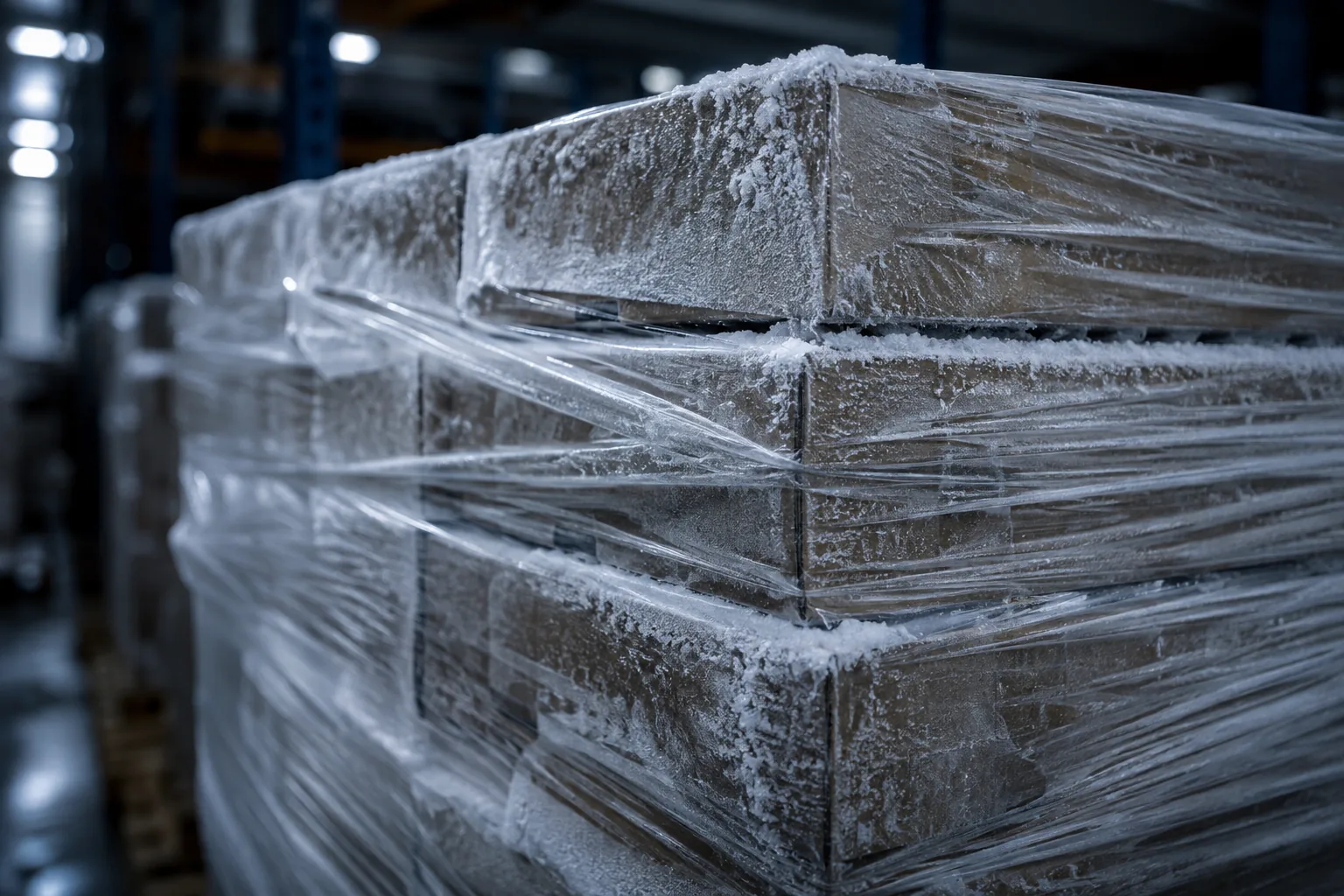
“Great save. Without your timely interference, things could have gone sideways; it turned out to be a great save.”
Operations Manager, national frozen smoothie brand
Are you a food distributor?
We stop spoilage claims before the truck leaves the dock.
Built for the cold, and for buildings that sprawl.
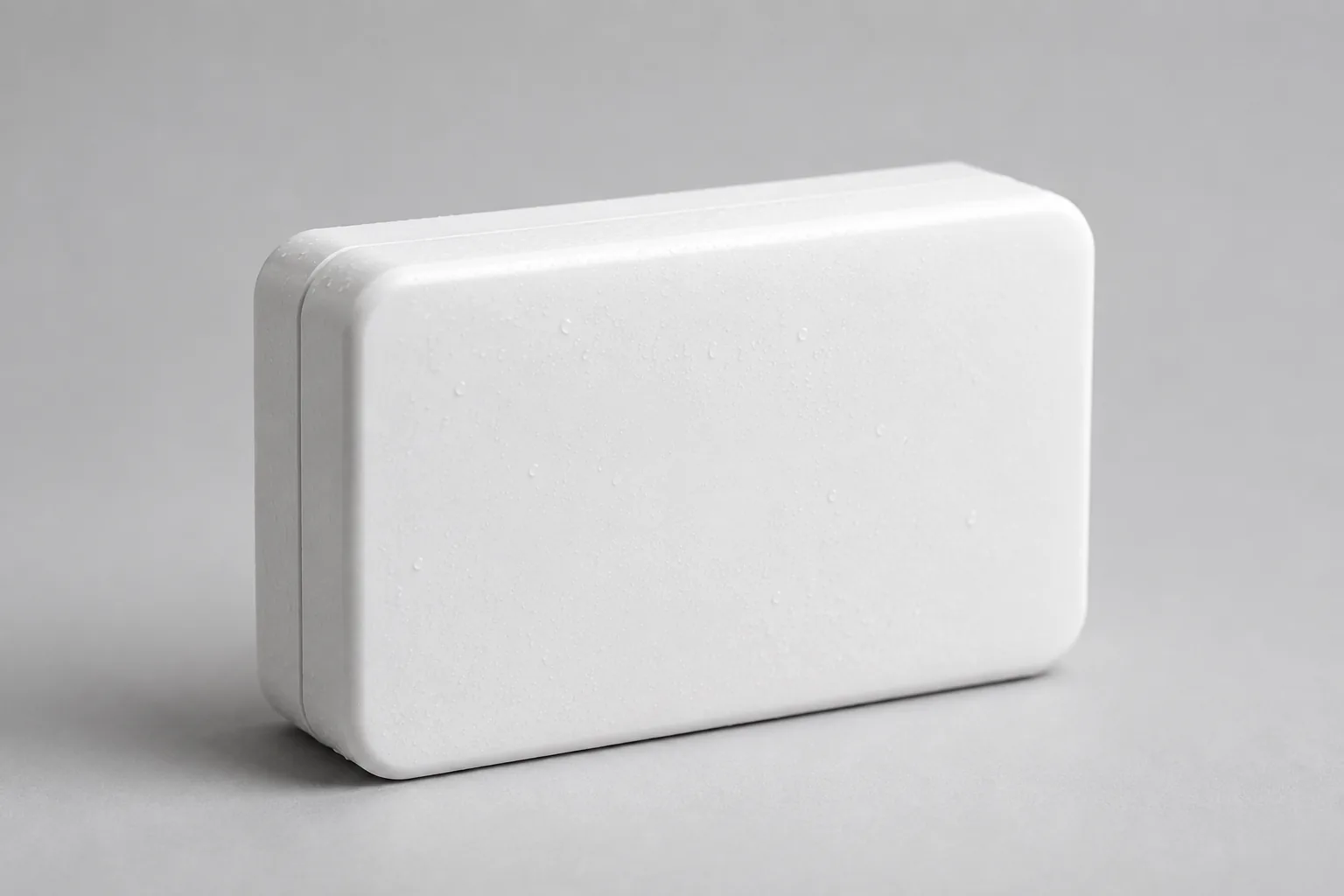
Wireless, no electrician
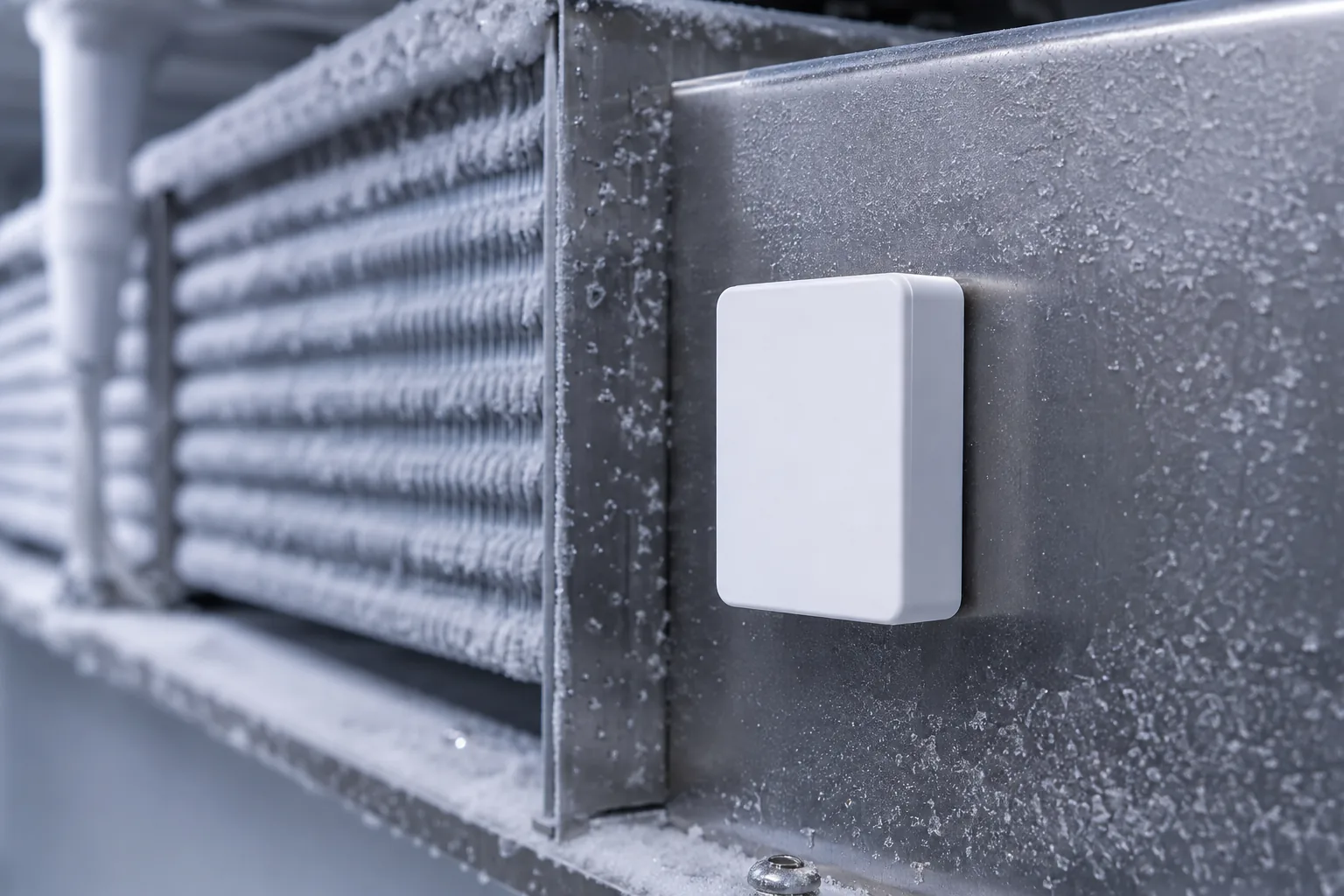
Magnet, industrial 3M adhesive, or wall screw. No wiring, no downtime. Probe form available for liquids.
Rated to -40°C
Operating range -40°C to 100°C, accuracy ±0.2°C. Battery lasts 5 to 8 years, even in a deep freezer.
Campus wide range
Encrypted LoRa reaches across multiple buildings from a single gateway. No dead zones, no dependency on plant WiFi.
Enterprise grade security
Diffie-Hellman key exchange with AES-128 CBC encryption, end to end.
Continuous record
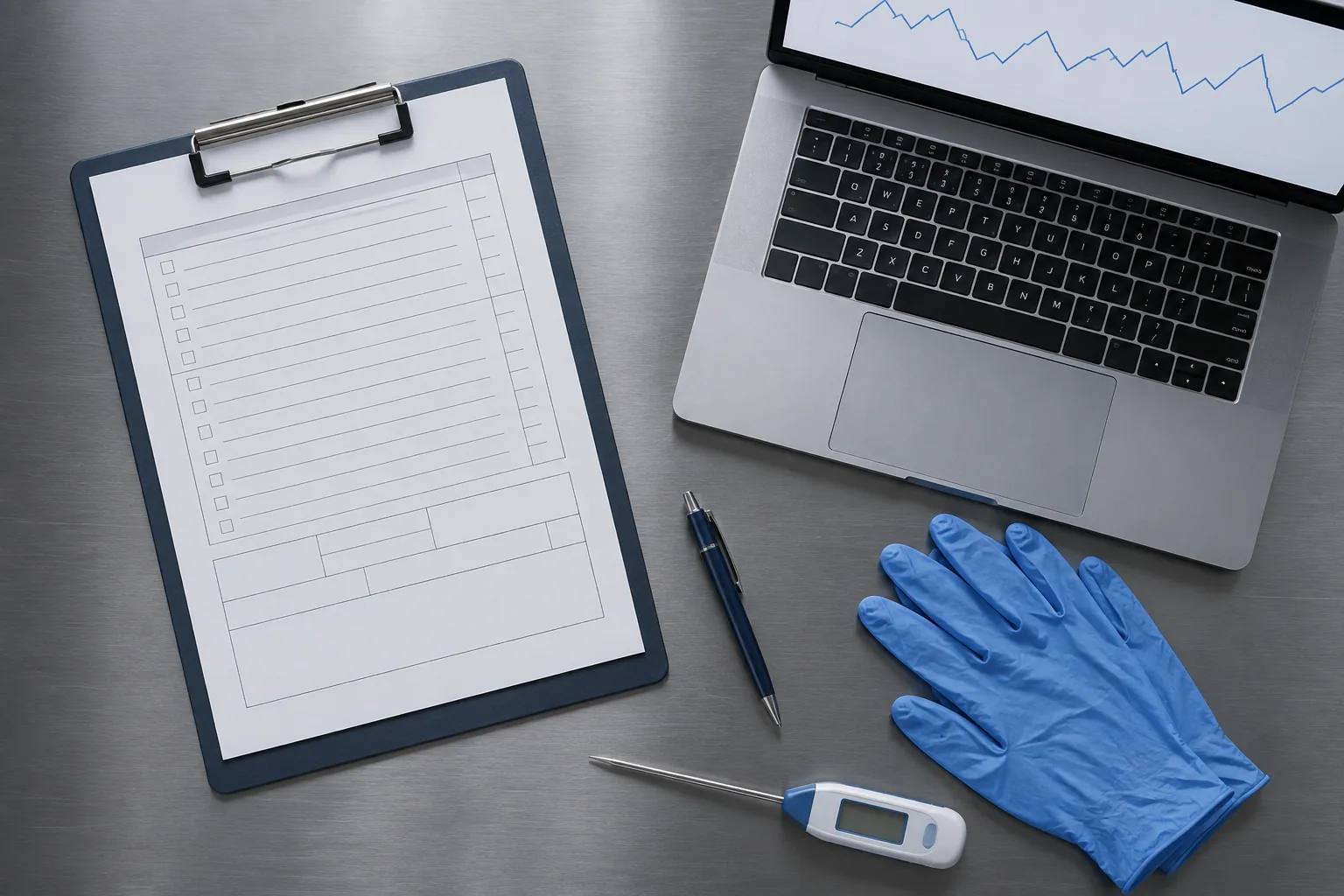
Readings every 15 minutes, retained indefinitely. Audit trail for HACCP, BRC and SQF.
Temperature and humidity
One integrated sensor reports both. Humidity catches a failing door seal or an icing coil before the temperature moves.
Already have sensors?
In many cases we can connect to the monitoring hardware you already own, rather than replacing it. Same AI, same alerts, same audit trail, on the equipment already mounted in your freezers. Worth a conversation before you buy anything new.
Running a BMS or a BAS? With our BACnet gateway the readings appear as ordinary BACnet points, alongside everything else your facilities team already watches, so cold storage stops being the one system that lives in its own app.
Your whole portfolio, one screen.
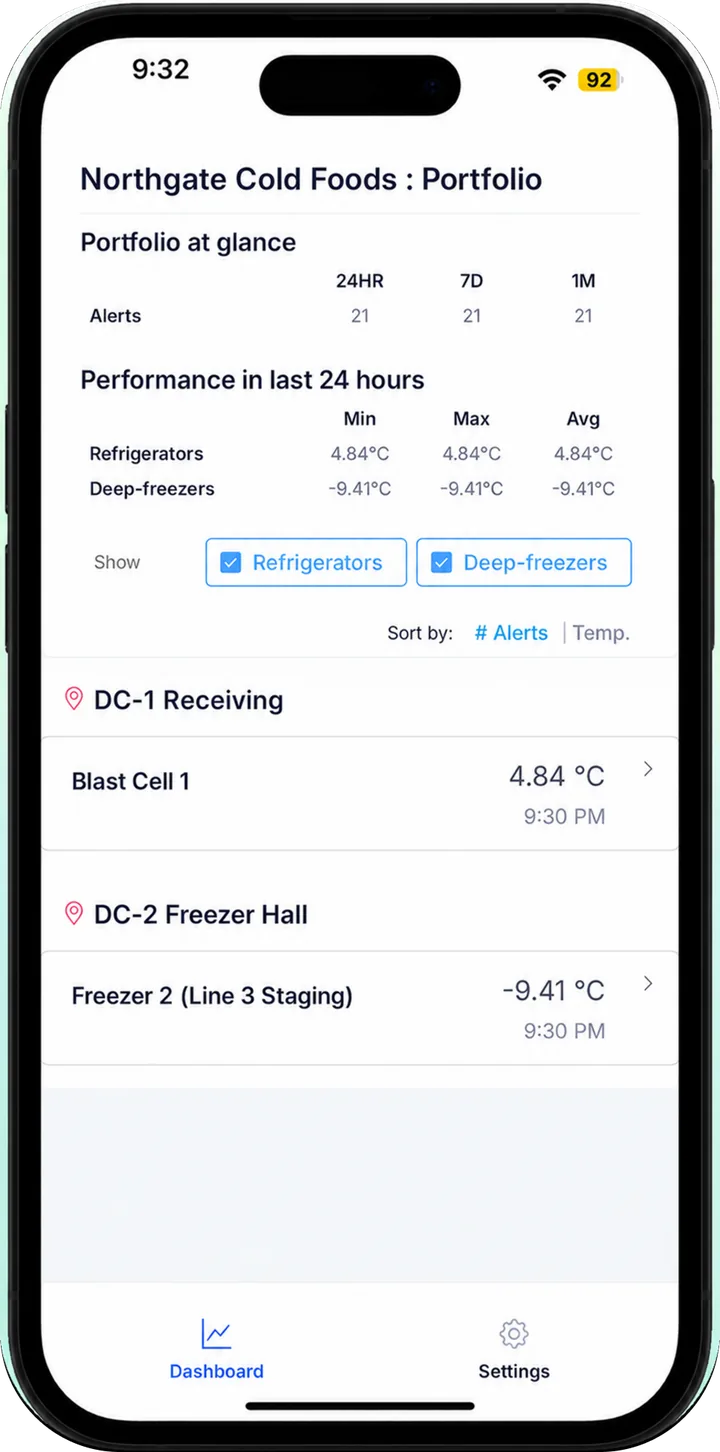
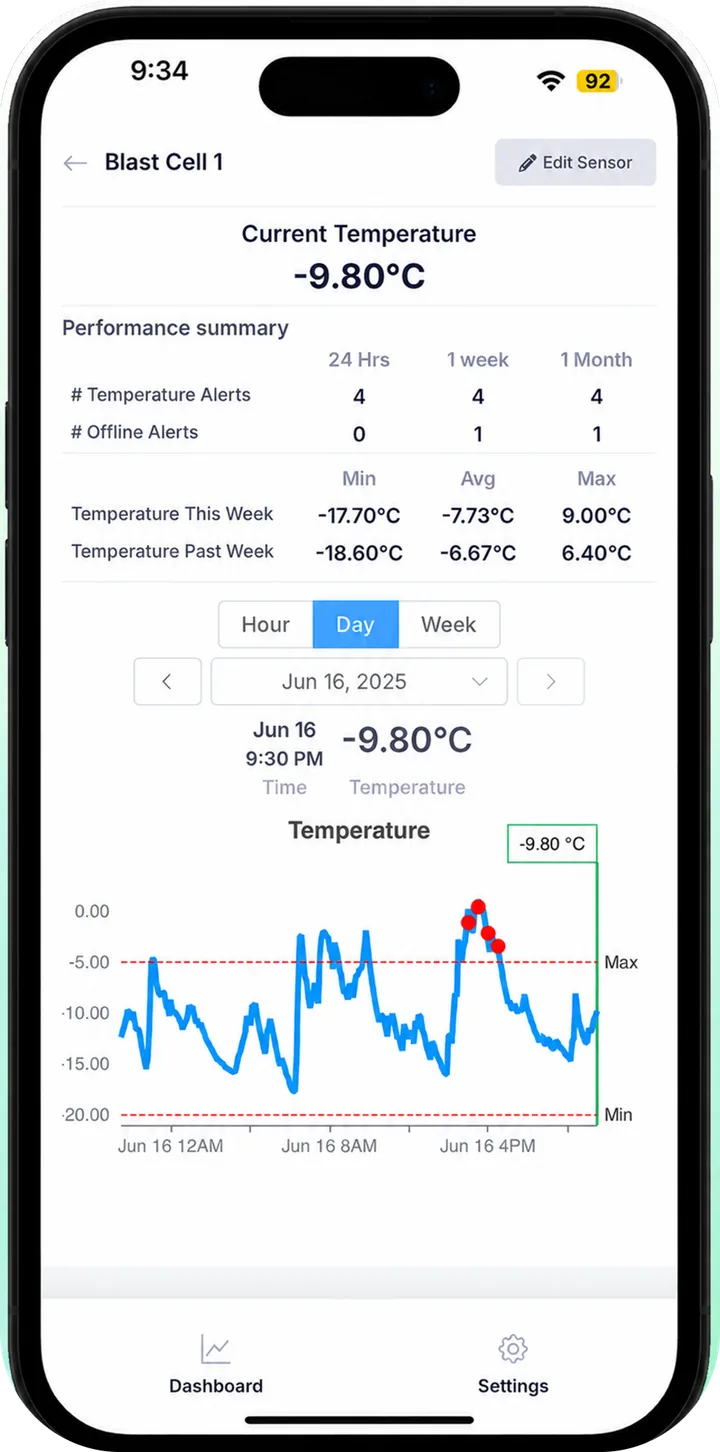
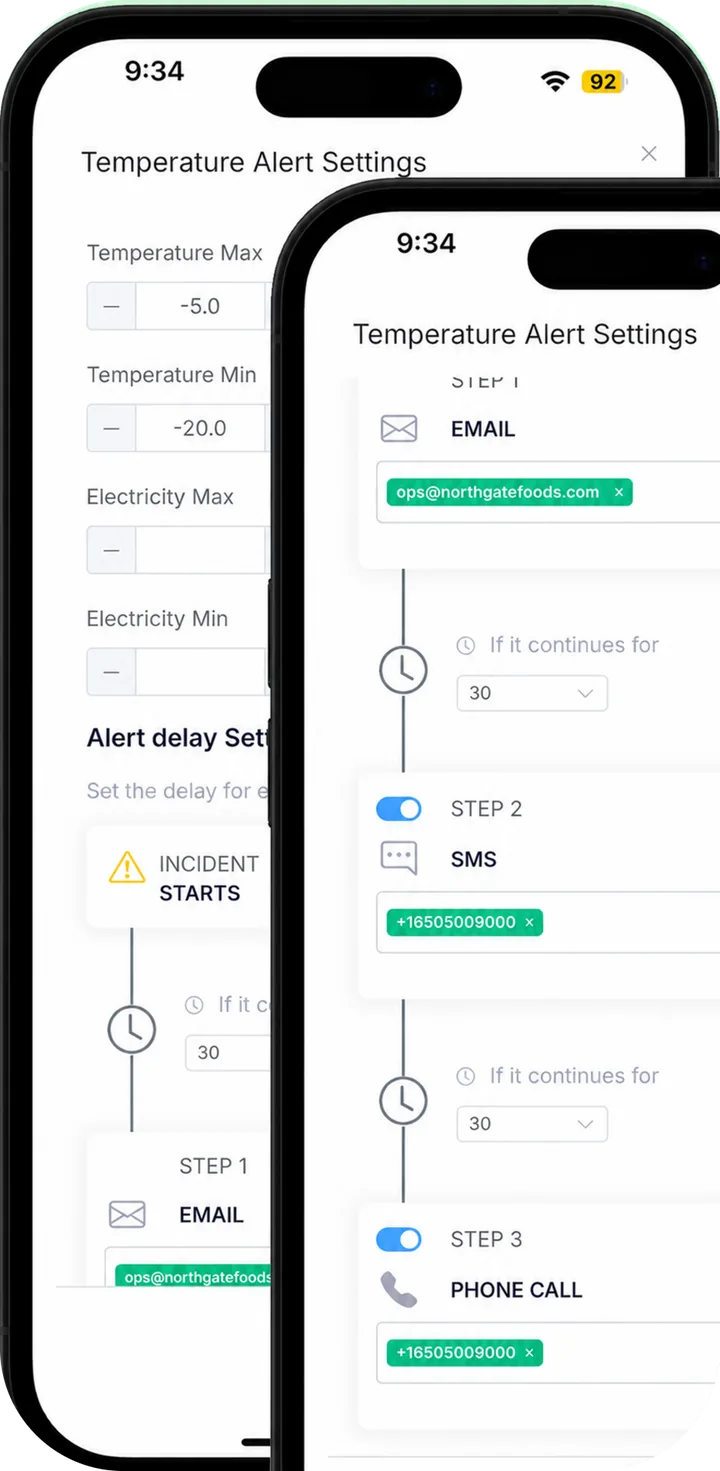
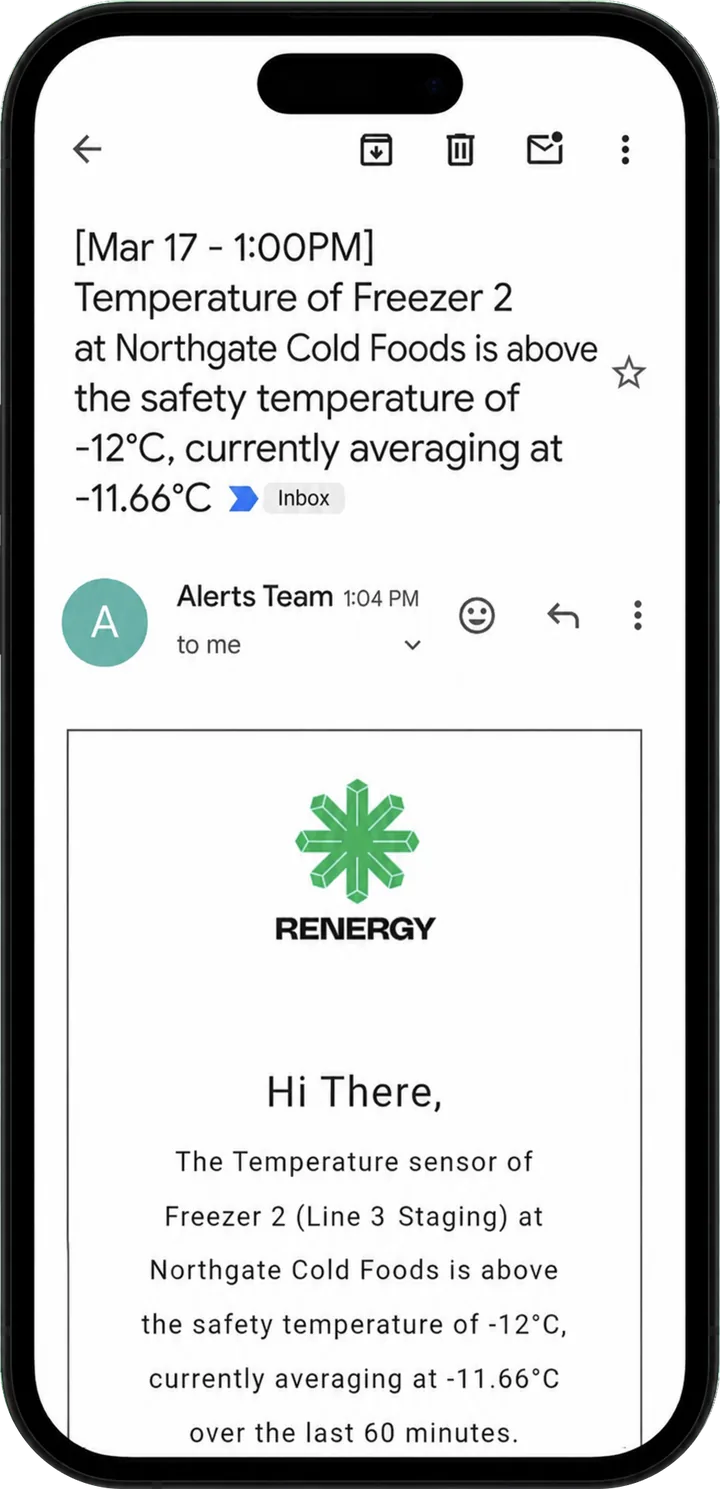
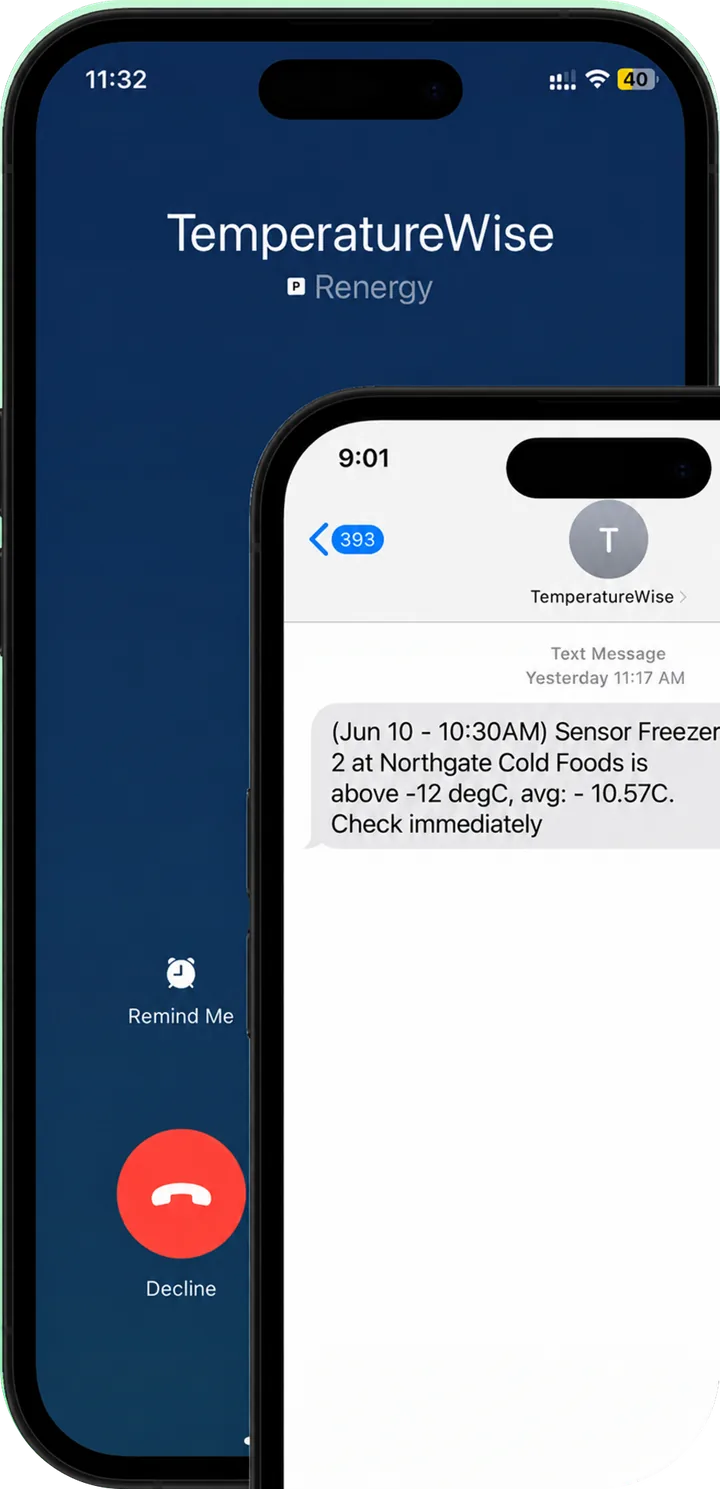
Representative dashboard. Site names and equipment shown are illustrative.
From install to insight in three steps.
Install or connect
Mount sensors in freezer halls, blast cells and walk-ins using a magnet or 3M pad, no wiring. Or connect the sensors you already have.
Monitor continuously
Encrypted LoRa reports to the Renergy cloud every 15 minutes. Every site, one view.
Get diagnosed, not alarmed
AI watches around the clock. When something drifts you get the fault, the root cause and the lead time, and we stay with you through the fix.
What TemperatureWise costs
TemperatureWise costs $250 per sensor per year, about $21 a sensor per month, plus one-time hardware that scales with the size of the site.
- A small restaurant with three reach-ins and its own Wi-Fi: $175 up front, $750 a year
- A mid-sized restaurant with two walk-ins: $1,050 up front, $1,000 a year
- A large site with three walk-ins, cellular and battery backup: $2,500 up front, $2,300 a year
No extra charge: dashboard, alerts, setup.
Calculate your price
Calculator needs JavaScript. Full price list below.
What you install
Default example below.
One-time
| Gateway: 1 × $250 | $250 |
| Sensors: 4 × $200 | $800 |
| One-time total | $1,050 |
Recurring, per year
| Monitoring: 4 × $250 | $1,000 |
| Annual total | $1,000 |
What you protect
Your ROI
Prevented failure
Manual checking cost
Prices true as of Sep 1 2026 price lists. Further discounts depend on the deployment specifics.
See your own number.
Enter your work email to use the calculator. The price list above stays visible either way.
FAQs
Yes. Temperature is a critical control point under HACCP, and monitoring it is one of the seven HACCP principles: you must measure it, record the measurement, and record the corrective action when a reading goes out of range.
HACCP does not require the monitoring to be automated. It requires it to be documented and verifiable. That is the practical difference between a paper log and a continuous system. A paper log records what someone wrote down; a continuous system records what actually happened, including overnight and at weekends when nobody is there to write anything down.
A sensor inside the freezer sends readings to a gateway on site, and you see them on a phone or a web dashboard, with alerts when a reading crosses a threshold you set.
What decides whether this works is the radio, not the app. Wi-Fi and Zigbee do not pass through an insulated freezer panel, which is why many systems run a wired probe through the wall instead. That does work, but the probe is awkward to install, it costs more, and it means cutting into the insulation.
TemperatureWise uses LoRaWAN, a long-range low-power band that passes through several walls of steel and insulation without any penetration at all. The sensor goes inside the box, the gateway sits anywhere on site, and nothing is drilled through the panel. You get live and historic internal temperature, humidity and current draw, with text and email alerts when something goes out of range.
A freezer alarm tells you the temperature is wrong now. A monitoring system records temperature continuously, keeps the history for audits, alerts more than one person, and watches the pattern rather than only the threshold.
TemperatureWise detects developing equipment problems four to five days before failure and identifies the root cause. An alarm cannot do that, because by the time an alarm sounds the product is already warm and the only question left is how much of it you throw away.
In the warmest part of the box under normal operation, which is usually near the door and away from the evaporator's direct discharge. Mounting it in the evaporator airflow gives you a reading that looks better than the food's actual temperature, which is the most common placement mistake we see.
For product temperature rather than air temperature, the probe sits in a buffer, typically a sealed bottle of glycol, so the reading follows what the food is doing instead of spiking every time somebody opens the door. Renergy supplies the buffer where it is needed and matches it to what you actually store, because the right buffer for cases of frozen protein is not the right one for a cooler holding fresh produce.
Most health authorities and HACCP plans expect a recorded check at least twice a day, and many operators do one at every shift change. Confirm the frequency your own health authority requires, because it varies by jurisdiction.
Continuous monitoring does not remove the requirement to hold records. It replaces the manual reading with a recorded one, so the log is complete including the sixteen hours a day nobody is on site, which is also when most failures start.
$250 per sensor per year, which works out at roughly $21 per sensor per month, plus one-time hardware that scales with the size of the site.
A small restaurant with three reach-ins and its own Wi-Fi pays $175 up front and $750 a year. A mid-sized restaurant with two walk-ins pays $1,050 up front and $1,000 a year. A large site with three walk-ins, cellular and battery backup pays $2,500 up front and $2,300 a year.
Connectivity is free if you supply the internet. The full breakdown is in the pricing section above, with a calculator for your own sites.
Monitoring is billed annually at $250 per sensor per year, which works out at roughly $21 per sensor per month.
Connectivity is the only other recurring cost, and it is zero if you supply the internet at the site. There is no separate charge for the dashboard, the alerts, the reporting or the setup.
Two for a mid-sized walk-in and three for a larger one, as a starting point.
The real number depends on the size and layout of the box, because a long walk-in with product stacked against the far wall does not behave like a square one. We size it with you rather than selling a fixed bundle, and more sensors costs more.
Yes. Pricing is quoted per location because each site needs its own gateway, and which one depends on the size of the site: $100 for a smaller site, $250 for a mid-sized one, $450 for the strongest unit on a larger site.
Sensors talk to the gateway over LoRaWAN, which passes through steel and insulation, so one gateway covers a site without needing a device in every room.
Cellular costs $125 once for the hardware package plus $50 per year per location. If you supply the internet over Wi-Fi or Ethernet, connectivity is free.
Cellular is also what makes the battery backup option work, since a power cut usually takes the site router down with it.
If you want monitoring to survive a power cut, we supply a backup mini-inverter for $125 as a one-time cost. It needs the cellular connectivity package, because a power cut usually takes your router down with it, and a monitor running on site Wi-Fi goes silent at exactly the moment you most need it to speak up.
With the backup installed, the cellular connection stays up through the outage, so the sensor keeps logging and reporting without any gap and nothing needs re-pairing by hand once power returns.
As many email recipients as you want. For the urgent path, each sensor can be configured with up to three SMS and phone-call recipients.
Routing is set per sensor, so the walk-in freezer can wake the kitchen manager and the general manager while the dry store only notifies the site lead. That matters more than it sounds: a three in the morning alert sent to one sleeping phone is the same as no alert, and single-recipient alerting is a common and much-resented limitation elsewhere in this category.
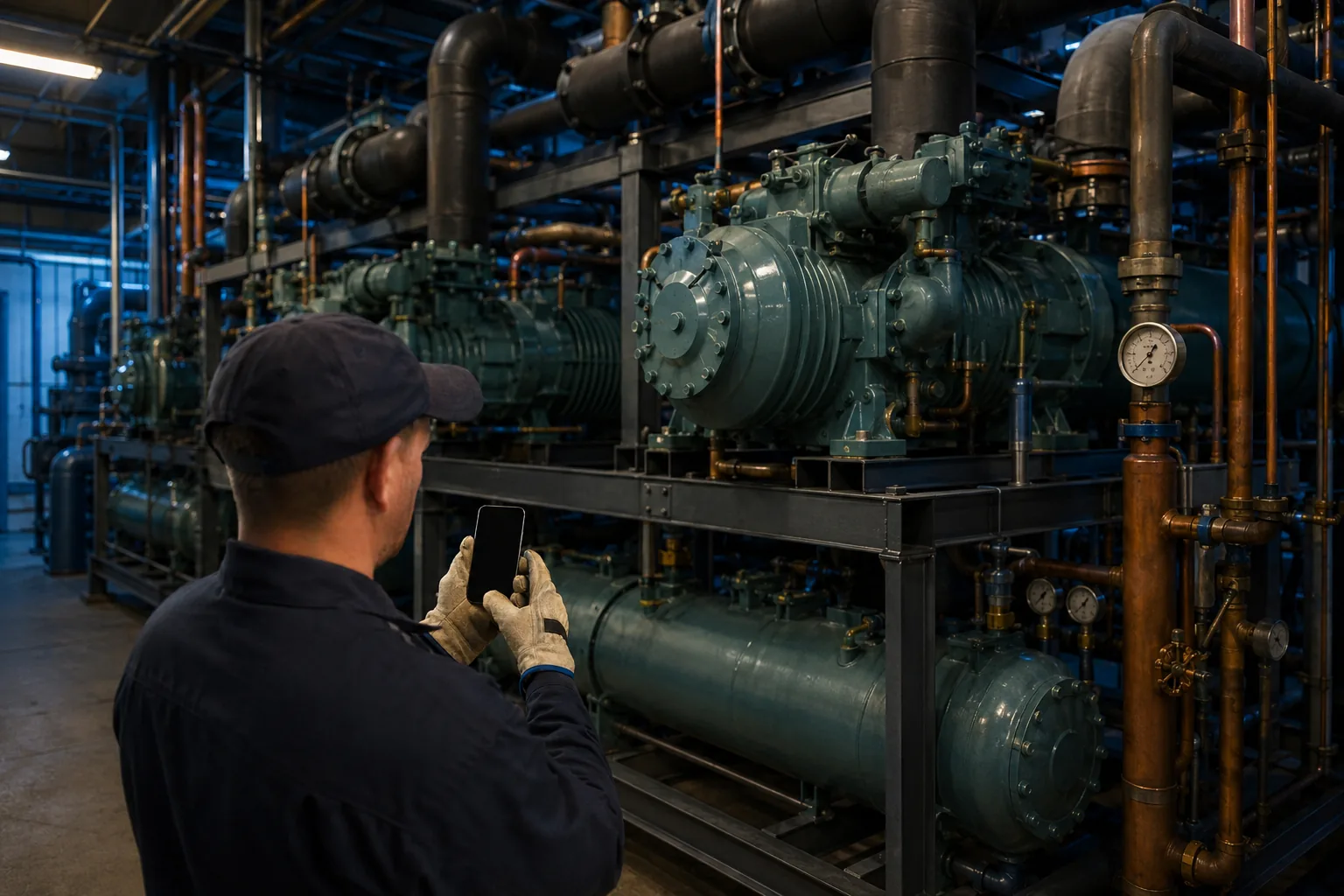
Yes. Renergy supports HVAC, refrigeration and electrical motors from most manufacturers and at most sizes, including centralised systems, secondary loop systems and standalone units.
Monitoring is added to your existing equipment rather than replacing it, so this is not a capital project. In most cases nothing about how the refrigeration runs changes at all, you simply start being able to see it.
See it on your own equipment.
We will walk through your sites, your failure history, and what monitoring would actually catch. No obligation.

Explore More Products
Explore our range of products, each designed to offer specific solutions, from monitoring to maintenance, ensuring energy efficiency and operational excellence.
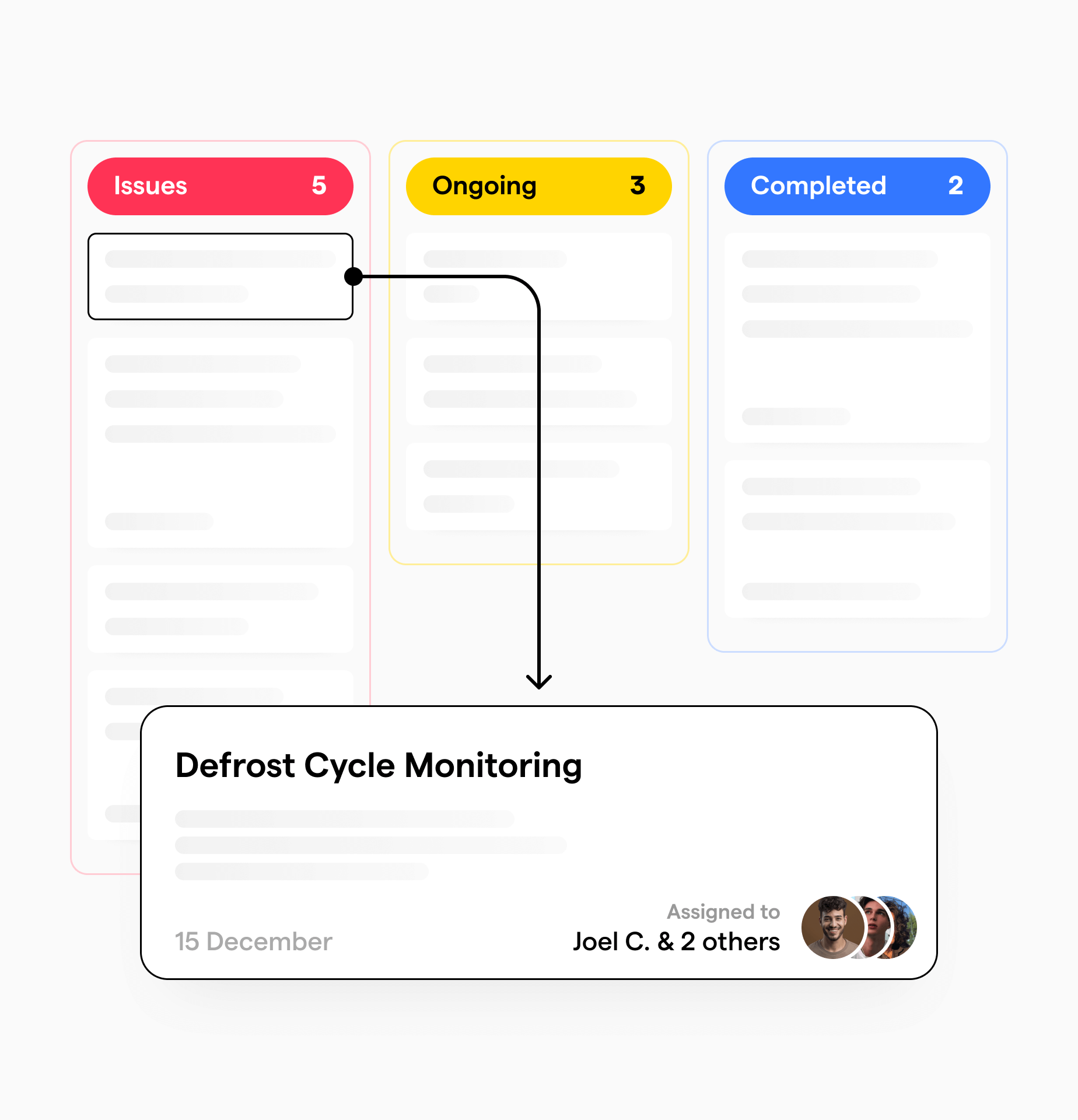
AI Maintenance Management
Streamline maintenance process by automatically generating work orders. Ensure prompt repairs, minimize downtime, and prolong equipment lifespan.
AI Equipment Intelligence
EcoWise uses advanced IoT sensors to monitor vibration, motor health, and fluid levels in your heaviest equipment. From car wash water pumps to industrial cooling towers, catch mechanical failures before they stop your operations.