
Temperature mapping for pharma distributors and 3PLs
Warehouse temperature mapping for pharmaceutical distributors and 3PLs
We ship calibrated wireless sensors for your warehouse, cold rooms and vehicles, and your team places them with us on a video call. The readings reach us live, and the signed report comes 2 business days after the study.
- No site visit
- 7 days, weekend included
- Summer and winter
- Report in 2 business days
From $4,750per season, for about 10,000 sq ft
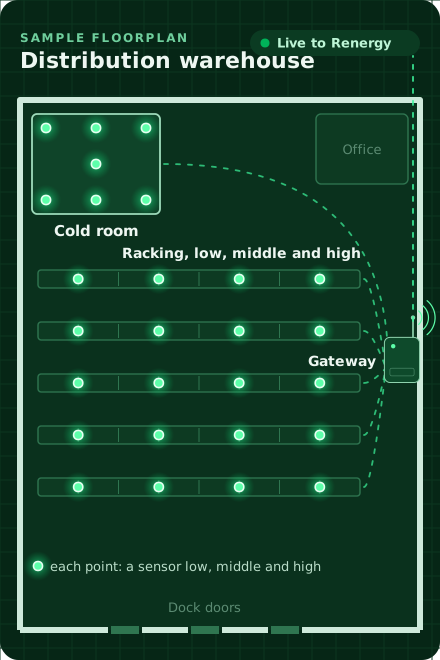
30 to 50sensors, low, middle and high
2 business daysto the signed report
How it works
From your racks to a signed report, live

Calibrated sensorsCertificates in the report
Own cellular linkNothing joins your network. No IT headache.
Signed by a certified engineerA Renergy engineer with career expertise in cold chain logistics
Packages
Every price, posted. Pick your unit.
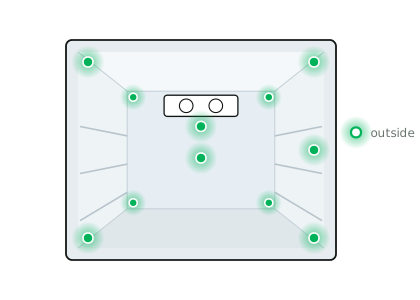
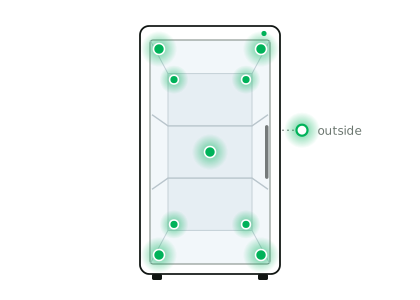
US dollars, before tax, for a remote study. Shipping at the carrier's rate, no markup. On-site service and -80°C (-112°F) freezers are quoted separately.
Keep some of the sensors after the study, and you have continuous monitoring for $250 a sensor a year.
See TemperatureWiseOrdering
Four steps, no site visit
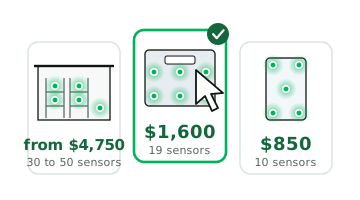
Pick a package
By unit size, with a date.
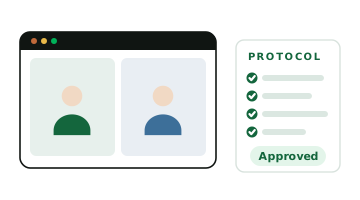
Approve the protocol
On a call, before we ship.
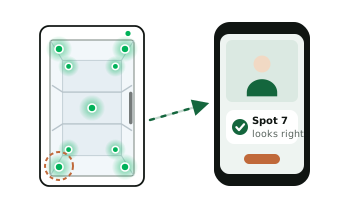
Place sensors on video
We check each spot with you.
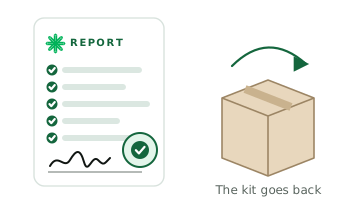
Get the signed report
2 business days after the study.
Need more hands-on help? We also offer assisted installation, up to full white-glove service, quoted separately.
Talk with usThe report
The report fills in while the study runs

The details
How a warehouse study runs
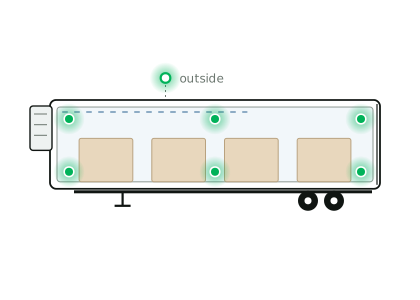
Every 5 to 10 m, at three heights
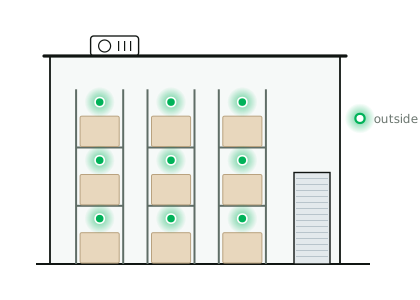
WHO guidance puts sensors every 5 to 10 m (16 to 33 ft) across the floor, low, middle and high, because heat gathers under the roof and comes in at the docks and the outside walls. For about 10,000 sq ft (930 m²) that is 30 to 50 sensors.
7 days, weekend included
The study runs at least 7 days and includes a weekend, when the doors stay shut and the building settles into its quietest pattern.
Summer and winter, two different buildings
In July the roof bakes and the top racks run warm. In January the heating cycles and the dock doors let in cold. WHO guidance maps both seasons where the seasons matter, and across most of the US and Canada they do. Book both studies at once and the second date is fixed before the season turns.
Placed with the lift you already use
We ship 30 to 50 numbered sensors with a placement map for your racking. Your team places them low, middle and high while we check each spot on a video call. The high spots need the lift you already use for your top racks.
Map again after changes, and on a cycle
WHO guidance maps a space before it is first used, again after any significant change, such as new racking, a new HVAC unit or a new layout, and on a cycle such as every 3 years. Keep each report: it is the evidence that the space you store in is the space you mapped.
Cold rooms and vehicles follow the same rules
A 2°C to 8°C (36°F to 46°F) cold room is mapped on a grid at two heights, with a door-open and a power-off test. Your own vehicles are mapped on their real routes in both seasons.
Cold storage temperature mappingReefer and truck temperature mapping
The rules
The rules ask for proof that the whole space holds temperature
United States
Federal rules for wholesale drug distributors, at 21 CFR 205.50, ask that drugs be stored as the label or the USP requires, with temperature records that show it.
21 CFR 205.50USP chapter 1079.4
Covers how to map a storage area, for every link that stores or moves a finished drug: where the probes go and how long a study runs. It is guidance rather than law, and a manufacturer's auditor will often ask for the report.
About the chapterCanada
Health Canada's GUI-0069 makes mapping a rule for drug licence holders and the 3PLs they contract: find the warmest and coldest areas and monitor there (5.1), map vehicles (5.2) and keep logger calibration records (5.5).
GUI-0069Common questions
Is warehouse temperature mapping required in the US?
No US federal rule names mapping outright. Federal rules ask wholesale distributors to store drugs as the label or the USP requires, with records to prove it, and USP's chapter 1079.4 describes mapping as how a storage area is qualified. A manufacturer's auditor will often ask for the report.
Is temperature mapping required by Health Canada?
For drug licence holders, yes. Health Canada's guidance GUI-0069 says to identify the warmest and coldest areas through temperature mapping and to monitor there (section 5.1), and to map temperature-controlled vehicles (section 5.2). It applies to fabricators, packagers, testers, distributors, importers and wholesalers, and to the 3PLs they contract.
How long does a warehouse temperature mapping study take?
At least 7 days, including a weekend, in each season. The signed report comes 2 business days after the study ends.
How many sensors does warehouse temperature mapping need?
WHO guidance puts sensors every 5 to 10 m at three heights. For a 10,000 sq ft (930 m²) warehouse that is 30 to 50 sensors, depending on the racking and the ceiling height.
Do you need to map a warehouse in summer and winter?
Where the seasons change the building, yes, and across most of the US and Canada they do. The roof and top racks run warm in summer, and heating and dock doors change the pattern in winter.
How much does warehouse temperature mapping cost?
$4,750 to $7,900 per season for about 10,000 sq ft, in US dollars, before tax and shipping. Larger buildings take more sensors, and are priced the same way.
Can a warehouse be mapped remotely?
Yes, it is our default. We ship the sensors with a placement map for your racking, and your team places them while we check each spot on a video call. Assisted installation and full white-glove service are quoted separately.
Does the kit need our network or IT team?
No. The gateway sends the readings over its own cellular link, so nothing joins your network and there is nothing for IT to set up.
How often should a pharmaceutical warehouse be re-mapped?
After any significant change, such as new racking, new HVAC or a new layout, and on a cycle such as every 3 years, following WHO guidance.
More temperature mapping
Book a study, or ask what yours would cost
Tell us the unit and the date.