Vehicle, summer and winter
A cube van (12 sensors) to a 53 ft trailer (16), mapped once in each season
$1,400 to $1,850for both seasons
Book
Temperature mapping for refrigerated transport
We ship calibrated wireless sensors to your yard, your team places them with us on a video call, and your driver runs the normal routes. The readings reach us live, and each signed report comes 2 business days after its run.
How it works

Packages
A cube van (12 sensors) to a 53 ft trailer (16), mapped once in each season
$1,400 to $1,850for both seasons
BookUS dollars, before tax, for a remote study. Shipping at the carrier's rate, no markup. On-site service and -80°C (-112°F) freezers are quoted separately.
Keep some of the sensors after the study, and you have continuous monitoring for $250 a sensor a year.
See TemperatureWiseOrdering
By unit size, with a date.
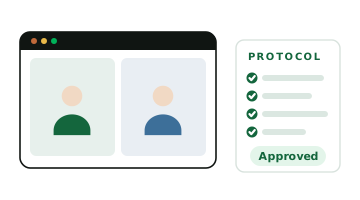
On a call, before we ship.
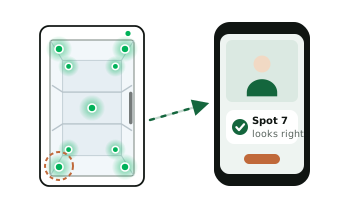
We check each spot with you.
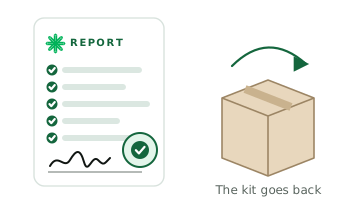
2 business days after the study.
Need more hands-on help? We also offer assisted installation, up to full white-glove service, quoted separately.
Talk with usThe report

The details
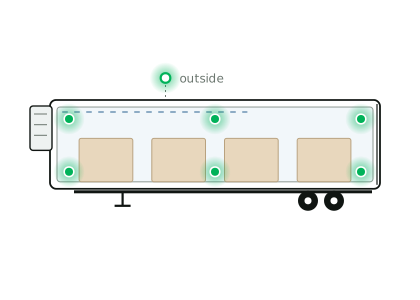
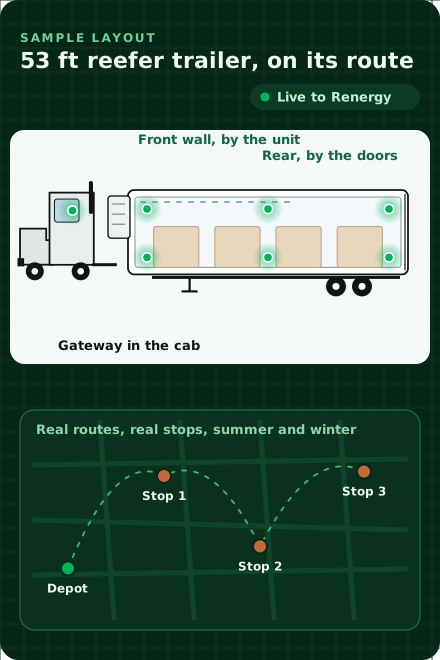
The cargo space is mapped as a box: sensors at the front wall by the unit's discharge, along the middle, and at the rear by the doors, at floor level and near the ceiling, with one outside the vehicle as a reference. A cube van takes 12, a 53 ft trailer 16. The rear corners and the top of the load are where a box most often runs warm.
A parked truck tells you little. WHO guidance qualifies a refrigerated vehicle on the routes it actually drives, with the door openings at each stop, because every stop lets warm air in at the rear. The map shows how far the load moves at a stop and how long the unit takes to pull it back.
In summer the unit fights heat through the roof and walls. In winter, a load held at 2°C to 8°C (36°F to 46°F) can freeze, and many units have to heat to stop it. One study in each season covers both, 2 days each, and the price covers both.
We ship numbered, calibrated sensors with a placement map for your box. Your team places them while we check each spot on a video call, and the driver then runs the normal routes. A second kit ships before the other season.
A trailer parked at the dock as extra cold storage is a room, not a route. It is mapped the way a cold room is mapped, over 3 days, with a door-open test.
The report shows where the probe that travels with every load should sit, how far product should stay from the doors and the front wall, and how long the unit needs to pre-cool. Those become your loading rules, with the map as the evidence behind them.
Who asks
United States, food
The FDA's sanitary transportation rule has the shipper set the operating temperature in writing, including pre-cooling, and lets the shipper or receiver ask the carrier to show it held it. A map shows the box can hold it from the front wall to the doors.
21 CFR 1.908Drug carriers
WHO guidance qualifies refrigerated vehicles on their real routes, in both seasons.
WHO Supplement 11Canada
Health Canada's GUI-0069 asks drug licence holders to map their temperature-controlled vehicles (section 5.2).
GUI-0069Sensors go from the front wall to the doors and from the floor to the ceiling, 16 in a 53 ft trailer, with one outside as a reference. The trailer then runs its normal routes, with its normal stops, for 2 days in summer and 2 days in winter.
Yes, where the seasons change how the unit works, and across most of the US and Canada they do. In summer the unit fights heat. In winter it can have to heat to keep a 2°C to 8°C (36°F to 46°F) load from freezing. WHO guidance qualifies vehicles in both seasons.
In the US, the FDA's sanitary transportation rule has the shipper specify the operating temperature, including pre-cooling, and lets the shipper or receiver ask the carrier to show it held it (21 CFR 1.908). The rule does not name mapping, but a map shows the box can hold that temperature end to end. In Canada, Health Canada's GUI-0069 asks drug licence holders to map temperature-controlled vehicles (section 5.2).
12 in a cube van and 16 in a 53 ft trailer, plus one outside the vehicle as a reference.
$1,400 to $1,850 for both seasons, depending on the size of the vehicle, in US dollars, before tax and shipping. Each signed report comes 2 business days after its run ends.
The gateway rides in the cab on its own cellular link, so the readings reach us during the run. There is nothing for your IT team to set up.
Yes. A trailer parked at the dock as extra cold storage is mapped like a cold room, over 3 days, with a door-open test.
Yes. Keep as many as you need and they become continuous monitoring with TemperatureWise, at $250 a sensor a year.
Tell us the unit and the date.