
How a reefer unit works, and what normal looks like
By Vimal Bhaya, Founder and Lead Systems Architect · Last reviewed 7 October 2026
This is a continuation of Reach-ins, prep tables, display cases and reefers, a 10-part tutorial. You are on part 9 of 10.
A reefer unit is a self-contained refrigeration machine on the front of a trailer, with its own diesel engine, or an electric motor when it is plugged in. It blows cold air along the ceiling to the back doors and pulls it back under the load.
It is built to hold product at the temperature it was loaded, not to cool warm product down. Carrier's manual says so in as many words: the unit was not designed to cool warm product.
Four kinds of reefer unit cover almost every trailer and truck
Two makers, Carrier Transicold and Thermo King, build most North American trailer units, so most trailers run one of two families of controls, each with its own alarm codes. What changes is what drives the compressor.
Kind | How it is powered | How common, by our estimate | What it is prone to |
|---|---|---|---|
Diesel, direct drive | A small diesel engine turns the compressor directly, by belt or clutch | Just under half | A battery, fuel or glow-plug problem that stops it restarting, and slow refrigerant leaks at the compressor's shaft seal |
Truck and van units | Off the vehicle's own engine, or a small diesel of its own | About a third | No cooling while the engine is off, on vehicle-powered units, and a door opened at every stop |
Diesel-electric | The engine runs a generator, and electric motors drive the compressor and fans. Plugs into shore power with no changeover | About 1 in 5 | Electronics faults, and drift at a dock when nobody plugs it in |
All-electric | A battery pack, charged from shore power, the axle or solar | A few percent | Running low late in a long route, in heat or in a frigid winter |
The unit on the nose holds the whole machine, with the cold coil reaching inside
Thermo King describes its Precedent trailer unit as one piece, self-contained and diesel powered. It hangs on the front of the trailer. Its evaporator, the cold coil, reaches through an opening in the front wall into the load space.
- The engine, a small diesel. On a Precedent it is coupled directly to the compressor. Belts drive the alternator, the water pump and a generator.
- The compressor, which pumps the refrigerant round the loop.
- The condenser coil and fan, on the outside of the unit, which throw the heat into the outdoor air.
- The evaporator coil and fans, inside the trailer at the top, which pull heat out of the load space.
- The controller and its sensors. Carrier's measures the return air, coming back into the coil, and the supply air, leaving it. Thermo King calls the supply air the discharge air, and its controller also watches the coil.
- The fuel tank and battery. The Precedent S-600 carries a 50-gallon (190 L) tank under the trailer. The battery starts the engine, and the alternator keeps it charged while the unit runs.
Cold air goes out over the top of the load and comes back underneath
USDA's guide to trucking perishable food describes the path. Air leaves the unit at the front ceiling and travels over the top of the load. It comes down at the rear doors, then passes under and through the load back to the unit. A fabric air chute along the ceiling spreads the air evenly. A bulkhead at the front keeps a clear path for the air coming back.
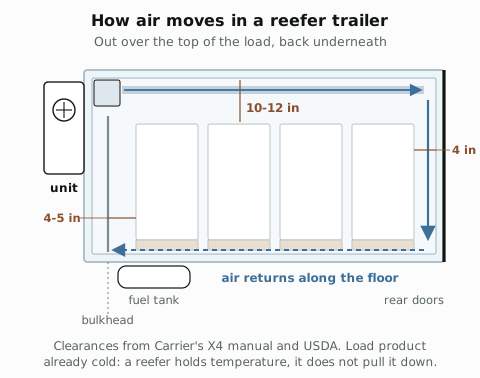
That path only works if the load leaves room for it. The makers' numbers differ a little:
Gap | Carrier X4 manual | Carrier, via Bill Maddox | Thermo King, Europe | USDA |
|---|---|---|---|---|
Top of the load to the ceiling | 10 to 12 in (25 to 30 cm) | 9 in (23 cm) | 300 mm (12 in) | |
Load to the front wall | 4 to 5 in (10 to 13 cm) | |||
Load to the side walls | 1 to 2 in (2.5 to 5 cm) | 50 mm (2 in) | ||
Load to the rear doors | 4 in (10 cm) | At least 4 in (10 cm), for top-air units |
USDA adds that the return path under the load needs about 240 square inches (1,550 square cm) of opening. Floor channels shallower than 2 inches (5 cm) need pallets or racks. Thermo King's own list says not to load to the ceiling, because the air short-cycles back to the unit. Nor should the load sit tight against the unit, walls or doors.
A reefer runs continuously or stops and starts, and the load decides which
Continuous: the unit runs all the time to hold its setpoint and keep the air moving. Start-stop, which Thermo King calls CYCLE-SENTRY, saves fuel: the engine stops when the load is at setpoint and starts again when it is needed.
On Carrier's X4 units, a stopped unit restarts for any of four reasons. The box drifts from its setpoint, the engine coolant gets too cold, or a maximum off time runs out. Or the battery falls below a set voltage, between 12.0 and 12.8 volts. Both makers warn that the unit can start by itself at any time.
Carrier's manual gives a mode for each kind of load. It also says that a delivery route with frequent stops and door openings should always run in continuous mode.
| Load | Setpoint | Mode |
|---|---|---|
| Bananas | 56°F to 58°F (13°C to 14°C) | Continuous |
| Fresh fruit and vegetables | 33°F to 38°F (0.5°C to 3°C) | Continuous |
| Fresh meat and seafood | 28°F to 32°F (-2°C to 0°C) | Start-stop or continuous |
| Dairy | 33°F to 38°F (0.5°C to 3°C) | Start-stop or continuous |
| Ice | 15°F to 20°F (-9°C to -7°C) | Start-stop |
| Frozen fruit, vegetables, meat and seafood | -10°F to 0°F (-23°C to -18°C) | Start-stop |
| Ice cream | -20°F to -15°F (-29°C to -26°C) | Start-stop |
Parked at a dock, many reefers can run on shore power instead of diesel
With electric standby, a parked trailer plugs into a power socket and the refrigeration runs with the diesel engine shut off. Carrier says the unit then runs like a large, sophisticated electric refrigerator.
Know how yours switches back. Thermo King units have a setting that decides what happens if the shore power fails. If Electric to Diesel Auto-Switch is set to NO, the unit will not switch to its diesel by itself. That setting exists so an engine does not start indoors or on a ferry. On a trailer parked in a yard, it means a power cut stops the cooling.
A reefer defrosts on a timer or on demand, and gives no cooling while it does
The coil in a reefer frosts like any freezer's, faster when doors open and humid air gets in. Thermo King's units send hot refrigerant gas through the coil to melt the frost, with electric heat added when running on shore power, and the water runs out through drain tubes onto the ground. Carrier's operator manual does not say which method its units use.
- A defrost starts on a timer or on demand. Thermo King's timer can be set to 2, 4, 6, 8 or 12 hours, and demand defrost starts when the controller's sensors show the coil is frosting. Thermo King's demand defrost can run as often as every 30 minutes if it is needed.
- On Thermo King trailer units such as the Precedent, a damper closes over the coil, so warm air is not blown into the load.
- The frost melts. Carrier's display shows DEFROST in place of the box temperature. As Carrier's Bill Maddox puts it, the unit is not providing any cooling while it runs.
- The defrost ends when the coil reaches 58°F (14°C) on Thermo King units, or when Carrier's coil and supply air sensors both pass 55°F (13°C). Carrier stops any defrost at 45 minutes.
Carrier also says to run a defrost just before loading, to clear moisture off the coil.
A pretrip check and a pre-cooled trailer come before the load
Both makers build an automatic test into the controller. Carrier recommends running its Pretrip before loading. It takes 7 to 15 minutes and ends with a pass or a fail. Thermo King's runs through the electrical draws, an engine start, a defrost, and cooling and heating checks.
The hand checks matter as much. Check there is fuel enough to reach the next stop. Then drain off any water: Carrier's list says to drain it from the bottom of the fuel tank and from the fuel filter's water separator. Water sinks below diesel and collects there, and water in the fuel can stop the engine. Check the oil, coolant, belts and battery terminals, then the door seals, the air chute and the floor channels.
Then pre-cool the empty trailer, and load product that is already at its temperature. Carrier says the unit is built to keep the load at the temperature it was loaded. Thermo King says product loaded at the wrong temperature carries a high risk of temperature excursions. Shut the unit off while loading from an open dock, USDA says, or warm, wet air will ice the coil.
Here are the vital numbers of a healthy reefer
| What | Normal | Where the number comes from |
|---|---|---|
| Frozen load | -10°F to 0°F (-23°C to -18°C) in Carrier's table. USDA: 0°F (-18°C) or colder | Carrier, USDA |
| Chilled load | 33°F to 38°F (0.5°C to 3°C) in Carrier's table. USDA: around 35°F (2°C) | Carrier, USDA |
| US food code line | 41°F (5°C) or colder for chilled food that needs temperature control | FDA Food Code 3-501.16 |
| US shipper's instructions | The shipper sets the operating temperature, and any pre-cooling, in writing. The carrier pre-cools as told, and shows the temperature was held if asked | FDA sanitary transportation rule, 21 CFR 1.908 |
| US records | Kept for 12 months beyond the agreement or procedure they cover. Offsite records produced within 24 hours of an official request | 21 CFR 1.912 |
| Chill-sensitive produce | Bananas 56°F to 58°F (13°C to 14°C). Mature-green tomatoes 55°F (13°C). Colder than that causes chilling injury | USDA Handbook 669 |
| Refrigerated vaccines | 36°F to 46°F (2°C to 8°C), CDC's storage range. Each vaccine maker's guidance sets the transport conditions | CDC Vaccine Storage and Handling Toolkit, 2024 |
| Canada, storage guidance | 4°C (39°F) or colder for refrigerated food, -18°C (0°F) or colder for frozen | CFIA |
| Mode | Continuous for fresh produce and multi-stop routes. Start-stop is fine for frozen loads | Carrier |
| Defrost | On a timer or on demand. Ends at a 55°F to 58°F (13°C to 14°C) coil. Carrier stops it at 45 minutes | Carrier, Thermo King |
| Gap above the load | 10 to 12 inches (25 to 30 cm) | Carrier |
| Pretrip and pre-cooling | Pretrip 7 to 15 minutes, before loading. Then pre-cool the empty trailer to the transit temperature, which USDA says can take 2 hours or more in hot weather | Carrier, USDA Handbook 669 |
| Battery | Carrier's start-stop restarts the engine when the battery falls to a set point between 12.0 and 12.8 volts | Carrier |
US and Canadian rules ask for the right temperature, and a record if anyone asks
In the US, the FDA's sanitary transportation rule says the shipper sets the operating temperature in writing, including any pre-cooling. The carrier must pre-cool as specified. If the shipper or receiver asks, the carrier must show it held the temperature, for example with time and temperature data. The rule sets no particular monitoring device.
In Canada, the CFIA says no licence is needed just to transport food. Its preventive control guidance for food businesses says food that needs refrigeration is stored at 4°C (39°F) or colder, and frozen food at -18°C (0°F) or colder. That is storage guidance, not a transport rule. In Ontario, the food premises rule applies 4°C (39°F) to food being transported as well as stored.
Five symptoms cover most of what goes wrong
Each one has its own section, with what it usually is and what to check, on reefer troubleshooting.
- The load will not hold temperature
- A defrost alarm, ice at the drains, or defrosts too often
- The box warms at each stop, or one end of the load is warm
- The unit shuts down, or will not restart
- A parked trailer on shore power stops cooling
This page describes the common trailer unit, not your exact one
Carrier and Thermo King each make several platforms, and settings differ between them. Some Thermo King figures here come from its European online manuals, and North American models may differ. Your unit's manual and its dealer win over the typical figures here.
The real readings we have from a reefer are from one that stopped and did not restart, and they are on reefer troubleshooting.