
The condenser coil and fan: how a dirty coil or a dead fan warms the box, and what you can check
By Vimal Bhaya, Founder and Lead Systems Architect · Last reviewed 20 October 2026
This is a continuation of Walk-in refrigeration parts, a 14-part tutorial. You are on part 5 of 14.
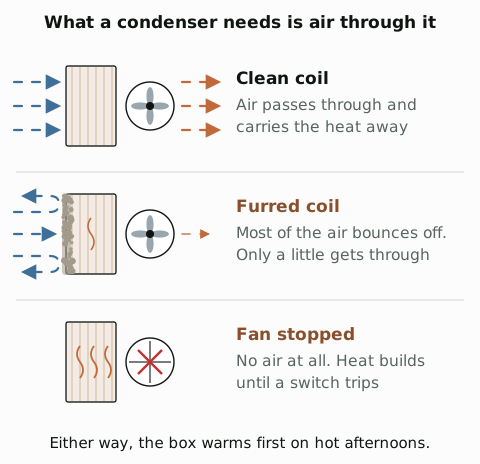
The condenser is the radiator on the outside of a refrigeration system. A fan pulls air through it to carry away the heat taken out of the box. When the coil is furred with dust or grease, or the fan stops, the heat stays in. The box warms on hot afternoons, the compressor runs hotter, and the unit can trip on its high-pressure switch.
A dirty condenser is common on every kind of commercial cooler and freezer, and among the easiest faults to fix. On most reach-ins and prep tables, the maker expects you to clean it, with the unit unplugged. On a walk-in, switch the unit off at its disconnect first, or book a cleaning.
The condenser throws the box's heat away, and its fan keeps air moving through it
The compressor squeezes the refrigerant coming back from the box into a hot gas. In the condenser, air blowing across the fins cools that gas until it turns back to liquid. The heat leaves with the air.

So a condenser works only as well as the air through it. Block the air, or stop the fan, and the heat has nowhere to go. The pressure on the hot side, which technicians call head pressure, rises. The system then moves less heat out of the box.
Heatcraft's installation manual is blunt about it: if the warm air is not carried away, head pressure rises, and the unit runs poorly and can fail. It asks for clear space at least as wide as the unit on every side, nothing overhead, and no corner where the unit breathes its own exhaust. It also keeps units away from steam, hot air and fume exhausts.
A condenser fails in four common ways
Each one cuts how much heat the system can move, so the box warms. The troubleshooting pages show where each sits among the other reasons for the same symptom.
What the readings show | What you see | Fault | Where it is covered |
|---|---|---|---|
Warm on hot afternoons or busy hours and fine at night at first, then warm more of the time | A coil you cannot see light through, and hot air from the grille | A furred coil | |
A fast climb, often ending in a trip | The compressor runs, but the fan behind the coil is still | A dead condenser fan | |
Warm with kitchen hours, worst during service | A unit boxed into a counter, pushed against a wall, or breathing a fryer's heat | Starved of air | |
The box climbs from a unit that has stopped | The unit stops on a hot afternoon. Some switches stay off until someone resets them | A high-pressure trip |
Here is what a bad condenser does to the rest of the refrigeration system
Every bit of heat the system pulls out of the box has to leave through the condenser. When the condenser cannot get rid of it, the rest of the system pays:
- The box runs warm, first on hot afternoons and in busy hours, then more of the time.
- The unit runs longer and uses more energy, as much as 20% more by Hussmann's figure. That is why a dirty condenser is among the reasons a walk-in cooler, a reach-in cooler, a reach-in freezer or a prep table never stops.
- The compressor runs hotter, and heat wears it out.
- The pressure climbs until the high-pressure switch stops the unit. Some switches stay off until someone resets them.
The three parts below show how each of those happens.
A furred coil cuts capacity when you need it most
Dust, flour, lint and grease build up on the fins until air cannot get through. Outdoors it is leaves, dust and cottonwood seed. FER quotes a technician on how grease particles act as an insulator on condensing units.
The worse the coil, the higher the pressure, and the harder a hot day hits. Hussmann says a dirty condenser coil can raise energy use by as much as 20%.
"Is cleaning the condenser every year really necessary?"
r/hvacadvice, thread title
The makers say yes, and most want it done more often than once a year. Their schedules are below.
A compressor kept hot wears out
With a dirty condenser, ACHR News notes, the compressor runs hotter than normal. John Tomczyk names a dirty condenser coil and a burned-out condenser fan among the causes of an overheating compressor. Heat breaks down its oil and wears it out, as how a reach-in cooler works explains.
A stopped fan is a same-day call
Without its fan, a condenser moves almost no heat. Pressure climbs fast, until the high-pressure switch stops the compressor. Heatcraft tests that switch exactly this way: it disconnects the condenser fans and watches the pressure rise.
One exception. In cold weather, some walk-in units switch some condenser fans off on purpose, to keep the pressure up. Heatcraft says at least one should run whenever the compressor runs.
In the readings, a dirty condenser shows on hot afternoons first
Look for a box that holds at night and slips on hot afternoons or during service. As the coil gets worse over weeks, it slips more of the time.
For what lost capacity looked like in a customer's freezer, see the refrigerant leaks page.
You can clean most reach-in condensers yourself, with the power off
Makers set the schedule, and it is often monthly. The busier and greasier the room, the more often it needs doing.
Maker and unit | How often |
|---|---|
Randell, prep tables | Monthly |
Avantco, prep tables | Monthly |
Hussmann, display cases | Monthly |
True, TGN reach-ins | A check every month |
Victory, UltraSpec reach-ins | Every 3 months, or monthly near grease |
Turbo Air, M3 reach-ins | Every 90 days |
Arctic Air, prep tables and undercounters | Every 90 days, or 30 where dirt builds up |
Traulsen, UHT reach-ins | Every six months |
- Cut the power. Unplug a reach-in. Switch a walk-in off at the disconnect beside its condensing unit.
- Open the way in. Take off the grille or panel in front of the condenser, if your manual shows how.
- Brush along the fins, never across them. True's manual says the same. Then vacuum the loose dust.
- Put it back. Refit the grille, restore power, and check that the fan turns.
Do not blast compressed air into the coil. The fins are thin and bend easily, and bent fins block the air for good. A strong blast can also drive dust deeper between the fins, and air does nothing for grease, or for dust caked onto grease. Some makers allow a gentle stream: True's cleaning sheet says to blow compressed air gently through the fins. Follow your own manual.
A coil caked in grease, a roof unit, or any coil you cannot reach safely is a job for your technician.
Where the condenser sits decides what clogs it
Unit | Where the condenser is | What clogs or heats it | More on this |
|---|---|---|---|
Walk-in, outdoor or roof unit | In the condensing unit, outside | Leaves, dust, cottonwood seed and sun. Roof units get cleaned least | |
Walk-in, indoor unit | In the condensing unit, in a back room or kitchen | Grease, flour and its own hot exhaust | |
Reach-in, bottom-mount | Behind the grille near the floor | Floor dust, flour, lint and grease | |
Reach-in, top-mount | On top of the cabinet | The hottest air in the kitchen. It needs a ladder, so it gets cleaned less | |
Undercounter and chef base | Behind a front grille | No room to breathe, and the heat of the fryer or griddle beside it | |
Prep table | In the base | Kitchen dust, and plastic wrap caught on the grille | |
Display case, self-contained | In the base | Store dust, and cases pushed against a wall | |
Reefer | In the unit on the trailer's nose | Road dirt and debris. Carrier's checks include anything blocking its air |
In winter, a condenser can do its job too well
In freezing air, a condenser can drop the pressure too low for the system to feed the coil. Winter controls hold it up, by switching fans off or by backing liquid up into the condenser. Heatcraft's manual covers both.
So on a cold day, a condenser fan standing still can look like a failure. It is not. It is the winter controls working well, holding the pressure up. The fault is the opposite: when they fail, a walk-in can warm on cold nights.
The simpler way: TemperatureWise watches for a dirty condenser or a stopped condenser fan
Everything on this page takes time, and you have to know what to look for. TemperatureWise takes that complexity out:
- It learns each box. It uses machine learning on the full temperature history of each box, and learns that box's own pattern.
- It watches for a dirty condenser or a stopped condenser fan. In the readings, that looks like a box that slips on hot afternoons first.
- It names the likely culprits. When it sees that change, TemperatureWise tells you what has changed and the top three likely parts at fault, so you know where to look.
It does not clean the coil. It tells you when the box has started to struggle, so the cleaning can happen before the trip.
This is one of our walk-in refrigeration parts pages. The refrigerant leaks and charge page covers the other common reason a box loses capacity.