
Reach-in cooler troubleshooting, symptom by symptom
By Vimal Bhaya, Founder and Lead Systems Architect · Last reviewed 7 October 2026
This is a continuation of Reach-ins, prep tables, display cases and reefers, a 10-part tutorial. You are on part 2 of 10.
A reach-in cooler that will not hold temperature is most often short of air: a clogged condenser, a cabinet boxed in or packed too tight, or a door that is not sealing.
All of those can be checked without tools. Look at the grille, feel for warm air coming out of it, and let the door swing shut on its own.
If the food is above 41°F (5°C), or 4°C (39°F) in Ontario, move it to another cold box now and call a technician. A small cabinet warms fast.
Seven symptoms cover most reach-in cooler problems
Find what you are seeing, then jump to its section. Each section lists its reasons in roughly the order the makers' own troubleshooting tables and our failure-mode reference put them. Nobody publishes how often each fault happens in the field.
| # | What you see | What it usually is | Parts to suspect | Can you check it yourself? | How urgent |
|---|---|---|---|---|---|
| 1 | A clogged condenser, a leaking door or product blocking the air | Condenser, door gasket, coil fan, refrigerant | Mostly. Look at the grille, the door and the shelves | Today if the food is above 41°F (5°C) | |
| 2 | Boxed in, or cooked from above and beside | Condenser, the grille's air path, drawer gaskets | Yes. Find the grille and what is next to it | This week. Today if the food is warm | |
| 3 | Set too cold, or food in the coil's cold air | Thermostat or controller, its relay | Partly. Check the setting and where the food sits | Today. Frozen produce is lost | |
| 4 | Wet air getting in, or the cooling never resting | Door gasket, coil fan, controller, refrigerant | Partly. Check the door and the setting | Within a day. A warm cabinet is next | |
| 5 | A torn gasket, a sagging hinge or a cabinet out of level | Gasket, hinges, door, levelling legs | Yes | This week | |
| 6 | A dirty condenser, a door that does not close, or a hot room | Condenser, door, coil, refrigerant | Partly. Look at the grille and the door | This week | |
| 7 | The coil's water is not reaching its pan, or the pan cannot keep up | Drain tube, pan, levelling | Yes. Look at the tube and the pan | This week. Today if people can slip |
Here is a list of eight things you can check to assess your reach-in's health
None of these needs a tool or an open panel.
- The compressor. Listen for its hum, and hold a hand at the grille. Should be: running, then resting, with warm air coming out of the grille while it runs.
- The condenser. Shine a torch through the grille. Should be: light showing through the coil, with no fur of dust or grease. True and Continental ask for a cleaning every month.
- The grille and the space round the cabinet. Should be: nothing in front of any grille, and the gap your manual asks for at the back: from 1 inch (2.5 cm) on True to 5 inches (13 cm) on Turbo Air. Front-breathing undercounters need none.
- The door. Open it part way and let go. Should be: it swings shut and seals all round by itself.
- The gasket. Should be: whole, soft and seated in its groove all round, with no tears, flat stretches or gaps.
- The space round the product. Should be: about 4 inches (10 cm) clear below the coil housing, and the middle of each shelf open for air.
- The setting. Read the display or the dial. Should be: usually 35°F to 38°F (2°C to 3°C), or whatever your manual gives. The food itself at 41°F (5°C) or colder, or 4°C (39°F) in Ontario.
- The compressor's heat. Feel the air from the grille, never the compressor itself. Should be: warm air, and a compressor that runs and rests without clicking off and restarting minutes later. How a reach-in cooler works explains how to check it safely.
Leave gauges, refrigerant and anything inside an electrical panel to a technician. Most new reach-ins hold a small charge of R-290, a flammable hydrocarbon refrigerant, so a leak repair needs someone trained for it. Never chip or pick ice off the coil.
1. A reach-in cooler that runs warm usually has a clogged condenser, a leaking door or product blocking the air
The cabinet creeps above its setting, recovers slowly after the door, and staff notice warm drinks or soft butter first.
Reason 1: A clogged condenser is the most common reach-in fault, by our own estimate
- Parts: condenser coil and fan.
- What happens: The condenser throws the cabinet's heat into the kitchen. Dust, flour, lint and grease build up on its fins until air cannot get through, and then the heat stays in. ACHR News puts it plainly: with a dirty condenser, the compressor runs hotter than normal.
- The proof: warm in the afternoon or during service and fine overnight at first, then warm more of the time over weeks. A furred coil behind the grille, very hot air from it, and on bad days a compressor that clicks off and restarts. A compressor kept this hot wears out, as how a reach-in cooler works explains.
- Check: shine a torch through the grille. Many makers expect the owner to clean it: unplug the unit first, then brush along the fins, never across them.
- What to do next: If the coil is furred, unplug the unit and brush along the fins, or book a cleaning this week. If it is clean, look at what surrounds the cabinet next.
Reason 2: A cabinet boxed in, or in a hot spot, cannot shed its heat
- Parts: none. Where it stands is the problem.
- What happens: Every model needs some air round its grille, and makers set different room limits: True 60°F to 104°F (16°C to 40°C), Beverage-Air 60°F to 100°F (16°C to 38°C). Turbo Air's troubleshooting table lists a cabinet in sunlight, near heat, or with its back too close to the wall.
- The proof: warm on the hottest days, beside the oven, or since the cabinet was moved.
- Check: look at what is round the grille, and feel the air the cabinet is breathing.
- What to do next: If the grille is boxed in, clear it and give the cabinet the gap your manual asks for. If it sits by the oven, move it, or ask the maker whether it is rated for that spot.
Reason 3: A door that does not seal lets warm air in all day
- Parts: door gasket and hinges.
- What happens: Victory's troubleshooting table lists a door left ajar or held open too long, and Traulsen's a poor door or gasket seal. Every gap pulls in warm, wet kitchen air. See symptom 5.
- The proof: sweat or a wet line along one edge of the door, and a door that does not swing shut by itself.
- Check: let the door close on its own, and look all round the gasket.
- What to do next: If the door will not seal, work through symptom 5. Until it is fixed, check the door is shut after every use.
Reason 4: Product packed too tight blocks the cold air
- Parts: none. How it is loaded is the problem.
- What happens: The coil's fan has to push air through the cabinet. True and Turbo Air ask for about 4 inches (10 cm) between the product and the coil housing, and Beverage-Air warns that product can block the inside air duct. Packed full, the air stays at the top.
- The proof: warm on the bottom shelves or at the back, and cold near the coil.
- Check: clear the space under the coil housing and down the middle of the shelves.
- What to do next: If the shelves are packed tight, take some product out, clear 4 inches (10 cm) under the coil housing, and open the middle of each shelf.
Reason 5: Warm food, or too much of it at once, takes hours to pull down
- Parts: none. The load is the problem.
- What happens: A reach-in is built to hold cold food cold. Traulsen, Turbo Air and Victory all list warm or excessive product as a cause of a warm cabinet. Even an empty Continental cooler takes about an hour to reach 40°F (4°C) from warm.
- The proof: warm after deliveries or after a batch of cooked food goes in, recovering when it is left alone.
- Check: note when it happens, and load cold product a shift at a time, as one FER article suggests.
- What to do next: If it recovers once left alone, load cold product a shift at a time. Cool cooked food first, the way your food safety plan says, before it goes in.
Reason 6: A stopped coil fan leaves the cold at the coil
- Parts: evaporator fan.
- What happens: Without the fan, the coil cools only the air touching it. The rest of the cabinet warms, and the coil can ice.
- The proof: no air moving inside with the door shut and the compressor running, and ice building on the coil.
- Check: listen at the closed door while the compressor runs. On many models the fan stops when the door opens, so silence with the door open is normal.
- What to do next: If no air moves with the door shut, call a technician today. Probe the food, and move anything above 41°F (5°C) to other cold storage.
Reason 7: A refrigerant leak makes it lose ground over days or weeks
- Parts: refrigerant charge.
- What happens: Small reach-ins hold a small charge with no reserve, so even a small loss shows up quickly. ACHR News calls them critically charged and advises technicians not to fit gauges unless they must.
- The proof: a slow slide, a compressor that runs longer and longer, and ice on one part of the coil.
- Check: a technician's job. Tell them how long the slide has been going on.
- What to do next: Book a technician this week, today if the food is above 41°F (5°C). Most new reach-ins use R-290, so only someone trained for it should touch the leak.
Less often: the thermostat set too warm, or bumped, which Traulsen lists among its first checks.
Before you call, check these five things
- Is it running, with warm air coming out of the grille?
- Can you see light through the condenser coil?
- Is anything stacked against the grille or the coil housing?
- Does the door swing shut and seal by itself?
- Is it worse in the afternoon, after deliveries, or all the time?
- When to call a technician: today if the food is above 41°F (5°C), or 4°C (39°F) in Ontario. By our failure-mode reference, a dead compressor can take a reach-in cooler past 41°F (5°C) in 2 to 4 hours. A slow slide over weeks can wait for a booked visit, but book it.
- What to tell them: the cabinet temperature, since when, the time of day it is worst, whether air comes out of the grille, and when the condenser was last cleaned.
2. An undercounter that runs warm on a cookline is usually boxed in or soaking up heat
An undercounter, worktop, refrigerated drawer or chef base lives at knee height, beside the fryer or under the griddle. It runs warm during cooking hours and recovers after close. Often it is not broken: it is breathing the wrong air.
Reason 1: A cabinet built into a counter cannot breathe out its heat
- Parts: condenser and its air path.
- What happens: Some undercounters take in and blow out their air through the front grille, so they can be built in. Continental says its front-breathing models need no clearance at the sides or back. Its standard models need 3 inches (7.5 cm) at each side and the back. A rear-breathing model built into a counter breathes its own hot exhaust.
- The proof: warm since the day it was installed, and worse every summer.
- Check: find the grille. Front only, or does it also vent at the back or sides? Is a kickplate or a cabinet face covering it? Traulsen says its UHT undercounters must stand on legs, casters or a vented base.
- What to do next: If the grille is covered, take off the kickplate or cabinet face that blocks it, or stand the unit on legs or casters. Ask the installer if the counter must change.
Reason 2: Cooking equipment on top or beside it heats the cabinet
- Parts: none. Where it stands is the problem.
- What happens: Continental's griddle stands carry a warning that the top surface should not go above 100°F (38°C), and ask for 4 inches (10 cm) of space between the cabinet top and the heat-producing equipment above. Turbo Air says to avoid hot corners and spots near stoves.
- The proof: warm with cooking hours, coolest after close, and warmest on the shelf nearest the heat.
- Check: feel the top of the cabinet during service, and look at what stands on it and next to it.
- What to do next: If equipment sits on top or right beside it, move the heat away, or ask the maker whether that pairing is allowed. Probe the shelf nearest the heat during service.
Reason 3: Grease and lint clog a condenser at floor level
- Parts: condenser coil.
- What happens: A cookline's floor-level air carries grease, and FER quotes a technician on how grease particles get into condensing units and act as an insulator. FE&S says the biggest problem with refrigeration of this kind is a lack of air movement.
- The proof: warm with service, then warmer every week.
- Check: look through the grille with a torch.
- What to do next: If the condenser is furred, unplug the unit and clean it, or book a cleaning. Floor-level units in kitchens usually need it more often than the manual's minimum.
Reason 4: Pans and carts damage drawer gaskets
- Parts: drawer gaskets and slides.
- What happens: Drawers get bumped by pans and carts all day. A torn or loose drawer gasket lets in warm, wet air, which leaves condensation, or frost, inside the drawer.
- The proof: condensation or frost in one drawer, and a drawer that does not close flush.
- Check: look at each drawer's gasket and push each drawer shut.
- What to do next: If a drawer gasket is torn or the drawer does not close flush, order the maker's replacement this week. Until then, push each drawer shut by hand.
A hot kitchen costs energy as well as temperature. In tests funded by PG&E, units run in a simulated hot kitchen at 100°F (38°C) used about double the energy they used at the standard test conditions.
Before you call, check these four things
- Is the grille at the front, and is it clear?
- Does the cabinet also need air at the back or sides, and does it get it?
- How hot is the top of the cabinet during service?
- Is it warmest during cooking hours and fine after close?
- When to call a technician: this week, or today if the food is above 41°F (5°C). Often the fix is space and airflow, not a part. Moving a rear-breathing unit, or swapping it for a front-breathing one, may be the real answer.
- What to tell them: the model, where it stands, what is on and beside it, and when in the day it runs warm.
3. A reach-in cooler that freezes the food is set too cold, or the food sits in the coil's cold air
Lettuce turns glassy, milk has ice in it, or the back of the bottom shelf is frozen while the front is fine.
"Reach in Produce Cooler Freezing product"
r/refrigeration, thread title
Reason 1: The setting is too cold, or someone bumped the dial
- Parts: thermostat or controller.
- What happens: Victory lists a control set too low first. Traulsen lists very cold food recently added, then the setting. On Turbo Air's dial, 1 is the warmest and 7 the coldest, with 4 the factory setting. A dial is easy to knock while loading.
- The proof: the whole cabinet runs colder than it should, and the setting is lower than it was.
- Check: check the setting, and compare the display with a thermometer in a glass of water on a middle shelf.
- What to do next: If the setting has moved, set it back to your manual's figure and check the water glass again in a few hours. If the display and the glass disagree, book a technician.
Reason 2: Food against the coil housing freezes in a healthy cabinet
- Parts: none. Where the food sits is the problem.
- What happens: The coil runs below freezing, and the air leaving it is the coldest in the cabinet. True and Turbo Air ask for 4 inches (10 cm) below the coil housing, for airflow. Food packed against the housing, in its coldest air, can also freeze while the rest of the cabinet holds its setting, though no maker says so in as many words.
- The proof: only the food near the coil, or in the stream of air from it, is freezing.
- Check: move it and see if the problem stops.
- What to do next: If moving the food stops the freezing, keep that space clear from now on. The cabinet itself is fine.
Reason 3: A failed control or a relay stuck closed keeps the compressor running
- Parts: controller, its sensor and its relay.
- What happens: If the controller's sensor fails or comes loose, or the relay that switches the compressor sticks closed, the compressor keeps running whatever the setting says.
- The proof: the compressor never stops, and turning the setting warmer makes no difference.
- Check: a technician's job. Do not open the panel.
- What to do next: Call a technician today, and do not open the panel. If food is freezing fast, unplug the unit and move the food until they come.
Traulsen also lists cold food recently added: a load that went in very cold can drag the cabinet down for a while.
Before you call, check these four things
- What is the setting, and has anyone changed it?
- Does a thermometer in the cabinet agree with the display?
- Is only the food near the coil freezing?
- Does the compressor ever stop?
- When to call a technician: today if the cabinet is below freezing or the compressor never stops. Frozen produce and dairy are usually lost.
- What to tell them: the setting, the actual cabinet temperature, which food froze and where it sat, and whether the compressor stops.
4. Ice behind the fan guard that does not clear means wet air is getting in, or the cooling never rests
A light frost on the coil that clears each time the compressor rests is normal. Ice that stays is not.
Reason 1: A door or gasket that leaks feeds the coil water
- Parts: door gasket, hinges, door.
- What happens: Warm kitchen air carries water. When it leaks in round the door, the water freezes on the coil faster than the rests can melt it. ACHR News links door problems to excessive frosting of the evaporator.
- The proof: sweat near the door edge, and ice that builds fastest on busy days.
- Check: look at the gasket, and let the door swing shut on its own.
- What to do next: If the gasket leaks or the door does not close itself, fix the door first, as in symptom 5. Then let the coil clear: the makers' fix is to switch it off, with the food moved.
Reason 2: A cooler that never rests never defrosts
- Parts: none, usually. The load, the room or a dirty condenser.
- What happens: On most coolers the defrost is the compressor's rest. If it never stops, because the condenser is clogged or the door is open, the frost never melts.
- The proof: a compressor that runs for hours without a break, and ice that grows through the day.
- Check: listen for the compressor stopping. See symptom 6.
- What to do next: If it never rests, work through symptom 6. Once it rests again, the coil can clear between cycles.
Reason 3: Ice over the whole coil points to the control
- Parts: thermostat or controller.
- What happens: ACHR News says even icing across the whole coil is normally the result of a temperature control issue. Set too cold, the cabinet air is too cold to melt the frost during the rests.
- The proof: an even coat of ice, and a cabinet that reads colder than it should.
- Check: check the setting.
- What to do next: If the setting is too cold, set it back to your manual's figure. Move the food, unplug the unit to let the coil clear, then watch whether the ice returns.
Reason 4: Ice heavy at the coil's inlet points to low refrigerant
- Parts: refrigerant charge.
- What happens: With too little refrigerant, the first part of the coil runs colder than it should. ACHR News describes the inlet of the coil as heavy with ice when the charge is low.
- The proof: ice on one end or one section of the coil, and a cabinet that runs warmer than usual.
- Check: a technician's job. Describe where the ice is.
- What to do next: Book a technician this week, and tell them where the ice sits on the coil. Never chip it, and probe the food meanwhile.
Less often: a stopped coil fan, so the coil freezes in place. Turbo Air lists damp food stored in the cabinet as a cause of dew inside.
Before you call, check these four things
- Is the ice all over the coil, or on one part?
- Does the door seal, and is the gasket whole?
- Does the compressor ever stop?
- What is the setting?
- When to call a technician: within a day. An iced coil moves less heat, so a warm cabinet is usually next. Victory's fix is to switch the unit off, let the coil defrost, then check the setting and the gasket. Move the food first.
- What to tell them: where the ice is, whether the door seals, whether the compressor stops, and the setting.
5. A reach-in door that will not seal is usually a torn gasket, a sagging hinge or a cabinet out of level
The door stays open a crack, has to be pushed shut, or sweats along one edge.
Reason 1: A gasket that is torn, hard or out of its groove leaks
- Parts: door gasket.
- What happens: The gasket is already magnetic: a soft vinyl seal with a magnet strip inside, which pulls it flat against the steel frame. Traulsen calls its own a magnetic snap-in gasket. When the vinyl hardens, flattens or tears, the magnet no longer meets the frame squarely, and the seal leaks. Turbo Air's troubleshooting table lists a gasket that has come out of its groove. Snap-in gaskets, like Traulsen's, press back into their groove by hand. True says never to scrape a gasket with a knife or a sharp tool, and counts gaskets as wear parts that its warranty does not cover.
- The proof: a gap you can see or feel, a stretch that is flat or torn, or sweat along one edge.
- Check: look all the way round, and press any loose stretch back into its groove. If it is wearing out anyway, replace it with the maker's own magnetic gasket for that model, rather than gluing or taping the old one.
- What to do next: If a stretch only came out of its groove, pressing it back may fix it. If it is torn, hard or flat, order the maker's own gasket for that model this week.
Reason 2: A cabinet out of level lets the door swing open
- Parts: levelling legs or casters.
- What happens: A self-closing door relies on the cabinet being level. Beverage-Air says a cabinet that has been moved might not be level any more. Victory's fix is to level the cabinet first, then shim the hinges.
- The proof: a door that drifts open, or closes on one side but not the other, since the cabinet was moved or cleaned behind.
- Check: put a level on the top of the cabinet.
- What to do next: If the cabinet is out of level, adjust its legs or casters the way the manual says, so the door swings shut. Then check the door seals all round.
Reason 3: Dry, loose or bent hinges let the door drop
- Parts: hinges and door.
- What happens: Beverage-Air says hinges can get dry and caked with dirt. FE&S says loose or bent hinges let doors wobble and leak cold air. Turbo Air lists a bent door.
- The proof: a door that rubs the frame, sits lower on one side, or wobbles.
- Check: open and close it slowly, and watch the hinge side.
- What to do next: If the hinges are loose, tighten them, or have them replaced if bent. Then check the door swings shut and seals.
Reason 4: A door slammed shut can bounce back open, and wears the gasket and hinges
- Parts: none. How the door is closed is the problem.
- What happens: In the kitchens we work in, staff often ram reach-in doors shut. A slammed door can bounce off the gasket and come to rest a crack open, and every knock flattens the gasket and works the hinges loose. A self-closing door is built to close itself from part open, gently, and the magnet in the gasket pulls it the last inch.
- The proof: a door found a crack open after a busy spell, and a flattened stretch of gasket on the handle side.
- Check: watch how the door is closed during service. Let it close itself, and check it has sealed.
- What to do next: If the door bounces open, show staff how to let it close by itself. Check the gasket on the handle side, and replace it if it is flattened.
Reason 5: A door pushed wide open stays open
- Parts: none. How it is used is the problem.
- What happens: Self-closing doors only close from part open. Traulsen's UHT doors close themselves from up to 90 degrees and stay open at 120 degrees, on purpose, for loading.
- The proof: a door found wide open after a busy spell.
- Check: check that staff are not leaving it at its stay-open point.
- What to do next: If it is left at its stay-open point, remind staff to close it, and add a door check to the closing routine.
Before you call, check these five things
- Is the gasket whole and seated all round?
- Is the cabinet level?
- Does the door rub, sag or wobble?
- Does it swing shut from part open?
- Is it slammed shut, or left to close itself?
- When to call a technician: this week. A snap-in gasket is often a part you can order by model number and fit yourself. A hinge or a bent door is a service call.
- What to tell them: the model, which side leaks, and whether the cabinet was moved.
6. A reach-in cooler that never stops usually has a dirty condenser, a door that does not close, or a hot room
A healthy reach-in runs, rests and runs again, about twice an hour in the one on how a reach-in cooler works. One that runs without a break is either getting too much heat or cannot get rid of it.
Reason 1: A dirty condenser keeps it running
- Parts: condenser coil and fan.
- What happens: Beverage-Air puts a dirty condenser first for a unit that runs all the time. Traulsen lists doors not closing, then a dirty condenser.
- The proof: a furred coil, and a cabinet that is barely holding.
- Check: look through the grille.
- What to do next: Unplug the unit and brush the condenser along the fins, or book a cleaning. It should start to rest within a few hours if the coil was the cause.
Reason 2: A door that does not close lets the heat in as fast as it is pumped out
- Parts: door, gasket, hinges.
- What happens: Traulsen lists doors not closing, and Victory a bad gasket seal.
- The proof: running is worst during and after service, or the door was found open.
- Check: let the door swing shut, and look at the gasket.
- What to do next: Fix the door first, as in symptom 5. Until then, make sure it is shut after every use, especially through service.
Reason 3: A hot room gives it more heat than it was built for
- Parts: none. The room is the problem.
- What happens: Beverage-Air lists high room temperature for a unit that runs all the time.
- The proof: it runs all the time on hot days and rests on cool ones.
- Check: check the room against the maker's limit.
- What to do next: If the room is over the maker's limit, cool the room or move the cabinet somewhere cooler. Clean the condenser too, because a hot room makes a dirty coil worse.
Reason 4: An iced coil cannot take heat out of the air
- Parts: cold coil.
- What happens: Traulsen and Beverage-Air both list an iced evaporator, and the fix they give is a manual defrost. See symptom 4.
- The proof: ice on the coil and less air coming off it.
- Check: look at the coil.
- What to do next: If the coil is iced, follow symptom 4 to find out why. Never chip the ice off.
Less often: low refrigerant, which Beverage-Air's table sends to a technician to check.
Before you call, check these four things
- Can you see light through the condenser?
- Does the door seal?
- How hot is the room?
- Is there ice on the coil?
- When to call a technician: this week. A compressor that never rests wears out, and the coil will soon ice.
- What to tell them: how long it runs between rests, when it started, and whether the cabinet is holding.
7. Water inside a reach-in or on the floor means the coil's water is not reaching its pan
The coil makes water all day. It should run down a tube into a pan in the machine compartment and evaporate there. A puddle inside the cabinet or on the floor means it is going somewhere else.
Reason 1: A drain tube out of the pan, or clogged, sends the water elsewhere
- Parts: drain tube.
- What happens: ACHR News says a clogged drain hose is fixed by taking it off and cleaning it, and that water on the floor often comes from a hose not directed into the pan. True's monthly check is that the drain line is clear, and its installation step is that the hose sits in the pan.
- The proof: water inside the cabinet under the coil, or a drip from the machine compartment.
- Check: look where the tube ends. Is it in the pan?
- What to do next: If the tube has slipped out of the pan, put it back in. If it is clogged, unplug the unit and clear it, or book a technician this week.
Reason 2: A cabinet out of level holds water inside
- Parts: levelling legs or casters.
- What happens: Continental says to make sure the cabinet is level or pitched slightly back, so water runs to the drain. FER's technicians make the same point.
- The proof: water pooling on the cabinet floor, at the front.
- Check: put a level on the cabinet floor.
- What to do next: If the floor is out of level, adjust the legs or casters so the water runs to the drain, as the manual says.
Reason 3: A pan that cannot keep up overflows
- Parts: condensate pan, its heater or wick.
- What happens: Some pans are heated by an element, some by a loop of hot pipe, and some by the condenser's air. ACHR News lists a pan too small for the water. A failed heater, worn wick pads (Continental says to replace them once a year), or extra water from a door left open can all overflow it.
- The proof: water on the floor under the machine compartment, worst on humid days.
- Check: look at the pan with a torch. Is it full? Do not touch it: heated pans run hot.
- What to do next: If the pan is full, mop up, put a sign out, and book a technician this week to check its heater or the drain.
Before you call, check these four things
- Is the water inside the cabinet or under the machine compartment?
- Does the drain tube end in the pan?
- Is the cabinet level?
- Is the pan full?
- When to call a technician: this week, or today if water is spreading where people walk. Mop it up and put a tray down in the meantime.
- What to tell them: where the water is, whether the pan is full, and whether the cabinet was moved.
One night, a reach-in held flat near 46°F (8°C) for 15 hours: the shape of a door left ajar
This is the same two-door reach-in as on how a reach-in cooler works, holding drinks in a restaurant. On a normal night it draws a big sawtooth between 35°F and 40°F (2°C and 4°C).
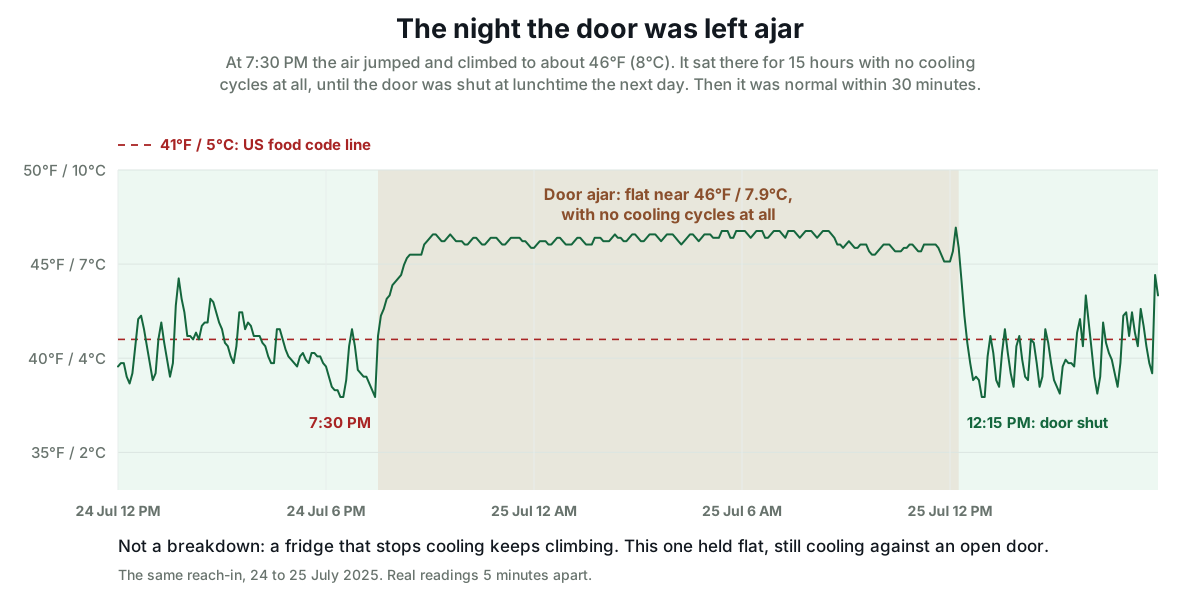
At 7:30 PM on 24 July the air jumped from 38°F to 41°F (3°C to 5°C) in five minutes and kept climbing. By 9 PM it was at 46°F (8°C). Then it sat there, between 45.5°F and 46.8°F (7.5°C and 8.2°C), until noon the next day, with no cycles at all. At about 12:15 PM it dropped, and by 12:40 PM it was back at 39°F (4°C) and cycling normally.
Why that shape means a door, not a breakdown. A fridge that stops cooling keeps climbing toward room temperature. This one did exactly that earlier in the month, when it was off for about three days, probably for maintenance. A flat line well above the setting, with no cycles, means the cooling is running nonstop and only just holding against a steady leak of warm air. A door left ajar does that. So does a coil iced up by a door left open, until it clears.
The site was alerted that a door had been left ajar on this fridge. The readings alone cannot prove which night that alert was for. 24 to 25 July is simply the clearest example of the shape.
It was not the only warm stretch. In the 28 days we can use from that month, the fridge spent about 30% of its time above 41°F (5°C), most of it in six long, flat stretches of 8 hours to almost 2 days. A simple alarm at 41°F (5°C) with a 30-minute delay would have gone off on 13 of the 28 days.
The other stretches could be the door again, or a machine short of capacity in a hot kitchen. The readings alone cannot say which. It held drinks, so no food was at risk. In a fridge holding food, those stretches would matter.
This is where TemperatureWise is different: it reads the shape, not just the line
A threshold alarm asks one question: is it above the line right now? On this fridge it would have gone off for the door, and also for every busy afternoon that brushed 41°F (5°C). It could not tell you which was which.
TemperatureWise uses machine learning on the full temperature history of each cabinet. It learns that cabinet's own pattern in its first week: its sawtooth, its busy hours and how fast it recovers after the door. When the pattern changes, TemperatureWise tells you what has changed. A sawtooth that stops and goes flat points to the door. A steady climb points to a cabinet that has stopped cooling.
Each TemperatureWise sensor also reads humidity, which rises when a door seal fails or a coil starts to ice. On this fridge, TemperatureWise alerted the site to a door left ajar. See how TemperatureWise works.