
Refrigeration controller or standalone monitoring, and why they disagree
By Vimal Bhaya, Founder and Lead Systems Architect · Last reviewed 13 September 2026
This is a continuation of Which kind of monitoring to buy, a 5-part tutorial. You are on part 3 of 5.
The short answer: a controller runs the machine. TemperatureWise keeps the record and tells a person. They both read the box, they get different numbers, and both numbers are correct.
The reason is placement. A control probe sits in the evaporator's return air, because that is where it has to be to run the coil. A TemperatureWise sensor goes in the warmest part of the box, near the door, because that is where the food is at most risk.
Three things a controller cannot do for you. It does not cover the reach-ins, prep tables and older cabinets that have no controller, which in most kitchens is the majority of the cold. It gives you one dashboard per brand on a mixed site. And its record lives on the equipment, so it goes when the equipment does. TemperatureWise covers every box, keeps one record independently of the machine, and offers NIST-traceable calibration.
A refrigeration controller runs the coil, and that is a different job
Worth three sentences. The argument rests on it, and half the people reading this have never opened the box on the wall.
A refrigeration controller is a small computer bolted to the evaporator or the wall beside it. It reads two or three temperature probes and decides when to run the compressor, when to run the fans, when to start a defrost and when to stop it. It is the thing that makes the box cold and keeps the coil clear.
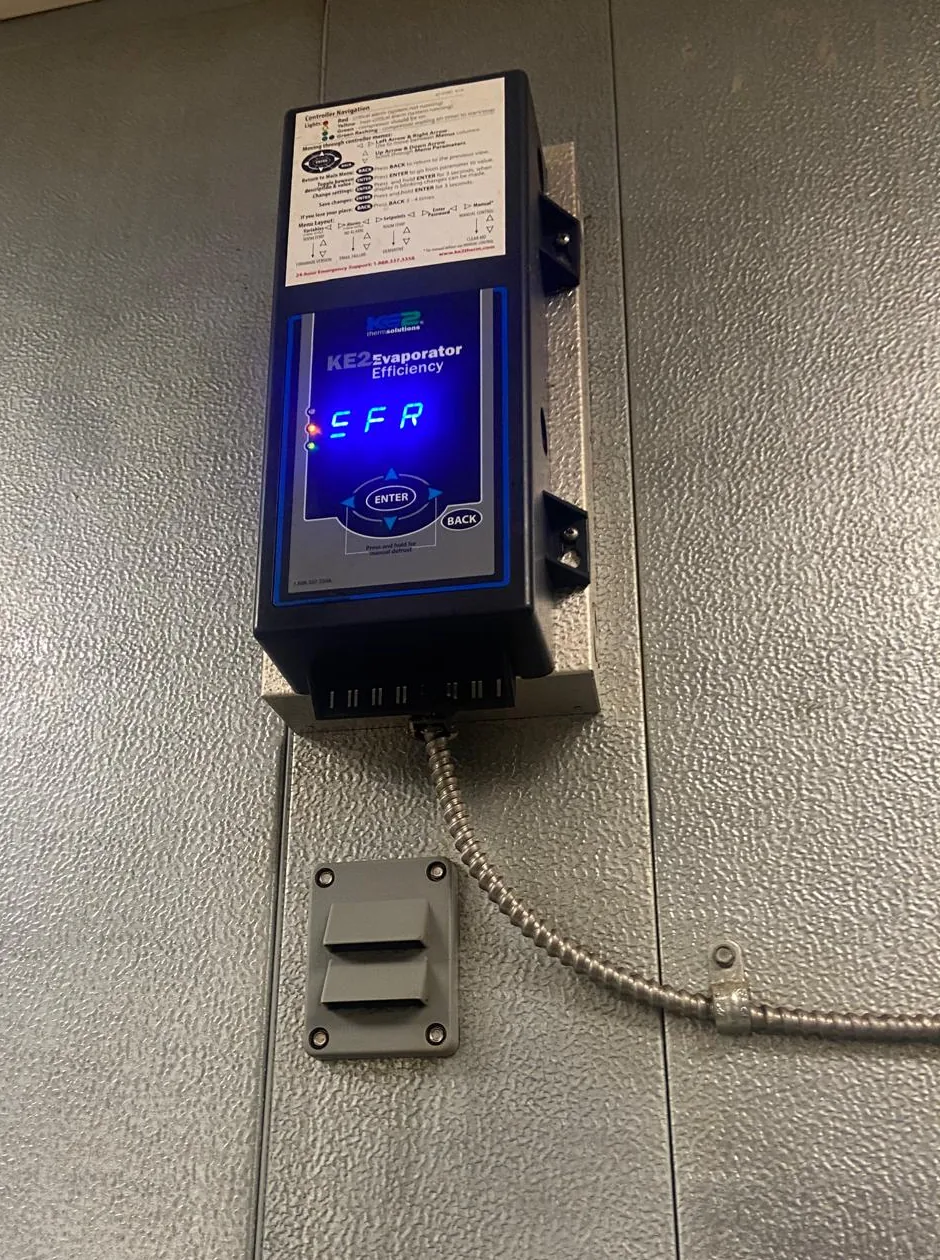
Technicians like these, and they are right to. TemperatureWise is not competing with them:
"KE2's good solution for coolers that tend to have defrost problems. Have pretty easy-to-set parameters."
Refrigeration technician, public discussion
If you are deciding whether to fit a controller, fit one. Nothing on this page argues against that.
The basic case for a controller is efficiency, not just control. A modern controller runs condition-based defrost, starting a cycle when the coil actually needs one rather than a mechanical timer defrosting on a fixed schedule whether the coil is iced or not. A documented restaurant-chain case study saw defrosts drop from four cycles a day to three and walk-in energy use fall 11% to 30%. The payback on upgrading from a mechanical timer depends on your electricity rate, the installation cost, and any local utility or government incentive, but that study found it typically two to three years on a freezer and seven to nine years on a cooler, since a freezer defrosts far more often and has more energy to save.
| Controller | Typical cost |
|---|---|
| Basic defrost controller, replacing a mechanical timer | about $950 |
| KE2 Evaporator Efficiency controller | $1,600 to $3,500 |
| Condenser or valve controller, added to the above | $800 to $1,600 more |
Installation is on top of every figure in that table, and it is usually where a local incentive applies.
The control probe sits 8 to 10 inches from the coil, not where your food is
This is the whole page, so here it is with the source attached.
KE2's own fitting guide puts the return air sensor in the evaporator's return air stream. Roughly 8 to 10 inches from the coil face, in the upper part of the unit. Two more sensors go on the coil itself, at the coldest points, near the edges in the bottom third.
Those are correct placements. The controller is managing a coil, so it needs to know what the coil is doing and what air is arriving at it. The manual says so plainly: "Sensor location is critical to the proper operation of the controller."
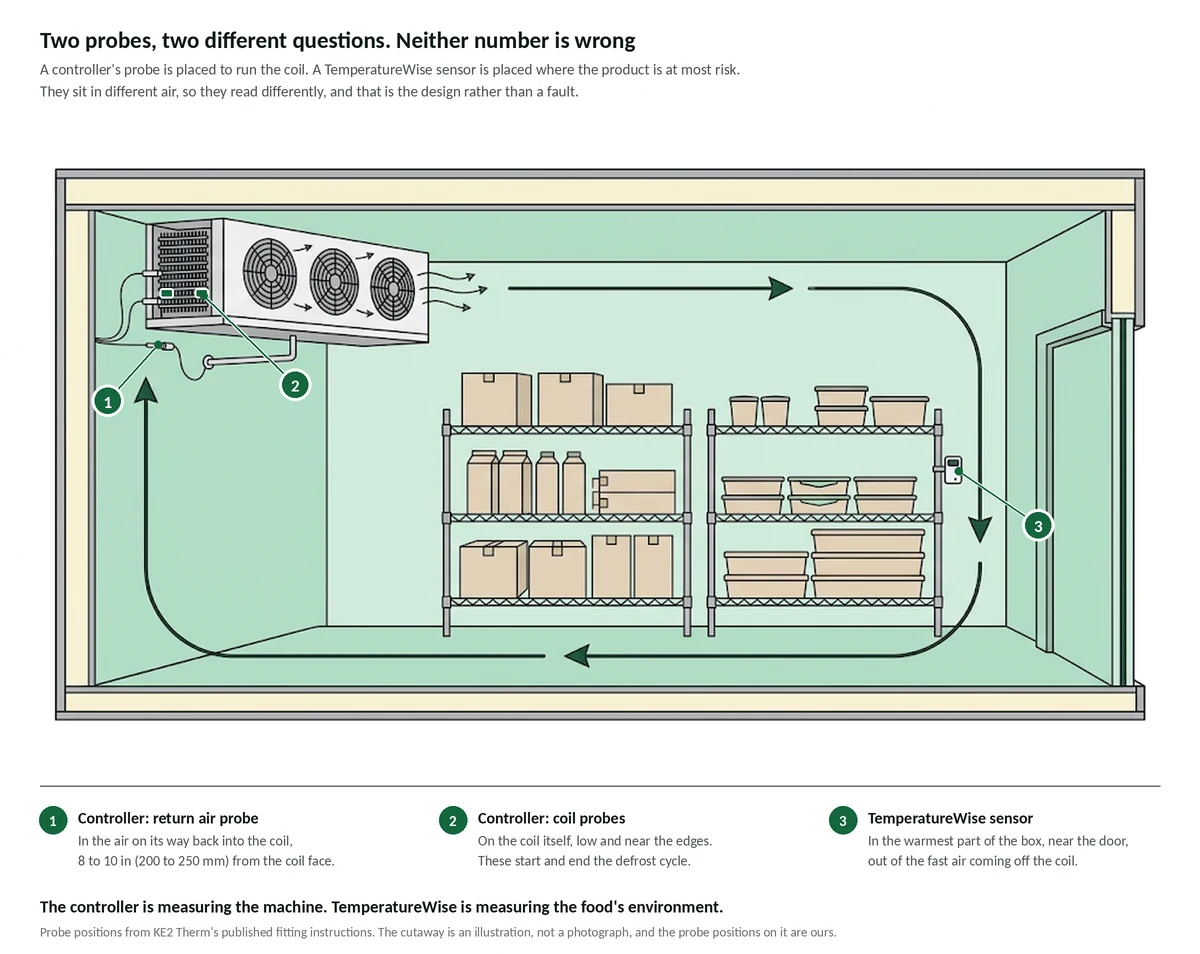
Now compare that with where a TemperatureWise sensor belongs. In the warmest part of the box, usually near the door, out of the coil's airflow. That is where the food is most at risk.
Put a monitoring sensor in the coil's airflow and you get a reading that flatters the box. It is the commonest mistake we see. TemperatureWise sets this out on where to put a sensor in a walk-in.
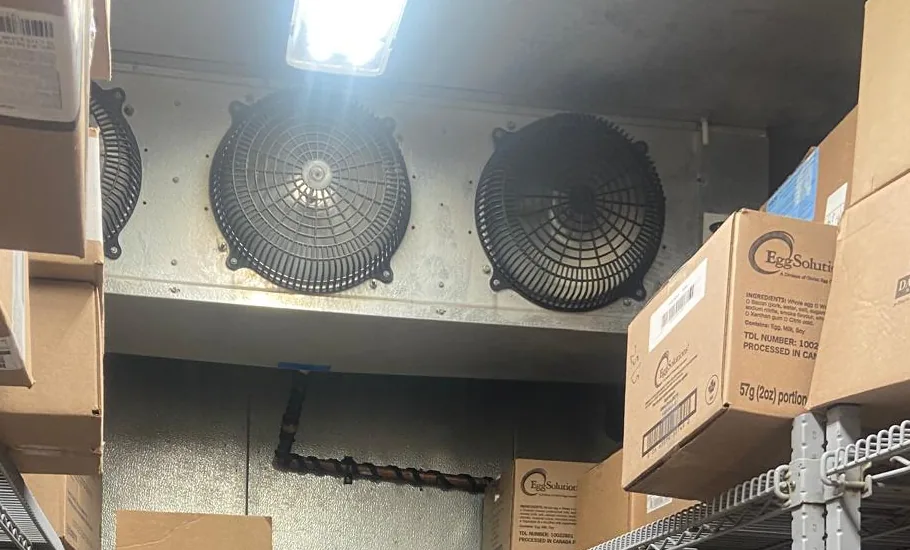
So the controller's number and the TemperatureWise number are not supposed to match. One is measuring the machine. The other is measuring the food's environment. A technician reading both at once is not seeing a fault, and this is worth knowing before somebody spends an afternoon chasing the difference.
A controller hides defrost on purpose, and its alarm can be blind for two hours
A defrost cycle is the freezer warming its own coil on a timer. The frost on the coil melts and drains away. The air in the box gets warmer for a while. The food, which is dense and cold, barely moves. TemperatureWise explained the whole thing on why temperature alarms cry wolf.
KE2's published defaults terminate a defrost at 50°F (10°C) for electric and hot gas defrost, and 40°F (4°C) for air defrost. The controller drives the coil to those temperatures on purpose, four or so times a day, and knows it is fine.
Their alarm delays are adjustable from 0 to 120 minutes for exactly this reason. An alarm that does not know about defrost has to be blindfolded long enough to get through one. That is also long enough to miss the start of a real failure.
TemperatureWise does not need the blindfold. Its detection is a proprietary mix of machine learning on the full temperature history, not just the current reading. So a planned 50°F (10°C) coil warm-up reads as a defrost. A failing compressor reads as a failing compressor.
What a controller does, and what TemperatureWise does
| Refrigeration controller | TemperatureWise | |
|---|---|---|
| Runs the equipment | Yes. Compressor, fans, defrost, valves | No, and it never will. TemperatureWise switches nothing |
| Where it measures | Evaporator return air and the coil, to run the coil | Where the food is, or in a glycol buffer for product temperature |
| Reach-ins with a sealed controller | Has one built in, but on most models it is not upgradable, not connected, and not swappable for an advanced one | Covered. A TemperatureWise sensor goes in anything cold, packaged controller or not |
| Mixed brands on one site | One gateway and one dashboard per brand | One TemperatureWise record, whatever is cooling each box |
| Tells a person off site | Needs an added gateway, by brand, covering up to ten controllers of that make | Email, then text, then a phone call that keeps ringing, to as many people as you list |
| The long record | Lives with the controller and goes when it is replaced | Kept indefinitely and exportable, independent of the equipment |
| Calibration | Not certified. It is a control probe | Factory calibrated to ±0.2°C, with NIST-traceable calibration available |
| Catches a developing fault | Sees its own coil closely, which is a real advantage | Machine learning on the full temperature history, which catches a fault days before the threshold moves |
A controller cannot text you on its own, and its gateway covers one brand
The lazy version of this page says a controller can tell you nothing. That is not true, and a technician would know it at once. Here is what it takes.
KE2 Therm publish an add-on box called the Local Area Dashboard and Alarms. Their own data sheet says what it does:
"Monitor, control and receive alarm notifications for up to ten KE2 Therm Ethernet or SerialModbus controllers, in a single view."
KE2 LDA data sheet
It will also send email alarms to more than one address, and alerts by email or text.
It also acts as the connection to their hosted portal, which their data sheet says carries "a nominal monthly charge". They do not publish the figure, so neither will we.
Read the limits in that description. Ten controllers. One brand. Controllers only. A site with eleven boxes, or two controller makes, or a single reach-in without a controller, is already outside it.
Most of the cold in a kitchen has a controller sealed inside it
Walk into most restaurant kitchens and count. Two or three walk-ins, custom-built for that room, and this is where a standalone controller like a KE2 actually belongs. Then reach-ins, prep tables, a bar fridge and an ice machine, factory units that already ship with a basic controller sealed into the case. That packaged controller is not missing. On most models it is also not the kind you can upgrade, add a gateway to, or connect to anything else. The health inspector still asks about all of them, packaged controller or not.
TemperatureWise covers all of it the same way, walk-in or reach-in, because it does not depend on what is already inside the case. A cold room built around a CoolBot is another box in that count, and TemperatureWise looks at what an inspector makes of one on CoolBot against a real walk-in.
Then there is the mixed fleet. Sites pick up kit over the years. A KE2 on the new freezer. A Keeprite ESP+ on the one before it, which is the same controller wearing a different badge. A Danfoss on the cooler, and a dial on the prep table.
Each brand's gateway sees its own. Nobody ships a dashboard for somebody else's controller. TemperatureWise is one record for all of it.
A controller's record is written by the machine being judged. TemperatureWise records separately
This is the one that matters most and it is the least obvious.
When a controller keeps the temperature history, the same device is running the box and writing the account of how the box ran.
Most of the time that is fine. It stops being fine in exactly the cases the record exists for.
A controller with a drifting probe reports the box as colder than it is. Its own history agrees with it, because the history came from that probe. Replace the controller after a failure and the history goes with it, usually on the same afternoon somebody wants to see it.
This is also why TemperatureWise adds its own battery sensor rather than reading numbers out of your controller. It could be done, and it is a fair question to ask.
A record that comes out of the kit being judged is not proof of how that kit behaved. A separate sensor, on its own battery, writing to a record the kit cannot reach, is a different thing. It is the kind an auditor asks for.
The same independence question turns up in the build-your-own conversation, where the record and the person maintaining it are the same person. TemperatureWise costed that out at 10, 50 and 160 boxes on build your own or buy it.
How to decide, in one table
| If your site... | Buy |
|---|---|
| Has no controllers and a defrost problem | A controller first. Fix the machine before you measure it |
| Is one brand, under ten boxes, all controlled | That brand's gateway is cheaper, and it is the same conversation as the service contract |
| Has reach-ins with a sealed, non-upgradable controller, which is most kitchens | TemperatureWise, because a record with holes in it is not a record |
| Has two or more controller brands | TemperatureWise, unless you want a dashboard per brand |
| Has to hand records to an inspector, auditor or insurer | TemperatureWise, for the independence, the export and the NIST-traceable calibration |
| Has controllers but no internet at the site | Either way, the connection is a separate decision. See cellular against Wi-Fi |
| Wants both | Both, and they will disagree by a degree or two. That is the placement, not a fault |
How a site gets its readings out to a person is a separate choice again, and cheaper than most people expect. TemperatureWise compares the two routes on cellular or Wi-Fi.
Where TemperatureWise falls short
TemperatureWise does not control anything. It will not run your defrost, shut your fans off when a door is propped, or save you money on defrost cycles. A controller does all three and we have no intention of competing with that.
A controller sees things TemperatureWise cannot. It has probes on the coil itself. Coil temperature, defrost end point and superheat are all visible to it, and a sensor in the room will never match that. A technician reading a controller's history gets better detail about the machine.
For one brand, under ten boxes, all controlled, the brand gateway is cheaper. Ask your refrigeration contractor to quote it before you talk to us.