
Which kind of monitoring to buy
By Vimal Bhaya, Founder and Lead Systems Architect · Last reviewed 13 September 2026
Most comparison pages in this market start in the wrong place. They line up brands. The question in front of you is usually one step earlier: what kind of thing am I buying at all. A $23 sensor from a marketplace, a Raspberry Pi you build yourself, the controller already bolted to the evaporator, and TemperatureWise are four different answers to what sounds like one question.
This is a five-part tutorial about that earlier decision. Each part says plainly where TemperatureWise wins, and each one ends with a short section on where TemperatureWise falls short. Every price is either ours and published, or taken from a published page with the date we read it.
The 5 parts, in order
By the end you will know five things. Why accuracy is never what separates a cheap sensor from TemperatureWise, and what the yearly fee actually buys. What a build-it-yourself fleet costs once you price the person who maintains it. Why the probe in your refrigeration controller reads a different number to a TemperatureWise sensor, and why both are right. Which of the two radio links in your system cellular actually changes. And what a health inspector is really objecting to when they say a CoolBot is not a walk-in.
-
1. Consumer sensors or commercial monitoring
The cheap sensor is accurate enough and always was. The TemperatureWise entry sensor is consumer hardware too, so the yearly fee is not buying a better thermometer. What it buys is escalation to phone calls, a record you own, and NIST-traceable calibration. Plus the five things that break when a home product goes into a business.
Read part 1 -
2. Build your own or buy it, at 10, 50 and 160 coolers
A Pi build is cheaper per cooler than TemperatureWise, at every scale, and the gap widens. What changes is who owns it. Work it in hours rather than dollars and the break-even is ten hours per cooler a year. That hides inside a job at 10 boxes. At 160 it is a person you have not hired.
Read part 2 -
3. Refrigeration controller or standalone monitoring
Your controller reads the coil, not the food, and its record dies with the unit. It also covers only the boxes it is fitted to, which in most kitchens is two of nine. TemperatureWise covers all nine and keeps one record the equipment cannot reach.
Read part 3 -
4. Cellular or Wi-Fi, and which link you are choosing
Cellular is not a better sensor and not a better radio. It changes the route out of the building and nothing about getting the reading out of the freezer. TemperatureWise puts one cellular radio at the site for $125 and $50 a year. Products that put one in every device charge again for every box.
Read part 4 -
5. CoolBot or a real walk-in, and what an inspector checks
A health inspector publicly argues that a CoolBot is not a walk-in. He is half right, and the half that matters is narrower than either side thinks. Certification is a shortcut rather than a law, so an uncertified room has more to prove, and a TemperatureWise record is how you prove it.
Read part 5
How to use this
Read them in order if you are starting from scratch. That is the usual path. If you already know which piece you need, jump to it from the list above.
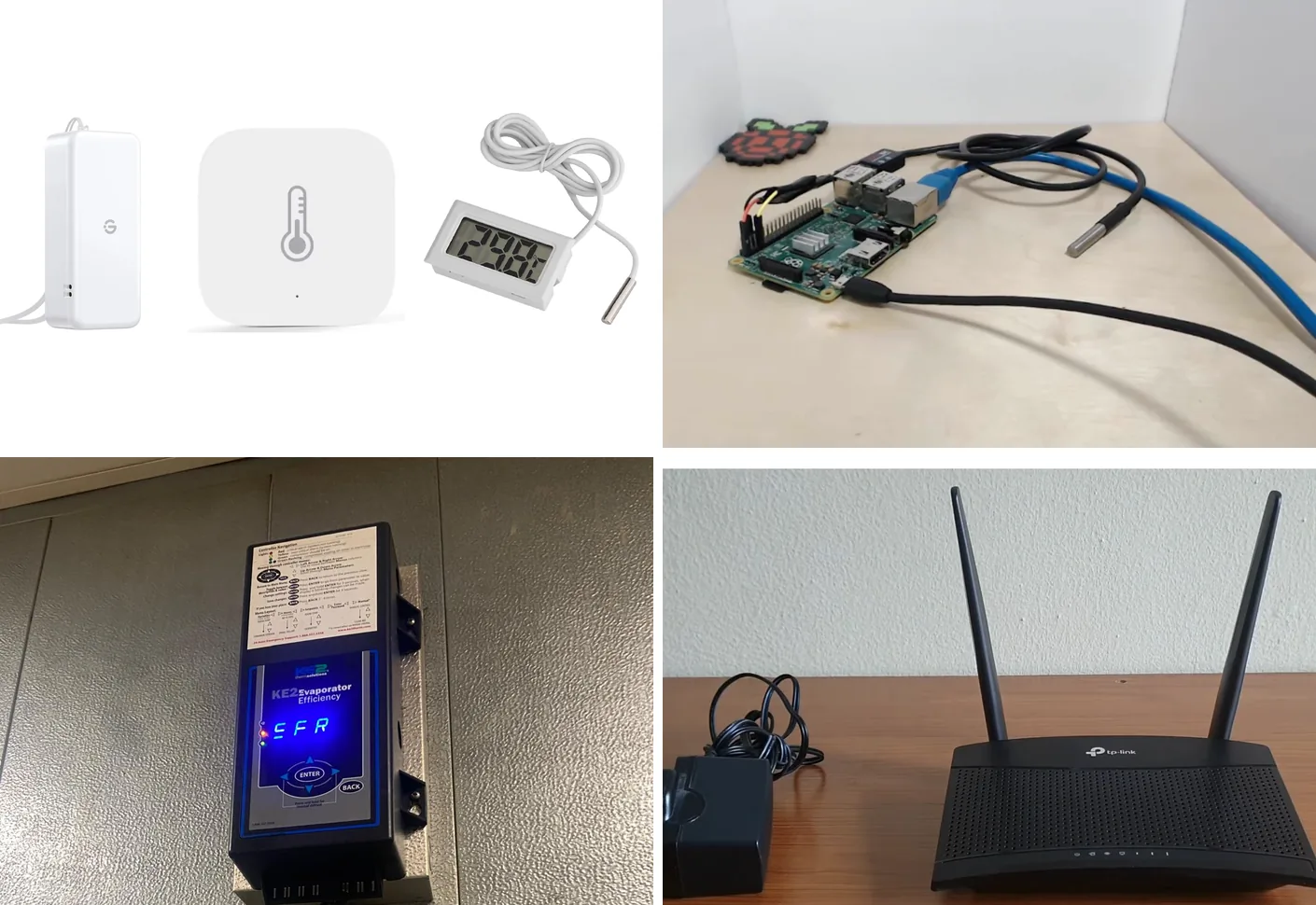
Every price on these pages is one of three things. Ours, and published. Taken from a published page, with the date we read it. Or clearly marked as what an operator reported paying. Specifications are sourced to datasheets, installation manuals and the FDA's own list of food equipment standards. Each part lists its sources at the foot.
This tutorial sits alongside three others. The alerting problem is about what to do with the readings. The physical reality is about getting them out of a metal box. What if the monitoring fails is about whether the whole arrangement stays up. This one is about what to buy in the first place.