
Consumer sensors or commercial monitoring, and what the money actually buys
By Vimal Bhaya, Founder and Lead Systems Architect · Last reviewed 13 September 2026
This is part 1 of 5 in Which kind of monitoring to buy, a short tutorial on choosing a category rather than a brand.
The short answer: the cheap sensor is accurate enough, and that was never what separated the two. Consumer sensors publish tolerances around ±0.5°C to ±0.9°F, inside what the Food Code asks of an ambient air thermometer. They read cold, and they read accurately.
So here is the awkward part first. The TemperatureWise entry sensor at $25 is an off-the-shelf consumer device. The $250 a year is not buying you a better thermometer, and anybody who tells you it is has not thought about it.
What it buys is everything around the reading. TemperatureWise escalates from email to text to a phone call that keeps ringing, to as many people as you list. It keeps the record indefinitely and exports it. It offers NIST-traceable calibration. And its detection reads the full temperature history, not just the current reading. A consumer sensor sends an app notification to one phone, on one account, belonging to one person.
What the cheap ones get right, and it is most of it
Operators buy these and they are not being foolish. From our own research into public discussions:
"I have been using Tuya smart thermometers for the last 8 months, and I ordered off of Amazon."
Restaurant owner, public discussion
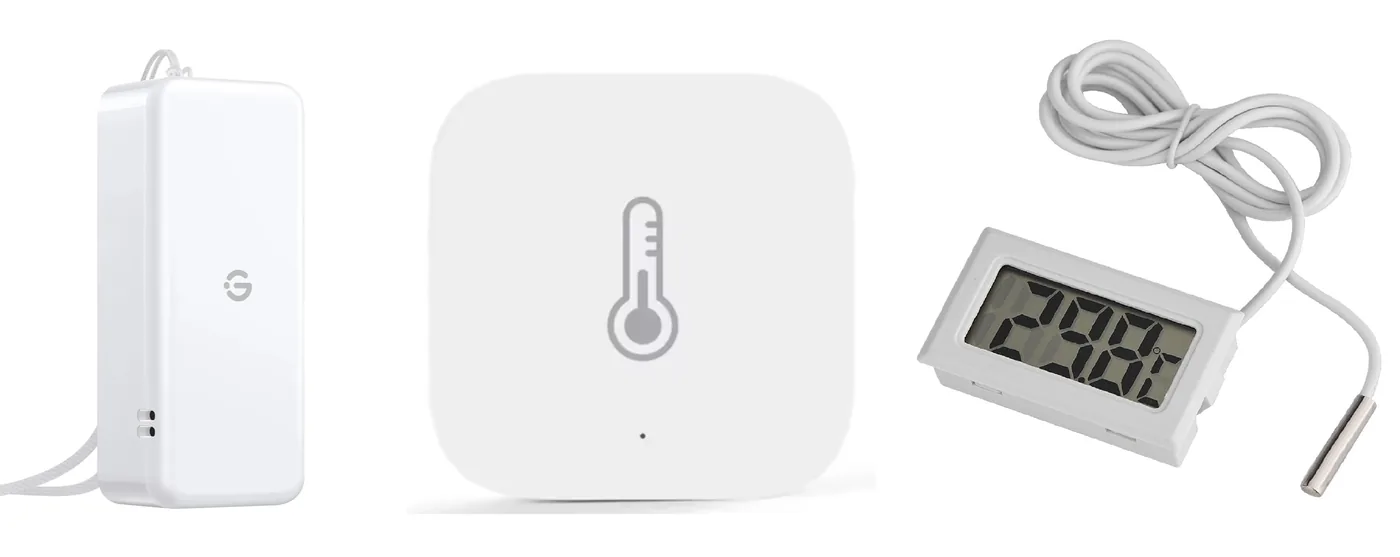
Three things are genuinely right about them.
The accuracy is fine. One widely sold kit publishes ±0.9°F over a range of -40°F to 158°F (-40°C to 70°C). Another publishes ±0.54°F (±0.3°C). The Food Code asks for ±1.5°C on an ambient air thermometer. They pass, with room. TemperatureWise set out that whole ladder on sensor accuracy, drift and calibration.
The price is real. A hub and two probe sensors for $49.99 works out at about $25 a monitored point including the hub. Operators report paying $12 to $15 for the cheapest single units and $36 to $40 for others.
No subscription is real too. Several say so plainly on their own pages and they mean it.
The caveats, in short: unreliable for high-value walk-in inventory, since the radio is plain Wi-Fi being asked to cross a steel and foam panel. No proactive fault detection, only a reading. And no real escalation, since an app notification is usually where it stops, with email the rare exception and a text message or a phone call rarer still.
What you give up at each price, and what TemperatureWise adds
This is the table almost nobody publishes, so here it is.
| What you pay | What you get | What you give up | Where it belongs |
|---|---|---|---|
| TemperatureWise entry $25 a sensor, $50 hub, $250 a year |
The same class of hardware, plus escalation to text and phone calls, multiple recipients, one record across every box, indefinite history and export, NIST-traceable calibration available, machine learning on the full history, and somebody to call | Range. The hub has to be near the boxes, and a spread-out site needs a second one | A restaurant. Reach-ins, prep fridges and a walk-in or two |
| $0 A dial thermometer and a clipboard |
A legal thermometer in the box, and a record if somebody writes it down | Every hour nobody is standing there, which is most of them | Nowhere, on its own. It is the thing you are replacing |
| About $13 a sensor Reported |
A reading on your phone, a push alert, no fees | Escalation, phone calls, multiple people, calibration paperwork, export you control | A reach-in in a room with good Wi-Fi and somebody on site |
| About $25 a point Hub plus two probe sensors at $49.99 |
External probes, hub, app and email alerts, no subscription | Text messages, phone calls, escalation, a history you own | A small kitchen where one named person is always reachable |
| $36 to $75 a sensor Reported, and one published list price |
Better build, longer stored history, export from the app | The same things. More money, same category | Same as above, with a nicer app |
| TemperatureWise LoRa $200 a sensor, gateway, $250 a year |
All of the above, plus one gateway across a whole site or several buildings, and a 5 to 8 year battery | Reporting speed. Into the record every 15 minutes rather than every 5 | A cold store, a plant, or any box worth more than the system |
Notice the shape of the second column as you go down it. The hardware barely changes. What changes is what happens at 2am.
Five things break when a consumer sensor goes into a business
None of these are defects. They are a product built for a house being used by a company, and the gap shows up in specific places.
1. The alert is an app notification. It goes to a phone, in a notification tray, alongside everything else. Nobody wakes up for one. TemperatureWise escalates to a phone call that keeps ringing, because a phone call is the thing that wakes people. Consumer sensors do not make phone calls, since every call costs the vendor real money.
2. There is one recipient. One phone, one person, who is on holiday twice a year and asleep every night. TemperatureWise sends to as many people as you list and keeps going until somebody answers. We worked through what happens otherwise, with a Boxing Day timeline, on alerting more than one person.
3. The account belongs to whoever set it up. This is the one nobody writes about and it is the one that bites. The sensors are registered to a personal email address, usually a manager's. When they leave, the alerts leave with them, and the next person finds out the week something fails. A TemperatureWise account belongs to the business.
4. The history is on their terms. One vendor states that core monitoring is free of subscription, but that cloud history review and export remain subject to service availability. Another stores 20 days online. Both are reasonable for a greenhouse.
Neither is a promise you want under two years of records somebody asks for on a Tuesday morning. TemperatureWise keeps the record indefinitely and exports it, with NIST-traceable calibration available for the sensor that produced it.
5. Most of them share one crowded band. Not all of these sensors are Wi-Fi. Some run on Zigbee, some on Bluetooth, and one manufacturer states plainly that its sensor only works with 2.4 GHz Wi-Fi. The protocol changes, but the band mostly does not: almost all of them sit on the same 2.4 GHz range as the router, the microwave and every neighbouring network in the building, and that crowding is what costs the link its reliability, on top of a walk-in's steel and foam panel. TemperatureWise measured what the panel alone costs a signal on will wireless work through a freezer wall.
That last one is why the recurring complaint about cheap sensors is connectivity rather than accuracy. The sensor is fine. The link is not, and a sensor that drops off for six hours has produced a record with a hole in it.
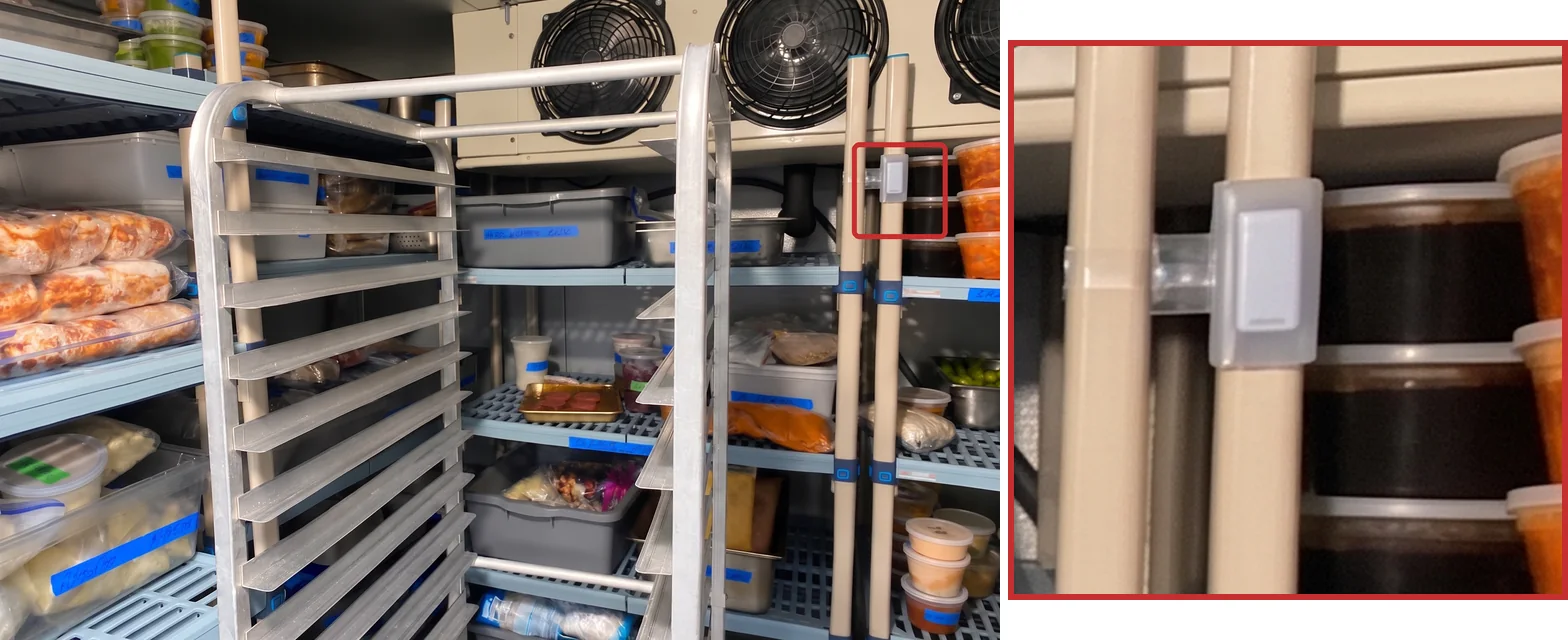
Worth being clear about which link the coverage problem is on, because people reach for a cellular product to fix it and cellular changes a different hop entirely. TemperatureWise separated the two on cellular or Wi-Fi.
The TemperatureWise entry sensor is consumer hardware, and we will not pretend otherwise
TemperatureWise sells two sensors. The $25 one is an off-the-shelf consumer device. The $200 one is not.
So when you compare our $25 sensor with a $23 sensor on a marketplace, you are looking at very similar hardware. The honest answer to "what am I paying $250 a year for" is: not the thermometer.
What is different is what happens before the sensor is stuck to a wall. We have made it more reliable through signal mapping and redundant hubs, not better hardware. TemperatureWise takes the site's floorplan, runs a signal simulation against it, and places every sensor and hub where that simulation says the link will hold, adding a second hub wherever the model shows a weak spot. You can do the same thing yourself with sensors from AliExpress, if you are willing to spend an hour and a half to two hours walking the site and testing placements by hand. Our team has simply done it enough times to have perfected it.
It pays for five things and they are worth naming so you can decide whether you want them.
- The escalation. Email, then text, then a phone call that keeps ringing until somebody picks up, to as many people as you list. Every text and every call costs real money to send, every time, for everyone.
- The record, kept indefinitely and exportable. Not subject to a service tier, and not 20 days.
- The calibration paperwork. Factory calibrated to ±0.2°C, with NIST-traceable calibration available. No consumer sensor comes with a certificate an auditor will accept.
- The detection. A proprietary mix of machine learning on the full temperature history, not just the current reading. That is the expensive part to run and it is the reason TemperatureWise exists rather than being a thermometer with an app.
- Somebody to call when a sensor stops reporting and you cannot work out why.
You get what you pay for is true here, and we would rather sell you the cheap tier than lose you to a spreadsheet. The full price list, with every line item, is on what you need to buy.
One free tip if you have already bought a cheap sensor
Put lithium cells in it. Alkaline is recommended down to 0°F (-18°C), which is roughly where a freezer sits, so the cells most consumer sensors ship with are struggling exactly where you need them. Energizer Ultimate Lithium is rated to -40°F (-40°C) and drops into the same slot, the L91 in AA and the L92 in AAA. It is what TemperatureWise fits in its own sensors.
That tip is free and it is worth more than this page to anybody running a cheap sensor in a freezer today.
Where the cheap one is the right buy, and TemperatureWise means it
| If this is your situation... | Buy |
|---|---|
| One reach-in, a prep table or a bar fridge, and somebody on site most hours | A consumer sensor. $13 to $25 and you are done |
| A food truck or a single-operator business where you are the only person who would answer | A consumer sensor. Escalation to a second person is worth nothing if there is no second person |
| More than one person who needs to know, or anybody ever asleep while the site is not | TemperatureWise. This is the actual dividing line |
| You need the alert to reach somebody as more than an app notification: an email, a text, a phone call that keeps ringing | TemperatureWise. That escalation is the actual product |
| You want to catch equipment trouble before it drifts into a health-code violation | TemperatureWise. Detection is a proprietary mix of machine learning on the full temperature history, not just the current reading |
| You are carrying more than $2,500 in food across your fridges and freezers | TemperatureWise. That much inventory is not the place to save $200 a year |
| A walk-in, where the sensor has to get through the panel | TemperatureWise, on a hub near the boxes or a LoRa gateway. Not a Wi-Fi sensor inside the box |
| Anyone outside the business who has to believe the record | TemperatureWise, for the export, the continuity and the NIST-traceable calibration |
| Product in one box worth more than the whole system | TemperatureWise, and probably the longer-range tier |
| Technical enough to be tempted to build your own | A real option, and cheaper per box. See build your own or buy it |
If you are technical, there is a third answer worth costing properly, which is building it yourself out of this same class of parts. TemperatureWise costed it honestly on build your own or buy it.
Where TemperatureWise falls short
TemperatureWise is more expensive, and there is no version of this where it is not. $250 a sensor a year against $0 is not a close call on price, and we are not going to argue it on price. What we will argue is the escalation: the extra email, text and phone call alerts pay for themselves even if they only fire once a year, because one catch is worth more than the fee.
A consumer sensor with a person behind it beats a commercial system nobody configured. The best monitoring in this market is the one somebody actually set thresholds on and actually answers.
We have not tested these consumer products. Everything here comes from the manufacturers' own published pages and from operators describing what they bought, in public. Specifications change. If anything here has moved, tell us and we will correct it.