
Sensor accuracy, drift and calibration
By Vimal Bhaya, Founder and Lead Systems Architect · Last reviewed 9 September 2026
This is a continuation of What if the monitoring fails?, a 6-part tutorial. You are on part 4 of 6.
The TemperatureWise LoRa sensor reads to ±0.3°C (±0.5°F) at 25°C in its freezer version, and to ±0.5°C (±0.9°F) in its cooler version. The FDA Food Code asks an ambient air thermometer to be accurate to ±1.5°C (±3°F). Both are three to five times tighter than the rule they have to satisfy, and that gap is not where your risk lives.
Here is the number that puts it in perspective. Across a healthy week in a walk-in freezer TemperatureWise monitors, the air inside it swung between 4.5°F and 23.8°F (2.5°C and 13.2°C) in a single day, every day, with nothing wrong. The box moves more in an afternoon than the sensor could be wrong by in ten years.
Drift is also smaller than it sounds. A modern digital temperature element is a solid-state part with published long-term drift under 0.03°C a year. What degrades a sensor in a cold room is condensation, ice and grease on the outside of it, not the electronics inside, which is why TemperatureWise sensors run a periodic self-heat cycle to drive that off.
Four words that get used as if they meant the same thing
Most of the confusion in this subject is vocabulary, so it is worth thirty seconds.
| Word | What it means | Worth paying for? |
|---|---|---|
| Accuracy | How close the reading is to the truth | Yes, up to the point the rule asks for |
| Resolution | How many decimal places it shows you | No. It is free and it proves nothing |
| Drift | How much the accuracy changes over years | Worth asking about. Rarely worth worrying about |
| Calibration | Checking it against a known reference, and being able to show you did | Only if somebody is going to ask for the certificate |
A cheap sensor showing -18.34°C looks more convincing than a good one showing -18.3°C. That is resolution pretending to be accuracy, and it is the oldest trick in the specification sheet.
What the rules actually ask for
There is a ladder here, and knowing which rung you are on saves money in both directions.
| Where | Required accuracy | Certificate? |
|---|---|---|
| Food probe, poked into product FDA Food Code 4-203.11 |
±1°C (±2°F) | No |
| Air in a walk-in FDA Food Code 4-203.12 |
±1.5°C (±3°F) | No |
| Vaccine fridge or freezer CDC storage and handling |
±0.5°C (±1°F) | Yes, and retested every 2 to 3 years |
| The TemperatureWise LoRa sensor | ±0.3°C (±0.5°F) at 25°C, freezer version. ±0.5°C (±0.9°F), cooler version | Ask us, see below |
The second row is the one that applies to a monitoring sensor hanging in a walk-in, and it is the loosest of the three. That is not regulators being careless. It is regulators knowing what air does.
A freezer swings 23.8°F (13.2°C) in a day. The sensor drifts 0.5°F (0.3°C) in ten years.
This is the fact that reframes the whole question, and it comes out of our own published records rather than an argument.
We took nine days from a walk-in freezer that was working perfectly, with no fault, no alert and nobody complaining, and looked at what the air did each day.
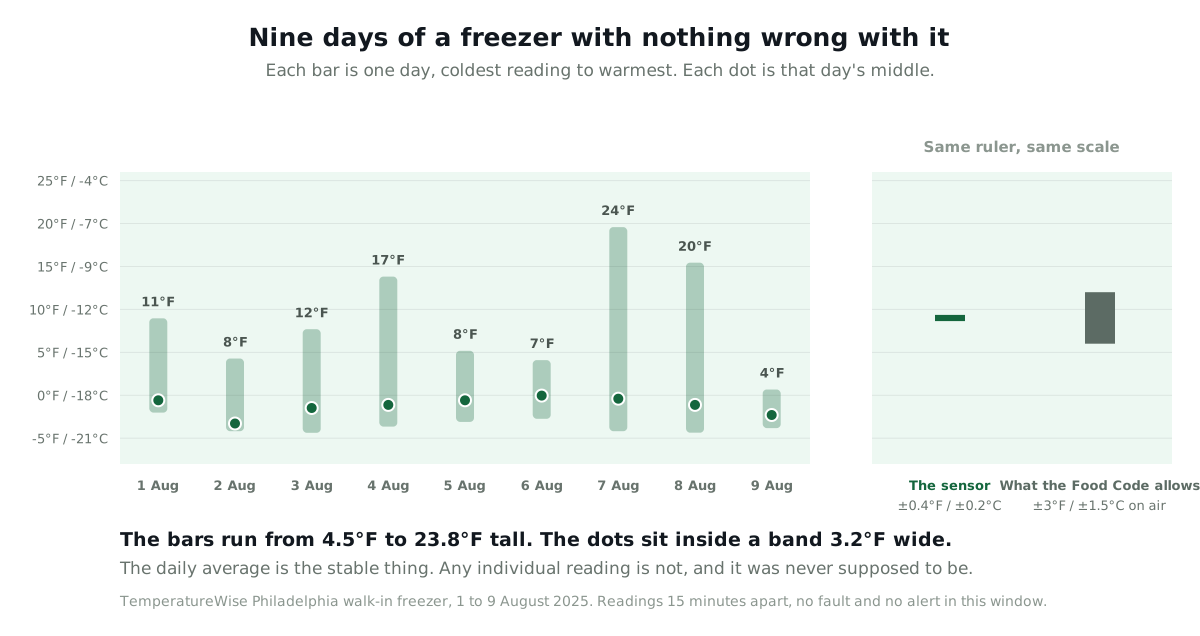
The tall bars are ordinary life: doors opening, product going in warm, and the defrost cycle the freezer runs on a timer to melt frost off its coil.
Now look at the dots. The daily median barely moves. Nine days of chaos in the individual readings, and the middle of each day sits inside a band about 3°F (1.7°C) wide.
That is what a healthy freezer looks like: a stable average with a great deal of noise on top. And the sensor's accuracy spec, drawn on the same chart, is a hairline.
Put the two numbers side by side. The box moves up to 23.8°F (13.2°C) in one day. The sensor drifts about 0.5°F (0.3°C) in ten years. The thing you are measuring changes roughly forty times more in a single day than the instrument changes in a decade.
Which is the whole point of this page. Buying a tighter sensor is buying down the smallest number in the problem.
Food changes temperature far more slowly than the air around it
Because the food is not the air. Air has almost no thermal mass, so it moves the instant anything happens. A pallet of frozen product does not.
The rules are written about the food for exactly this reason. Ontario's food premises regulation, for instance, is worded around the internal temperature of the product rather than the air around it.
So the thing that matters is whether your product is being held cold on average, not whether the air brushed a limit at 4pm while somebody loaded a delivery. Put a probe in a bottle of glycol next to the air probe and the difference is obvious, which is the whole point of glycol buffers and why air temperature lies.
None of that is an argument for a sloppy sensor. It is an argument about where to spend: an extra tenth of a degree of accuracy buys you nothing next to measuring the right thing in the right place.
A digital sensor barely drifts
Far less than people expect, and for a good reason.
An old dial thermometer drifts because it is mechanical. A bimetal strip work-hardens, a spring relaxes, a fluid ages. A modern digital sensing element has none of those parts. It is a solid-state circuit that measures temperature from a property of silicon itself, and there is nothing in it to go slack.
The published long-term drift for parts of this class is typically under 0.03°C a year. Ten years of that is less than 0.3°C, which is still five times inside what the Food Code allows for air.
So the honest answer to "how often does it need recalibrating" is that the electronics are not what is going to move.
What does degrade a sensor in a cold room
The outside of it. A walk-in is a wet, cold, greasy place. Sensors ice up during defrost, get condensation on them every time the door opens onto humid summer air, and pick up an oily film in a kitchen.
That layer is the real enemy. It slows the sensor's response and, on the humidity side, it shifts the reading outright.
So TemperatureWise sensors have a very small heater built into the sensor itself, and run it briefly on a schedule. It warms the element just enough to drive off condensation and clear what has settled on it, then the element returns to box temperature. Nothing about the walk-in gets warmed, and the food never notices.
It is housekeeping, not correction. In a place where nobody is ever going to go and wipe a sensor, the sensor wipes itself.
Two honest notes. It keeps the sensor clean and protects the humidity reading, because the temperature element was never the part that was drifting. And while it is heating it is not measuring the room, so those readings are not used.
What a calibration certificate certifies, and what it does not
A certificate certifies the sensor. It does not certify the reading. That sentence is worth more than everything else on this page.
A calibration certificate says that on a stated date, this specific device was compared against a reference traceable to a national standard, at stated temperatures, and found to be within a stated uncertainty. It is a fact about a piece of hardware in a laboratory.
It says nothing at all about whether that device, mounted where you mounted it, is telling you about your product. A certified sensor in the evaporator's discharge air is a certified wrong number.
Who needs one
- Vaccine storage. The CDC expects each logger to have a current Certificate of Calibration Testing, retested every 2 to 3 years or to the manufacturer's schedule. This is not optional and you should ask for it by name.
- Accredited labs and regulated pharma. Same answer, usually stricter.
- A restaurant walk-in. No. The Food Code asks the device to be accurate. It does not ask you to hold a certificate for the thermometer in your cooler.
If somebody is quoting you annual calibration on a restaurant freezer sensor, ask them which rule requires it. There may be a good answer for your jurisdiction or your customer's audit. There is often no answer at all.
The check you can do yourself in ten minutes
The ice point check is the standard field method, it costs nothing, and it will catch anything seriously wrong.
- Fill a container with crushed ice, not cubes. Crushed matters, because you want ice touching ice everywhere.
- Add cold water until the ice is just wet, not floating. It should look like a slush, not a drink.
- Stir, and let it sit for a couple of minutes to settle.
- Put the sensor or probe in the middle of the slush, not touching the sides or the bottom, and stir gently.
- Wait for the reading to stop moving. It should read 32°F (0°C).
The honest limit of this test: it checks one point, at the freezing point of water. It tells you the sensor is alive and roughly right. It tells you nothing about how it behaves at -20°F (-29°C), which is where your product actually lives. For that you need a reference at that temperature, and that is what a calibration lab is for.
The error that dwarfs all of this
Where the sensor is.
TemperatureWise measured this on the probe types page and the result was blunt: moving a sensor within the same walk-in changes the reading roughly fifty times more than the difference between one probe type's tolerance and another's.
Fifty times. If you are choosing between two sensors on a tenth of a degree, and you have not decided where they are going, you are optimising the wrong variable by a factor of fifty. Read where to put a sensor in a walk-in first.
Five questions to ask any vendor, with the TemperatureWise answers
- What is the accuracy, and over what temperature range?
TemperatureWise: the freezer version of the LoRa sensor reads to ±0.3°C (±0.5°F) at 25°C (77°F) and runs from -40°C to 55°C (-40°F to 131°F). The cooler version reads to ±0.5°C (±0.9°F) and runs from -20°C to 55°C (-4°F to 131°F). Ask separately for the Bluetooth sensor's figure, because it is a different part. Watch for a vendor quoting one number with no range, since accuracy usually widens at the extremes. - What is the published long-term drift, per year?
TemperatureWise: the published figure for this class of digital element is typically under 0.03°C a year. If a vendor has no figure at all, there was no measurement. - Do you supply a NIST traceable calibration certificate?
TemperatureWise: yes, and it is a separate quote at a different price, because it is a different piece of work from shipping a sensor. A restaurant walk-in does not need one. Vaccine storage does, so tell us before you buy rather than after. - How do I check it myself without sending it away?
TemperatureWise: the ice point check, set out step by step above. It takes ten minutes and costs nothing. - What happens when it ices up or gets condensation on it?
TemperatureWise: a very small heater inside the sensor runs briefly on a schedule and clears it. Most specification sheets are silent about the failure that actually happens in a walk-in.
What this does not fix
Our ±0.3°C is one sensor's specification, not a system promise. It is the figure for the freezer version of the TemperatureWise LoRa sensor, and the cooler version is ±0.5°C. There is a cheaper Bluetooth sensor as well, and if that is the one you are quoted then ask for its number rather than assuming this one, because it is a fair question and the answer is not the same for both.
Either way a specification is the smallest term in the sum. What lands on your dashboard is that sensor, in that spot, in that airflow, in that box.
Accuracy at the extremes is a fair question and we would rather you asked it. Most parts are tightest around room temperature and loosen towards the ends of their range. A vendor who quotes one number for the whole range and no curve has simplified something. Ours is quoted at 25°C (77°F), the way the maker rates it, and like most parts it is tightest near that temperature.
NIST traceable certificates are available, and they are quoted separately. TemperatureWise supplies them where the application needs them, at a different price from a standard sensor, because certifying a specific device against a traceable reference is a different piece of work from shipping one. Tell us before you buy rather than after, because it changes the quote.
And no amount of accuracy tells you what the food is doing. A perfect reading of the air is still a reading of the air. What decides whether the number means anything is buffering and placement, and both of those cost less than a tighter sensor.