
Why temperature alarms cry wolf, and how to stop it
By Vimal Bhaya, Founder and Lead Systems Architect · Last reviewed 18 October 2026
This is part 1 of 5 in The alerting problem, a short tutorial on making freezer alerts worth reading.
False alarms happen because the alarm is watching the wrong thing, not because you picked the wrong number. Three fixes, in the order that matters:
- Put the sensor in glycol. Then it reads like a box of food instead of like the air. Air jumps around every time someone opens the door. Food does not.
- Tell the system when your defrosts happen. A freezer is meant to warm up during a defrost. That is not an emergency, so it should not set off an alarm.
- Watch whether the freezer is slowly getting worse. A dying freezer shows that up days before it gets warm enough to trip any alarm you would be willing to set.
Do all three and you can keep the alarm set tight enough to protect your product without it waking you up for nothing.
The problem, in an operator's own words
Here is the whole thing in one paragraph, from a restaurant operator who was shopping for a monitoring system and could not make the numbers work:
"Man... I want one of these so bad, but like, what is that actually like to live with? Am I going to get alerts anytime my freezer or walk-in goes into a defrost cycle? OK, well then just set the temp alert threshold to a higher temp. Well, if I bump my freezer up to like 35 and my cooler up to like 50, that is going to be really late into an outage to alert my reefer guy in a timely manner."
Restaurant operator, r/Chefit
Nobody in that thread answered him. So let us answer him properly, with real numbers from a real freezer.
First, what a defrost cycle actually is
Every walk-in freezer builds up frost on its cooling coil. Frost blocks airflow, so the freezer has to melt it off. It does this by deliberately warming the coil for a set time, usually up to 45 minutes, a few times a day.
That is a defrost cycle. It is normal. It is scheduled. It is the freezer working properly.
While it is happening, the air inside the box gets noticeably warmer, then goes back down. The food barely changes temperature because a frozen pallet takes hours to warm up, not minutes.
The problem is that a simple alarm cannot tell the difference between a defrost and a breakdown. It only sees a number going up.
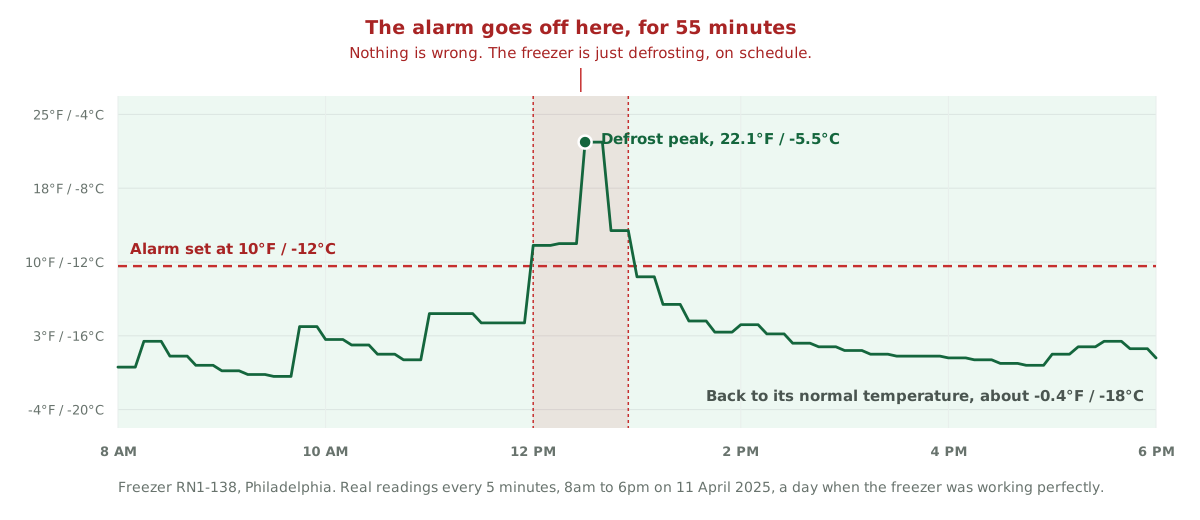
Look at the shape. The freezer sits near -0.4°F (-18°C) all morning. At midday it climbs to 22.1°F (-5.5°C), stays up for under an hour, and comes straight back down.
Your phone does not know that. All it knows is that the freezer went above 10°F (-12°C), so it wakes you up. Then it does the same thing tomorrow, and the day after.
After about a week of this, people stop reading the alerts. That is the real damage. The alarm is now switched on and useless at the same time.
So raise the setting. Then you find out too late.
This is what the operator worked out for himself, and he was right. Here is the proof from the same freezer.
Eleven days after that ordinary day, this freezer broke. Its defrost timer failed, the coil iced up solid, and the box climbed to 31.5°F (-0.3°C), which is above freezing. The site had about $150,000 of frozen inventory in it.
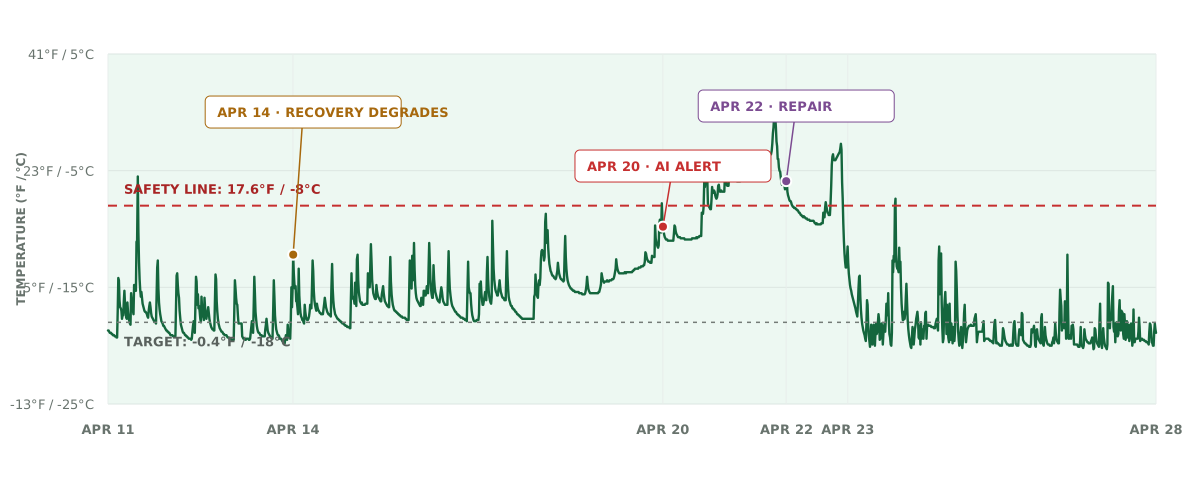
The freezer logs a reading every five minutes, so there are 5,179 readings covering the whole thing. That means we can take every alarm setting an operator might reasonably pick and replay it against what actually happened.
In the table below, an alarm counts as going off if the freezer stays above the setting for 15 minutes or more, and it cannot go off again until the freezer has been back below it for an hour. That is roughly how a sensible system behaves.
| Alarm set at | False alarms in four normal days | Warning before the freezer peaked |
|---|---|---|
| 0°F (-18°C) | 11 | 122 hours |
| 5°F (-15°C) | 13 | 72 hours |
| 10°F (-12°C) | 2 | 49 hours |
| 15°F (-9°C) | 1 | 30 hours |
| 20°F (-7°C) | 1 | 21 hours |
| 25°F (-4°C) | 0 | 3 hours |
| 30°F (-1°C) | 0 | 20 minutes |
Read the two right-hand columns together. Set the alarm at 0°F (-18°C) and you get five days of warning, plus eleven alarms in a week when nothing was wrong. Set it at 25°F (-4°C) and your phone stays quiet, but you first hear about the problem three hours before the freezer goes above freezing.
There is no row in that table where a single number gives you both. That is the whole problem, and it is why so many operators end up with an alarm system they have quietly muted.
What the freezer was doing that no alarm setting could catch
Now look at a different number from the same readings: the coldest the freezer managed to get each day.
Think of it as the freezer's best effort. On a healthy day it pulls down to about -3°F (-19°C) at some point. If it can no longer get that cold, something is wearing out, even though the box still looks fine.
| Date | Coldest it got that day | Time spent at normal temperature |
|---|---|---|
| 11 April | -2.7°F (-19.3°C) | 27% |
| 12 April | -3.1°F (-19.5°C) | 60% |
| 13 April | -3.1°F (-19.5°C) | 81% |
| 14 April | -3.6°F (-19.8°C) | 17% |
| 15 April | -1.3°F (-18.5°C) | 17% |
| 16 April | 0.0°F (-17.8°C) | 0% |
| 17 April | -0.2°F (-17.9°C) | 0% |
| 18 April | 0.1°F (-17.7°C) | 0% |
| 19 April | 3.9°F (-15.6°C) | 0% |
| 20 April | 7.3°F (-13.7°C) | 0% |
| 21 April | 12.4°F (-10.9°C) | 0% |
| 22 April | 15.6°F (-9.1°C) | 0% |
| 24 April, after repair | -4.4°F (-20.2°C) | 58% |
For four days the freezer's best effort is steady, between -2.7 and -3.6°F (-19.3 and -19.8°C). Then on 15 April it starts slipping, and from there it loses roughly a degree a day, every day, for a week.
Nothing in that middle stretch is an emergency. Every single reading on 16, 17 and 18 April is below any alarm setting a sensible operator would use. The freezer looks fine. It is not fine.
An alarm cannot see this, because an alarm only asks one question: is it too warm right now? It has nothing to say about a freezer that is quietly losing ground.
What happened next
TemperatureWise flagged a likely fault on the cooling coil at 5:30 AM on 20 April, at 10.4°F (-12°C), and told the team to look at the evaporator rather than just telling them a number. A technician found the failed defrost timer and an iced-up coil, replaced the part on 22 April, and the freezer was back to normal by the evening of 23 April. About $150,000 of frozen product, none of it lost.
Every figure in this article was calculated from the exported readings, which we publish in full alongside the Philadelphia freezer case study. You can check the numbers yourself.
Being straight about what this proves
The alert on 20 April was not hours ahead of a well-set alarm. An alarm set at 10°F (-12°C) would have gone off that same morning.
The difference is what happened before that. By 20 April, a 10°F alarm had already gone off during ordinary defrost cycles, and a 0°F alarm had gone off eleven times in four days when nothing was wrong. An alarm that has been wrong all week is not an alarm any more. It is a notification people swipe away without reading.
The slow slide was visible from 16 April, and it had not spent a single false alarm getting there. That is the honest claim. Not that you always get extra days on the clock, but that you get an alert people still believe.
The three things that actually fix it
1. Put the sensor in glycol
A sensor hanging in the air measures the thing that changes fastest and matters least. Every open door, every pallet of warm stock and every defrost moves it several degrees within minutes. The food does not move anywhere near that fast.
Refrigeration technicians solved this years ago with a small bottle of glycol with the sensor sitting inside it. One put it plainly:
"False alarms product, I put lots of sensors in glycol bottles. Use a small bottle, and an electrical strain relief in the lid to seal it."
Refrigeration technician, r/refrigeration
The bottle slows the sensor down so it behaves like a package of food. It does not hide a real failure, because a real failure warms the food too. It just stops the sensor reacting to things that were never a risk. We ship glycol bottles matched to what the customer actually stores.
There is more to this than it looks, including when a buffer is the wrong choice, in glycol buffers and thermobuffers.
2. Tell the system when your defrosts happen
Your defrost timer runs on a schedule you can look up. Once the monitoring system knows that schedule, it can leave those windows alone and instead check the one thing that matters: did the freezer come back down afterwards?
Grocery operators see exactly the same pattern in display cases:
"during defrost they can sometimes temp around 40-50, but go back down after"
Grocery supervisor, r/GroceryStores
3. Watch whether the freezer is slowly getting worse
This is the daily-best-effort number in the table above. It costs nothing extra to collect, it is already in the data you are paying to store, and on this freezer it turned six days before anyone would have been allowed to worry.
The mechanics of that, with the curves from all three of our published failures, are in threshold versus rate-of-change alerting.
A walk-in cooler needs a longer delay, not a higher number
This page is about a freezer and its defrost. A walk-in cooler has no defrost schedule to plan around, but it has door traffic: on one busy cooler the air went above 41°F (5°C) 156 times in 46 days, and a 30 minute delay would have alarmed on 37 of those days. The setting, the delay and what to do when it goes off are on walk-in cooler alarm settings.
What this does not fix
Watching for a slow slide needs a baseline. The system has to learn what your freezer normally does first, so it has nothing useful to say in the first week or two after it goes in. It also needs to relearn after a real change, like a new compressor or a change in how you load the room. During those windows you are back to a plain alarm setting.
It is also weaker on failures that are instant. A door left wide open, a power cut, or a compressor that stops dead will trip a plain alarm at about the same moment. Slow-slide detection earns its money on things that wear out, which is most refrigeration failures but not all of them. Keep the alarm setting. It is a floor, not a plan.
And none of it helps if the alert goes to one phone that is face down on a bedside table. Getting the alert to the right person is a separate problem, and it is worth solving separately: see alerting more than one person and what a good alert looks like at 3am.
What to ask any company selling you this
- Do you offer a glycol bottle for the sensor, or does it only read air temperature?
- Can I tell you my defrost schedule, and will the system stay quiet during it?
- Do you spot a freezer slowly getting worse over days, or only a temperature crossing a line?
- Can I add a time rule as well as a temperature, for example above 5°F (-15°C) for more than 15 minutes?
- What happens if nobody answers the alert, and who does it go to next?
- Will you show me this on a real failure from your own customers, with the readings attached?