
Walk-in cooler alarm: what to set it to, and how long it should wait
By Vimal Bhaya, Founder and Lead Systems Architect · Last reviewed 18 October 2026
Set a walk-in cooler alarm at your food safety line, 41°F (5°C), or 4°C (39°F) in Ontario, and give it a delay of 60 to 90 minutes on a bare air sensor. The delay is what keeps it quiet. On 46 days of a busy, healthy cooler, a 30 minute delay at 41°F would have alarmed 50 times. A 90 minute delay, 6 times.
Do not quiet it by raising the number. At 47°F (8°C) with a 90 minute delay, the same cooler never alarmed, not even through an 8 hour warm spell that peaked at 54.5°F (12.5°C). Put the probe in a small bottle of glycol instead, so it reads like the food, and the delay can be shorter.
Then make sure the alarm reaches someone: more than one person, stepping up from a text to a phone call, with a plan for the first ten minutes.
A busy cooler's air crosses 41°F most days, and that is normal
The numbers on this page come from a walk-in cooler in a busy quick-service coffee shop in Ontario, read every 5 minutes from 1 March to 15 April 2026: 13,229 readings. Nothing broke in that time. It is the same cooler shown on how a walk-in cooler works.
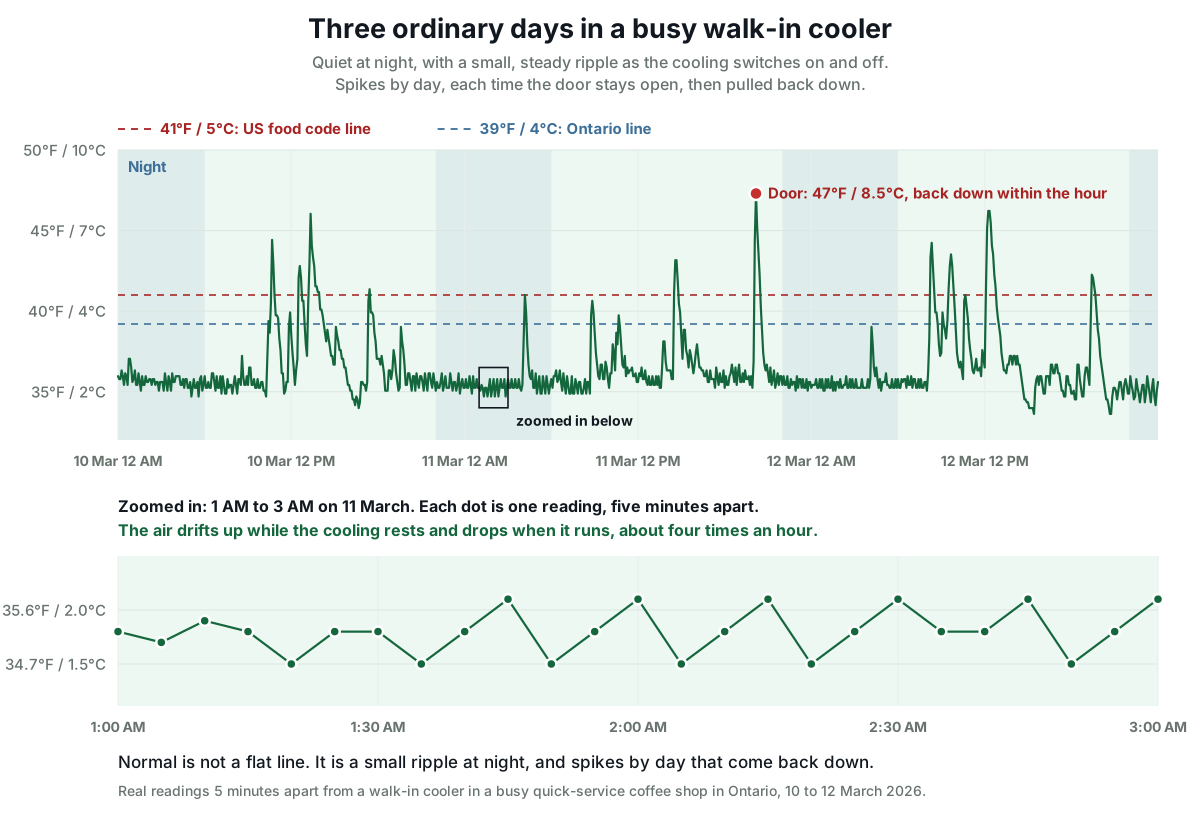
At night the air sat between 34°F and 37°F (1°C and 3°C). By day the door kept opening. Over the 46 days the air went above 41°F (5°C) 156 times. Half of those warm spells were over within 25 minutes, and nine in ten within about an hour. 138 of the 156 started between 8 AM and 8 PM, and the longest one at night lasted 65 minutes.
This is the air, not the food. A loaded cooler's food changes temperature far more slowly than the air around it, which is why a short spike from the door is not a reason to throw anything away, and why an alarm has to tell a spike from a problem.
The delay decides how many alarms you get, more than the number does
Because we have every reading, we can replay any alarm setting against what actually happened. In the table, an alarm goes off when the air stays above the setting for the whole delay, and it cannot go off again until the air has been back below for an hour. That is roughly how a sensible system behaves.
| Alarm set at | 15 min delay | 30 min | 60 min | 90 min |
|---|---|---|---|---|
| 4°C (39°F), the Ontario line | 104 | 77 | 39 | 20 |
| 41°F (5°C), the US food code line | 81 | 50 | 19 | 6 |
| 43°F (6°C) | 56 | 27 | 8 | 4 |
| 45°F (7°C) | 28 | 17 | 5 | 1 |
| 47°F (8°C) | 16 | 11 | 2 | 0 |
Read it across, not down. At the food line, a 30 minute delay sends 50 alarms, on 37 of the 46 days. Nobody keeps answering that, and an alarm nobody answers is no alarm. At 60 minutes it is 19, and at 90 minutes 6, about one a week. Ontario's stricter 4°C line needs the longer delay even more: 20 alarms at 90 minutes.
Raising the number hides the warm spells you want to hear about
Seven times in the 46 days, the air stayed above 41°F (5°C) for 90 minutes or more, peaking between 47.8°F and 57.9°F (8.8°C and 14.4°C). The longest lasted about 8 hours. The record does not say what caused each one: a door left open, a long delivery, a machine having a bad afternoon. Each was worth somebody looking.
At 41°F with a 90 minute delay, the alarm goes off on six of the seven. At 47°F with the same delay, it goes off on none of them, the 8 hour one included. That is the trade every operator makes when the false alarms get too much, and it is the wrong one. Why temperature alarms cry wolf shows the same trade on a freezer that failed, where raising the setting cut 49 hours of warning to 3.
A glycol bottle lets the delay be shorter
The table is a bare sensor in the air. A probe sealed in a small bottle of glycol changes temperature at the speed of the food, so most door spikes never reach it. Glycol buffers and thermobuffers explains how.
We do not have buffered readings from this cooler, so we will not put a number on it. Expect far fewer alarms at the same setting, and a shorter delay that still stays quiet. Keep the setting at the food line either way.
An alarm only works if it reaches someone who can act
Send it to at least two people. Step it up: an email or text first, then a phone call if nobody answers, and a second person if the first does not pick up. Night and weekend alarms are the ones that cost money, because that is when nobody is in the building to notice. Alerting more than one person covers how.
Test it once. Most systems have a test alert; make sure it reaches every phone on the list, including the one that is usually on silent.
When the alarm goes off, check the door first, then the machine
- Is the door shut and sealing? Most warm spells in this cooler followed door traffic. Check the gasket and any strip curtain.
- Is the temperature coming back down? If it falls once the door is shut, it was the door. If it keeps climbing, it is the machine.
- Check the condensing unit outside the box. Is it running, is its fan turning, and can you see through its coil? Those three checks need no tools.
- If the box is above 41°F (5°C), or 4°C in Ontario, move the food to another cold box now and call a technician.
The walk-in cooler diagnostic checklist walks through it with yes or no questions, and walk-in cooler troubleshooting explains each cause.
This page describes one cooler, not yours
The readings come from one busy cooler in one shop, over six weeks of spring. A quieter cooler crosses the line less, and a cooler in a hot summer kitchen crosses it more. Count your own warm spells for a couple of weeks before you settle the delay. Your health inspector's rules come first, and a freezer needs different numbers, which are on why temperature alarms cry wolf.