
Glycol buffers and thermobuffers: why air temperature lies
By Vimal Bhaya, Founder and Lead Systems Architect · Last reviewed 18 October 2026
This is a continuation of The alerting problem, a 5-part tutorial. You are on part 3 of 5.
A temperature buffer is a mass around a temperature probe, most often a small sealed bottle of glycol, that makes the probe read like food instead of like air. A sensor hanging in the air tells you about the air, which is the fastest-moving, least important thing in the box, and not what the health inspector is asking about.
A glycol buffer, also called a thermobuffer, is a small sealed bottle of antifreeze with the probe inside it. It has roughly the same thermal mass as a small package of food, so it warms and cools at food speed instead of air speed.
Put one in and two things happen. Your false alarms mostly stop, because doors and defrosts no longer move the reading. And the number on your screen starts to mean something, because it now tracks what your product is doing.
You already know this, from the drive home
You buy meat and milk, you put them in the boot, and you drive for forty minutes on a warm day. Nothing has spoiled when you get home. The middle of that pack of mince is still cold.
The air around the bag was warm the whole time. It made almost no difference, because food is dense and wet and it takes real time and real energy to change its temperature. Air is neither of those things.
That is the entire argument for a buffered probe, and every operator has run the experiment.
The reverse is true as well, and it catches people out more often. Cold air around something does not mean the thing is cold inside. Put a hot tray of cooked chicken into a walk-in and the air stays cold, because the room's cooling is winning. The middle of that tray can still be in the danger zone two hours later.
An air probe is happy in both of those situations. It is measuring the wrong thing in both of them.
What a glycol buffer actually is
It is not clever. It is a small bottle, usually of propylene glycol, with the temperature probe sealed into the lid and sitting in the liquid. Refrigeration technicians have been making them by hand for years, out of whatever bottle was to hand.
"False alarms product, I put lots of sensors in glycol bottles. Use a small bottle, and an electrical strain relief in the lid to seal it."
Refrigeration technician, r/refrigeration
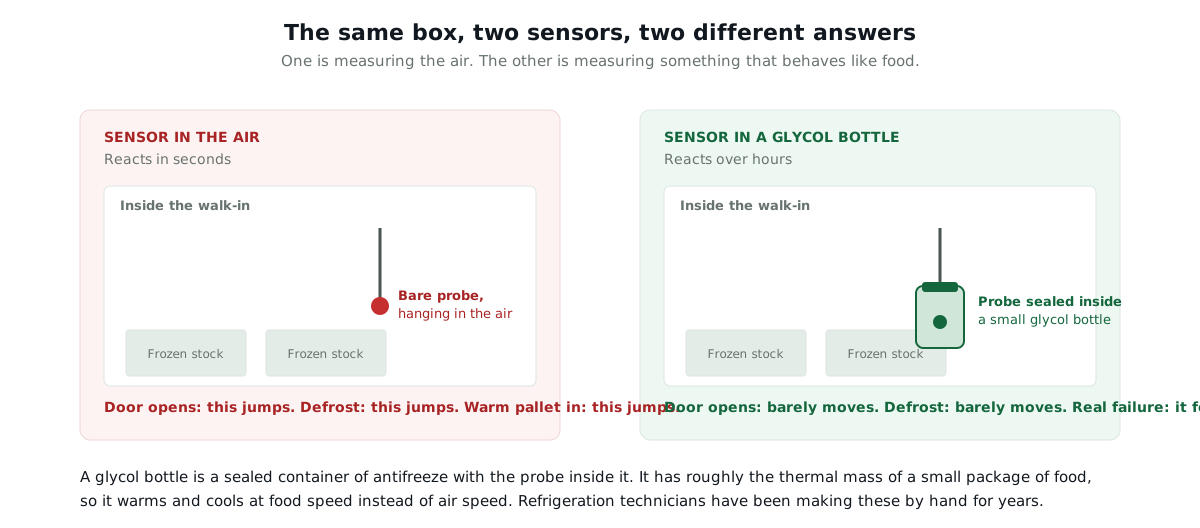
The word you will see on spec sheets is thermobuffer. It means the same thing. Some vendors use a glycol bottle, some use a solid resin block or a sand-filled cylinder. They all do the same job, which is to slow the sensor down until it behaves like a package of food.
This is standard practice in the trade rather than a clever idea somebody is selling you. In the threads we researched, three separate people described doing it, none of them selling anything:
"The installed secondary monitoring probe is in glycol to minimize the excursions and justify any alarms."
Refrigeration technician, r/refrigeration
A buffer bottle is a small sealed bottle of glycol with the probe in the middle
The version people search for most is the simplest one: a small plastic bottle of food-grade propylene glycol, with the probe pushed through a sealed gland in the lid so its tip sits in the middle of the liquid, clear of the walls.
- What is in it. Propylene glycol, straight or mixed with water. In a cooler the mix hardly matters. In a freezer it has to stay liquid below the box temperature: a 40% mix by volume freezes at about -7°F (-21°C), warmer than many freezers, while a 50% mix holds to about -29°F (-34°C). Use 50% or stronger in a freezer.
- How big. About the size of a small package of the food you store, so it changes temperature at the same speed. A bigger bottle is steadier, and also slower to show a real failure, which is why the size should follow the product.
- Where it goes. On a shelf among the product, in the warmest part of the box under normal running, usually near the door and out of the coil's direct airflow. Where to put a sensor in a walk-in covers the choice.
- Bottle or block. Buffers come as a liquid in a bottle, loose media such as sand or glass beads, or a solid block of plastic or aluminum. A bottle is cheap and easy to size. A block cannot leak. They do the same job.
How much faster is air, really?
This is the part that is usually asserted and never measured. We publish the full readings from three units, so it can be measured.
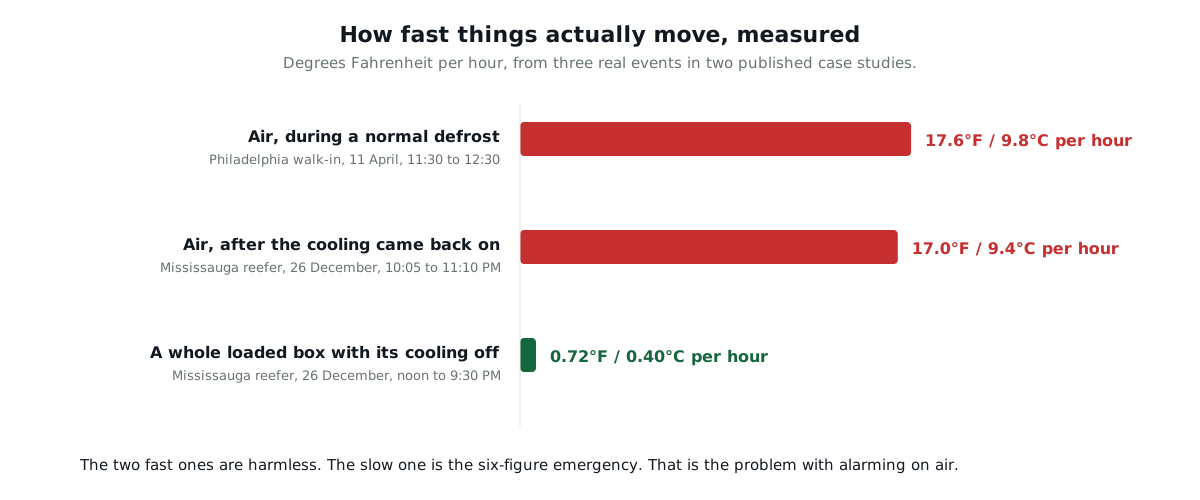
Read the top and bottom bars together, because that pair is the whole point.
- On a Philadelphia walk-in that was working perfectly, the air gained 17.6°F (9.8°C) in one hour during a scheduled defrost.
- On a Mississauga reefer with its cooling completely switched off, the whole loaded trailer gained 6.8°F (3.8°C) in nine and a half hours.
The air moved further in sixty minutes than an entire trailer of frozen product moved in a working day. And the fast one was the one where nothing was wrong.
The recovery says the same thing from the other direction.
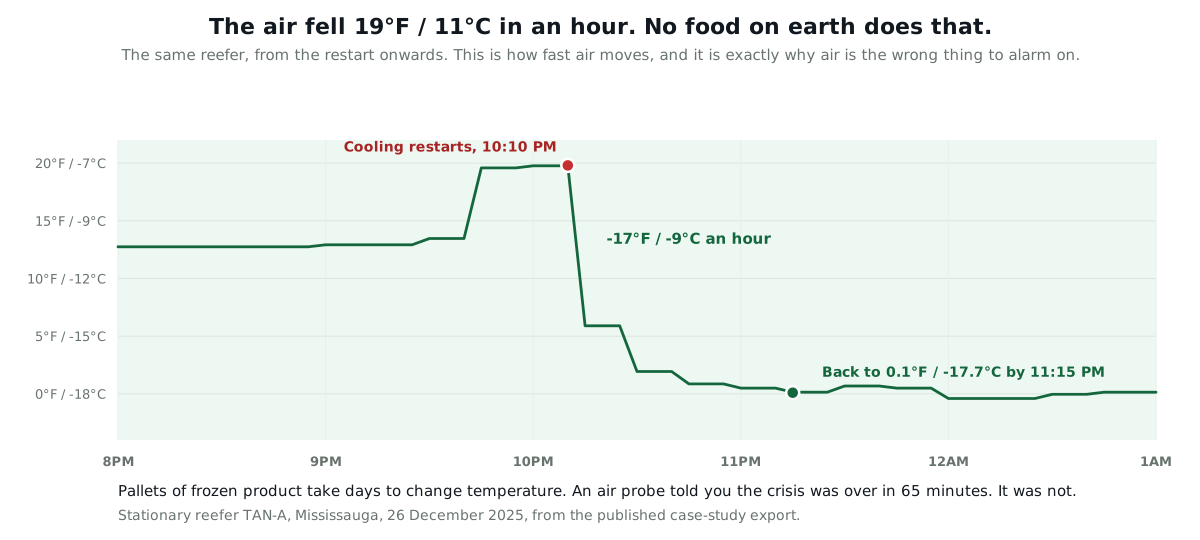
Nothing made of food cools 19°F (11°C) in an hour. The pallets in that trailer were still recovering long after the air said everything was fine.
An air probe overstates the problem going up and overstates the recovery coming down. A buffered probe does neither.
The rule is written about the food, not the air
This is the part most vendors skip, and it is the strongest reason to buffer.
Ontario's food premises regulation, O. Reg. 493/17, is written about the temperature inside the food. The infraction an inspector actually writes up is worded "refrigerate potentially hazardous foods at internal temperature above 4 C". In the United States the equivalent figure is 41°F (5°C), and it is also about the food.
Nobody is asking what the air did. They are asking what the product did.
An air probe cannot answer that question, and it errs in the direction that gets you in trouble. It shows excursions the food never had, which fills your record with events you then have to explain, and it under-reports how long warm product stayed warm.
| Probe | What it measures | Reacts in | Use it for |
|---|---|---|---|
| Bare probe in the air | Room air | Seconds | Equipment behaviour: defrost timing, door events, whether the coil is working |
| Probe in a glycol buffer | Something that behaves like a small package of food | Hours | Product risk, alarms and the compliance record |
| Hand probe into the food | That one item, right now | About a minute | Receiving checks, cooling checks, settling an argument |
If you can only have one, buffer it. If you can have two, put a bare probe near the coil to watch the equipment and a buffered one out on the shelf to watch the product. The two disagreeing with each other is itself useful information.
Humidity is the one thing you cannot buffer
There is an exception to everything above, and it is worth knowing because it runs the other way.
A buffer works by giving the sensor thermal mass, so it stops following the air and starts following the food. Humidity has no equivalent. Relative humidity is a property of the air itself, and the moment you seal a probe inside a bottle you are measuring the air in the bottle, which tells you nothing at all. There is no glycol trick here and there never will be.
So if you want humidity, it has to be a bare sensor, out in the room, exposed to exactly the air a buffered temperature probe is deliberately ignoring.
That is not a problem, because humidity is a room question rather than a product question, and it is worth having:
- Too dry and your product shrinks. Unwrapped meat and produce lose weight to the air, which is money leaving the box slowly. In a freezer, dry air is what causes freezer burn.
- Too damp and you get ice where you do not want it. Moisture ends up on the coil instead of in the air, defrost cycles run longer and more often, and floors and door frames start icing.
- A humidity trend that changes on its own is a symptom. A door seal going, a drain blocking, or a coil starting to ice will often show in humidity before the temperature moves at all.
The practical answer is that the two readings do different jobs. Buffer the temperature so it tracks your product. Leave the humidity bare so it tracks the room. A modern sensor gives you both from one unit, so this costs you nothing extra to have.
What a buffer does not fix, and when it is the wrong choice
A buffer makes you slower on genuinely fast events. If a door is left wide open at closing time, a bare probe screams within minutes and a buffered probe takes a while to catch up. That delay is the price of not being woken by every defrost, and for most sites it is worth paying. If door discipline is your actual problem, fix that with a door sensor rather than by un-buffering the temperature probe.
A buffer is an approximation, not your product. A bottle of glycol behaves roughly like a small sealed package. It does not behave like a tray of loose salad leaves, and it does not behave like a whole frozen pallet either. It sits somewhere in the middle, which is why the size of the bottle matters and why one size does not suit every box.
It is the wrong tool where the air is the point. On a prep table rail, in a display case, or when you are diagnosing an airflow fault, you want the air reading, unbuffered, because the air is what is failing.
It does not replace a hand probe. Receiving checks and cooling checks are about specific items, and nothing mounted on a wall will do those for you.
What we ship, and what we would tell you to do instead
Renergy supplies the buffer with the sensor where it is needed, and matches the size to what you actually store. The right buffer for cases of frozen protein is not the right one for a cooler holding fresh produce, so we ask before shipping rather than sending everyone the same bottle.
If you already own sensors you are happy with, you do not need to buy anything from us to fix this. A small bottle, food-grade propylene glycol and a cable gland in the lid costs a few pounds, and it is what the technicians in the quotes above are doing. Use propylene glycol rather than ethylene glycol, which is the toxic one, and keep the bottle sealed.
Buffering also solves only one of the three reasons alarms cry wolf. The other two are defrost cycles and watching the number instead of the trend, which are covered in why temperature alarms cry wolf and in threshold versus rate-of-change alerting.