
Walk-in cooler troubleshooting, symptom by symptom
By Vimal Bhaya, Founder and Lead Systems Architect · Last reviewed 4 October 2026
This is a continuation of How walk-ins work, and how they fail, a 4-part tutorial. You are on part 2 of 4.
A walk-in cooler that will not hold temperature is the most reported problem, and the condensing unit is the first place to look.
Check that it is running, that its fan is turning, and that you can see through its coil. Those three checks need no tools.
If the box is above 41°F (5°C), or 4°C (39°F) in Ontario, move the food to another cold box now and call a technician.
Five symptoms cover most walk-in cooler problems
Find what you are seeing, then jump to its section. Each section lists its reasons most reported first: most reported in the public threads we read and in the technicians' answers to them. That is not the same as how often each fault happens in the field, which nobody publishes.
| # | What you see | What it usually is | Parts to suspect | Can you check it yourself? | How urgent |
|---|---|---|---|---|---|
| 1 | Lost capacity, or too much load | Expansion valve, condenser, refrigerant, evaporator fans | Partly. Look at the condensing unit and the fans | Today if above 41°F (5°C) | |
| 2 | Warm, wet air getting in | Door gasket, closer, strip curtain | Yes. Look at the gasket and let the door close itself | This week | |
| 3 | The coil never gets a chance to clear | Thermostat, evaporator fans, refrigerant | Partly. Check the setting and the fans | Within a day. A warm box is next | |
| 4 | Told to run too cold, or cannot stop | Thermostat and controller, compressor contactor | Partly. Check the setting | Today. Frozen produce is lost | |
| 5 | Too much load, or wrong pressure settings | Pressure switches, refrigerant, condenser, door | Partly. Time a few cycles | This week |
Here is a list of seven things you can check to assess your walk-in's health
None of these needs a tool or an open panel.
- Is the condensing unit running? Listen at the outdoor or back-room cabinet. Silence with a warm box points to the next check.
- Is a switch off or a breaker tripped? Look at the disconnect switch beside the unit and at the breaker panel. Tell the technician what you find. Do not keep resetting a breaker that trips again.
- Are the fans in the box turning? On most coolers they run all the time.
- Is the condenser coil furred with dust or grease? Look through the guard. Do not reach in. A coil you cannot see through cannot get rid of heat.
- Does the door close and seal by itself? Open it a few inches and let go. It should swing shut and seal all the way round.
- Has someone moved the thermostat? Check the setting against what it should be.
- Is product blocking the coil? Boxes stacked against the unit, or in front of its fans, starve it of air.
Leave gauges, refrigerant and anything inside an electrical panel to a technician. Never chip or pick ice off the coil. The tubes are thin, and one hole turns an ice problem into a refrigerant leak.
1. A walk-in cooler that runs warm has lost capacity or gained load
The box creeps above its setting and stays there, or recovers slowly after every delivery. Staff notice warm drinks first.
"Walk in cooler not holding at temperature"
r/healthinspector, thread title
Reason 1: An expansion valve that feeds too little starves the coil
- Parts: expansion valve.
- What happens: The valve meters refrigerant into the coil through a fine screen. If debris blocks the screen, or the valve is set or driven to feed too little, the box cannot pull down. A starved coil is the cause named in two of the threads we read on this symptom.
- The proof: for the technician: readings that look like a leak, but no leak found.
- Check: a technician's job.
Reason 2: A dirty condenser or a hot spot round the unit cuts capacity on hot afternoons
- Parts: condenser coil and fan.
- What happens: If the condenser cannot shed heat, the whole loop slows down. An outdoor unit suffers in the sun. An indoor unit suffers in a hot kitchen, breathing grease, flour and its own exhaust.
- The proof: warm on hot afternoons or during service, fine overnight, and a coil you cannot see through.
- Check: look at the coil and fan through the guard, and feel the air round an indoor unit.
Reason 3: A refrigerant leak makes the cooler lose ground week by week
- Parts: refrigerant leaks and charge.
- What happens: Less refrigerant moves less heat. The box holds on cool days, then slips a little further every week. The coil may start to ice.
- The proof: a slow slide over weeks, and a unit that runs longer and longer.
- Check: a technician's job. Tell them how long the slide has been going on.
Reason 4: A stopped evaporator fan warms the box within hours
- Parts: evaporator fans.
- What happens: With a fan out, less air crosses the coil. The box warms unevenly, and the coil can ice.
- The proof: one fan still while the others turn.
- Check: from the floor, look at each fan.
Reason 5: Too much load is not a broken part
- Parts: none. The load is the problem, not a part.
- What happens: A door left open, a pallet of warm product, or a system too small for the box from the start all look like a fault. Nothing is broken, so there is no part to replace.
- The proof: warm after deliveries or a busy service, recovering when the box is left alone. A system that was always marginal shows it in its first hot week.
- Check: note when it happens: after deliveries, during service, or all the time.
Less often: an outdoor unit that has lost its winter controls: head-pressure control and crankcase heater, which warms the box on cold nights rather than hot afternoons. The walk-in freezer page explains the pattern under warm on cold nights.
When several boxes on one site run warm at once, look for what they share: one condensing unit, one electrical feed, or one rack. That points away from any single box.
Before you call, check these five things
- Is the condensing unit running, with its fan turning?
- Can you see through the condenser coil?
- Are all the evaporator fans turning?
- Is the coil icing?
- Is it worse in the afternoon, after deliveries, or all the time?
- When to call a technician: today if the box is above 41°F (5°C), or 4°C (39°F) in Ontario. A stopped fan or a tripped unit can warm the box within hours. A slow slide over weeks can wait for a booked visit, but book it.
- What to tell them: the box temperature, since when, what time of day it is worst, which fans are turning, and whether the coil is icing.
2. Condensation inside a walk-in cooler means warm, wet air is getting in
Water beads on the ceiling and walls, drips onto product, or a frost line forms along the door. The door may stick, swing open, or not quite close.
"Help? This regularly occurs in the walk in cooler at my bar"
r/refrigeration, thread title
Reason 1: A gasket gone hard, torn or loose lets air in all day
- Parts: door gasket, closer, strip curtain and door heaters.
- What happens: The gasket is the seal round the door. In time it hardens, tears or pulls away from the door. Every gap pulls in warm, damp kitchen air.
- The proof: wet or frosty patches along one side of the door, and gaps or tears in the gasket.
- Check: look all the way round the gasket, and at the sweep along the bottom.
Reason 2: A door out of line, or a failed closer, leaves a gap
- Parts: door closer and hinges.
- What happens: US federal rules require walk-in doors to have closers that pull them firmly shut from within an inch of closed. A closer that has failed, or a door that has dropped on its hinges, leaves the door resting just open.
- The proof: the door does not swing shut and seal by itself, or it rubs the frame.
- Check: open it a few inches and let go.
Reason 3: A missing strip curtain, or a propped door, lets the kitchen in
- Parts: strip curtain.
- What happens: Federal rules also require strip curtains, spring-hinged doors or another way to limit air coming in while the door is open. Curtains get taken down because they are in the way, and doors get propped during deliveries.
- The proof: condensation that is worst after deliveries and busy service.
- Check: check the curtain is up and whole, and watch how the door is used during a delivery.
Reason 4: Air leaking through panel joints wets the box from the outside in
- Parts: wall panels and pipe holes, which have no part page.
- What happens: The walls are panels locked together. A joint that has opened, or a hole cut for a pipe and never sealed, lets humid air into the wall and the box.
- The proof: wet or frosty lines along panel joints or round pipe holes, away from the door.
- Check: look along the joints and round every pipe that enters the box.
Before you call, check these four things
- Is the gasket whole all the way round?
- Does the door close and seal on its own?
- Is the strip curtain up and whole?
- Is the wet patch by the door, or along a panel joint?
- When to call a technician: this week. A door or gasket is often a maintenance or door-company job rather than a refrigeration call.
- What to tell them: where the water forms, whether the door closes by itself, and whether it is worse after deliveries.
3. Ice on a walk-in cooler's coil is always a fault
A cooler's coil clears its own frost every time the cooling switches off. So if ice is building, something is stopping that from happening.
"Commercial cooler frozen up"
r/hvacadvice, thread title
Reason 1: A thermostat set too cold leaves the coil no chance to clear
- Parts: thermostat, controller and pressure switches.
- What happens: Off-cycle defrost only works while the box air is above freezing. Emerson's refrigeration manual uses it for rooms of 35°F (2°C) or warmer. Set the box colder, and the air the fans blow over the coil cannot melt the frost.
- The proof: the setting is at or near freezing, and the box reads that cold too.
- Check: check the setting on the thermostat or controller.
Reason 2: A cooler that never switches off never defrosts
- Parts: none, usually. The load, or a system too small for the box.
- What happens: If the compressor runs nonstop, there is no rest for the fans to clear the coil. The cause is usually load: a door left open, warm product, or a system too small for the box.
- The proof: the compressor runs for hours without a break, and the ice grows during busy days.
- Check: listen for the compressor stopping. See runs all the time.
Reason 3: A stopped evaporator fan lets the coil freeze in place
- Parts: evaporator fans.
- What happens: The fans both carry the cold away and, during each rest, carry the box's warmer air in to melt the frost. With a fan stopped, that part of the coil freezes solid.
- The proof: ice in front of one fan, and that fan not turning.
- Check: from the floor, look at each fan.
Reason 4: Too little refrigerant makes part of the coil too cold
- Parts: refrigerant leaks and charge.
- What happens: With too little refrigerant, the part of the coil that does get it runs colder than it should, and frosts heavily while the rest stays bare.
- The proof: ice on one end or one section of the coil, and a box running warmer than usual.
- Check: a technician's job. It needs gauges.
Less often: product stacked against the coil, so air cannot get through. Or, on coolers with a defrost timer, off cycles set too short to clear the coil.
Before you call, check these five things
- What is the thermostat set to?
- Does the compressor ever stop?
- Are all the fans turning?
- Is the ice all over, or in front of one fan?
- Is product blocking the unit?
- When to call a technician: within a day. An iced coil moves less heat, so a warm box is usually next. Do not chip the ice. A technician can melt it safely and find out why.
- What to tell them: the setting, whether the compressor ever stops, where the ice is, and which fans are turning.
4. A walk-in cooler that freezes the food is being told to, or cannot stop
Lettuce turns glassy, milk has ice in it, and the thermometer reads below freezing. Sometimes it happens slowly. In one thread the box held 36°F (2°C) for weeks, then dropped to 18°F (-8°C).
"Walk in cooler. Too cold"
r/KitchenConfidential, thread title
Reason 1: The thermostat setting or its sensor is the most reported cause
- Parts: thermostat, controller and pressure switches.
- What happens: Someone turned the dial, the controller lost its settings, or its sensor has failed, come loose or moved to a warmer spot, so it keeps asking for cold. The machine is doing what it is told.
- The proof: the setting is lower than it should be, or the controller shows a normal reading while a separate thermometer in the box reads much colder.
- Check: check the setting, and compare the controller's reading with a thermometer near the food.
Reason 2: A valve that sticks open keeps feeding the coil
- Parts: liquid line valve.
- What happens: On most split systems the thermostat stops the cooling by closing a valve on the liquid pipe. If that valve sticks open, refrigerant keeps flowing after the box is cold enough.
- The proof: the box keeps cooling past its setting, often after weeks of behaving normally.
- Check: a technician's job.
Reason 3: A contactor stuck closed means the compressor never stops
- Parts: compressor, contactor and starting parts.
- What happens: The contactor is the heavy switch that turns the compressor on and off. On systems where the thermostat switches the compressor directly, contacts that weld shut keep it running whatever the thermostat says.
- The proof: the compressor runs nonstop, and turning the thermostat up makes no difference.
- Check: a technician's job. Do not open the panel.
Reason 4: Product in the cold air stream freezes in a healthy box
- Parts: none. Where the product sits is the problem.
- What happens: The air leaving the coil is much colder than the box. Food stacked right in front of the fans can freeze even when the box itself is fine.
- The proof: only the product near the unit is freezing.
- Check: move it and see if the problem stops.
Before you call, check these four things
- What is the thermostat set to, and has anyone changed it?
- Does a separate thermometer agree with the controller?
- Does the compressor ever stop?
- Is only the product near the fans freezing?
- When to call a technician: today if the box is below freezing. Frozen produce and dairy are usually lost, and a compressor that never stops is wearing itself out.
- What to tell them: the setting, the actual box temperature, whether the compressor stops, and when it started.
5. A walk-in cooler that never stops, or clicks on and off, has two different problems
A healthy cooler runs, rests, and runs again. One that runs for hours without a break is losing a fight with its load. One that clicks on and off every few minutes is being stopped by something before it finishes.
"Brewery walk-in cooler underperforming when cold"
r/refrigeration, thread title
Reason 1: Pressure control settings can make a cooler short cycle
- Parts: thermostat, controller and pressure switches.
- What happens: Many systems start and stop the compressor on a low-pressure switch. If its cut-in and cut-out settings are wrong, the compressor stops and starts in quick bursts. That is the answer in the thread above.
- The proof: the compressor clicks on and off every few minutes, while the box struggles to hold.
- Check: time a few cycles with your phone, and tell the technician.
Reason 2: Low refrigerant trips the low-pressure switch over and over
- Parts: refrigerant leaks and charge.
- What happens: With too little refrigerant, pressure falls fast once the compressor starts. The low-pressure switch stops it, pressure recovers, and it starts again.
- The proof: short cycles that began gradually, and a box that has been getting warmer.
- Check: a technician's job.
Reason 3: A dirty condenser or a bad door seal makes it run for hours
- Parts: condenser coil and fan; door gasket, closer, strip curtain and door heaters.
- What happens: A condenser that cannot shed heat, or a door that lets warm air in all day, means the compressor never catches up.
- The proof: the compressor almost never rests, and the box is barely holding.
- Check: look at the condenser coil and the door gasket.
Less often: a system too big for the box, which cools it so fast that it short cycles. That one is built in, not broken.
Before you call, check these four things
- Does the compressor run for hours, or click on and off every few minutes?
- Time three cycles: how long on, how long off?
- Is the condenser coil clean?
- Does the door seal?
- When to call a technician: this week. Short cycling wears a compressor out, and a cooler that never rests will soon ice its coil.
- What to tell them: how long it runs and rests, when it started, and whether the box is holding.
One night, a busy cooler lost its ripple and stayed near 39°F (4°C) until morning
This is the same cooler as on how a walk-in cooler works, in a busy quick-service coffee shop in Ontario. On most nights it sits near 36°F (2°C) with a small ripple, as the cooling switches on and off about four times an hour.
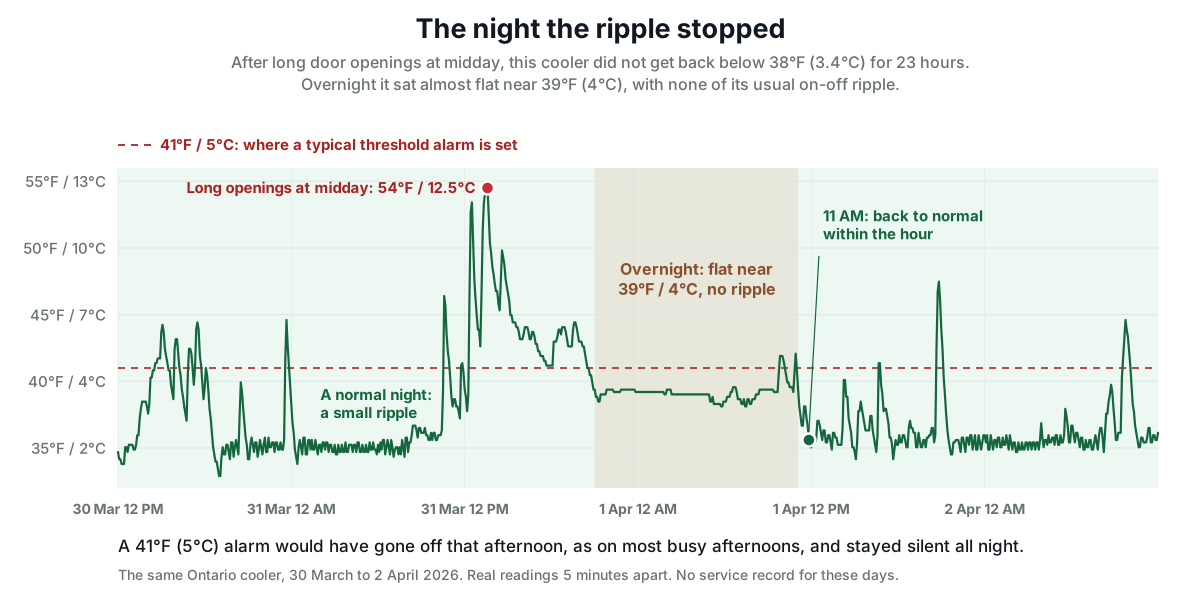
On 31 March, after long door openings at midday, it did not come back. For 23 hours it never got below 38°F (3.4°C). Overnight it sat almost flat near 39°F (4°C), with no ripple at all. At about 11 AM the next day it dropped back to normal within the hour, and the next night looked ordinary again.
We have no service record for those two days, so we cannot say for certain what it was. A line that goes flat and will not come down usually means the cooling is running without catching up. The usual reasons are a coil that iced during the long openings (symptom 3), a door that did not close fully (symptom 2), or a fan that stopped (symptom 1).
Now look at what a simple alarm would have done. Set at 41°F (5°C) with a 30-minute delay, it would have gone off on 39 of the 46 days we have for this cooler, almost always from door traffic. On 31 March it would have gone off in the afternoon too, and looked like any other busy day. Overnight, when the box was actually stuck, it would have stayed silent, because 39°F is under the line. In Ontario, where the line is 4°C, the box sat right on it.
The same kind of change, building over eight days on a walk-in freezer, is on walk-in freezer troubleshooting.
This is where TemperatureWise is different: it is not just a threshold alarm
A threshold alarm asks one question: is it too warm right now? By the time a cooler crosses 41°F (5°C), a dirty condenser or a slow leak has usually been working on it for weeks.
TemperatureWise uses machine learning on the full temperature history of each box. It learns that box's own pattern: how it cycles, how fast it recovers after the door, and how it behaves on a hot afternoon. When the pattern changes, TemperatureWise tells you what has changed and where to look.
On the cooler above, the useful sign was not a number crossing a line. It was the ripple stopping, a change in that box's own pattern. On a walk-in freezer in Philadelphia, the same approach pointed the team to the evaporator side rather than just sending a number, and the technician found the fault on the first visit. The full story is on the freezer page.
It does not replace your technician. It tells you which one to call, and when, so you can sleep through the night. See how TemperatureWise works.