
The wall panels, floor and pipe holes: how the box itself leaks, frosts and heaves, and what you can check
By Vimal Bhaya, Founder and Lead Systems Architect · Last reviewed 20 October 2026
This is a continuation of Walk-in refrigeration parts, a 14-part tutorial. You are on part 14 of 14.
A walk-in is a box of insulated panels locked together: walls, ceiling and, on most freezers, a floor. Each panel is foam between two metal skins, and US federal rules set the minimum: R-25 on coolers and R-32 on freezers. The box only works if every joint, and every hole cut for a pipe, stays sealed.
When one opens, warm, damp air gets into the wall and the box. A cooler gets wet lines along a joint. A freezer gets frost lines, and in time the insulation can fill with ice. Under a freezer, years of cold can freeze the ground and lift the floor. Frost or wet lines away from the door, and a floor that cracks or bulges, are worth a call this week.
A walk-in is panels locked together, and every seam has to stay sealed
The box keeps the building's heat and damp out, so the refrigeration only has to deal with what comes in through the door and with the food. It is built from insulated panels, locked together on site:
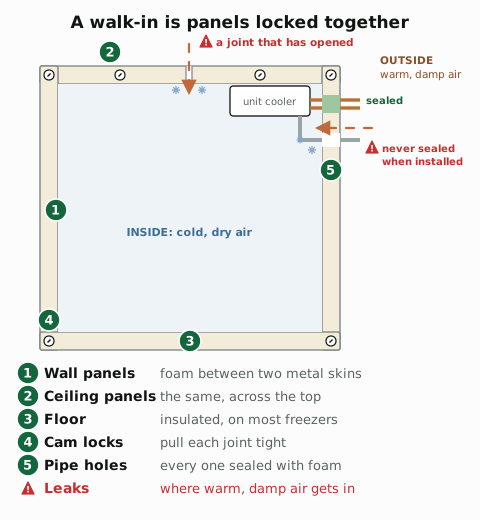
The numbers match the drawing:
- Wall panels. Foam insulation bonded between two metal skins. Norlake's are 4 inches thick, with the foam poured in place.
- Ceiling panels. The same, across the top.
- Floor. A freezer needs an insulated floor: floor panels, or an insulated slab under the box. Some walk-ins have no floor panels at all: the walls stand on the building's floor on a sealed strip.
- Cam locks. Hooks inside the panel edges that pull each joint tight, turned with a wrench through a small hole. On Norlake's panels, a foam gasket along each joint seals it.
- Pipe holes. Every pipe, wire and drain that enters the box goes through a hole cut in a panel. Thermo-Kool says to seal each one tightly with foam and silicone.
US federal rules set how well the box must keep heat out, on walk-ins built since 2009:
- Coolers: walls, ceiling and doors of at least R-25.
- Freezers: walls, ceiling and doors of at least R-32.
- Freezer floors: at least R-28.
What the R numbers mean
- Think of a winter coat. The R number is how warm a coat the box wears: how hard it is for heat to get through its walls. The higher the number, the warmer the coat.
- Twice the number lets in half the heat. So a freezer wall at R-32 lets in about a fifth less heat than a cooler wall at R-25. A freezer needs the warmer coat, because the cold inside it is colder.
- Thicker foam makes a warmer coat. The number depends on the kind of insulation, how thick it is and how dense it is.
- A coat only works zipped up. An open joint or an unsealed pipe hole is an open zip: warm, damp air goes straight past the insulation, whatever its R number.
Why a small gap matters
- Damp always moves toward dry. Water vapor moves from warm, damp air toward cold, dry air, through anything that lets it.
- A walk-in is the coldest, driest place in the building, so damp air pushes in at every gap.
- A small gap is a big load. Plumbing & HVAC calls air passing through even a small opening a very significant source of refrigeration load, and a cause of frost in freezers.
- Inside a freezer wall, that water freezes. Over time it can soak the insulation, and insulation full of ice keeps less heat out.
The box leaks or moves in four common ways
Most of them start small and get worse each season. The troubleshooting pages show where the leaks sit among the other reasons for the same symptom.
What the readings show | What you see | Fault | Where it is covered |
|---|---|---|---|
Longer runs, and more frost on the coil | Frost or wet lines along one joint, away from the door | A panel joint that has opened | |
Longer runs, and more frost on the coil | Frost or wet rings round a pipe where it enters the box | A pipe hole never sealed, or a seal that has broken | |
A box that runs a little longer every season | Panels that feel cold from outside, or sweat on the outside | Wet or iced insulation | |
Nothing: the air does not show it | Small cracks and bulges in the floor, a sill that rises, a door that starts to bind | Frost heave under a freezer |
Here is what a leaking box does to the rest of the refrigeration system
Every gap lets in heat and water, all day and all night:
- The refrigeration runs longer, pumping out heat that should have stayed outside.
- The water lands as frost on the coil, so every defrost has more to clear. More on the evaporator coil page.
- Frost builds on the walls and ceiling round the leak, and drips when it melts.
- Ice builds inside the wall, out of sight, and the panel keeps less heat out every season.
- Under a freezer, the ground can freeze, crack the floor and lift it.
How water gets into the wall
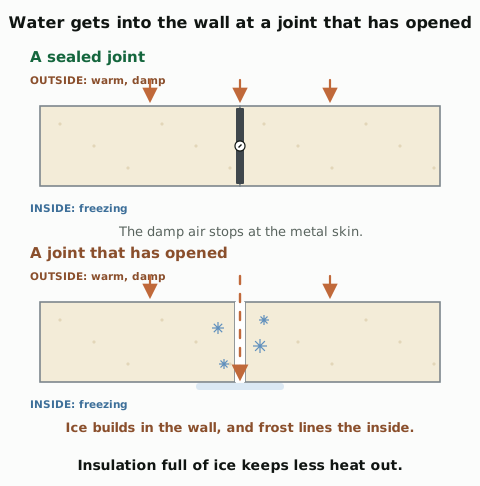
- A sealed joint stops the damp at the outer metal skin.
- An open joint lets it into the foam, where it freezes.
- The ice spreads through the insulation round the gap, and frost lines the inside face.
Not every frost line is a leak
KPS Global, a panel maker, explains that a joint can run a little colder than the foam round it. Where the panel edge has a wood frame, that frame lets more heat through than the foam does. In a humid freezer, frost can form there with no fault at all. So look at how it behaves:
- A light, even line along many joints, worst after busy, humid days: likely damp air from the door, freezing at the coldest spots.
- Frost at one joint only, or a line that grows week by week: likely a leak at that joint.
- A ring round a pipe: the pipe hole's seal has gone.
KPS also advises keeping stock at least 2 inches from the walls, so air can move along them.
"Frost in a walk in freezer"
r/refrigeration, thread title
Under a freezer, the floor can heave
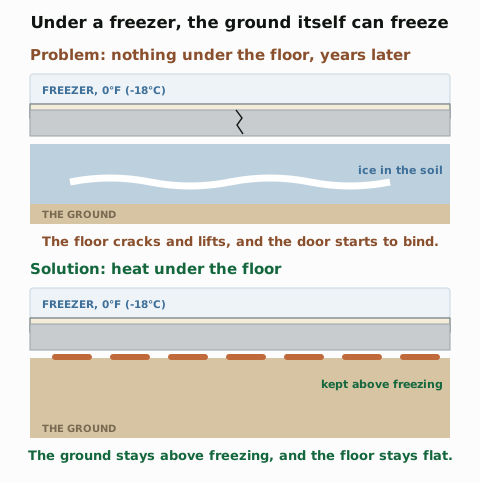
- Cold leaks down through even a well-insulated floor, Danfoss notes.
- The water in the soil freezes and expands, and the ice pushes the floor up.
- It is slow. Plant Services says the first signs are small cracks and bulges in the concrete, and in time doors that no longer close.
- The fix is to keep the ground above freezing: heating cables or warm fluid under the floor, or air pipes under it. Insulation helps, too: one inch is worth about two feet of soil.
If your walk-in freezer stands on a slab on the ground, ask the installer what is under the floor.
A leaking box shows as a slow change, not a spike
- A panel leak works like a small door left open, all day. The box runs longer and sits a little warmer than it used to, most of all in humid weather.
- It builds over months, as ice spreads through the wall.
- Floor heave never shows in the air temperature. It shows in the floor and the door.
The door page shows a leak at its worst, in a real fridge: a door left ajar, flat near 46°F (8°C) for about 15 hours. A panel leak is a smaller version of the same thing, spread over months.
Every cold box has walls, and each leaks in its own way
Unit | What keeps the heat out | What goes wrong | More on this |
|---|---|---|---|
Walk-in cooler | Panels, R-25 or better, sometimes standing on the building's floor | Wet lines at joints and pipe holes | |
Walk-in freezer | Panels, R-32 or better, on an insulated floor of R-28 or better | Frost lines, ice in the walls, and frost heave over the years | |
Reach-in and prep table | A cabinet insulated at the factory, with no joints to open on site | The leaks come through the door instead | |
Open display case | Three insulated sides, and a curtain of cold air where the fourth would be | A broken air curtain lets the store in | |
Reefer | An insulated trailer body and its doors | USDA notes good insulation is of little value if the door seals leak. Carrier's checks end with leaks in the box |
You can walk round the box in ten minutes
Take a torch, and follow the numbers:
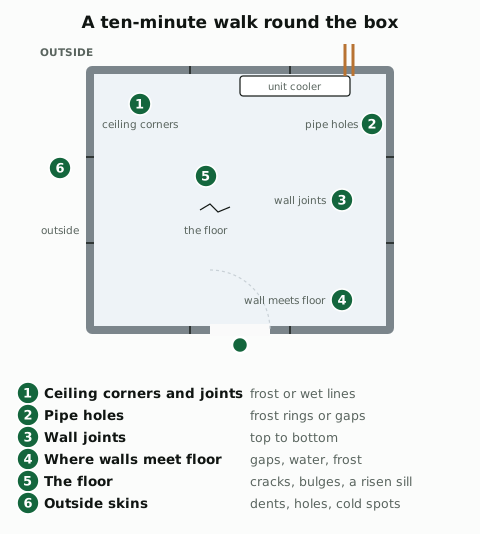
- The ceiling corners and joints, from inside. Look for frost or wet lines.
- Every pipe hole, where the refrigeration lines, the drain and the wires come in. A frost ring or a gap means the seal has gone.
- The wall joints, inside, top to bottom.
- Where the walls meet the floor. Look for gaps, water and frost.
- The floor. Look for cracks, bulges and a sill that has risen, and notice whether the door has started to bind.
- The outside skins. Look for dents and holes from carts and pallets, wet patches, and cold spots you can feel with your hand.
Show a technician or the panel installer the frost lines, and ask them to seal the joints and pipe holes. Clear the frost only once the leak is fixed. Clean the panels with mild soap and a damp cloth, never an abrasive pad.
Do not drill or cut into a panel yourself: Thermo-Kool warns against drilling within six inches of a cam lock, and every new hole is a new leak. Never chip ice off the walls or ceiling, and never flush the inside of a walk-in with water.
The simpler way: TemperatureWise watches for a leaking box
Everything on this page takes time, and you have to know what to look for. TemperatureWise takes that complexity out:
- It learns each box. It uses machine learning on the full temperature history of each box, and learns that box's own pattern.
- It watches for a leaking box. In the readings, that looks like a box that runs a little longer and warmer every season.
- It names the likely culprits. When it sees that change, TemperatureWise tells you what has changed and the top three likely parts at fault, so you know where to look.
It does not seal a joint. It tells you which box has started to slip, so the leak is found while it is a frost line, not a wall full of ice.
This is one of our walk-in refrigeration parts pages. The door page covers the biggest opening in the box.