
The winter controls: how head-pressure control and a crankcase heater keep an outdoor unit working on freezing nights
By Vimal Bhaya, Founder and Lead Systems Architect · Last reviewed 20 October 2026
This is a continuation of Walk-in refrigeration parts, a 14-part tutorial. You are on part 13 of 14.
An outdoor condensing unit can work too well on a freezing night. Its condenser gets so cold that the pressure on the hot side, the head pressure, collapses, and too little refrigerant reaches the coil inside. The box warms even though the machine runs. Winter controls fix this by making the condenser worse at its job, on purpose: they switch its fans off, or back liquid up inside it. A crankcase heater keeps the compressor's oil warm while it is off.
When they fail, a box that is fine on a hot afternoon is warm at 6 AM after a freezing night. Write down the nights and the outdoor lows, and book a technician before the next cold spell.
On a freezing night, winter controls hold the pressure up
It sounds backwards: a freezer that is fine on a hot afternoon and warm at 6 AM after a freezing night. It comes down to head pressure:
- The compressor squeezes the refrigerant. How hard it is squeezed, on the hot side of the system, is the head pressure.
- That pressure pushes liquid through the expansion valve into the coil, the way water pressure pushes water through a garden sprinkler.
- On a hot day, the condenser runs warm, the pressure stays high, and plenty of liquid gets through.
- On a freezing night, an outdoor condenser gets so cold that the pressure collapses. It is like turning the tap nearly off: the sprinkler dribbles. The coil inside gets too little refrigerant, and the box warms even though the machine is running.

Winter controls fix this by making the condenser worse at its job, on purpose. One maker's installation manual lists three parts:
- Fan cycling. A control switches condenser fans off as the condenser gets cold. The manual sets it to stop a fan when the condensing temperature drops to about 90°F (32°C). It says never to cycle every condenser fan on one control, and to keep each fan at least 5 minutes on and 5 off.
- A flooding valve, often called a head-pressure control valve. It backs liquid refrigerant up inside the condenser, so less of it can cool the gas, and holds the pressure at its setting: about 180 psi on Heatcraft's high-pressure systems. The system needs extra refrigerant to do it.
- A crankcase heater. A small heater on the compressor stops liquid refrigerant settling in its oil while it sits off in the cold. The manual says one is required, and asks for it to be on for 24 hours before a first start.
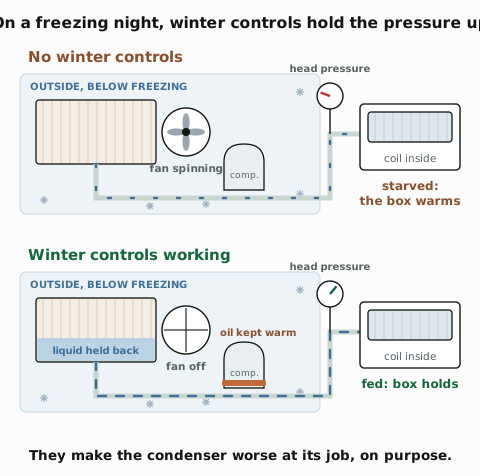
So on a cold night, a condenser fan standing still can look like a failure. It is the winter controls working, as the condenser coil and fan page explains.
Winter controls fail in three common ways
Each one shows up only when it is cold outside. The troubleshooting pages show where each sits among the other reasons for the same symptom.
What the readings show | What you see | Fault | Where it is covered |
|---|---|---|---|
A climb in the small hours that tracks the outdoor cold | Warm overnight and early in the morning on the coldest nights, back to normal by the afternoon | Failed or missing head-pressure control | |
The box climbs from a unit that is not running | A compressor that struggles or will not start after a cold night | A failed crankcase heater | |
A climb on the coldest nights | The same night-time warming, from a unit in a room that is not heated | An indoor unit in an unheated room |
Here is what failed winter controls do to the rest of the refrigeration system
A condenser that is too cold sounds harmless. It is not:
- The coil starves, so the box warms on the coldest nights even though the machine runs all night.
- The compressor runs on and on, chasing a box it cannot cool.
- Without crankcase heat, liquid settles in the compressor's oil while it sits off in the cold. A start in that state can damage it, which is why the heater is required.
- It is the mirror of a dirty condenser, which slips on hot afternoons instead. The condenser page covers that one.
"Walk-in freezer cold weather problem"
r/refrigeration, thread title
The answer in that thread was a head-pressure control and a crankcase heater: the two parts on this page.
Failed winter controls show on the coldest nights
The pattern is easy to miss, because the box looks fine every afternoon:
- Warm overnight and early in the morning, on the coldest nights.
- Back to normal by the afternoon, as the day warms up.
- Worse as the nights get colder, and fine all summer.
Put the warm nights next to the outdoor lows, and the pattern lines up with the cold. That list is what the technician needs.
You can spot the pattern, and leave the controls to the technician
- Write down the nights it happened, and how cold it was outside.
- On a cold night, a still condenser fan is normal. It is the winter controls working.
- After a cold night, check the compressor starts. If it struggles or will not start, call a technician today.
- Check the food is still frozen after each cold night.
- Book a technician before the next cold spell, with your list of nights and outdoor lows.
Do not keep resetting a compressor that will not start after a cold night. Do not adjust the winter controls yourself: they are set against the refrigerant's pressures, and that is a technician's job.
Winter controls matter wherever the condenser meets the cold
Unit | Winter controls | What goes wrong | More on this |
|---|---|---|---|
Walk-in, outdoor or roof unit | Yes, in the outdoor cabinet | A failed head-pressure control or crankcase heater | |
Walk-in, indoor unit | Usually none, as long as the room is heated | An unheated room behaves like outdoors | |
Reach-in and prep table | None. They are built for indoor rooms: True's from 60°F to 104°F (16°C to 40°C), Beverage-Air's from 60°F to 100°F (16°C to 38°C), and Randell's prep tables from 70°F to 86°F (21°C to 30°C) | A cabinet in a cold, unheated room can run outside its range | |
Display case | Self-contained cases sit in the heated store. Supermarket cases share a rack whose condenser is outside | The rack's controls are the refrigeration contractor's | |
Reefer | The unit heats as well as cools: a fresh load in winter runs in heating mode | A stopped unit lets the load fall toward the outdoor temperature. Weak batteries and gelled diesel stop restarts |
The simpler way: TemperatureWise watches for failed winter controls
Everything on this page takes time, and you have to know what to look for. TemperatureWise takes that complexity out:
- It learns each box. It uses machine learning on the full temperature history of each box, and learns that box's own pattern.
- It watches for failed winter controls. In the readings, that looks like a box that runs warm on the coldest nights and is back to normal by the afternoon.
- It names the likely culprits. When it sees that change, TemperatureWise tells you what has changed and the top three likely parts at fault, so you know where to look.
It does not replace your technician. It tells you which one to call, and when.
This is one of our walk-in refrigeration parts pages. The compressor page covers the part the crankcase heater protects.