
How a refrigerated display case works, and what normal looks like
By Vimal Bhaya, Founder and Lead Systems Architect · Last reviewed 7 October 2026
This is a continuation of Reach-ins, prep tables, display cases and reefers, a 10-part tutorial. You are on part 7 of 10.
A refrigerated display case is built to sell food, not to chill it. An open case keeps its cold behind a curtain of cold air that falls from the top front to a grille at the bottom. A glass-door case keeps it behind doors.
Either way, the case holds product at the temperature it arrived, and most of its work is fighting the store's warm air. On an open multi-deck case, warm air getting in through the front is about 80% of the cooling load, so anything that breaks the curtain warms the food.
Four kinds of display case cover almost every store
They share a coil, fans and a defrost. What changes is whether the front is open, and where the compressor sits.
Kind | How to tell | How common, by our estimate | What it is prone to |
|---|---|---|---|
Self-contained glass-door merchandiser | Glass doors and lights, with its own compressor in the base or on top. Drinks and grab-and-go. Often owned by the drinks bottler | About half | A condenser that breathes its own heat against a wall, fogged doors, and energy-saving schedules that look like faults |
Remote (rack-fed) case | The long rows of a supermarket. No compressor in the case: pipes run to a machine room | About 1 in 4 | Faults shared by every case on one rack or one group, and defrost schedules set centrally (grocery stores) |
Self-contained open-air case | No doors, with a curtain of cold air down the front. Grab-and-go in convenience stores and cafes | About 1 in 8 | A broken air curtain, and product stacked above the load line |
Service case | Curved glass at the front, open at the back for staff. Deli, meat, seafood and bakery | About 1 in 12 | Warm air from the staff side all day, and fogging on the glass |
An open case holds its cold behind a falling curtain of cold air
Fans and a coil in the base push cold air up a duct in the back wall to the canopy at the top. The air leaves through a honeycomb grille at the front of the canopy, which straightens it into a smooth sheet. It falls down the open front to a return grille at the bottom, and goes back to the coil.
That falling sheet is the air curtain. Its job, in the words of a study in the Journal of Fluids Engineering, is to create a barrier between the cold product and the warm store. Low-temperature multi-decks usually have three curtains, one inside the other, ACHR News says.
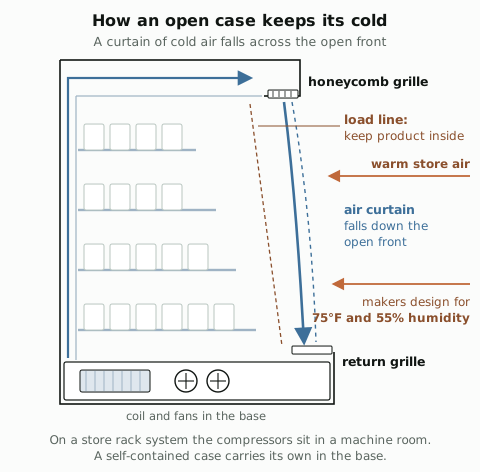
The curtain is never perfect. A Southern California Edison paper for the American Council for an Energy-Efficient Economy found that warm air getting in through the front is about 80% of the cooling load of an open vertical case. A later study put it at 70% to 80%. So the store's air, and anything that disturbs the curtain, decides how well the case holds.
The load line marks where product must stop
Every open case has a load line marked on it, usually on the end panels. Product stacked past it sits in the curtain's path or in the store's air. Hill Phoenix says not to load above it, because product there will not be properly refrigerated, and to keep product 1 to 2 inches (2.5 to 5 cm) below each shelf above. Structural Concepts says the line is placed where it is to allow proper refrigerated airflow.
The grilles matter as much. Hussmann says the air outlet and return must stay open, with no product, packages or signs blocking them. Structural Concepts puts it more bluntly: never set product on the return grille.
A night curtain cuts the warm air when the store is closed
Many open cases have a pull-down blind at the top. Pulled down and hooked at the bottom overnight, it stops most of the store's air mixing with the case's. The US Department of Energy cites a 1997 study that found night curtains used six hours a day cut a case's energy by about 8%. A UK lab study found 10% to 22% with the blinds down 12 hours in 24, less as the store got warmer.
A supermarket case shares its compressors with the rest of the store
A self-contained case carries its own compressor and condenser, usually in the base, and throws its heat into the store, like a reach-in. A remote case has only the coil, fans and controls. Its refrigerant comes from compressors in a machine room, shared with many other cases.
One group of compressors serves cases at different temperatures. So many case circuits have a valve that holds their coil at the right temperature, called an evaporator pressure regulator or EPR. Electronic versions hold the air leaving the coil within about half a degree Fahrenheit, ACHR News says. Set wrong, the case runs warm, or runs too cold and ices its coil. That is a technician's adjustment.
A display case defrosts several times a day, and the air sensor reads warm while it does
Moist store air pulled into the case freezes on the coil as frost, and frost blocks the air. So every case defrosts, on a schedule or on demand. Oak Ridge National Laboratory reports that defrosts are typically scheduled every six or eight hours, for 20 to 30 minutes.
Most medium-temperature cases, for dairy, deli and produce, use off-time defrost: the cooling stops, and the case's own fans melt the frost with air that is above freezing. Low-temperature cases, for frozen food, need heat, from electric heaters or hot refrigerant gas.
Case and use | Defrosts a day | Ends when the coil reaches | Time limit |
|---|---|---|---|
Hussmann IMPACT, dairy and deli, off-time | 4, every 6 hours | 48°F (9°C) | 35 minutes |
Hussmann IMPACT, meat | 4, every 6 hours | 43°F (6°C) | 35 minutes |
Hill Phoenix multi-deck, dairy and deli, timed off | 6 | 47°F (8°C) | 45 minutes |
Hill Phoenix multi-deck, drinks and bulk produce | 2 | 47°F (8°C) | 30 minutes |
Hill Phoenix frozen and ice cream single-deck, electric | 2 | 55°F (13°C) | 60 minutes |
What a sensor reads during a defrost. While the coil warms toward the point where the defrost ends, about 43°F to 48°F (6°C to 9°C) on medium-temperature cases, a sensor in the air can be expected to read in the 40s Fahrenheit. The product rises far less. Southern California Edison tested a case set to 30°F (-1°C) discharge air, and its warmest product reading came after a defrost, at 39.6°F (4.2°C).
Case controllers know this, and hide or delay alarms around a defrost by default. A Danfoss controller waits 90 minutes after a defrost before it will sound a temperature alarm. A Dixell controller shows the temperature from before the defrost started. Hussmann's shows dF.
Here are the vital numbers of a healthy display case
These are makers' start-up settings and design conditions. Store conditions change them, and your case's own sheet comes first.
| What | Normal | Where the number comes from |
|---|---|---|
| Air leaving the coil, dairy and deli | 29°F to 32°F (-2°C to 0°C) | Hill Phoenix and Hussmann setting tables |
| Air leaving the coil, meat | 25°F to 30°F (-4°C to -1°C) | Hill Phoenix and Hussmann |
| Air leaving the coil, produce | About 31°F (-1°C). 37°F (3°C) for drinks and bulk produce | Hill Phoenix and Hussmann |
| Air leaving the coil, frozen | -5°F to -8°F (-21°C to -22°C). Ice cream about -14°F (-26°C) | Hill Phoenix and Hussmann |
| Food safety line | 41°F (5°C) or colder for chilled food under the FDA Food Code. Frozen food must stay frozen, with no number set | Food Code 3-501.16 and 3-501.11 |
| Store design conditions | 75°F (24°C) and 55% humidity at most for a Type I case. 80°F (27°C) and 55% for Type II | Hill Phoenix, Hussmann |
| Defrost | 1 to 6 a day, by case type. Most end in 20 to 30 minutes, with a time limit of 30 to 60 minutes | Makers' tables, Oak Ridge National Laboratory |
| Distance from drafts | 10 feet (3 m) from ceiling air vents, 15 feet (4.5 m) from outside doors and 5 feet (1.5 m) from windows | Structural Concepts |
| Cleaning | Hill Phoenix recommends cleaning the case, honeycomb included, once a week. A self-contained case's condenser once a month: Hussmann says a dirty coil can raise energy use by as much as 20% | Hill Phoenix, Hussmann |
Store humidity and drafts decide how hard a case works
Every bit of water in the store's air that gets into the case ends up as frost on the coil. Oak Ridge National Laboratory reports that frost built up exponentially as humidity rose, and one dairy multi-deck collected twice as much defrost water in summer as in winter. In the 2000 ACEEE study, dropping store humidity from 55% to 35% cut an open dairy case's compressor power by about a fifth and its defrost time by 40%.
Drafts do their damage through the curtain. Hussmann says air currents passing round its cases will seriously impair them, and not to let air conditioning, fans, open doors or windows make them. ACHR News says to keep store humidity to 55%.
A display case holds product cold, it does not pull warm product down
Display cases are built to hold product at the temperature it arrives, ACHR News says. Structural Concepts' first fix for a case that will not hold temperature is to chill the product before it goes in. Stocking from a warm back room or a delivery left on the floor makes the case look broken when it is not.
Six symptoms cover most of what goes wrong
Each one has its own section, with what it usually is and what to check, on display case troubleshooting.
- The case will not hold temperature
- It reads warm around its defrosts
- The top rows or the front are warm: the air curtain is broken
- Weak air from the honeycomb, or frost on the product
- Water on the floor, or in the case
- Glass doors fog or sweat
This page describes the common case, and we have no display case readings yet
Makers publish start-up settings that store conditions are expected to change, and supermarket racks vary a great deal. Your case's own data sheet, and your refrigeration contractor, win over the typical figures here.
No maker we read states what an air sensor normally reads during a medium-temperature defrost. The 40s Fahrenheit above is our reading of the makers' end-of-defrost settings, not a measured figure. We do not yet have display case readings, so this page shows no chart of one.