
Prep table troubleshooting, symptom by symptom
By Vimal Bhaya, Founder and Lead Systems Architect · Last reviewed 7 October 2026
This is a continuation of Reach-ins, prep tables, display cases and reefers, a 10-part tutorial. You are on part 6 of 10.
Warm food in a prep table's pans is often a fill, lid or room problem, not a broken machine: food piled above the fill line, a lid left open between rushes, or a kitchen hotter than the table was tested for.
First find out which kind of rail you have. A forced-air rail has vents in the well and shares one coil with the base. A cold-wall rail has cold walls, no vents and its own switch. They go wrong in different ways, so this page splits the symptoms by kind.
Food above 41°F (5°C), or 4°C (39°F) in Ontario, needs action under your food safety plan now.
Vents in the well mean a forced-air rail, and cold walls with no vents mean a cold wall
Lift the lid, take out a pan and look at the well, the metal box the pans hang in. It takes a minute, and it decides which half of this page applies to you.
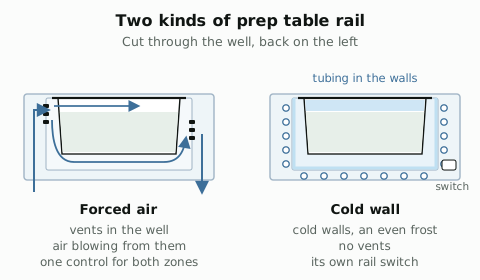
| What to look at | Forced air | Cold wall |
|---|---|---|
| The well | Slots or vents in the walls, often along the back | Plain metal walls, often with an even coat of frost |
| The air at the pans | Cold air blowing out of the vents with the lid up | Still air. The cold sinks into the well |
| Controls | One control for the rail and the base | A separate switch or control for the rail |
| Where you find it | Most prep tables, and almost every mega top. True, Turbo Air, Traulsen, Continental and Beverage-Air | Many raised-rail tables. Randell, and Delfield's 18600 series |
A third kind, the glycol rail, runs chilled glycol through metal bars round the pans. It is rare, and Traulsen's TB series is one. If you have one, its manual is your guide. How a prep table works explains all three.
Ten symptoms cover most prep table problems: four on forced-air rails, three on cold walls and three on either
Find your kind of rail, then what you are seeing, and jump to its section. Reasons are listed in roughly the order the makers' troubleshooting tables and trade sources put them. Nobody publishes how often each fault happens in the field.
Forced-air rails
| # | What you see | What it usually is | Parts to suspect | Can you check it yourself? | How urgent |
|---|---|---|---|---|---|
| 1 | Overfilled pans, open lids, a draft or a blocked vent | Usually none: the fill, the lid, the pans and the room | Yes. Probe the top and bottom of a pan | Now, for the food. This week for the cause | |
| 2 | The shared coil is iced or its fan has stopped, or the condenser is dirty | Coil, coil fan, condenser, base doors | Partly. Look at the grille and the doors, and listen for the fan | Today if the food is warm | |
| 3 | The control set too cold, or the lid shut for hours | Control, lid habits | Partly. Check the setting and where the food sits | Today. Frozen produce is lost | |
| 4 | The coil is icing from open lids and too little rest | Coil, defrost settings | Partly. Feel the vents and watch the lids | Within a day |
Cold-wall rails
| # | What you see | What it usually is | Parts to suspect | Can you check it yourself? | How urgent |
|---|---|---|---|---|---|
| 5 | The rail is off or was started late, or the pans are overfilled or left open | Rail switch or control, or none | Yes. Check the rail switch and probe a pan | Now, for the food. This week for the cause | |
| 6 | The rail is not getting its daily off time | Usually none: how the rail is shut down | Yes. Look at the walls | Within a day | |
| 7 | The rail set too cold, or left on overnight with food in it | Rail control | Partly. Check the rail setting | Today. Frozen produce is lost |
Either kind: the base and the machine
| # | What you see | What it usually is | Parts to suspect | Can you check it yourself? | How urgent |
|---|---|---|---|---|---|
| 8 | A door or gasket, product against the coil, or the setting | Gasket, coil fan, control | Partly. Look at the gaskets and the back of the cabinet | Today if the food is warm | |
| 9 | A clogged condenser, blocked grilles or a hot room | Condenser, grilles | Yes. Look at the grilles | This week. Today if the food is warm | |
| 10 | The coil's water is not reaching its pan, or the pan overflows | Drain hose, pan | Yes | This week. Today if people can slip |
Here is a list of nine things you can check to assess your prep table's health
Only the first needs a tool: a probe thermometer. Each one says what you should find. The picture shows how full a pan should be and where the probe goes.
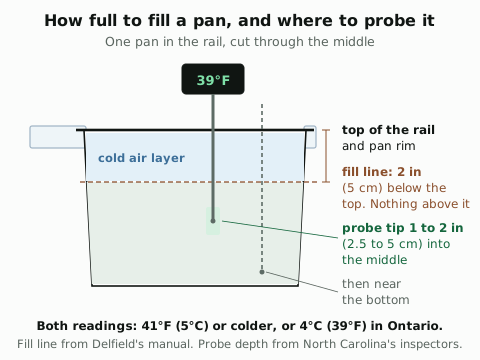
- The food in a pan. Push a clean probe 1 to 2 inches (2.5 to 5 cm) into the middle of the food, then take a second reading near the bottom. Should read: 41°F (5°C) or colder at both, or 4°C (39°F) in Ontario. The makers aim for 33°F to 41°F (1°C to 5°C).
- The fill level. Look along the rail. Should be: no food above the fill line. Delfield's line is 2 inches (5 cm) below the top of the cold pan, the well the food pans hang in. It is the only maker's line we found, so use it unless your manual gives another.
- The lids. Watch them between rushes. Should be: closed whenever nobody is working from the rail, as Avantco, Continental and Traulsen all say. Delfield says to cover the pans when not serving. At close, the rail emptied into the base or the walk-in, unless your manual allows food in the rail overnight.
- The pans. Should be: a pan in every slot, empty if need be. Metal, not plastic, and not bent. On a forced-air rail, the baffles and rail inserts in place.
- The rail itself. Should be, on a forced-air rail: cold air moving at every vent with the lid up, and no food in them. On a cold-wall rail: the rail switched on 45 minutes to an hour before the first pans go in, as Randell advises, with only an even frost on the walls.
- The room at the table. Read a thermometer beside the table in the busiest service. Should be: 86°F (30°C) or cooler, the room the NSF test uses, unless your manual allows more. Avantco says below 75°F (24°C) is best. Nothing blowing across the rail: no fan, hood or air-conditioning vent.
- The grilles and the condenser. Shine a torch through the grille. Should be: nothing stacked against any grille, and light showing through the condenser coil. True, Delfield, Randell, Avantco and Continental ask for a cleaning every month.
- The base doors. Open each part way and let go. Should be: the door swings shut by itself, as Arctic Air's manual says it must, and the gasket meets the frame all round with no tears or gaps.
- The base cabinet. Probe the food on a middle shelf. Should read: about 34°F to 40°F (1°C to 4°C). Delfield designs its bases for 36°F to 40°F (2°C to 4°C).
Leave refrigerant, the controller's wiring and the electrical panel to a technician.
1. Forced air: warm pan tops over a cold base mean overfilled pans, open lids, a draft or a blocked vent
The base reads fine and the bottom of each pan is cold, but the top inch of food is warm. On a forced-air rail this is usually how the table is used, not a fault.
Reason 1: Food piled above the fill line sticks out of the cold air
- Parts: none. How the pans are filled is the problem.
- What happens: The fan keeps a layer of cold air over the pans, an air blanket in Traulsen's words. Food piled above it sits in the kitchen's air. In a North Carolina inspectors' training scenario, food stacked above the fill line read 44°F (7°C) at the top and 39°F (4°C) at the bottom.
- The proof: the top of the food warm and the bottom cold, in the fullest pans.
- Check: probe the top and bottom of the fullest pan, and fill no higher than the line in the picture above.
- What to do next: If the top reads above 41°F (5°C), take the heaped food out and put it in the base or the walk-in. Fill only to the line from now on, and top up from cold stock.
Reason 2: Lids left open between rushes let the cold out
- Parts: none. How the lids are used is the problem.
- What happens: Avantco, Continental and Traulsen all say to close the lid when the table is not in use, and Delfield to cover the pans when not serving. The NSF test only checks four hours with the lids off, FER explains, and Unified Brands, the company behind Randell, notes that nothing is tested for longer.
- The proof: warm after quiet spells with the lids up, and worst late in the day.
- Check: watch how the lids are used between rushes.
- What to do next: If lids stay up in quiet spells, make closing them part of the routine. Probe the top of the fullest pans after the next quiet spell to see the difference.
Reason 3: A draft or a hot room breaks up the air over the pans
- Parts: none. The room is the problem.
- What happens: Traulsen's manual says drafts from heat, air conditioning or ventilation disrupt the air blanket over the product. Its list of warm-rail causes also includes a room above 86°F (30°C). Beverage-Air's fix for a hot room is to cool the room.
- The proof: warm when the line is hottest, or near a hood, fan or air-conditioning vent.
- Check: check the room temperature at the table during service, and look for anything blowing across the rail.
- What to do next: If air blows across the rail, turn the fan away or have the vent redirected. If the room is over 86°F (30°C), see whether the table can move away from the hottest spot.
Reason 4: Blocked vents, missing pans or bent pans let the air escape
- Parts: pans, inserts, baffles, vents.
- What happens: Traulsen lists food blocking the air outlets and returns, missing rail inserts and missing pans, and says bent pans let the cold air escape. True says removing the baffles from the pan area will hurt the cooling. Traulsen asks for a pan in every space, even an empty one.
- The proof: some pans warm while their neighbours hold.
- Check: clear any food from the vents, and put back any missing pans, inserts or baffles.
- What to do next: Once the vents are clear and every slot is filled, probe the warm pans again after an hour. If they are still warm, look at the base and the coil in symptom 2.
Reason 5: Warm food loaded into the rail never catches up
- Parts: none. The food going in is the problem.
- What happens: A prep table holds cold food cold. It is not built to chill. Traulsen says to load the rail at 36°F (2°C) or colder, and lists food loaded above that as a cause of a warm rail. In North Carolina's inspector training scenario, cut lettuce at 53°F (12°C) put into a make unit is a cooling violation.
- The proof: a pan that is warm from the moment it goes in.
- Check: probe food before it goes into the rail.
- What to do next: If food goes in warm, chill it in the walk-in first. Food above 41°F (5°C) in the rail needs action under your food safety plan now.
Reason 6: Plastic pans hold the cold back
- Parts: pans.
- What happens: Traulsen lists product held in plastic pans as a cause of a warm rail, and Spokane's health district says to use metal insert pans in prep coolers.
- The proof: plastic pans warmer than metal ones beside them.
- Check: swap to metal pans.
- What to do next: Swap plastic pans for metal ones, then probe both rows again after an hour of service.
Before you call, check these five things
- How warm is the top of the food, and the bottom?
- Is any food above the fill line?
- Are the lids closed between rushes?
- Is anything blowing across the rail?
- Are any pans plastic, bent or missing?
- When to call a technician: rarely, for this one. If the base is cold and only the pan tops are warm, the fix is how the pans are filled, covered and placed. If the food stays warm with all of that right, the table may be too small or in too hot a spot for the job.
- What to tell them: the food temperatures at the top and bottom of a pan, the room temperature at the table, and how the lids are used.
2. Forced air: pans and base warm together mean the shared coil is iced, its fan has stopped, or the condenser is dirty
On a forced-air table one coil cools both zones. When it falls behind, the pans and the base warm together.
Reason 1: A base door left open, or a leaking gasket, warms both zones
- Parts: door gasket.
- What happens: Traulsen lists base doors left open among its warm-rail causes, and says to check the doors and gaskets for a proper seal. FER's advice is to replace gaskets that are filthy, coming off, bulging, gapping or cracked.
- The proof: sweat or a wet line at one door, and a door that does not swing shut.
- Check: look at each gasket and let each door close by itself.
- What to do next: If a gasket leaks or a door will not close itself, order the maker's gasket or have the hinge fixed this week. Until then, check the doors are shut after every use.
Reason 2: Product packed against the coil blocks the air for both zones
- Parts: none. How it is loaded is the problem.
- What happens: True asks for 4 inches (10 cm) between the product and the coil housing, and Avantco 2 to 4 inches (5 to 10 cm) at the back wall. Arctic Air says not to pack the cabinet so tight that the air cannot move. Avantco adds that blocking the coil fans leads to a warmer cabinet and, in the end, compressor failure.
- The proof: the base warm with the back packed tight.
- Check: clear the space at the back and round the coil.
- What to do next: If the back is packed tight, take some product out and clear the space round the coil. Probe the base and the pans again after an hour.
Reason 3: An iced coil starves the rail and the base
- Parts: evaporator coil.
- What happens: Beverage-Air's table lists an iced-over coil for a cabinet that is too warm, and the fix is a defrost. On a forced-air table the iced coil also starves the rail of air. See symptom 4.
- The proof: weak air at the rail's vents, then a warm base.
- Check: feel the vents with the lid up.
- What to do next: If the air at the vents is weak, follow symptom 4 to clear the ice. Move the rail food to the walk-in while you do.
Reason 4: A coil fan that has stopped leaves the cold at the coil
- Parts: evaporator fan.
- What happens: Beverage-Air's technician table lists an evaporator fan not turning. On a forced-air table that fan also feeds the rail, so the pans warm too.
- The proof: no air moving in the base or at the vents, and the coil icing.
- Check: listen for the fan with the doors shut and the compressor running.
- What to do next: If you hear no fan, call a technician today, and move the food above 41°F (5°C) to other cold storage.
Reason 5: A dirty condenser warms everything
- Parts: condenser coil and fan.
- What happens: Beverage-Air's table lists a dirty condenser for a unit that runs all the time with the space too warm. See symptom 9.
- The proof: a furred coil behind the grille, worst in the afternoon.
- Check: look through the grille with a torch.
- What to do next: If the coil is furred, unplug the table and brush along the fins, or book a cleaning. See symptom 9 for what else keeps it running.
Before you call, check these four things
- Does each base door seal?
- Is product packed against the back or the coil?
- Is there air at the rail's vents?
- Can you see light through the condenser?
- When to call a technician: today if the food is above 41°F (5°C). A stopped fan or a failed compressor warms a small cabinet within hours.
- What to tell them: the base and pan temperatures, that it is a forced-air table, whether the fan runs, and when the condenser was last cleaned.
3. Forced air: food freezing in the pans or the base means the control is too cold, or the lid stays shut for hours
Lettuce goes glassy at the bottom of a pan, or the milk in the base has ice in it.
Reason 1: The control is set too cold
- Parts: thermostat or controller.
- What happens: Turbo Air's fix for freezing food is to turn the dial warmer, and Beverage-Air's is to adjust or replace the control. On True's dial and Delfield's export control, settings run from 1 to 9, with 9 the coldest.
- The proof: both zones colder than they should be.
- Check: check the setting, and whether anyone turned it colder to fix warm pans.
- What to do next: If the setting was turned colder, set it back to your manual's figure. Fix warm pans with the fill, the lids and the room, not the dial.
Reason 2: A lid shut for hours drives the rail colder
- Parts: none. The lid is doing its job too well.
- What happens: With the lid down, the rail's cold air has nowhere to go. A Hoshizaki patent notes that closing the cover can lower the rail's temperature a lot. Turning the setting colder to fix warm pans at lunch makes this worse overnight.
- The proof: frozen food at the bottom of the pans after a night or a quiet spell with the lid down.
- Check: check whether the freezing follows the lid being shut for hours.
- What to do next: If the freezing follows a long lid-down spell, empty the rail at close as your manual says, rather than turning the setting warmer.
Reason 3: Keeping the rail cold freezes food in the base
- Parts: none. One coil is doing two jobs.
- What happens: On a forced-air table, the colder you push the rail, the colder the base gets. FER notes that keeping the rail cold can freeze products in the base, and a cold-wall maker says forced air risks freezing base product and the coil.
- The proof: frozen food in the base, near the coil.
- Check: move cold-sensitive food in the base away from the coil. Do not turn the setting warmer if the rail food is already near 41°F (5°C). Call a technician instead.
- What to do next: If moving the food stops the freezing, keep that space clear. If the rail food is also near 41°F (5°C), call a technician: the table is short of capacity.
Before you call, check these four things
- What is the control set to, and was it turned colder recently?
- Does the freezing follow the lid being shut for hours?
- Is it in the rail, the base, or both?
- Is the frozen food near the coil?
- When to call a technician: today if the setting is right and food still freezes, or the compressor never stops. A failed control can keep it running.
- What to tell them: the setting, which zone freezes, and whether it follows the lid.
4. Forced air: weak air at the rail's vents means ice on the coil, from open lids and too little rest
The coil sits behind a panel in the base, so the ice is rarely the first thing you see. First the air at the rail's vents gets weak, and the pans warm a little more each day. Behind the panel, the coil is white with ice. Leave the panel to a technician, or unplug the table first: there is a fan behind it.
Reason 1: Open lids let in heat and water all day
- Parts: none. How the lids are used is the problem.
- What happens: A cold-wall maker points out that room air brings extra heat and humidity as a forced-air table circulates it back through the coil. An open lid lets that air in, and its water freezes on the coil.
- The proof: ice that builds on the busiest days.
- Check: keep the lids down between rushes.
- What to do next: If lids stay up between rushes, make closing them the routine. Then clear the ice as the makers say, with the food moved and the table unplugged or in defrost.
Reason 2: A coil that never rests never defrosts
- Parts: none, usually. The load, the room or a dirty condenser.
- What happens: On many forced-air tables the coil's frost melts while the compressor rests, as Continental describes. If it never rests, because the room is too hot or the condenser is clogged, the frost builds into ice.
- The proof: a compressor that runs for hours without a break.
- Check: listen for it stopping. See symptom 9.
- What to do next: If the compressor never stops, work through symptom 9 first. Once it rests again, the coil can clear between cycles.
Reason 3: Defrost settings that do not suit how the table is used
- Parts: defrost settings.
- What happens: Makers set defrosts differently: every 3 hours for 10 to 20 minutes on Traulsen's TS, every 6 hours on Arctic Air. Traulsen says its defrost can be adjusted to suit the location and use.
- The proof: ice that builds steadily, even with good lid habits.
- Check: ask your technician whether the defrost settings suit the table's use.
- What to do next: If the ice keeps coming back with good lid habits, book your technician to adjust the defrost settings for how the table is used.
Reason 4: A fault only a technician can find: low refrigerant, or a blocked drain
- Parts: refrigerant charge, coil drain.
- What happens: In a small self-contained system, ACHR News describes the coil heavy with ice at its inlet when the refrigerant charge is low. Parts Town's troubleshooting guide for Delfield prep tables says to check the drain when the coil fan is stuck in ice.
- The proof: ice on only part of the coil, or ice that comes back soon after a full defrost.
- Check: tell your technician where the ice sits on the coil.
- What to do next: Book a technician within a day, and tell them where the ice sits and how soon it came back. Never chip it, and move the food meanwhile.
Before you call, check these four things
- Is the air at the rail's vents weaker than it was?
- Are the lids up for long spells?
- Does the compressor ever rest?
- Does the display ever show a defrost, often dEF?
- When to call a technician: within a day. The makers' fix is to move the food, then unplug the unit or run a defrost and let the coil clear. Do not chip the ice.
- What to tell them: that it is a forced-air table, how the lids are used, and the defrost settings if you know them.
5. Cold wall: a warm rail over a cold base usually means the rail switch, the fill or the lids
On a cold-wall table the rail has its own switch and control, so the rail can warm while the base holds. The walls do the cooling, and cold air pools in the well over the food.
Reason 1: The rail is switched off, or was switched on too late
- Parts: rail switch or rail control.
- What happens: Delfield's rail switch shuts off the rail only, and Randell's rail has its own power button. Randell's product team says to turn the cold pan on 45 minutes to an hour before the first pans go in.
- The proof: a warm rail first thing in the day, or a rail display that is dark.
- Check: check the rail's switch or display, and when it was turned on.
- What to do next: If the rail is off, switch it on and probe the pans after an hour. From now on, turn it on 45 minutes to an hour before the first pans go in.
Reason 2: Food piled above the fill line sits above the cold air
- Parts: none. How the pans are filled is the problem.
- What happens: Randell's product specialist explains that the pans are recessed so a blanket of cold air can sit over the food. The same article says that in real kitchens the pans are often filled to the top or overflowing. Delfield's fill line is 2 inches (5 cm) below the top of the cold pan.
- The proof: the top of the food warm and the bottom cold, in the fullest pans.
- Check: probe the top and bottom of the fullest pan, and fill no higher than the line in the picture above.
- What to do next: If the top reads above 41°F (5°C), take the heaped food out to the base or the walk-in. Fill only to the line from now on, and top up from cold stock.
Reason 3: Open lids, drafts or a hot room spill the cold air
- Parts: none. The lids and the room are the problem.
- What happens: An open lid leaves the cold air in the well open to the kitchen, where drafts and the heat of the line stir it out. Delfield says to cover the pans when not serving, and warns that air from air vents can affect the temperature in the cold pans. Randell's manual gives a room of 70°F to 86°F (21°C to 30°C).
- The proof: warm when the line is hottest, or when the lids stay up.
- Check: check the room at the table, look for anything blowing across the rail, and watch the lids.
- What to do next: Close the lids between rushes, and turn away or redirect anything blowing across the rail. If the room is over 86°F (30°C), see whether the table can move.
Reason 4: Warm food loaded into the rail
- Parts: none. The food going in is the problem.
- What happens: Randell's manual says product going in must be at 35°F (2°C), give or take 2°F. Delfield says its units are not designed to cool warm food.
- The proof: a pan that is warm from the moment it goes in.
- Check: probe food before it goes into the rail.
- What to do next: If food goes in warm, chill it in the walk-in first, to about 35°F (2°C) as Randell's manual asks. Food above 41°F (5°C) in the rail needs action now.
Reason 5: Thick frost on the walls, or a hot room, keeps the rail running
- Parts: none, usually. See symptom 6.
- What happens: Delfield's alarm table says a cold pan that has run without stopping for a day may be in too hot a room, or may not have been shut off at night. See symptom 6.
- The proof: frost thicker than an even coat, and a rail that never stops.
- Check: look at the walls with the pans out.
- What to do next: If the frost is thick, follow symptom 6 tonight. Check the room at the table too, because a hot room keeps the rail running.
Before you call, check these five things
- Is the rail switched on, and when was it turned on?
- How warm is the top of the food, and the bottom?
- Is any food above the fill line?
- Are the lids closed between rushes?
- How thick is the frost on the walls?
- When to call a technician: if the rail is on, the pans are filled and covered right, and the food is still warm. The rail's own control or its refrigeration may have failed.
- What to tell them: that it is a cold-wall table, whether the base holds, the food temperatures, and how thick the frost is.
6. Cold wall: frost that thickens on the well walls day by day means the rail is not getting its daily off time
An even frost on the walls and floor of the well is normal on a cold-wall rail. Randell's manual says to expect it. Frost that thickens from one day to the next, or builds into lumps, is not.
Reason 1: The rail is never switched off
- Parts: none. How the rail is shut down is the problem.
- What happens: Delfield requires at least one hour of off time a day with the pans removed, to defrost the rail. Randell says to take the product out at the end of the day, and its product team says to turn the rail off each night. Once the frost has melted, Randell's manual says the rail drain can be opened to let the water out.
- The proof: frost that grows each day, on a rail that runs round the clock.
- Check: at close, move the food to the base or the walk-in, switch the rail off and let it clear.
- What to do next: Make the nightly shut-down part of closing: food out, rail off, frost melted, then the rail drain, as the manual says. Never chip the frost.
Reason 2: Open lids feed the walls water
- Parts: none. How the lids are used is the problem.
- What happens: An open lid lets in warm, damp kitchen air. Its water freezes onto the coldest surface it meets, the walls of the well.
- The proof: frost that builds fastest on the busiest days.
- Check: keep the lids down between rushes.
- What to do next: Keep the lids down between rushes, and give the rail its nightly off time to clear what has built up.
Reason 3: The defrost setting does not suit the table's use
- Parts: rail control.
- What happens: Randell offers a control with a settable defrost to limit frost build-up, and its controls have a manual defrost button.
- The proof: frost that builds even with good lid habits and nightly shut-downs.
- Check: ask your technician whether the rail's defrost settings suit the table's use.
- What to do next: If frost still builds with nightly shut-downs and closed lids, book your technician to adjust the rail's defrost settings.
Before you call, check these three things
- Is the rail switched off for at least an hour a day, with the pans out?
- Are the lids up for long spells?
- Is the frost an even coat, or thick and lumpy?
- When to call a technician: within a day if the frost keeps building after nightly shut-downs. Do not chip it: let it melt with the rail off.
- What to tell them: that it is a cold-wall table, how often the rail is switched off, and how thick the frost gets.
7. Cold wall: lettuce frozen at the walls means the rail is set too cold, or left on overnight with food in it
The food at the edges of the pans goes glassy or stiff, while the middle stays soft.
Reason 1: The rail is set too cold
- Parts: rail control.
- What happens: Randell's troubleshooting table gives a wrong set point for a unit that is too cold, and the fix is to adjust it. Its product team says to change the setting 2 degrees at a time, and its manual says to wait 24 hours between changes.
- The proof: freezing every day, not just after a night.
- Check: check the rail's setting, and change it in small steps.
- What to do next: If it is set too cold, raise it 2 degrees, wait 24 hours, and probe again, as Randell says.
Reason 2: Delicate food freezes against a cold wall
- Parts: none. The food is the problem.
- What happens: FER notes that a cold-wall rail may freeze delicate, high-water ingredients like lettuce.
- The proof: only the most delicate food freezing, at the edges of its pan.
- Check: check the setting first. If it is right, ask your technician or the maker whether that food suits the rail.
- What to do next: If the setting is right, ask your technician or the maker whether a slightly warmer rail setting suits that food, still holding 41°F (5°C) or colder.
Reason 3: Food left in the rail overnight with the rail on
- Parts: none. How the rail is shut down is the problem.
- What happens: Randell offers a settable defrost to reduce overnight freezing, and Randell and Delfield both say to take the food out of the rail at the end of the day.
- The proof: frozen food in the morning, soft food in the afternoon.
- Check: empty the rail at close, as your manual says.
- What to do next: Empty the rail at close from now on, into the base or the walk-in, and switch it off for the night.
Before you call, check these three things
- What is the rail set to, and was it changed recently?
- Is the freezing every day, or only after a night?
- Which foods freeze, and where in the pan?
- When to call a technician: today if the setting is right and food still freezes. A failed rail control can keep the walls too cold.
- What to tell them: that it is a cold-wall table, the rail setting, and which foods freeze.
8. Either kind: a warm base cabinet usually has a leaking door, product against the coil, or the wrong setting
On a cold-wall table the base has its own coil and control, so it can fail on its own. On a forced-air table a warm base usually comes with warm pans: see symptom 2.
Reason 1: A door left ajar, or a gasket that leaks, lets in kitchen air
- Parts: door gasket.
- What happens: The base doors open all through service. Randell's troubleshooting table lists a door ajar and a gasket torn or out of place for a unit that is too warm. Avantco adds that the gaskets must be snapped in all the way.
- The proof: sweat or a wet line at one door, and a door that does not swing shut.
- Check: look at each gasket and let each door close by itself.
- What to do next: If a gasket leaks or a door hangs open, order the maker's gasket or have the hinge fixed this week. Until then, check the doors are shut after every use.
Reason 2: Product packed against the coil blocks the cold air
- Parts: none. How it is loaded is the problem.
- What happens: True asks for 4 inches (10 cm) between the product and the coil housing, Avantco 2 to 4 inches (5 to 10 cm) at the back wall, and Arctic Air warns that bags at the back can block the air.
- The proof: the base warm with the back packed tight.
- Check: clear the space at the back and round the coil.
- What to do next: If the back is packed tight, take some product out and clear the space round the coil. Probe the base again after an hour.
Reason 3: The base is set too warm
- Parts: thermostat or controller.
- What happens: Randell's table also lists a wrong set point for a unit that is too warm. Delfield designs its bases for 36°F to 40°F (2°C to 4°C).
- The proof: a base that holds steady, just too warm.
- Check: check the setting against your manual.
- What to do next: If it is set too warm, set it to your manual's figure. Probe the food on a middle shelf again in a few hours.
Reason 4: A coil fan that has stopped leaves the cold at the coil
- Parts: evaporator fan.
- What happens: Beverage-Air's technician table lists an evaporator fan not turning for a cabinet that is slow to cool.
- The proof: no air moving in the base, and the coil icing.
- Check: listen for the fan with the doors shut and the compressor running.
- What to do next: If you hear no fan, call a technician today, and move the food above 41°F (5°C) to other cold storage.
Before you call, check these four things
- Does each base door seal?
- Is product packed against the back or the coil?
- What is the base set to?
- Can you hear the fan in the base?
- When to call a technician: today if the food in the base is above 41°F (5°C). A stopped fan or a failed compressor warms a small cabinet within hours.
- What to tell them: the base and pan temperatures, which kind of rail it has, whether the fan runs, and when the condenser was last cleaned.
9. Either kind: a table that runs all the time and warms in the afternoon usually has a clogged condenser or a hot spot
The condenser breathes kitchen air, and a kitchen's air carries grease, flour, dust and plastic wrap. When the condenser cannot shed heat, the whole table warms.
Reason 1: A condenser clogged with grease and dust cannot shed heat
- Parts: condenser coil and fan.
- What happens: FER says the condenser gets coated with dust, debris and plastic wrap, and quotes the owner of a service company on how airborne grease gets into condensing units and insulates them. True, Delfield, Randell, Avantco and Continental ask for cleaning every month. Arctic Air and Turbo Air allow up to 90 days, and Arctic Air says every 30 days where grease or dirt builds up faster.
- The proof: warm in the afternoon and during service first, then warmer week by week.
- Check: look through the grille with a torch. Some tables warn you first: Traulsen's TS shows CLN-FIL when the condenser runs hot, and Randell's controls show a dirty-condenser alarm.
- What to do next: If the coil is furred or the alarm is showing, unplug the table and brush along the fins, or book a cleaning. Clean it monthly from now on.
Reason 2: Blocked grilles starve the condenser of air
- Parts: none. Where it stands is the problem.
- What happens: Beverage-Air says the front grille must be free and clear, Continental not to block the rear grille, and Turbo Air nothing that restricts the front or back grilles. True's warranty does not cover a unit with blocked vents.
- The proof: boxes, bags or another unit against a grille.
- Check: find every grille and clear it.
- What to do next: Clear every grille now, and keep a clear gap in front of them from now on. Probe the pans again after an hour.
Reason 3: A room hotter than the maker's limit
- Parts: none. The room is the problem.
- What happens: Limits differ: Traulsen's TS and Randell 86°F (30°C), Avantco 90°F (32°C), Beverage-Air 100°F (38°C). Turbo Air and Arctic Air say to avoid hot corners and stoves.
- The proof: it runs all day only on the hottest days, or since it moved beside the fryer.
- Check: check the room at the table against the manual.
- What to do next: If the room is over the manual's limit, move the table away from the fryer or the hottest spot, or cool the room.
Reason 4: Running without pans or covers keeps it running
- Parts: none. How it is used is the problem.
- What happens: Arctic Air warns that running the table without pans or covers may damage it through continuous running.
- The proof: empty slots and lids up overnight.
- Check: fill the slots and close the lids.
- What to do next: Fill every slot, with empty pans if need be, and keep the lids closed when the table is not in use.
Before you call, check these four things
- Can you see light through the condenser?
- Is every grille clear?
- How hot is the room at the table?
- Are the slots filled and the lids closed?
- When to call a technician: this week, or today if the food is above 41°F (5°C). A compressor that never rests wears out, and the coil will ice.
- What to tell them: when it started, the room temperature, and when the condenser was last cleaned.
10. Either kind: water under a prep table means the coil's water is not reaching its pan, or the pan overflows
The coil's melt water should drain to a pan in the base and evaporate. Water on the floor means it is going somewhere else.
Reason 1: A drain hose out of the pan, or clogged
- Parts: drain hose.
- What happens: True says to keep the drain hose in the pan, to check that the drain line is clear as part of its regular maintenance, and to clear a clog with a narrow tube brush.
- The proof: water on the floor near the machine end.
- Check: look where the hose ends.
- What to do next: If the hose has slipped out of the pan, put it back. If it is clogged, unplug the table and clear it with a narrow tube brush, as True's manual shows.
Reason 2: A pan that is cracked or overflowing
- Parts: condensate pan.
- What happens: FE&S says to check the pan is not cracked or overfilling. Continental offers a pan heater as an option for humid kitchens, where the coil makes more water.
- The proof: water worst on humid days or after the lids were left up.
- Check: look at the pan with a torch, without touching it: heated pans run hot.
- What to do next: If the pan is cracked or full, mop up, put a sign out, and book a technician this week. Do not touch a heated pan.
Reason 3: On a cold-wall rail, the rail's own drain
- Parts: rail drain.
- What happens: A cold-wall rail has its own drain for the water from its frost. Randell's manual says to open it once the rail has defrosted, to let the water out.
- The proof: water under the rail end of the table after the nightly shut-down.
- Check: find where the rail drain empties, and make sure it reaches a pan or a floor drain.
- What to do next: If the drain water has nowhere to go, lead it to a pan or a floor drain, and mop up and put a sign out meanwhile.
Before you call, check these four things
- Does the drain hose end in the pan?
- Is the pan full, or cracked?
- Is it worse on humid days?
- Were the lids left up for long?
- When to call a technician: this week, or today if water is spreading where people walk.
- What to tell them: where the water is, and whether the pan is full or cracked.
This is where TemperatureWise is different: it learns the rushes and watches the recovery
A prep table warms every service. A threshold alarm on it either goes off every lunch or is set so loose that it misses a table that has stopped recovering. Neither helps.
TemperatureWise uses machine learning on the full temperature history of each unit. It learns that table's own pattern in its first week: how far it rises in each rush and how fast it comes back. When the pattern changes, such as a table that no longer recovers after lunch or overnight, TemperatureWise tells you what has changed.
Where the sensor sits matters more here than anywhere. A sensor in the rail air reads colder than the top of the food. For a reading that follows the food, TemperatureWise puts the probe in a buffer, typically a sealed bottle of glycol, as glycol buffers and thermobuffers explains. See how TemperatureWise works.