
How a refrigerated prep table works, and what keeps the pans cold
By Vimal Bhaya, Founder and Lead Systems Architect · Last reviewed 7 October 2026
This is a continuation of Reach-ins, prep tables, display cases and reefers, a 10-part tutorial. You are on part 5 of 10.
A refrigerated prep table, or sandwich unit, is a refrigerated cabinet with a rail of food pans on top. On most, one cold coil in the base cools both: a fan pushes cold air up around the pans and back down.
The rail is open to the kitchen all day. So the food in the pans stays cold only if it sits below the fill line, the lid is closed between rushes, and the room is no hotter than the table was tested for. The makers aim for food at 33°F to 41°F (1°C to 5°C), and the US food code line is 41°F (5°C), or 4°C (39°F) in Ontario.
Three designs cool the rail, and forced air from the base is by far the most common
What you have decides what goes wrong. Look at the pan well: is there a vent blowing air, or are the walls of the well themselves cold?
Design | How it cools the pans | How to tell | What to watch for |
|---|---|---|---|
Forced air from the base | One coil and fan in the base. Cold air is ducted up into the rail, flows over, round and under the pans, and returns to the base | Vents or slots in the pan well, with cold air blowing out of them. True, Turbo Air, Traulsen, Continental, Beverage-Air and others | One coil and one control for both zones. Keeping the rail cold can freeze food in the base (freezing) |
Cold-wall rail | Refrigerant tubing wraps the pan well. The walls go cold, and cold air settles into the well round the pans | Frost on the walls of the well, no vents. A separate on/off switch for the rail. Randell and Delfield | The rail has its own control, so one zone can fail while the other holds. It may freeze delicate food like lettuce, and needs daily off time to defrost |
Glycol rail | Chilled glycol runs through bars round the pans | Less common. Traulsen's TB series | Traulsen's own claim: no frost, no defrost, no fans |
By our own estimate, forced air covers about seven in ten prep tables. Nobody publishes a count. A fourth kind, the drop-in cold well built into a serving line, works on the same ideas and is not covered here.
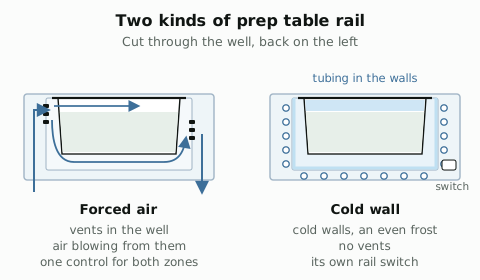
Food in the rail stays cold because it sits below the cold air, not because the pans are sealed
Cold air is heavier than warm air, as Randell puts it. In a forced-air rail, the fan keeps a layer of cold air moving round the pans, below the rim of the well. Traulsen calls it an air blanket. Food that sits under it stays cold. Food piled above it sits in the kitchen's air, however well the machine works.
FER sums up the idea: forced air is directed over, around and under the pans in the rail. In one Hoshizaki design, the air comes in through openings in the back wall of the well, circulates round every pan, and leaves through openings in the front, back to the coil. Paths vary by maker.
That is why the pans are recessed into the rail, and why makers mark a fill line. Delfield says to fill the pans to 2 inches (5 cm) below the top of the cold pan. In real kitchens, a cold-wall maker notes, pans are often filled to the top or even overflowing.

The difference can be big. In a North Carolina inspectors' training scenario, food stacked above the fill line read 44°F (7°C) at the top and 39°F (4°C) at the bottom of the same pan. That is a teaching example, not a measurement, but it shows why the top inch is the one to probe.
A prep table is tested in an 86°F (30°C) room, for four hours
Prep tables sold in the US are tested to NSF/ANSI 7, and the standard itself is not public. Unified Brands, the company behind Randell, describes the test as four hours in an 86°F (30°C) room, with the pans at or below 41°F (5°C). FER says the pan lids are off for it. Hoshizaki says the test room is typically 86°F, and the pans must stay between 33°F and 41°F (1°C and 5°C). Unified Brands adds that nothing is tested for longer than that.
From 1 April 2027, the standard's new edition labels open-top prep units Type I or Type II. Type I is for rooms that typically stay at or below 86°F (30°C), and Type II for rooms up to 100°F (38°C). Turbo Air already says its PST tables hold NSF temperatures in a 100°F room.
So a table rated for 86°F (30°C), standing next to a fryer on a 95°F (35°C) afternoon, is being asked to do more than it was tested for. Warm pans then may be a rating problem rather than a fault. Rule out a dirty condenser first, because it gives the same afternoon pattern.
The cooling and the defrost work as in a reach-in, with one coil doing two jobs
The machine is a small, self-contained reach-in system: a compressor and condenser in the base, breathing kitchen air, a capillary tube on many models, and one cold coil. How a reach-in cooler works explains each part.
On a forced-air table the coil's frost melts while the compressor rests, as Continental describes. Makers schedule extra defrosts differently. Arctic Air defrosts every 6 hours, and Traulsen's TS every 3 hours for 10 to 20 minutes. Beverage-Air defrosts as needed, and Delfield as often as every hour under heavy use. A cold-wall rail needs off time too: Delfield asks for at least one hour a day with the pans removed.
The temperature on the display is not the temperature of the food
Beverage-Air's control runs on a probe in the return air. Delfield says it outright: the rail temperature displayed is for the set point only, and does not show the air or product temperature in the unit.
The coil runs below freezing, so the air near it reads colder than any food. The food at the top of a pan, near the kitchen air, reads warmer. The only way to know is a probe thermometer in the food. North Carolina's inspectors say to probe only 1 to 2 inches (2.5 to 5 cm) down from the top of the food.
Here are the vital numbers and habits of a healthy prep table
These are the makers' own figures. Your manual comes first, and on some points the makers disagree.
| What | Normal | Where the number comes from |
|---|---|---|
| Food in the pans | 33°F to 41°F (1°C to 5°C). Turbo Air: 33°F to 39°F (1°C to 4°C) | True, Arctic Air, Delfield, Continental, Turbo Air |
| Base cabinet | About 34°F to 40°F (1°C to 4°C) | Arctic Air, Delfield, Traulsen |
| Food safety line | 41°F (5°C) or colder in the US. 4°C (39°F) or colder in Ontario, measured inside the food | Food Code, O. Reg. 493/17 |
| Fill line | 2 inches (5 cm) below the top of the cold pan | Delfield |
| Lid | Closed whenever the table is not in use. Delfield says to cover the pans when not serving | Avantco, Continental, Traulsen, Delfield |
| Pans | Metal, not plastic. Every slot filled, with empty pans if need be. Baffles and inserts in place | Traulsen, True, Beverage-Air, Avantco, Spokane health district |
| Pan depth | 4 inches (10 cm) gives the best temperatures on Traulsen's TS. Deeper pans also pass on some models | Traulsen |
| Food going in | Already cold. Traulsen says load the rail at 36°F (2°C) or colder | Traulsen, Delfield, Continental |
| Room | Tested at 86°F (30°C). Makers' limits run from 86°F (30°C) on Traulsen's TS and 90°F (32°C) on Avantco, which says below 75°F (24°C) is best, to 100°F (38°C) on Beverage-Air, Delfield and Continental | NSF/ANSI 7, makers' manuals |
| Condenser cleaning | Monthly on True, Delfield, Randell, Avantco and Continental. At least every 90 days on Arctic Air and Turbo Air. Beverage-Air's SPE manual says monthly in one place and quarterly in another | Makers' manuals |
Makers disagree on whether food can stay in the rail overnight
Arctic Air and Continental say the rail is not for overnight storage. Delfield says to move the rail's food into the base at the end of the day. Traulsen's TS manual says to cover the rail with plastic wrap and close the covers. Traulsen's glycol rail can keep wrapped pans in place. True's manual says nothing either way.
So read your own manual. If it says nothing, the safe habit is the strict one: empty the rail into the base or the walk-in at close.
Ten symptoms cover most of what goes wrong, and four of them differ by kind of rail
Each one has its own section, with what it usually is and what to check, on prep table troubleshooting. The page splits them by kind of rail.
Forced-air rails
- Warm food at the top of the pans, over a cold base
- Pans and base warm together
- Food freezing in the pans or the base
- Weak air at the rail's vents, or ice on the coil
Cold-wall rails
- Warm food in the rail, over a cold base
- Frost thickening on the well walls
- Lettuce frozen where it touches the walls
Either kind
This page describes the common case, and we have no prep table readings yet
Makers differ on defrost, rooms, clearances and overnight use, so your manual wins over the typical figures here. The NSF/ANSI 7 test details come from makers' and trade descriptions, because the standard itself is not public.
We do not yet have readings from a prep table, so this page shows no chart of one. When we have one, it will go here.