
How a reach-in cooler works, and what normal looks like
By Vimal Bhaya, Founder and Lead Systems Architect · Last reviewed 7 October 2026
This is part 1 of 10 in Reach-ins, prep tables, display cases and reefers, a short tutorial on the refrigeration outside the walk-in: how each kind works, and what each failure looks like.
A reach-in cooler is a commercial fridge with the whole machine built into the cabinet. Makers set most of them to hold between 35°F and 38°F (2°C and 3°C), under the 41°F (5°C) food code line, or 4°C (39°F) in Ontario.
It works like a walk-in cooler in a smaller box. A cold coil and a fan inside pull heat out of the air, and a compressor and condenser in the base or on top push that heat into the kitchen. Most reach-in coolers clear the coil's light frost every time the cooling rests. Because the box is small and the door opens all day, its air swings further and faster than a walk-in's.
Four layouts cover almost every reach-in cooler, and the undercounter is a fifth
Every reach-in has the same insulated cabinet, a door with a magnetic gasket and a cold coil inside. What changes is where the rest of the machine sits, and that decides what clogs it and what heats it.
Nobody publishes a count of which layout is most common, so the shares below are our own estimate.
Layout | How to tell | How common, by our estimate | What it is prone to |
|---|---|---|---|
Bottom-mount | A grille near the floor, under the door. The machine slides out from behind it. | About half | Floor dust, flour, lint and grease clog its condenser (warm box). |
Top-mount | A grille on top of the cabinet. You need a step to see the machine. | About a third | It breathes the hottest air in the kitchen, near the ceiling, and its condenser gets cleaned less often because it needs a ladder. We found one hot enough to cook an egg (compressor heat). |
Undercounter, worktop, drawers and chef base | Counter height, under a worktop or a cookline. Drawers or a griddle on top on some. | A family of its own. Door-style models are just over half of it | Built into a counter with no room to breathe, or heated by the fryer or griddle beside it (undercounter runs warm). |
Roll-in and pass-through | No lip at the floor, so a rack of pans rolls straight in. A pass-through has doors on both sides. | About 1 in 20 | Carts tear gaskets, and full racks of warm food push it hard (door and gasket). |
Remote | No machine on the cabinet. Pipes run to a condensing unit elsewhere, or to the store's rack. | About 1 in 20 | If the remote unit or the rack fails, several cabinets warm together. |
Which is better next to the cooking line is argued both ways. FER, a trade magazine, says a top-mount suits the hot, busy cookline. Wasserstrom, a dealer, says grease rises into a top-mount's machine. Migali, a maker, says a top-mount keeps the compressor away from floor grease and dust.
Both work. What matters is that the condenser gets clean, cool air and gets cleaned on schedule.
A reach-in cooler moves heat out of the cabinet, it does not make cold
Cold is only the absence of heat. So the machine's whole job is to pick up heat inside the cabinet and dump it into the kitchen, over and over. It does that with refrigerant, a fluid that boils at low temperatures and soaks up heat as it boils.
Here are the parts, in the order the refrigerant meets them. The full loop is explained step by step in how a walk-in cooler works, and a reach-in works the same way.
- The compressor, in the machine compartment. A pump that squeezes the refrigerant vapour until it is hot enough to give its heat away.
- The condenser coil and its fan, beside the compressor, behind the grille. A small radiator that blows the heat into the kitchen.
- The capillary tube, on almost all small reach-ins. A long, very thin tube that meters liquid refrigerant into the cold coil at a fixed rate. It is a fixed restriction with no reserve of refrigerant behind it, which is why the charge has to be exactly right.
- The cold coil (the evaporator) and its fan, in a housing under the ceiling or behind a back panel. The liquid boils in the coil and soaks heat out of the air the fan pushes through it.
- The thermostat or controller. On most new reach-ins, a digital display on the front of the cabinet, near the top or by the grille, that shows the temperature and lets you set it. On older and simpler models, a numbered dial inside the cabinet: on Turbo Air's, 1 is the warmest and 7 the coldest. Either way, it starts and stops the compressor.
The door seals on a magnetic gasket. Water from the coil runs down a tube to a pan in the machine compartment, where heat evaporates it. Depending on the maker, that heat comes from an electric element, from a loop of hot refrigerant pipe, or from the condenser's warm air.
Most new reach-ins use R-290, a hydrocarbon refrigerant, in a small sealed charge. A small charge empties fast if it leaks, and the repair needs a technician trained for hydrocarbon refrigerants.

Air paths vary by maker. Some blow down the back and across the shelves. The rule that does not vary is the space: True and Turbo Air both ask for about 4 inches between the product and the coil housing, and Beverage-Air warns that product can block the cabinet's inside air duct.
Each part has a healthy look or sound you can check
Part | What it does | Where it sits | Healthy looks or sounds like |
|---|---|---|---|
Compressor | Pumps the refrigerant round the loop | In the machine compartment, in the base or on top | Runs in steady stretches with an even hum, then rests. Hot while it runs, but it does not click off on its own and restart minutes later |
Condenser coil and fan | Throws the cabinet's heat into the kitchen | Behind the grille, next to the compressor | Fins you can see light through. Warm air coming out whenever the compressor runs |
Capillary tube and refrigerant | Meter and carry the heat | Sealed inside the machine | Nothing to see. Small reach-ins are critically charged, so a technician avoids even fitting gauges unless they must |
Cold coil and fan | Soak heat out of the air | Under the ceiling, or behind a back panel | Clear, or a light frost that is gone each time the cooling rests. Never ice |
Thermostat or controller | Decides when to cool | Usually a digital display on the front. On older models, a numbered dial inside the cabinet | Still at the setting you chose |
Door, gasket and hinges | Keep warm, wet kitchen air out | The door and its frame | The door swings shut by itself from part open and seals all round, with no sweat or wet patch along an edge |
Drain tube and pan | Carry the coil's water away and evaporate it | From the coil down to a pan in the machine compartment | The tube sits in the pan. No water inside the cabinet or on the floor |
A compressor runs hot, and too hot wears it out
Squeezing the refrigerant heats it, so the compressor is the hottest part of the machine. Its shell and the pipe leaving it run hot the whole time it runs. That is normal.
Too hot is not. John Tomczyk, writing in ACHR News, puts the limit for the pipe leaving the compressor at 225°F (107°C), measured by a technician. Inside, at the valves, it runs about 75°F (42°C) hotter than that pipe, and most compressor oil starts to break down at about 350°F (177°C). He lists what follows: worn rings, acid in the system and broken-down oil.
It feeds itself. A worn compressor has to run longer to move the same heat, and running longer makes it hotter still.
What pushes it there is anything that makes the condenser's job harder. Tomczyk names a dirty condenser coil, a burned-out condenser fan and a hot room. A reach-in in a hot kitchen starts with less margin. At the restaurant this page's readings come from, the compressor on top of a top-mount reach-in freezer was hot enough to cook an egg, with dust bunnies piled round it, in a kitchen already at about 86°F (30°C).
Check it without touching it
- Feel the air from the grille, not the compressor. Warm air is normal. Air hot enough that you pull your hand away means the condenser is struggling.
- Listen for it cutting out. A compressor that clicks off after a few minutes and tries again later is often tripping its overload because it is too hot.
- Use an infrared thermometer if you have one. Point it at the painted top of the compressor, not the shiny copper pipes: Fluke notes that shiny metal reads low. Write the reading down with the room temperature, and compare month to month. A rising number in the same room is the warning. A technician can tell you what is normal for your model.
- Do not touch it. The shell and the pipes can burn, and the wiring sits on the side of the compressor under a cover. On a top-mount it is easy to reach, so take care on the step.
- Any tingle from the cabinet means switch it off. If any metal on the cabinet gives you a shock or a tingle, switch the unit off at its breaker and call a technician. Metal that shocks is an electrical fault, never normal.
One cooling cycle runs from the thermostat calling for cold to the compressor stopping
- The cabinet warms a little past its setting, and the thermostat starts the compressor and the condenser fan.
- The compressor squeezes the vapour and sends it to the condenser, where the fan blows the heat into the kitchen.
- The cooled liquid passes through the capillary tube into the cold coil.
- The liquid boils in the coil, soaking up heat from the air the fan pushes through it. The vapour returns to the compressor.
- The cabinet reaches its setting, and the thermostat stops the compressor.
What the coil fan does next depends on the maker. ACHR News says a reach-in cooler's coil fans are designed to run all the time. True's sequence of operation says they may turn off while the compressor rests, and Victory's controller lets the installer set the fan's speed for the off cycle.
Most reach-in coolers defrost every time they rest
The cold coil runs below freezing, so moisture from the cabinet's air settles on it as a light frost. Most reach-in coolers clear it without heaters.
- The cabinet reaches its setting and the compressor stops.
- The air in the cabinet, which is above freezing, melts the light frost on the coil.
- The water runs down the drain tube to the pan.
- On True's coil-sensing controls, the compressor will not restart until the coil is above freezing, so every rest clears the coil.
This is called off-cycle defrost, and True, Continental and Beverage-Air all describe it for their reach-in coolers. Beverage-Air puts it simply: the cooler defrosts as needed, with no set time.
A few coolers add a timed defrost. Traulsen's G-Series refrigerators run an electric defrost every 8 hours, for 25 minutes at most. Victory's controller has a defrost interval set at 12 hours. So read the manual before you decide a regular warm bump is a fault.
Why a reach-in cooler should not ice. Off-cycle defrost only works if the cooling gets its rests. A cooler that never stops, because the door is open or the condenser is clogged, never gets the chance to clear its coil.
Here are the vital numbers of a healthy reach-in cooler that you can check
These are the makers' own figures, from their manuals. Your model's manual comes first, and makers disagree more than you might expect.
| What | Normal | Where the number comes from |
|---|---|---|
| Cabinet setting | Usually 35°F to 38°F (2°C to 3°C). Victory presets 35°F (2°C). Beverage-Air sets 38°F (3°C) and holds product between 35.5°F and 40.5°F (2°C and 5°C). True's TUC undercounter holds 33°F to 38°F (1°C to 3°C) | Traulsen, Victory, Beverage-Air and True manuals |
| Food safety line | 41°F (5°C) or colder under the FDA Food Code. 4°C (39°F) or colder in Ontario | FDA Food Code 3-501.16, O. Reg. 493/17 |
| Where the thermometer goes | In the warmest part of the cabinet | Food Code 4-204.112 |
| Defrost | Every time the compressor rests, on most coolers. Traulsen's G-Series adds an electric defrost every 8 hours, 25 minutes at most | True, Continental, Beverage-Air, Traulsen |
| Space round the product | About 4 inches (10 cm) below the coil housing. Keep the middle of each shelf clear for air | True, Turbo Air, Beverage-Air |
| Room temperature | True: 60°F to 104°F (16°C to 40°C). Beverage-Air: 60°F to 100°F (16°C to 38°C) | True and Beverage-Air manuals |
| Space round the cabinet | Varies by model. True: none at the top and sides, 1 inch (2.5 cm) at the back. Beverage-Air: 3 inches (7.5 cm) at the back. Turbo Air: at least 5 inches (13 cm) from the wall. Front-breathing undercounters: none. Above the machine, Traulsen's G-Series asks for 12 inches (30 cm), and Victory 12 inches to the ceiling | True, Beverage-Air, Turbo Air, Continental, Traulsen, Victory |
| Condenser cleaning | Monthly on True's and Continental's checklists. Every 3 months on Turbo Air's. Every 6 months on Traulsen's UHT. Hussmann says a dirty coil can raise energy use by as much as 20% | Makers' manuals |
| Pull-down from warm | About 1 hour to 40°F (4°C) on an empty Continental cooler. True says to run a new unit empty for 24 hours before loading | Continental, True |
A healthy reach-in cooler draws a big, steady sawtooth
These are real readings from a two-door reach-in holding drinks on the first floor of a restaurant, taken every 5 minutes in July 2025. This is 20 July, an ordinary day.
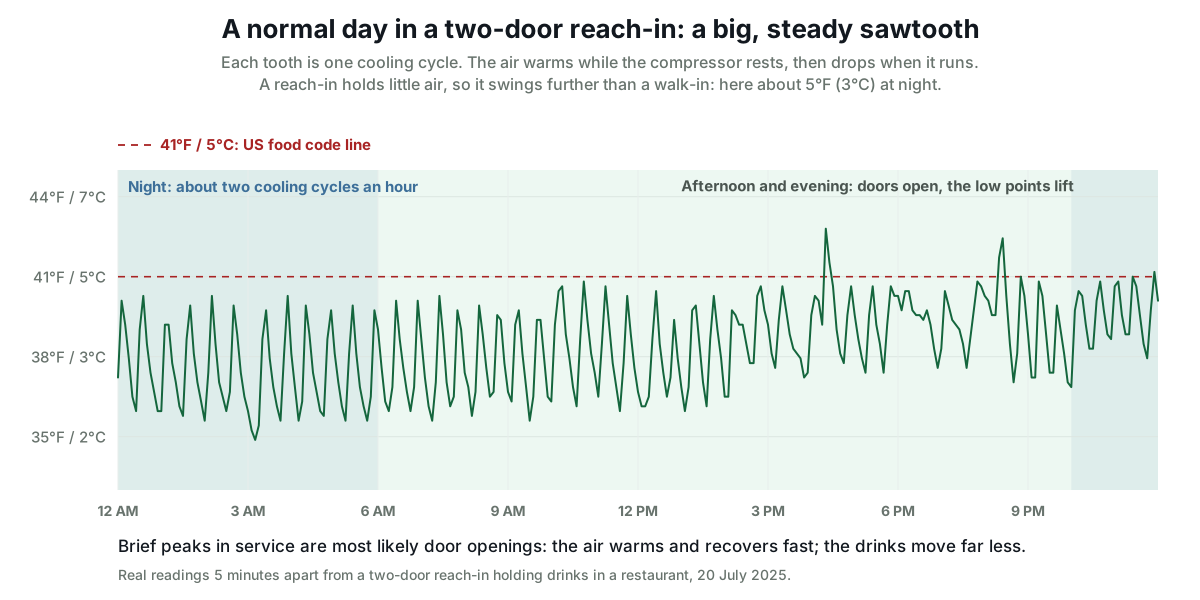
At night, each tooth is one cooling cycle. The air warms while the compressor rests and drops when it runs, about twice an hour. Overnight it swung between 35°F and 40°F (2°C and 4°C).
That swing is far bigger than a walk-in's. The walk-in cooler on how a walk-in cooler works ripples by about 1°F (0.5°C), four times an hour. A reach-in holds much less air and food to slow the change down, so each cycle moves its air further.
By day, the door shows. From mid-afternoon the low points lift, and two brief peaks reached about 43°F (6°C). They are most likely the door during service. Each one was back down within about half an hour, and the air spent 25 minutes above 41°F (5°C) all day.
This is the air, not the drinks. A full cabinet's contents change temperature far more slowly than the air around them, so a short peak from the door is not a reason to throw anything away. That is why a sensor in a small bottle of glycol reads like the food.
Not every day in this fridge looked like this. The same month had long, flat, warm stretches, and the clearest one is on reach-in cooler troubleshooting.
Seven symptoms cover most of what goes wrong
Each one has its own section, with what it usually is and what to check, on reach-in cooler troubleshooting.
- The cooler is warm and will not hold temperature
- An undercounter runs warm on the cookline or under a counter
- It freezes the food
- Ice behind the fan guard that does not clear
- The door will not close or seal
- It runs all the time
- Water inside the cabinet or on the floor
A reach-in freezer is the same machine with heaters added, and it fails in some different ways. That is on how a reach-in freezer works.
This page describes the common case, not your exact cabinet
Makers differ on settings, defrost, fan behaviour, clearances and cleaning, so your manual wins over the typical figures here.
Our readings come from one drinks fridge in one restaurant, in July. A food cooler is usually set colder, and the same fridge in winter, or in a cooler kitchen, would swing less in the afternoon.