
The drain line, trap and drain heater: why meltwater floods a cooler or freezes in a freezer, and what to check
By Vimal Bhaya, Founder and Lead Systems Architect · Last reviewed 20 October 2026
This is a continuation of Walk-in refrigeration parts, a 14-part tutorial. You are on part 8 of 14.
Every cooler and freezer makes water. Frost on the coil melts, drips into a pan under the coil, and runs out of the box through a drain line. The line falls all the way, passes through a trap outside the box, and ends over an open drain. In a freezer, a heater wrapped round the line stops the water refreezing on its way out.
When the drain fails, the water has nowhere to go. In a cooler it spills onto the floor. In a freezer it refreezes in the pan, and the ice climbs back into the coil from the bottom up. Icicles under the unit, or water on the floor, are a call within a day.
Meltwater has to leave the box, downhill all the way
A coil pulls water out of the air and holds it as frost. In a cooler, that frost melts every time the cooling rests. In a freezer, heaters melt it a few times a day, during defrost. Either way, the water drips into a pan under the coil, and from there it has to leave the box.
There is more water in the air than you think
Warm air holds far more water than cold air. Take a walk-in freezer about 10 feet each way, so about 1,000 cubic feet of air, at 0°F (-18°C):
- The freezer's own air holds about 1 ounce of water (30 grams), about two tablespoons, even when it is as humid as it can get.
- The same box of kitchen air holds about ten times as much. At 75°F (24°C) and 50% humidity, that is about 11 ounces (300 grams), more than a cup. On a hot, humid summer day it is nearer 18 ounces (500 grams), two cups.
- When kitchen air comes in, the cold squeezes its water out. Almost all of it turns to frost, most of it on the coil, the coldest thing in the box.
- It adds up fast. Heatcraft's sizing guide reckons a 1,000 cubic foot freezer swaps all its air about 13.5 times a day through its door and small leaks, and about twice that when it is busy. That brings in about a gallon (4 liters) of water a day. A busy freezer in a humid summer kitchen takes in more than 3 gallons (13 liters) a day: a bucketful.
- Every drop has to come back off the coil at defrost and leave through the drain.
These are our own estimates, worked out from standard humidity tables and Heatcraft's air-change figures.
The water leaves the box one of two ways
Most boxes drain downhill to a floor drain. Where there is no drain nearby, a small pump lifts the water away instead.
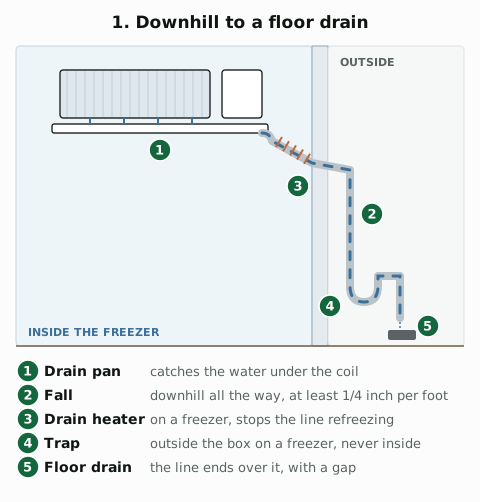
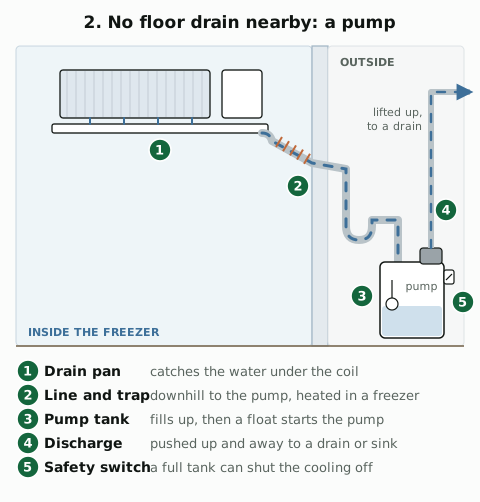
How the water gets out of the pan
- The pan is tilted toward its outlet. Russell hangs its unit coolers with a fall of 1/4 inch per foot toward the drain fitting, and Heatcraft says some designs build the slope into their mounting brackets. So the unit must hang the way its maker intends.
- In a cooler, that is all it takes. The water is already liquid, and the air round it is above freezing.
- In a freezer, the pan is heated too. On an electric-defrost unit, a heater sits inside the pan, which Russell's sheet says is there for fast drainage. On a hot-gas unit, a loop of hot refrigerant runs through the pan to stop the water freezing in it.
- Then the line takes over, heated all the way through the cold box.
Heatcraft's rules for the line
- At least as large as the pan's outlet.
- Downhill all the way, at least 1/4 inch per foot.
- Trapped, and run to an open drain, never straight into the sewer.
- On a freezer, the trap goes outside the box, in warm air. Water held in a trap inside a freezer freezes.
- On a freezer, heated and insulated from the pan's fitting to where the line leaves the box. Heatcraft gives 20 watts per foot of line for a 0°F (-18°C) room and 30 watts per foot for a -20°F (-29°C) room.
- A cooler's line normally has no heater, because its air is above freezing. Traps and long runs of line outside in freezing weather need one, though.
Why the line needs a trap
This one surprises people. The fans in the unit cooler pull air through the coil, and that leaves the pan sitting in slightly lower pressure than the room. It works like sipping through a straw:
- With no water in the trap, the line is an open straw. Room air is sucked up the line into the pan, and the water cannot run down against it. It sits in the pan, or spills over the edge. An HPAC engineering guide says a unit like this drains little or nothing without a trap.
- When the fans stop, the sucking stops, and the pan empties. So a pan that fills while the fans run and empties when they stop points to the trap.
- A trap is a U-bend that holds a little water. That water plugs the line against the air, but still lets the meltwater through. It keeps smells and insects out too.
- A trap that dries out is an open straw again.
- One trap, not two. ACHR News describes a line with two traps that locks up: the water is held between them, and leaks from the pan or refreezes in it.
A drain fails in six common ways
Each one leaves the water with nowhere to go. The troubleshooting pages show where each sits among the other reasons for the same symptom.
What the readings show | What you see | Fault | Where it is covered |
|---|---|---|---|
Nothing at first. Then the slow rise of an iced coil | The line frozen solid inside the box, ice in the pan, icicles under the unit | A failed pan or line heater, on a freezer | |
Nothing, until the water or ice reaches the coil | Standing water or ice in the pan, drips from the edge of the unit | A blocked pan or line | |
Nothing at first: a pan that empties slowly, or freezes after each defrost | A line that dips between its supports, or a trap inside a freezer | Too little fall, or a trap in the wrong place | |
Nothing: it shows as water, not temperature | A pan that empties when the fans stop and fills while they run, or a smell from the drain | A missing or dried-out trap | |
Nothing: it shows as water, not temperature | Water inside the cabinet or under it | A tube out of its pan, or a pan that cannot keep up, on reach-ins and prep tables | |
Nothing, unless its safety switch is wired to the cooling. Then the cooling stops and the box warms | A full pump tank, and a pump that does not run | A failed condensate pump, option 2 above |
Here is what a blocked or frozen drain does to the rest of the refrigeration system
Water that cannot leave has to go somewhere:
- In a cooler, it spills over the edge of the pan and onto the floor, where someone can slip.
- In a freezer, it refreezes in the pan. Each defrost adds a layer, and the ice climbs back into the coil from the bottom up.
- The iced coil moves less air, so the box warms slowly, as it does with an iced coil from any cause.
- In a display case, it floods the coil after each defrost.
Ice that grows from the bottom up points to the drain
Where the ice sits on a coil tells you what caused it. Ice thickest at the bottom of the coil and in the pan, often with icicles under the unit, points to the drain. The evaporator coil page sets out the other patterns.
A blocked line is often dirt, not ice
Dust, mould, slime and bits of food and packaging collect in the pan and the line. A freezer line can then fill with water that freezes, even when its heater works.
"Freezer Drain Line Keeps Freezing"
r/appliancerepair, thread title
Heatcraft says to clean the pan regularly with warm soapy water. All power must be off first, because the pan also covers the fans. That makes it a job for maintenance or a technician.
A frozen drain shows first as water and ice, then as an iced coil
A drain does not change the air temperature on the day it fails. The first signs are the water itself: icicles under the unit, ice or water in the pan, a puddle on the floor.
Over the following days, as ice builds back into the coil, the box starts to struggle. An iced coil looks the same in the readings whatever iced it. The freezer on walk-in freezer troubleshooting shows it. As its coil iced, the coldest reading of each day crept up for eight days before the peak. A normal freezer's readings, defrost bumps and all, are on how a walk-in freezer works.
You can check a drain from a step ladder, without opening anything
- Look under the unit for icicles, and at the floor for water.
- Look into the pan with a torch from a step ladder, without opening any panel. Standing water or ice means the drain is not carrying it away.
- Follow the line from the unit to where it ends. It should fall all the way, with no dips or flat runs. On a freezer, look for ice along the line inside the box, and check the trap sits outside.
- Check where it ends. The line should end over an open drain, with a gap, through a trap that holds water.
- On a reach-in or prep table, check the drain tube or hose sits in its pan. True's manual asks for a monthly check of the drain line.
- If the box drains to a pump, check it is plugged in, and listen for it running when its tank fills.
Do not cut or chip a frozen line, and never chip ice from the pan or the coil. Mop up and put a sign out if water reaches the floor. A frozen line in a freezer, or a pan that will not drain, is a call within a day.
"Freezer drain P trap?"
r/refrigeration, thread title
The answer is the same in Heatcraft's manual: on a freezer, the trap goes outside the box, and the line inside is heated.
Every cold box makes water, and each gets rid of it differently
Unit | Where the water goes | What goes wrong | More on this |
|---|---|---|---|
Walk-in cooler | Pan, an unheated line through the wall, a trap outside, an open drain. Some lift the water with a condensate pump | A blocked pan, a sagging line, a dry trap, a failed pump | |
Walk-in freezer | Pan, a heated and insulated line, a trap outside the box | A failed heater, a trap inside the box, a blocked line | |
Reach-in cooler | A drain tube to a pan on the unit, where the water evaporates. Some pans have a heater or a wick | A tube out of the pan or clogged, a pan too small | |
Reach-in freezer | A drain tube heated during defrost, to a pan with its own heat | A failed drain heater, a cracked or plugged tube | |
Prep table | A hose to a condensate pan. Cold-wall rails have their own drain | A hose out of the pan, a cracked pan, a blocked rail drain | |
Display case | A waste outlet and trap to a floor drain, or a pan on a self-contained case | A clogged drain that floods the coil after each defrost | |
Reefer | Drain tubes from the coil out of the unit. Carrier's checks include them | Clogged tubes that put the water back on the coil |
The simpler way: TemperatureWise watches for a frozen or blocked drain
Everything on this page takes time, and you have to know what to look for. TemperatureWise takes that complexity out:
- It learns each box. It uses machine learning on the full temperature history of each box, and learns that box's own pattern.
- It watches for a frozen or blocked drain. In the readings, that looks like the coldest reading of each day creeping up as ice builds back into the coil.
- It names the likely culprits. When it sees that change, TemperatureWise tells you what has changed and the top three likely parts at fault, so you know where to look.
It does not clear the drain. It tells you when the box has started to struggle, so the drain gets looked at before the coil is a block of ice.
This is one of our walk-in refrigeration parts pages. The defrost timer page covers the part that decides when the water comes.