
The walk-in evaporator coil: normal frost, ice patterns and leaks
By Vimal Bhaya, Founder and Lead Systems Architect · Last reviewed 4 October 2026
This is part 1 of 2 in Walk-in refrigeration parts, a growing guide to the parts inside a walk-in.
The evaporator coil is the cold radiator inside a walk-in, in the unit hung under the ceiling. Refrigerant boils in its copper tubes and pulls heat out of the air the fans push through its aluminium fins.
A light, even frost that clears at every defrost is normal. Ice that stays is a fault, and where it sits points to the cause: even ice to defrost, patchy ice to a heater, ice at the bottom to the drain, frost at one end to a starved coil.
The coil is copper tubes, aluminium fins and fans in one box
The trade calls the whole box a unit cooler. Inside it are the coil, the evaporator fans that pull air through it, a drain pan underneath, and the expansion valve at the coil's inlet. A freezer's unit cooler also carries defrost heaters and a switch that ends each defrost.
The coil runs colder than the box air. Heatcraft designs around a difference of about 10°F (6°C). That is why moisture in the box's air ends up on the coil as frost: it is the coldest surface in the room.
Freezer coils have their fins further apart. Russell's unit coolers, for example, use 6 fins per inch for coolers and 4 for freezers between 32°F and -30°F (0°C and -34°C), so frost takes longer to bridge the gaps.
A light, even frost is normal, and defrost clears it
In a cooler, the coil clears its own light frost every time the cooling switches off, because the fans keep blowing the box's air, which is above freezing, across it. See how a walk-in cooler defrosts.
In a freezer, heaters in the coil melt the frost a few times a day, and the water drains away through a heated line. See how a walk-in freezer defrosts.
So the test is simple. Frost that comes and goes is the coil working. Ice that stays, or grows, is something else failing.
Where the ice sits points to the cause
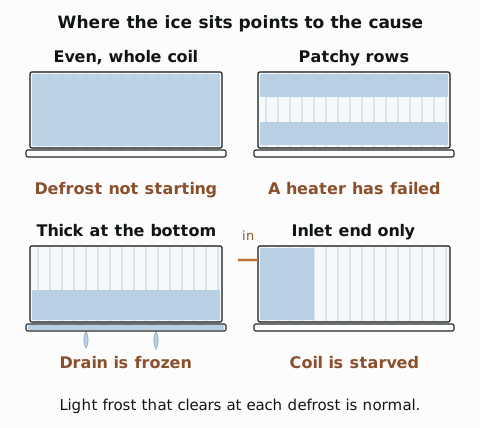
What you see | Usually means | Freezer | Cooler |
|---|---|---|---|
Even ice across the whole coil | Freezer: defrost is not starting. Cooler: set too cold, or never switching off | ||
Patchy: some rows iced, some clear | A defrost heater has failed | Not applicable: no heaters | |
Thickest at the bottom and in the pan | The drain is frozen or blocked | Rare: cooler drains do not normally freeze | |
Frost only where the refrigerant enters | A starved coil: low refrigerant or a blocked expansion valve | ||
Ice in front of one fan | That fan has stopped | ||
Frost on the ceiling and walls too | Warm, wet air is getting in |
These are the usual readings, not certainties. Two faults can overlap, and a technician confirms the cause.
Coils also leak, clog and get damaged
- Pinhole leaks from corrosion. Copper coil tubes can be eaten from the outside by what ACHR News calls formicary, or ant nest, corrosion: chemicals in the air collect in the water on the coil and etch tiny tunnels through the copper. The same article says perforation usually takes weeks or months, not years. It shows up as a slow loss of refrigerant leaks and charge.
- Dirty fins. Dust, grease and fluff on the fins block the air the same way a stopped fan does. Less air means a colder coil and more frost.
- Physical damage. Chipping ice off a coil punctures its tubes; ACHR News says never to use an ice pick, a screwdriver or anything similar. Boxes, carts and pallets stacked against the unit crush fins and block the air.
Five things you can check from the floor
- Where is the frost or ice? Compare it with the four sketches above.
- Are all the fans turning? Outside a freezer's defrost, they should be.
- Is anything stacked against the unit, or in front of its fans? Move it.
- Are there icicles or water under the unit? That points to the drain.
- Is there frost on the ceiling near the door? That points to wet air getting in.
Do not open the panels, and never chip ice off the coil. Bohn's unit cooler manual warns that the coil's sharp edges are an injury hazard, and its tubes are easy to hole.
A leaking coil is usually a replacement, not a repair
Corrosion leaks tend to be spread through the coil, so technicians often replace the coil, or the whole unit cooler, rather than chase each pinhole. Ask what is being replaced and why, and whether the cause, such as cleaning chemicals near the unit, has been dealt with.
Get the quote in writing, and ask whether it covers the coil alone or the whole unit cooler, and whether the refrigerant, labour and haul-away are included.