
Walk-in freezer defrost timers: how they work, how they fail, and what to check
By Vimal Bhaya, Founder and Lead Systems Architect · Last reviewed 19 October 2026
This is a continuation of Walk-in refrigeration parts, a 14-part tutorial. You are on part 3 of 14.
A defrost timer is the 24-hour clock that starts a walk-in freezer's defrosts, a few times a day. At each one, it stops the cooling and the fans and switches on heaters in the coil. A switch on the coil ends the defrost once the coil is clear, and the timer's own time limit is the backup.
A timer fails in four common ways: its clock stops, it ends defrosts too soon, it loses the time after a power cut, or new ones keep failing. Most of these show in the box's temperature before anyone sees ice. You can check the dial yourself. The rest is a technician's job.
A defrost timer is a 24-hour clock with a pin for each defrost
Frost builds on a freezer's coil all day, from the moisture in the box's air. Frost blocks the air, so it has to go. A freezer's air is far too cold to melt it, so the coil needs heat a few times a day. The timer decides when.
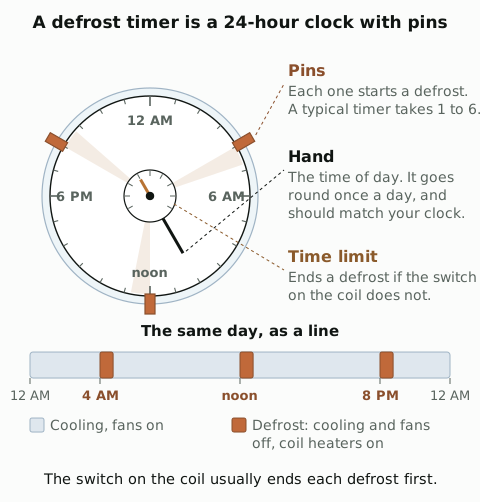
A mechanical timer has a dial that turns once a day. Pins, or tabs, on its rim mark when each defrost starts. Robertshaw's Paragon timers take 1 to 6 defrosts a day, at least 4 hours apart. Intermatic's set each start to the quarter hour.
At each pin, the timer flips a heavy switch inside it. That one switch turns the freezer from cooling to defrost, and back.
Part | Between defrosts | During a defrost |
|---|---|---|
Cooling | On whenever the thermostat asks | Off |
Evaporator fans | On | Off, and they stay off afterwards until the coil is cold again |
Heaters in the coil | Off | On, until the coil is clear |
On many split systems the timer does not stop the compressor directly. It cuts power to the thermostat, the fans and a valve on the liquid line. The valve closes, the compressor pumps the coil empty, and then it stops. Heatcraft calls this pump-down.
A switch on the coil usually ends the defrost, and the timer's limit is the backup
Most walk-in freezers end each defrost on temperature. A switch clipped to the coil closes once the coil is warm and clear, at 55°F (13°C) on Heatcraft's unit coolers. It tells the timer to go back to cooling.
If that switch fails, the timer's own time limit ends the defrost instead. On a Paragon timer the limit can be set from 4 to 110 minutes. Heatcraft says to set it about a quarter longer than a normal defrost.
That switch is a part of its own, the defrost termination and fan delay switch. It also holds the fans off after a defrost. Where all these parts sit in the box is on how a walk-in freezer works.
A freezer's readings show its timer's schedule, and the week it began to fail
Each defrost warms the air in the box for a short while. So a freezer's temperature record shows its timer's schedule as a row of bumps, at the same times every day.
This is a walk-in freezer at a Philadelphia distribution center in April 2025. Its timer ran three defrosts a day, at about 4 AM, noon and 8 PM. On 22 April a technician found the timer had failed and the coil had iced, and replaced the timer.

From 11 to 17 April, all 21 defrosts came on time. Yet from 15 April, the coldest reading of each day crept up, from about -3°F (-19°C) to about 0°F (-18°C). That is the sign of a coil carrying a little more ice each day.
From 18 April, the defrosts began to go missing. Only 3 of the 12 due by 21 April came. The floor climbed fast, to 12.4°F (-10.9°C) on 21 April.
So this timer did not stop on one bad day. Its trouble showed for a week in the readings, first as a rising floor and then as missing bumps. TemperatureWise flagged a likely fault on the evaporator side at 5:30 AM on 20 April, at 10.4°F (-12°C), 53 hours before the box peaked. No product was lost. The full record is in the Philadelphia freezer case study.
A defrost timer fails in four common ways, and each one looks different
Each of these leaves ice on the coil, or puts the defrosts at the wrong time. The troubleshooting pages show where each one sits among the other reasons for the same symptom.
What the readings show | What you see | Fault | Where it is covered |
|---|---|---|---|
The defrost bumps stop coming | Ice spread evenly over the whole coil. The dial does not move | The clock stops | |
The bumps keep coming, and the floor between them creeps up | Ice left on the coil after each defrost, growing over days | Defrosts end too soon | |
The bumps move to new times of day | Defrosts in your busiest hours | The time is wrong after a power cut | |
Any of the above | A second or third new timer in a short time | Timers that keep failing |
A stopped clock means no defrost at all
The timer's motor runs all the time the power is on. If it stops, no pin ever reaches the switch, so the freezer never defrosts. Frost builds a little more each day until the coil is a solid block. Joe Marchese of Heatcraft lists this first among timer faults.
A defrost that ends too soon leaves ice behind
The timer is part of what ends each defrost, as well as what starts it. If its end-of-defrost parts fail, or the coil switch sticks closed, the freezer goes back to cooling before the coil is clear. Each defrost leaves a little ice, and it adds up. The Philadelphia readings above show this pattern first, then the bumps going missing.
A power cut can move every defrost to the wrong time
A mechanical timer is driven by the power supply. When the power goes off, its clock stops, and when the power returns it carries on from the same point. A 3-hour cut moves every defrost 3 hours later, often into a busy time when the door is opening most. Some timers carry a battery that keeps the clock running for up to a week.
A timer that keeps failing may not be the timer's fault
"Need help with walk in defrost timer keeps going bad"
r/refrigeration, thread title
If a new timer fails again soon, ask the technician to check what feeds it, such as the voltage reaching its clock. Fitting a third timer does not fix that.
You can check a defrost timer three ways without opening anything
- Read the dial. Compare its time of day with your own clock. If it is wrong, the defrosts are landing at the wrong hours.
- Look again an hour later. The dial should have moved on by an hour. If it has not, the clock has stopped.
- Watch one defrost time. Soon after a pin comes round, the fans should stop and the box should warm a little. An hour after it starts, the fans should be turning again.
Leave the cover closed and the dial alone. Behind the cover are terminals at full line voltage, switching the heaters and the cooling. Setting the time is a minute's job for a technician.
What to tell the technician: the times the box warms, whether the dial moves, when the last power cut was, and how old the timer is.
Reach-ins, display cases and reefers schedule their defrosts in other ways
Not every unit has a separate timer. In many reach-in freezers, Marchese notes, a controller starts each defrost by time and ends it on a coil sensor. Coolers often need no timer at all, because their air is warm enough to melt the frost whenever the cooling rests.
Unit | What starts a defrost | How often | More on this |
|---|---|---|---|
Walk-in cooler | Usually nothing: it melts its frost each time the cooling rests. Some add a timer that forces the cooling off | At every rest | |
Reach-in freezer | A built-in controller or timer, by the clock or by how long the compressor has run | True: every 4 hours of running. Traulsen G-Series: 6 a day. Continental: 3 a day | |
Reach-in cooler | Usually nothing, as in a walk-in cooler. Some add a timed defrost | Traulsen G-Series: every 8 hours | |
Prep table | Usually nothing. Some add timed defrosts | Arctic Air: every 6 hours. Traulsen TS: every 3 hours | |
Display case | The case controller, or the store's central rack controller | Typically every 6 or 8 hours, for 20 to 30 minutes | |
Reefer | The unit's controller, on a timer or when its sensors show frost | Thermo King: every 2, 4, 6, 8 or 12 hours |
The faults are the same kinds as in a walk-in: a clock that resets after a power cut, too few defrosts for a busy door, or a sensor that ends defrost too soon. Each is covered on reach-in freezer troubleshooting, display case troubleshooting and reefer troubleshooting.
The simpler way: TemperatureWise watches for a failing defrost timer
Everything on this page takes time, and you have to know what to look for. TemperatureWise takes that complexity out:
- It learns each box. It uses machine learning on the full temperature history of each box, and learns that box's own pattern.
- It watches for a failing defrost timer. In the readings, that looks like defrost bumps that go missing, and the coldest reading of each day creeping up as ice builds.
- It names the likely culprits. When it sees that change, TemperatureWise tells you what has changed and the top three likely parts at fault, so you know where to look.
On the Philadelphia freezer on this page, TemperatureWise flagged a likely fault on the evaporator side 53 hours before the box peaked, and no product was lost.
It does not replace your technician. It tells you which one to call, and when.
This is one of our walk-in refrigeration parts pages. The evaporator coil page shows what each ice pattern on the coil points to.