
How a walk-in freezer works, and what normal looks like
By Vimal Bhaya, Founder and Lead Systems Architect · Last reviewed 4 October 2026
This is a continuation of How walk-ins work, and how they fail, a 4-part tutorial. You are on part 3 of 4.
A walk-in freezer keeps its air at 0°F (-18°C) or colder by pumping heat out of the box. It does not make cold.
It is two halves joined by copper pipe: a cold coil and fans inside the box, and a compressor and condenser outside it. A healthy one sits near its setting, warms up on purpose a few times a day to melt frost off its coil, and is back down within about two hours each time.
Three layouts cover almost every walk-in freezer
Every walk-in has the same insulated box, the same door and the same cold coil under the ceiling. What changes is where the other half of the machine sits.
By our own estimate, three layouts cover about four in five walk-ins in the US and Canada, and almost every one in restaurants and schools. Nobody publishes a count, so the order below is our estimate too.
Layout | How to tell | How common | What it is prone to |
|---|---|---|---|
Split system, condensing unit outdoors 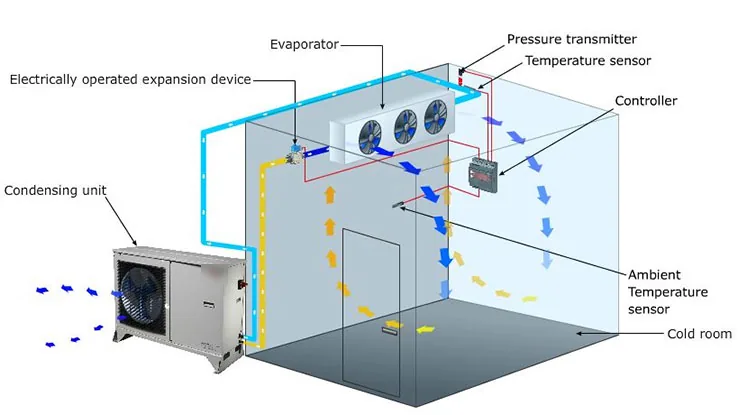 Coil inside, condensing unit outside, two pipes between. This drawing shows an electronic valve and controller. Most split walk-ins use a thermostatic valve instead. Coil inside, condensing unit outside, two pipes between. This drawing shows an electronic valve and controller. Most split walk-ins use a thermostatic valve instead. | Two copper pipes leave the box through the roof or a wall. They run to a metal cabinet with a large fan, on the roof or a concrete pad. | The most common | |
Split system, condensing unit indoors | The same cabinet sits on top of the box or in a back room. You hear it running indoors. | Common in older city buildings and in Canada | |
Packaged (self-contained) unit 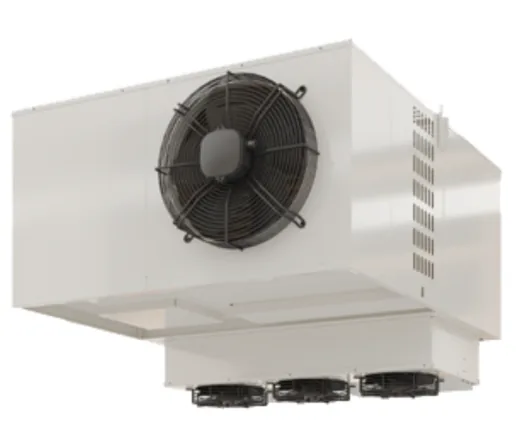 Ceiling mount Ceiling mount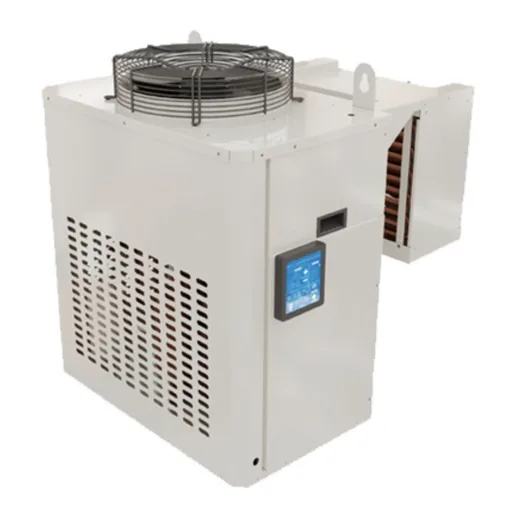 Wall mount Wall mount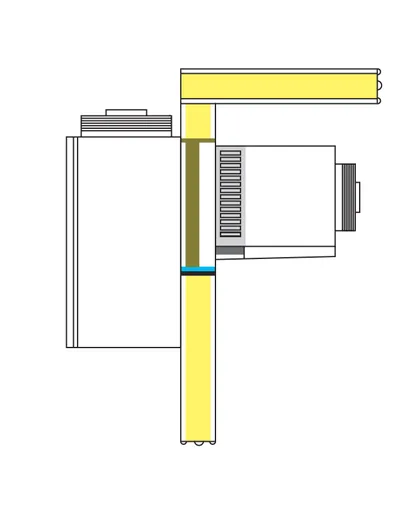 Side view: half outside, half in Side view: half outside, half in | One factory-built unit sits through the roof or a wall, half inside and half outside. No copper pipes run between parts. | Less common, and growing |
A fourth layout feeds the coil from a supermarket's central machine room, shared with the frozen food cases. That is a different system, and this page does not cover it.
A freezer moves heat out of the box, it does not make cold
Cold is only the absence of heat. So the machine's whole job is to pick up heat inside the box and dump it outside, over and over.
It does that with refrigerant, a fluid that boils at very low temperatures. Boiling soaks up heat, the way sweat cools your skin. Squeezing the vapour back into a liquid gives that heat up again somewhere else.
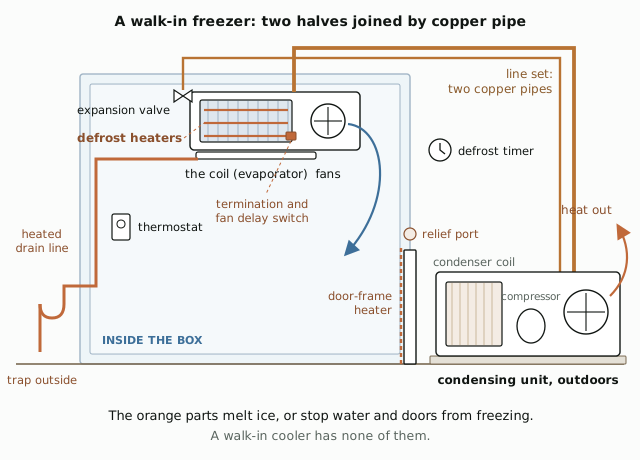
Here are the parts, in the order the refrigerant meets them.
- The compressor, outside the box. A pump that squeezes the refrigerant vapour until it is hot enough to give its heat away.
- The condenser coil and its fan, next to the compressor. A radiator that blows the heat into the outdoor air or the room. The refrigerant cools and turns back into a liquid.
- The line set, two copper pipes. The thin one carries liquid into the box. The thick, insulated one brings vapour back out.
- The expansion valve, where the liquid enters the coil. A tiny opening the liquid is squeezed through, so its pressure drops and it can boil cold. Walk-ins use three kinds, set out below.
- The coil inside the box (the evaporator). The liquid boils in its tubes and soaks heat out of the air blown across it.
- The evaporator fans, which pull the box's air through that coil and throw it back out cold.
Around that loop sit the parts that make a freezer different from a cooler. Heaters melt frost off the coil. A timer says when. A switch on the coil says when to stop. A heated drain carries the meltwater away, and heaters keep the door from freezing to its frame. A thermostat or controller decides when to cool.
The expansion valve comes in three kinds, and they behave differently
Every walk-in has one. It decides how much refrigerant reaches the coil. Too little, and the coil is starved: the box runs warm and only part of the coil frosts. Too much, and liquid can flood back to the compressor and damage it.
There are three kinds, and the difference matters. The same warm box has different causes, and a different repair, depending on which one you have.
Kind | How it meters | Adjusts to the load? | Where you find it | What goes wrong |
|---|---|---|---|---|
Capillary tube, or a fixed orifice | A long, very thin tube, or a fixed hole, that lets refrigerant through at a set rate | No. A fixed device will not open more when the load rises | Small packaged units. Daikin's SB ceiling monoblocks, for example, list expansion through a capillary tube | Blocked by moisture or debris. The refrigerant charge has to be exactly right |
Thermostatic expansion valve (TXV) | A valve with a sensing bulb clamped to the pipe leaving the coil. The bulb feels how warm the outgoing vapour is, and opens or closes the valve to match | Yes, by itself | Most split-system unit coolers | A plugged inlet screen, moisture freezing in the valve, or a bulb that has come loose or lost its charge |
Electronic expansion valve (EEV) | A motor-driven valve, moved by a controller that reads a pressure sensor and a temperature sensor | Yes, most precisely | Premium controllers and newer systems, like the split drawing above | A failed sensor, a failed driver, or the wrong setting |
A TXV aims for a target called superheat: how many degrees the vapour has warmed past its boiling point by the time it leaves the coil. A few degrees means the coil is full of boiling refrigerant, with no liquid escaping toward the compressor. Heatcraft gives 6°F to 10°F (3°C to 6°C) for a typical design.
You cannot check any of these yourself. What helps is knowing which one you have, from the unit's spec sheet or your technician, because it changes what a low charge diagnosis means. How each one fails, and how a technician tells a blocked valve from a leak, is on the walk-in expansion valve page.
Every part has a healthy look or sound you can check
This table is the page in one place. The last column links to a page on each part. Two are written so far; the rest are marked as links to come.
Part | What it does | Where it sits | Healthy looks or sounds like | Part page |
|---|---|---|---|---|
Compressor | Pumps the refrigerant round the loop | Outdoor split: in the cabinet on the roof or pad. Indoor split: on top of the box or in a back room. Packaged: in the unit on the box | Runs in long, steady stretches with an even hum. Not on and off every few minutes | compressor, contactor and starting parts |
Condenser coil and fan | Throws the box's heat away | Next to the compressor, in all three layouts | Fins you can see through. Fan turning whenever the compressor runs, warm air coming off | condenser coil and fan |
Refrigerant and line set | Carry the heat from the coil to the condenser | Split systems: two copper pipes between the halves. Packaged: sealed inside the unit | Nothing to see. A technician checks the charge with gauges | refrigerant leaks and charge |
Expansion valve | Meters liquid into the coil | At the coil inlet, inside the box. Packaged units often use a capillary tube instead | Nothing to see. A technician checks it by measuring | |
The coil (evaporator) | Soaks heat out of the box's air | Under the ceiling inside the box. Packaged: the inside half of the unit | A light, even frost that clears at every defrost | |
Evaporator fans | Push the box's air through the coil | In the unit under the ceiling | All turning, except during a defrost and for a few minutes after | evaporator fans |
Thermostat or controller | Decides when to cool, and on some boxes when to defrost | On the wall inside or outside the box, or on the unit | Still at the setting you chose. The box sits near it between defrosts | thermostat, controller and pressure switches |
Defrost timer | Starts each defrost on a schedule | On the wall near the box, or in the condensing unit's control box. Some boxes use a controller instead | Its dial shows the right time of day. Defrosts happen at the same times every day | defrost timer |
Defrost heaters | Melt the frost off the coil | Running through the coil | The coil is clear after every defrost | defrost heaters |
Termination and fan delay switch | Ends defrost when the coil is clear, then keeps the fans off until it is cold again | Clipped to the coil | Fans stop at each defrost and restart a few minutes after it ends | defrost termination and fan delay switch |
Drain line, trap and drain heater | Carry the meltwater out without it refreezing | From the pan under the coil, through the wall, to a trap outside the box | No ice in the pan, under the unit or on the floor | drain line, trap and drain heater |
Door, gasket, closer and door heaters | Keep warm, wet air out | The door and its frame, with a small heated relief port in the wall nearby | The door swings shut by itself and seals all round. The frame feels warm. No frost ring | door gasket, closer, strip curtain and door heaters |
Winter controls | Keep the system working in freezing weather | In the outdoor cabinet. Indoor units usually have none | The box holds on cold nights as well as warm days | winter controls: head-pressure control and crankcase heater |
One cooling cycle runs from the thermostat calling for cold to the compressor stopping
- The box warms a little past its setting, and the thermostat calls for cold.
- On most split systems, that opens a valve on the liquid pipe. Pressure rises in the system and the compressor starts.
- The compressor squeezes the vapour and sends it to the condenser, where the fan blows the heat away.
- The liquid travels into the box through the line set. The expansion valve meters it into the coil.
- The liquid boils in the coil, soaking up heat from the air the fans push through. The vapour returns to the compressor.
- The box reaches its setting, and the thermostat closes the valve on the liquid pipe.
- The compressor keeps running for a moment, then stops on its own.
That last step is called pump-down, and it is on purpose. The compressor pulls the refrigerant out of the coil and stores it before it stops, so liquid cannot pool in the compressor while it is off and damage it at the next start.
A freezer runs a periodic defrost cycle that heats the evaporator coil
Every time the door opens, warm, damp air comes in. The coil is the coldest thing in the box, so that moisture freezes onto it as frost. Frost blocks the air, so it has to go.
A freezer's air is far below freezing, so it cannot melt the frost by switching off. It needs heat. This is the sequence:
- At a set time, the defrost timer or controller stops the cooling and the evaporator fans.
- It switches on the heaters that run through the coil.
- A switch clipped to the coil senses when the coil is clear and warm, and ends the defrost. If that switch fails, the timer ends it anyway after a set limit.
- The meltwater runs into the pan and out through a heated drain line, so it cannot refreeze on the way out.
- Cooling restarts. The fans stay off until the coil is cold again, so they do not blow warm, wet air round the box. This wait is the fan delay.
- The fans come back on, and the box pulls back down to its setting.
Two more heaters work all day, not just at defrost. One runs round the door frame, so the gasket cannot freeze to it. The other warms a small pressure relief port in the wall, which lets air in and out so the door is not hard to open just after it has been shut.
The box air warms during every defrost. The food barely moves, because a frozen load takes hours to warm. Why that still sets off simple alarms, and what to do about it, is on why temperature alarms cry wolf.
Here are the vital metrics of a healthy walk-in freezer that you can check
These are typical figures from manufacturers' manuals and from one freezer's real readings. Your installer's settings come first.
| What | Normal | Where the number comes from |
|---|---|---|
| Box temperature | 0°F (-18°C) or colder. Systems are sized for rooms from 0°F to -20°F (-18°C to -29°C). One controller maker's default setting is -10°F (-23°C) | FDA storage chart, Heatcraft sizing guide, KE2 manual |
| Food safety line | Food kept at 0°F (-18°C) stays safe. Once food thaws, the cold-holding limit is 41°F (5°C) under the FDA Food Code and 4°C (39°F) in Ontario | FDA, O. Reg. 493/17 |
| Defrosts a day | A few. A typical mechanical timer can be set for 1 to 6. The Philadelphia freezer below ran 3, eight hours apart | Paragon timer literature, our own readings |
| How long a defrost lasts | Until the coil is clear, with a back-up time limit. One controller's default limit is 45 minutes | KE2 manual |
| Defrost ends when the coil reaches | About 50°F to 55°F (10°C to 13°C) | KE2 manual, Heatcraft unit cooler manual |
| Fans restart when the coil is back below | About 20°F to 35°F (-7°C to 2°C), depending on the switch | KE2 manual, Heatcraft unit cooler manual |
| Box air during a defrost | Up about 9°F (5°C), back down within about 2 hours | Our own readings, below |
| Run time | About 18 hours in every 24 | Heatcraft sizing guide |
| Coil compared with the box air | About 10°F (6°C) colder, on a typical design. A technician measures this | Heatcraft unit cooler manual |
| On and off cycles | No single normal number, because it depends on the load. Expect long runs with real rests, adding up to about 18 hours of running a day. More than 10 to 12 starts an hour is short cycling, by one compressor maker's limit | Heatcraft sizing guide, Tecumseh compressor manual |
What the technician will measure: refrigerant pressures, superheat at the coil, the compressor's current draw, and the temperatures where defrost ends and the fans restart. You do not need those numbers. You need to know whether your box behaves like this table.
Here is what a well-functioning freezer looks like in terms of air temperature
Here are three ordinary days on a walk-in freezer at a Philadelphia distribution centre. They come from the readings we publish with its case study. Nothing was wrong with it yet.
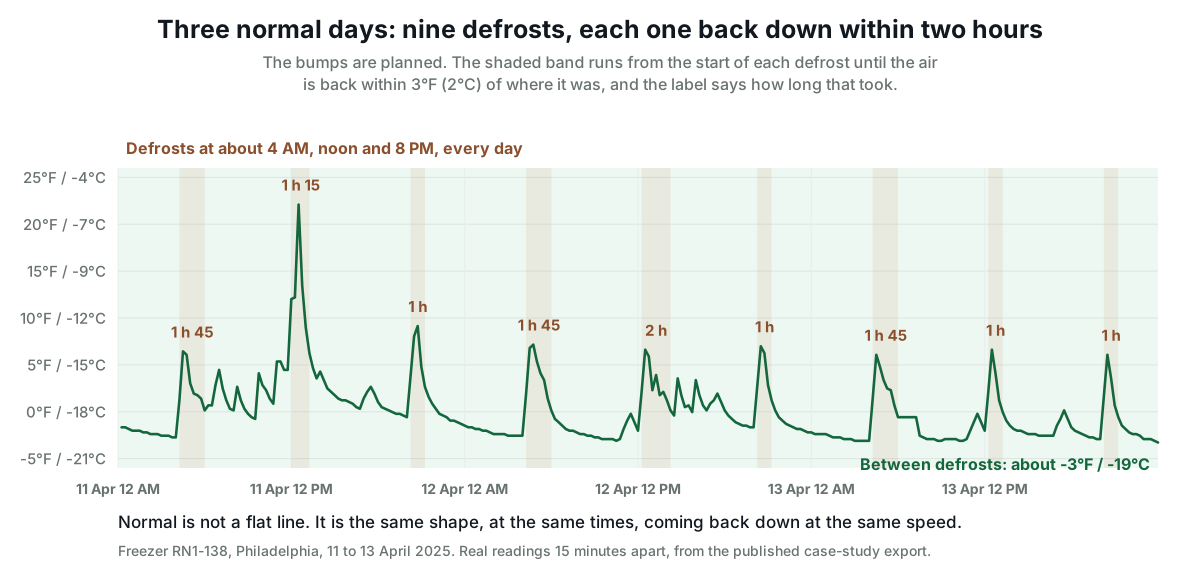
Three things to notice. The box sits near -3°F (-19°C) between defrosts. Three times a day, at about 4 AM, noon and 8 PM, the air jumps about 9°F (5°C). And every one of those nine bumps is back down within 1 to 2 hours.
One midday bump reached 22.1°F (-5.5°C). It still came back down in about an hour and a quarter. That is still normal.
This is the air, not the food. A frozen load takes hours to warm, so a 9°F (5°C) bump in the air barely touches it. That is why a sensor in a small bottle of glycol reads like the food rather than the air, as glycol buffers and thermobuffers explains. It is also why a defrost should not set off an alarm, which is the subject of why temperature alarms cry wolf.
The peaks are not the warning. Within days, this freezer's defrost timer failed and its coil iced. The first sign was not a taller peak. It was the temperature between the peaks creeping up. That chart is on walk-in freezer troubleshooting.
Seven symptoms cover most of what goes wrong
Each one has its own section, with what it usually is and what to check, on walk-in freezer troubleshooting.
- Ice building up on the coil
- Not getting cold enough, or stuck at 10°F to 20°F (-12°C to -7°C)
- Fans off after a defrost, or defrosts at the wrong time
- Ice on the floor, icicles under the unit, or water dripping inside
- A door that freezes shut, frost round the door, or a door that will not seal
- Warm on cold nights, fine in the afternoon
- A condensing unit that trips on hot days
This page describes the common case, not your exact box
Your freezer may differ. Some use hot refrigerant gas instead of heaters to defrost. Some have a controller that decides when to defrost by itself. Your installer's settings win over the typical numbers here.
The readings above come from one freezer. They are real, but they are not a standard. The point is to learn your own box's shape, then notice when it changes.