
The defrost termination and fan delay switch: how a freezer knows when to stop defrosting, and when to restart its fans
By Vimal Bhaya, Founder and Lead Systems Architect · Last reviewed 20 October 2026
This is a continuation of Walk-in refrigeration parts, a 14-part tutorial. You are on part 11 of 14.
The defrost termination and fan delay switch is a small switch clipped to a freezer's coil. It does two jobs. It ends each defrost once the coil is clear and warm, about 55°F (13°C) on Heatcraft's switch. Then it keeps the fans off until the coil is cold again, about 35°F (2°C), so they do not blow warm, wet air round the box.
When it fails, the defrost ends too soon and leaves ice, runs to its time limit and warms the box, or leaves the fans off after the defrost. Fans still off an hour after a defrost started is a same-day call. The switch itself is a technician's job.
One switch on the coil ends the defrost, then holds the fans until the coil is cold
A freezer's coil frosts up, so a few times a day the timer stops the cooling and turns on heaters to melt the frost. Something has to decide when the coil is clear, and when it is safe to blow air across it again. On most walk-in freezers that is one small switch clipped to the coil. It does two jobs:
- It ends the defrost. Once the coil warms past its set point, the switch tells the timer the ice is gone. On Heatcraft's switch that is about 55°F (13°C).
- It holds the fans off until the coil is cold again. That is the fan delay. On Heatcraft's switch the fans come back below about 35°F (2°C).
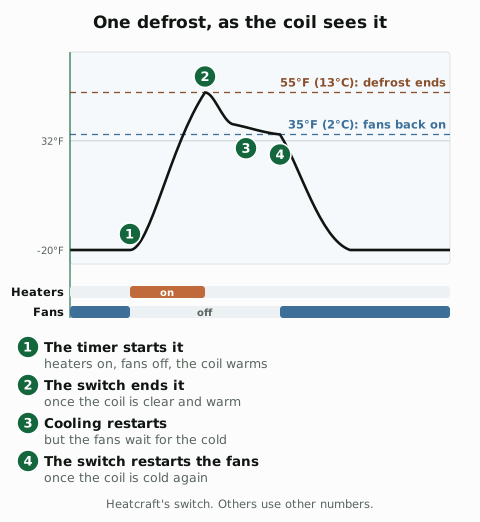
The numbers match the drawing:
- The timer starts the defrost. The heaters come on, the fans stop, and the coil warms.
- The switch ends it once the coil is clear and warm. If the switch never acts, the timer's own time limit ends it instead. Heatcraft sets that backup at the length of a normal defrost plus 25%.
- Cooling restarts, but the fans wait. The coil is still warm and wet. Blowing air across it now would spray warm, damp air round the box.
- The switch restarts the fans once the coil is cold again.
Heatcraft's switch cannot be adjusted. Electronic controllers do the same two jobs with a sensor on the coil and settings in a menu. One controller maker's defaults end an electric defrost at 50°F (10°C), stop it after 45 minutes at most, and restart the fans once the coil is below 20°F (-7°C).
A termination or fan delay fault shows up in four common ways
The switch can end a defrost too soon, never end it, or get the fans wrong. The troubleshooting pages show where each sits among the other reasons for the same symptom.
What the readings show | What you see | Fault | Where it is covered |
|---|---|---|---|
Normal-looking bumps, then the lows creeping up as ice builds | Patchy ice, clear in some rows and solid in others, that grows a little every day | Defrost ends too soon | |
Taller, longer bumps, at the same times every day | Defrosts that are longer and warmer than they used to be | Defrost never ends on temperature, so it runs to the time limit | |
A defrost bump that never comes back down | The compressor running, the coil clear and cold, and the fans still, long after defrost | Fans that never come back | |
A freezer that warms, and stays warm | On a reach-in freezer, a fan blowing while the heater is on, and a coil still frosted after it | Fans that never stop for defrost |
Here is what a bad termination switch does to the rest of the refrigeration system
A defrost is a balance. Too little heat leaves ice, and too much wastes energy and warms the box. The switch keeps it in balance, so when it fails, the rest of the system pays:
- Ended too soon, the defrost leaves ice behind. Each one leaves a little more, until the coil is a block and the box cannot hold its temperature.
- Run to the limit every time, the defrost heats the box as well as the coil. The air warms more at every defrost, and the compressor then has to pull all that heat back out.
- With the fans stuck off, no air crosses the coil. The coil is cold, but the box warms fast.
- With the fans never stopping, they blow the heater's warmth away from the coil, so the frost never clears.
A defrost that ends too soon looks like a heater fault
Both leave ice on the coil after every defrost. A burned-out heater tends to leave its own rows iced, as the defrost heaters page shows. A switch that ends too soon leaves ice wherever the heat had not yet reached. Telling them apart takes a meter, so it is a technician's job. Tell them where the ice is thickest.
"Defrost termination sensor not working (New and new clock)"
r/refrigeration, thread title
When a new timer and a new switch do not fix it, ask the technician to look at the heaters and the drain as well. The defrost timer page sets out why a part that keeps failing may not be the part at fault.
A normal defrost leaves a bump that comes back down
These are real readings from a walk-in freezer at a Philadelphia distribution center, on three ordinary days before its timer failed. All nine defrosts are laid over each other, lined up on the moment the timer started each one.

Each bump is the air warming while the defrost runs and the fans are still, then cooling once the fans are back. On these nine, the air rose 8°F to 10°F (4°C to 6°C), peaked about half an hour in, and came back down within 1 to 2 hours. The same three days are on how a walk-in freezer works.
A termination or fan delay fault changes that shape:
- Ended too soon: the bumps look normal, or smaller. The sign is slower: over days, the lowest reading between defrosts creeps up as ice builds.
- Never ending on temperature: every bump gets taller and longer, at the same times of day.
- Fans stuck off: the bump never comes back down.
You can check the defrost from the floor, and leave the switch to the technician
- Look at the fans an hour after a scheduled defrost starts. They should be turning.
- Look at the coil after a defrost. It should be clear. Ice that survives every defrost is a fault.
- Watch the drain during a defrost. Water should run. No water at all means nothing is melting.
- Time a few defrosts and compare them with last month. Longer and warmer bumps point to the switch.
The switch is wired into the unit cooler, under its covers. Do not open the unit, and never chip ice off the coil. Give the technician what you saw: the ice, the fans and the bump times.
Every freezer ends its defrost on temperature, with a backup on time
Unit | What ends the defrost | What restarts the fans | More on this |
|---|---|---|---|
Walk-in freezer, switch | A switch on the coil at about 55°F (13°C), with the timer's limit as the backup | The same switch, below about 35°F (2°C) | |
Walk-in freezer, controller | A coil sensor. One maker's default: 50°F (10°C), with a 45-minute limit | The coil sensor, below 20°F (-7°C) by that default | |
Walk-in cooler | Most have no switch: the coil clears while the cooling rests. A controller can end a forced one at about 40°F (4°C) | Nothing: the fans run all the time on most coolers | |
Reach-in freezer | A coil sensor. Traulsen's G-Series ends at 45°F (7°C), with a 30-minute limit | A delay. True holds the compressor off 2 minutes after the heater, then the fans 3 more. Continental's fans wait about 20 minutes | |
Display case | Temperature, normally well before the time limit, per Hussmann | The case controller | |
Reefer | Temperature. Thermo King's Precedent ends at 58°F (14°C). Carrier stops at 45 minutes and raises an alarm | The unit's controller |
The simpler way: TemperatureWise watches for a failing termination switch
Everything on this page takes time, and you have to know what to look for. TemperatureWise takes that complexity out:
- It learns each box. It uses machine learning on the full temperature history of each box, and learns that box's own pattern.
- It watches for a failing termination switch. In the readings, that looks like defrost bumps that grow taller and longer, or never come back down.
- It names the likely culprits. When it sees that change, TemperatureWise tells you what has changed and the top three likely parts at fault, so you know where to look.
It does not replace your technician. It tells you which one to call, and when.
This is one of our walk-in refrigeration parts pages. The defrost timer and defrost heaters pages cover the rest of the defrost.