
The defrost heaters: how a freezer melts its own frost, and what a burned-out heater leaves behind
By Vimal Bhaya, Founder and Lead Systems Architect · Last reviewed 20 October 2026
This is a continuation of Walk-in refrigeration parts, a 14-part tutorial. You are on part 12 of 14.
A freezer's coil runs far below freezing, so it cannot clear its frost by resting, as a cooler does. A few times a day the timer turns on electric heaters that run through the coil and the drain pan, and the frost melts and drains away. Some systems use hot refrigerant gas instead.
When a heater burns out, the defrost still runs on time, but part of the coil stays cold. Ice builds in the same rows after every defrost, and the box slowly loses its grip. Patchy ice that survives every defrost is a call within a day. Never chip the ice off.
Heaters in the coil melt a freezer's frost a few times a day
Every time the door opens, warm, damp air comes in and leaves frost on the coil. A cooler clears it by resting, because its air is above freezing. A freezer's air is far below freezing, so it needs heat. The heat comes from one of these:
- Heater rods through the coil. Electric heaters run through the coil itself, so the heat reaches the frost from inside.
- A heater in the drain pan. Russell puts one inside the pan for fast drainage, so the meltwater cannot refreeze before it leaves. More on the drain line, trap and drain heater page.
- Or hot gas instead. Some systems send hot refrigerant gas from the compressor through the coil and the pan instead of using electric heaters. Heatcraft's manual describes three ways of doing it.
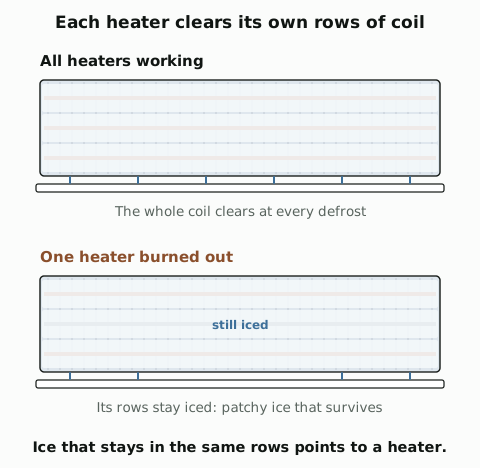
A walk-in unit cooler can have several heaters, each clearing its own rows of coil. So one can fail while the others carry on. One defrost runs like this:
- The timer starts it. The cooling and the fans stop, and the heaters come on.
- The frost melts and the water runs into the pan and down the heated drain.
- The termination switch ends it once the coil is clear and warm.
- The cooling restarts, and the fans wait until the coil is cold again.
The defrost heaters only run during the defrost. The heaters that run all day are different ones: round the door frame, and along the drain line.
Defrost heat goes wrong in four common ways
Most of them leave ice behind. The troubleshooting pages show where each sits among the other reasons for the same symptom.
What the readings show | What you see | Fault | Where it is covered |
|---|---|---|---|
Normal-looking bumps, then the lows creeping up as ice builds | Patchy ice, clear in some rows and solid in others, that grows a little every day | A heater burned out, on a walk-in | |
A cabinet a little warmer each day | Ice over the whole coil, and no water down the drain after a defrost | No heat at all, on a reach-in freezer | |
The slow rise of an iced coil | Ice in the pan after each defrost, building up into the coil from the bottom | A failed pan heater | |
The box climbs, and does not come back down | A warm cabinet and a warm coil, with no cooling | Heaters left on, by a timer or controller stuck in defrost |
Here is what a failed heater does to the rest of the refrigeration system
The defrost still runs on time. It just melts less than it should:
- Ice stays where the heat did not reach, and each defrost leaves a little more.
- Iced rows pass no air, so the box warms unevenly and the coil loses capacity, much as it does when an evaporator fan stops.
- The box still warms at every defrost, without getting a clear coil in return.
- The compressor runs longer, chasing a setting the box can no longer reach.
Where the ice sits points to the cause
- The same rows iced after every defrost: a heater, or a switch that ends the defrost too soon.
- Thickest at the bottom and in the pan: the drain or the pan heater.
- Even all over: wet air getting in faster than defrost can clear it, or no defrost at all.
The evaporator coil page sets out the patterns in full.
"Walk in Defrost heater"
r/HVAC, thread title
A failed heater shows slowly, as ice builds
A healthy defrost leaves a bump in the air that comes back down, as the nine normal defrosts on the termination page show. A failed heater barely changes that bump: the timer still starts the defrost, and the switch still ends it. The sign is slower:
- The lowest reading between defrosts creeps up a little each day, as ice blocks more of the coil.
- The box takes longer to come back after each defrost.
- In the end it cannot reach its setting at all.
An iced coil looks the same in the readings whatever iced it. The Philadelphia freezer on walk-in freezer troubleshooting shows the shape: its timer failed, its coil iced, and the coldest reading of each day crept up for eight days before the peak.
You can check the defrost from the floor, and leave the heaters to the technician
- Look at the coil after a defrost. It should be clear. Ice that stays in the same rows points to a heater.
- Watch the drain during a defrost. No water at all means nothing is melting.
- Check the box gets back below 0°F (-18°C) after each defrost. If it does not, call a technician today.
- Note which rows are iced and which are clear, and tell the technician.
Testing a heater takes a meter. Heatcraft's manual tests one by putting the right voltage across it, or with a continuity tester. That is a technician's job.
Do not open the unit cooler: the heaters are wired at full line voltage. Never chip ice off the coil with an ice pick, a screwdriver or anything like it.
How each kind of equipment defrosts, and what goes wrong
Unit | How it defrosts | What goes wrong | More on this |
|---|---|---|---|
Walk-in cooler | No heaters on most. The coil clears while the cooling rests, with the fans running, in rooms of 35°F (2°C) or warmer | Set too cold, the frost cannot clear | |
Walk-in freezer | Electric heaters in the coil and the pan, a few times a day, or hot gas on some systems | A burned-out heater leaves patchy ice | |
Reach-in freezer | Coil and drain tube heaters, every 4 to 8 hours depending on the maker | No heat: ice over the whole coil, and no meltwater | |
Reach-in cooler and prep table | Mostly no heaters: they defrost each time they rest. Traulsen's G-Series refrigerators add an electric defrost every 8 hours | Ice when wet air gets in faster than the rests can clear it | |
Display case | Frozen-food cases use electric heaters or hot gas | Defrosts that cannot clear the coil, so frost builds day after day | |
Reefer | Hot gas from the unit's own compressor, draining through tubes | A defrost that times out and leaves ice |
The simpler way: TemperatureWise watches for a burned-out defrost heater
Everything on this page takes time, and you have to know what to look for. TemperatureWise takes that complexity out:
- It learns each box. It uses machine learning on the full temperature history of each box, and learns that box's own pattern.
- It watches for a burned-out defrost heater. In the readings, that looks like the coldest reading between defrosts creeping up as ice builds.
- It names the likely culprits. When it sees that change, TemperatureWise tells you what has changed and the top three likely parts at fault, so you know where to look.
Here is that creep in a real walk-in freezer at a Philadelphia distribution center, in April 2025. Its coil iced because the defrost timer failed, not a heater. A burned-out heater ices the coil the same way, and leaves the same mark in the readings.
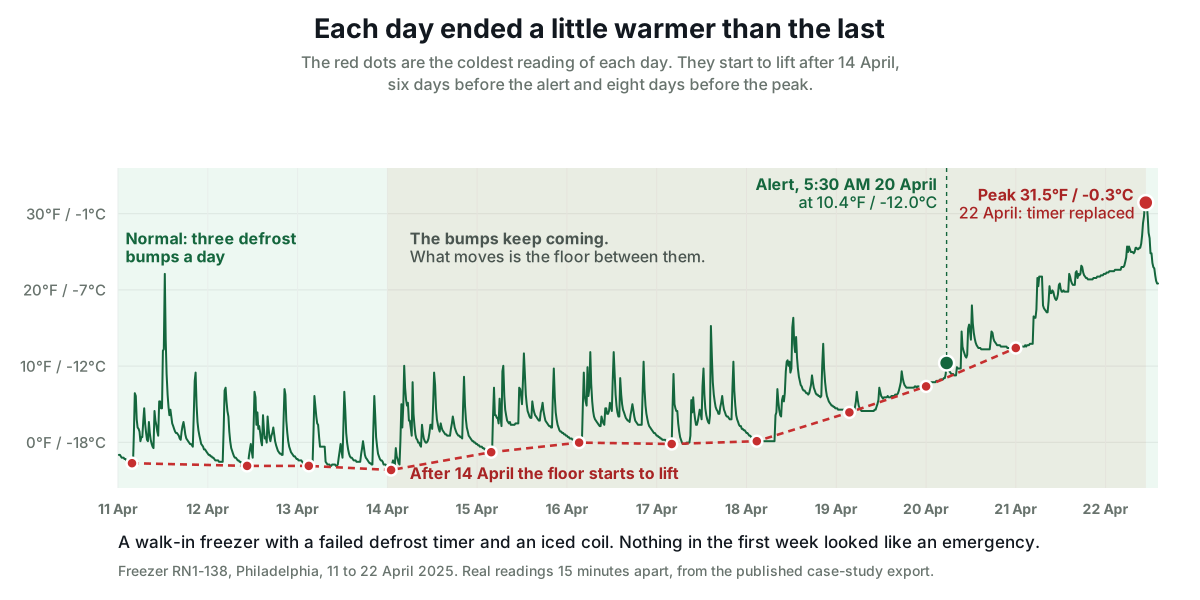
The red dots are the coldest reading of each day, and they start to lift after 14 April. TemperatureWise flagged a likely fault on the evaporator side at 5:30 AM on 20 April, 53 hours before the box peaked. One technician visit found the failed timer and the iced coil, and no product was lost.
It does not replace your technician. It tells you which one to call, and when.
This is one of our walk-in refrigeration parts pages. The defrost timer and termination switch pages cover the rest of the defrost.