
Reefer troubleshooting, symptom by symptom
By Vimal Bhaya, Founder and Lead Systems Architect · Last reviewed 7 October 2026
This is a continuation of Reach-ins, prep tables, display cases and reefers, a 10-part tutorial. You are on part 10 of 10.
A reefer that will not hold temperature is most often loaded warm, blocked from moving its air, or iced up. A parked reefer that goes quiet most often has a battery that could not restart it.
Check the unit's alarm list first. Carrier puts it first on its own troubleshooting list, then a manual defrost, then the air circulation.
If a frozen load is warming or a fresh load is drifting out of its range, act now: get the unit running or move the load, and call the dealer.
Five symptoms cover most reefer problems
Find what you are seeing, then jump to its section. Reasons are listed in roughly the order Carrier's and Thermo King's manuals and our failure-mode reference put them. Nobody publishes how often each fault happens in the field.
| # | What you see | What it usually is | Parts to suspect | Can you check it yourself? | How urgent |
|---|---|---|---|---|---|
| 1 | A warm load, a blocked air path, frost, or the wrong mode | Loading, air chute, coil, condenser, refrigerant | Partly. Read the alarms, run a defrost, look at the load | Today. On the road, now | |
| 2 | A defrost timing out, a blocked drain or a stuck damper | Coil, drain tubes, damper, sensors | Partly. Read the alarms and check the drains | Within the trip. Red alarms now | |
| 3 | Worn seals, doors open with the unit running, loads packed wrong | Door seals, door switch, the load | Yes | This trip | |
| 4 | A weak battery, no fuel, or an engine fault | Battery, fuel, engine, alternator | Partly. Read the alarms, check fuel and battery | Now. A stopped unit is not cooling | |
| 5 | Lost shore power, with no switch back to diesel | Shore power, auto-switch setting | Yes. Check the cord, the socket and the setting | Now |
Here is a list of six things you can check to assess a reefer's health
None of these needs a tool or an open panel.
- The alarm list. Should be: empty, or every alarm written down before you clear it, as Carrier says. The alarm code table lists the common codes.
- The mode and setpoint. Should be: continuous for fresh produce and multi-stop routes, by Carrier's table. The setpoint the shipper gave, usually 33°F to 38°F (0.5°C to 3°C) for a chilled load and -10°F to 0°F (-23°C to -18°C) for frozen.
- Fuel and battery. Look at the gauge and the battery alarms. Should be: enough fuel for the trip, and no battery alarm.
- The air path. Should be: a gap of 10 to 12 inches (25 to 30 cm) above the load, nothing tight against the front wall or the doors, the chute whole and the floor channels open.
- The door seals. Should be: tight all round, with no tears or gaps.
- The defrost drain tubes. Should be: clear at their outlets, with no ice or blockage.
Both makers warn that the unit can start by itself at any time. Switch it off at the controller before you touch the unit, and leave belts, refrigerant and electrics to the dealer. Thermo King also says never to use starting fluid.
1. A reefer that will not hold temperature is most often loaded warm, blocked or iced
The return air reads above setpoint, the unit runs and runs, or the receiver finds warm product at the back.
Reason 1: A load that went in warm cannot be pulled down
- Parts: none. The load is the problem.
- What happens: Carrier says its unit was not designed to cool warm product. It keeps product at the temperature it was loaded. Thermo King's in-transit checks list a load that was not pre-cooled first. By our failure-mode reference, this is the most common reefer complaint of all.
- The proof: warm from the start of the trip, slowly improving, worst in the middle of the load.
- Check: probe the product, not just the air, and check the loading records.
- What to do next: Probe the product and send dispatch the readings now. The unit cannot pull a warm load down, so the shipper or receiver decides what happens to it.
Reason 2: A blocked air path leaves the back of the load warm
- Parts: the load, the air chute, the bulkhead.
- What happens: Air has to run over the top of the load and come back underneath. Loaded to the ceiling, tight against the doors, or with boxes on the floor at the rear, it cannot. Carrier says boxes on the floor at the rear will cut off the airflow. A torn chute or a missing bulkhead lets the air fall short.
- The proof: the nose cold and the tail warm. By our reference, often 10°F to 20°F (6°C to 11°C) apart.
- Check: look at the gap above the load, the doors, the chute and the floor.
- What to do next: Probe the tail. If boxes block the gap or the rear floor, switch the unit off at the controller and clear them, with someone outside the doors. Book the dealer today for a torn chute or a missing bulkhead.
Reason 3: A frosted coil blocks the air
- Parts: evaporator coil.
- What happens: Thermo King's in-transit checks list evaporator frost plugging, and the fix is a manual defrost. Running with the doors open lets warm, humid air ice the coil, Carrier says, and then the unit defrosts more often.
- The proof: weak air from the unit, and recovery after each defrost.
- Check: run a manual defrost, as both makers advise.
- What to do next: If the air comes back strong, the frost was the cause: keep the doors shut while the unit runs. If it ices up again quickly, read the defrost section below and tell the dealer.
Reason 4: Start-stop mode on a load that needs continuous air
- Parts: controller settings.
- What happens: In start-stop mode the engine stops between cycles, and the temperature swings wider by design. Carrier's table puts fresh produce and multi-stop routes in continuous mode.
- The proof: wide swings on a fresh or multi-stop load.
- Check: check the mode against the load.
- What to do next: If a fresh or multi-stop load is in start-stop, set continuous mode at the controller, as Carrier's table advises. Tell dispatch you changed it, and check the setpoint matches what the shipper gave.
Reason 5: A restricted condenser, low refrigerant or a damaged box cuts capacity
- Parts: condenser, refrigerant, the trailer body.
- What happens: Carrier's list goes on to the condenser, for anything blocking its air, and the box, for damage or air leaks. Thermo King lists low refrigerant, which a technician checks at the receiver sight glass.
- The proof: a unit that runs all the time and still loses ground.
- Check: look at the condenser for debris. Leave refrigerant to the dealer.
- What to do next: If debris blocks the condenser, switch the unit off at the controller before clearing it away. If it is clean but the load is out of range at two checks 30 minutes apart, stop the unit and call the dealer, as Thermo King says.
Thermo King's European manual says to check a load on the road every four hours, and that if it is out of range at two checks 30 minutes apart, stop the unit and call a dealer.
Before you call, check these five things
- What do the alarms say?
- Was the load at its temperature when it went in?
- Is there a gap above the load, and are the doors and floor clear?
- Does a manual defrost help?
- Is the mode right for the load?
- When to call a technician: today, or now if a frozen load is warming on the road. The dealer network for your unit's maker can see you on the route.
- What to tell them: the alarm codes, the setpoint and mode, the return and supply air readings, what the load is, and when it was loaded.
2. A defrost alarm, ice at the drains or defrosts too often mean the defrost is timing out, draining badly or sticking
A defrost that ends normally is quick and gives no alarm. These are the ways it goes wrong.
Reason 1: A defrost that times out leaves ice behind
- Parts: coil, defrost sensors.
- What happens: If the coil does not warm enough to end the defrost on temperature, it ends on time. Carrier stops a defrost at 45 minutes and then waits 1.5 hours of compressor running before the next automatic one. Both makers raise an alarm: Defrost Terminated by Time, Thermo King 14 and Carrier 00054. Carrier's action is to check and repair at the end of the trip.
- The proof: the alarm, and a coil that frosts again quickly.
- Check: note the alarm and book the dealer for the end of the trip.
- What to do next: Record the alarm before clearing it, and watch the return air until the trip ends. If the load starts losing temperature, do not wait: call the dealer now.
Reason 2: Clogged drain tubes put the melt water back on the coil
- Parts: defrost drain tubes.
- What happens: Thermo King's pre-loading inspection lists clogged defrost drain tubes, and Carrier's pretrip says to check the drain line for blockage and proper water flow after a test defrost.
- The proof: ice at the drain outlets, or water inside the trailer.
- Check: look at the drain outlets under the unit.
- What to do next: If an outlet is plugged with dirt, switch the unit off at the controller before you clear it. If ice blocks the tubes, do not chip at it: book the dealer, mentioning any water inside the trailer.
Reason 3: A damper stuck closed stops the air
- Parts: defrost damper.
- What happens: Thermo King units close a damper over the coil during defrost. Alarm 30, Defrost Damper Stuck Closed, is a red alarm on its Asia Pacific alarm list: shut down and repair.
- The proof: the red alarm.
- Check: follow the alarm's instruction, and call the dealer.
- What to do next: Probe the load now, and have it moved if it is out of its range or no longer frozen. Tell the dealer it is red alarm 30, with the unit shut down and the load waiting.
Reason 4: Doors open with the unit running make defrosts come too often
- Parts: none. How the doors are used is the problem.
- What happens: Warm, humid air through open doors ices the coil, and the unit defrosts more often, Carrier says. USDA's guide says to shut the unit off when loading from an open dock for the same reason.
- The proof: frequent defrosts on busy delivery days.
- Check: switch the unit off before opening the doors, as Thermo King's checklist says.
- What to do next: Make it the routine at every stop, and at open docks while loading, as USDA's guide says. If defrosts stay frequent with the doors handled right, tell the fleet's service line how often it defrosts.
Before you call, check these four things
- Is there a Defrost Terminated by Time alarm?
- Are the drain outlets clear?
- Is there a damper alarm?
- Were the doors open with the unit running?
- When to call a technician: now for a red alarm. For a time-out, at the end of the trip, unless the load is losing temperature.
- What to tell them: the alarm codes, how often it is defrosting, and what the drains look like.
3. A box that warms at each stop, or one warm end of the load, means the seals, the doors or the loading
The box warms at every stop and does not quite recover, or one end of the load is always warm.
Reason 1: Worn door seals leak all trip
- Parts: door seals.
- What happens: USDA's guide puts it simply: good insulation is of little value if the door seals leak. Thermo King's hand checks say the seals should fit tightly.
- The proof: warm near the doors, and daylight round the seals from inside.
- Check: look at the seals from outside for tears and gaps. To look for daylight from inside, switch the unit off and keep a second person outside holding the door. Never shut yourself in a trailer.
- What to do next: Probe the product by the doors, and book a torn or gapping seal for the next service. If that product is out of range, or the box no longer recovers between stops, call the dealer today.
Reason 2: Doors opened with the unit running pull in warm air
- Parts: door switch, the routine.
- What happens: Thermo King says to turn the unit off before opening the doors. Carrier offers a door switch that can shut the unit down or slow it when a door opens. On a multi-stop route, every stop lets warm air in.
- The proof: a box that ends each stop a little warmer than the last.
- Check: check whether the unit has a door switch, and how it is set.
- What to do next: If a door switch is fitted, have the dealer set it to shut the unit down or slow it. Without one, switch the unit off at the controller before each door opening, as Thermo King says.
Reason 3: A load packed wrong blocks the return air
- Parts: none. The load is the problem.
- What happens: USDA says frozen food should go in a tight block, and produce with air channels, on pallets if the floor channels are shallow. Thermo King says not to load tight against the unit, walls or doors.
- The proof: warm product in one part of the load.
- Check: look at how the load is built.
- What to do next: Probe the warm part, and send the readings to dispatch if it is out of its range. Switch the unit off at the controller and, with someone outside the doors, restack it so air gets through.
Before you call, check these four things
- Do the seals fit tightly all round?
- Is the unit switched off, or slowed, when the doors open?
- Is the load built to let the air through?
- Does the box recover between stops?
- When to call a technician: for seals, at the next service. For a box that is not recovering between stops, today.
- What to tell them: the route, how many stops, how the doors are used, and where the warm product was.
4. A reefer that shuts down or will not restart is usually short of battery or fuel
The unit is silent, the temperature climbs in a straight line, or an alarm says the engine stopped or failed to start.
Reason 1: A weak battery cannot restart the engine
- Parts: battery, alternator.
- What happens: Thermo King's Tom Kampf told FleetOwner that the most common failure is a unit that fails to start, and the most common cause is an insufficiently charged battery. Carrier adds that telematics and other devices can drain even fresh batteries during long parked spells. In start-stop mode, the unit only restarts itself on low battery while it is switched on.
- The proof: a stop that turns into silence, a low battery alarm, and often a cold night or a long wait.
- Check: read the alarms, and check the battery terminals are clean and tight.
- What to do next: Report a low battery alarm or a loose, dirty terminal to the dealer or the person on call now. Switch the unit off at the controller before anyone touches the battery, and keep probing the load.
Reason 2: Running out of fuel stops the engine and makes it hard to restart
- Parts: fuel tank and fuel system.
- What happens: A Thermo King patent describes it: when the fuel pump starts to draw air, the engine dies suddenly and is then difficult to restart. Carrier says running out of fuel also leaves the battery uncharged, which it calls a leading reason for emergency call-outs.
- The proof: a low fuel alarm, then a shutdown.
- Check: check the gauge, and drain water from the tank at each pretrip, as Carrier says.
- What to do next: Fill a low tank and stand clear: on Carrier's 00019 shutdown, the unit restarts once fuel is added. If it will not restart with fuel in, the battery may be flat too: call the dealer now.
Reason 3: An engine fault or a pressure fault stops the unit
- Parts: engine, condenser, refrigeration system.
- What happens: Low oil pressure, high coolant temperature and high discharge pressure can all shut a unit down. High discharge pressure often means the condenser cannot shed its heat, and Carrier's list says to check the condenser for anything blocking its air.
- The proof: a red alarm, and a unit that stops again after a restart.
- Check: read the alarm, look at the condenser for debris, and call the dealer.
- What to do next: Switch the unit off at the controller before you clear any condenser debris, and probe the load. If it stops again after a restart, do not keep trying: give the alarm code to your service line.
Reason 4: Deep cold stops diesel units restarting
- Parts: glow plugs, fuel.
- What happens: Worn glow plugs and diesel that gels in a frigid winter can stop a restart, as on our reefer solutions page. Units carrying a fresh load in winter run in heating mode, and a stopped unit lets the load fall toward the outdoor temperature.
- The proof: no restart on the coldest nights.
- Check: tell the dealer the overnight low.
- What to do next: Probe a fresh load now, and ask dispatch to move it if it is dropping below its range. Never use starting fluid, as Thermo King says: leave glow plugs and gelled fuel to the dealer.
The alarms that go with this symptom, from low fuel and low battery to a failed start, are in the alarm code table below, with what each maker says to do.
Before you call, check these four things
- What alarms are showing?
- Is there fuel?
- Are the battery terminals clean and tight?
- How cold was it overnight?
- When to call a technician: now. A stopped unit is not cooling. On a parked trailer, nobody may notice until the load is lost, as the next section shows.
- What to tell them: the alarm codes, the fuel level, the overnight low, and when the unit last ran.
5. A parked trailer warming on shore power has usually lost its power, with nothing set to switch it to diesel
The trailer is plugged in at a dock or yard, the diesel is off, and the box is warming.
Reason 1: Shore power lost, with no automatic switch back to diesel
- Parts: shore power, the auto-switch setting.
- What happens: On Thermo King units, if Electric to Diesel Auto-Switch is set to NO and the shore power fails, the unit will not switch to its diesel. Carrier's alarm 00073, No A/C Power (Standby), says to switch to diesel and repair.
- The proof: a silent unit, plugged in, and a climbing box.
- Check: check the supply's breaker and that the cord is seated, and how the auto-switch is set. Turn the unit and the supply off before you handle the cord.
- What to do next: If the supply is dead, switch the unit to diesel, tell the yard, and probe the load. If the auto-switch is set to NO, ask the dealer whether it should change to diesel by itself.
Reason 2: An electrical fault on the standby supply
- Parts: standby electrics.
- What happens: Thermo King's alarms include 38 Electric Phase Reversed, a red alarm, and 90 Electric Overload.
- The proof: the alarm on the controller.
- Check: a dealer's or electrician's job. Thermo King says to turn the unit and the power supply off before connecting or disconnecting the cord.
- What to do next: Leave the cord and the supply alone, and give the dealer or the yard's electrician the alarm number now. Probe the load meanwhile, and ask them whether it can run on diesel until the repair.
Reason 3: A trailer that was never plugged in drifts
- Parts: none. The routine is the problem.
- What happens: A diesel-electric unit parked at a dock and not plugged in, with its diesel off, is not cooling. That looks like a unit fault and is not.
- The proof: a slow drift through a long dwell at the dock.
- Check: check it is plugged in and running on standby.
- What to do next: If it is unplugged, switch the unit off at the controller and the supply off before connecting the cord. Then switch both on, probe the load, and add the plug-in check to every drop at the dock.
Before you call, check these four things
- Is the cord plugged in, and does the supply's breaker or indicator show power?
- Is there a standby power alarm?
- How is the electric-to-diesel auto-switch set?
- Is anyone on site to restart it?
- When to call a technician: now, if the unit cannot be switched to diesel or the power restored.
- What to tell them: the alarm codes, the auto-switch setting, and how long it has been without power.
Common reefer alarm codes name the fault, and most of them point to one of the five symptoms above
Both makers number their alarms, and the same code can mean different things on different controllers. These are the common ones from Thermo King's North American alarm list and Carrier's alarm guide for its APX and Advance controls. Check your own unit's guide before acting, and write every alarm down before you clear it.
The last column links to the symptom on this page that the alarm usually goes with.
Thermo King
| Code | Name | Thermo King's status | What Thermo King says to do | Symptom |
|---|---|---|---|---|
| 03 | Check Control Return Air Sensor | Yellow: check as specified | Watch the load temperature by hand, and report it at the end of the day | None: a sensor fault |
| 10 | High Discharge Pressure (or Temperature) | Red: take immediate action | If the unit has shut down, repair it now. If not, report it at the end of the day | |
| 14 | Defrost Terminated by Time | Green: OK to run | Report it at the end of the day | |
| 17 | Engine Failed to Crank | Yellow: check as specified | If the unit has shut down, repair it now. If not, report it at the end of the day | |
| 18 | High Engine Coolant Temperature | Yellow: check as specified | If the unit has shut down, repair it now. If not, report it at the end of the day | |
| 19 | Low Engine Oil Pressure | Yellow: check as specified | If the unit has shut down, repair it now. If not, report it at the end of the day | |
| 20 | Engine Failed to Start | Yellow: check as specified | If the unit has shut down, repair it now. If not, report it at the end of the day | |
| 30 | Defrost Damper Stuck Closed | Red: take immediate action | The unit cannot run and has shut down. Repair it now | |
| 36 | Electric Motor Failed to Run | Red: take immediate action | Switch to diesel mode | |
| 61 | Low Battery Voltage | Yellow: check as specified | If the unit has shut down, repair it now. If not, report it at the end of the day | |
| 63 | Engine or Vapor Motor Stopped | Red: take immediate action | If the unit has shut down, repair it now. If not, report it at the end of the day | |
| 96 | Low Fuel Level | Yellow: check as specified | Add fuel | |
| 108 | Door Open Timeout | Yellow: check as specified | Close the doors, and report it at the end of the day |
A code shown in brackets, such as (20), may clear by itself, and can come with alarm 84, Restart Null. Thermo King asks drivers to record every alarm for the technician.
Carrier Transicold, APX and Advance controls
| Code | Name | Type | What Carrier says to do | Symptom |
|---|---|---|---|---|
| 00001 | Low Fuel Level Warning | Warning | Add fuel before the unit shuts down on 00019 | |
| 00011 | Check / Low Engine Oil Pressure | Shutdown | The unit restarts when it can. Report it if it comes back | |
| 00012 | High Coolant Temp | Shutdown | The unit restarts when it can. Report it if it comes back | |
| 00013 | High Pressure | Shutdown | The unit restarts when it can. Report it if it comes back | |
| 00016 | Low Battery Voltage | Shutdown | Report it and have it repaired now | |
| 00018 | Low Pressure Shut Down (Suction) | Shutdown | The unit restarts when it can. Report it if it comes back | |
| 00019 | Low Fuel Level Shutdown | Shutdown | Add fuel. The unit restarts | |
| 00031 | Auto Start Fail | Shutdown | Report it and have it repaired now | |
| 00053 | Temp out of Range | Shutdown on Advance, set by the fleet on APX | Reset it, and report it if it comes back | |
| 00054 | Defrost Terminated by Time Alarm | Alarm | Check and repair at the end of the trip | |
| 00061 | Door Open | Set by the fleet | Close all compartment doors, and the unit should restart. If it has shut down, repair it now | |
| 00073 | No A/C Power (Standby) | Shutdown on Advance, set by the fleet on APX | Switch to diesel and repair |
On Carrier's older Aspen controls some numbers mean something else: 00051 and 00073 are different alarms there. Carrier's X4 manual raises its failed-auto-start alarm after three start attempts in a row.
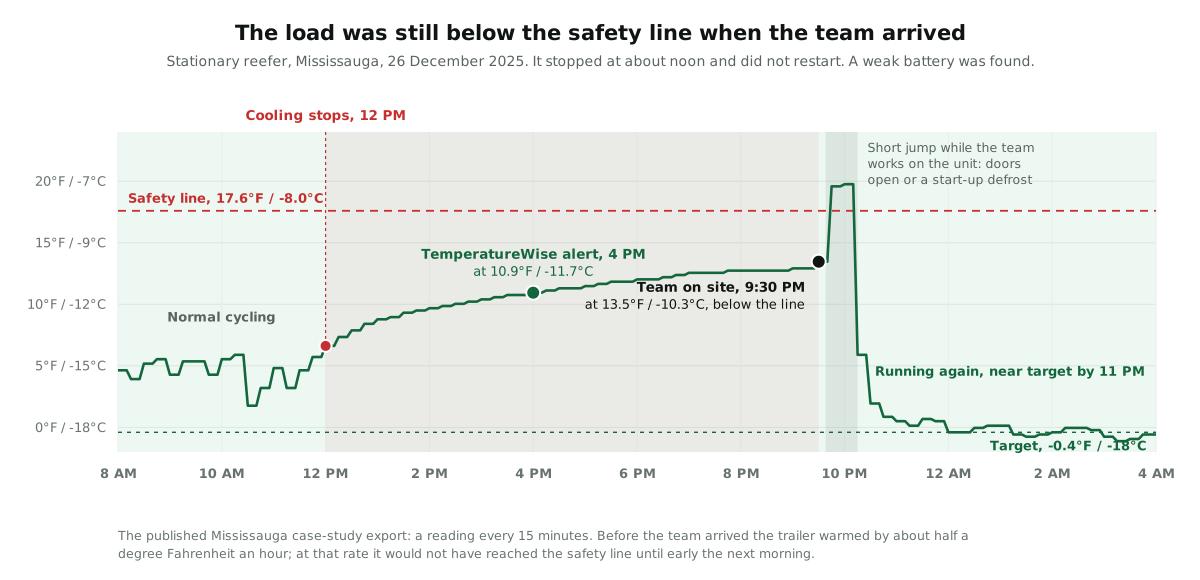
A parked reefer stopped at noon on Boxing Day, and TemperatureWise alerted the team at 4 PM
This is a stationary reefer at a production site in Mississauga, used as frozen storage and holding up to $125,000 of stock. On 26 December 2025, with nobody on site for the holiday, it stopped during an automatic engine-off period and did not restart.
| Time | What happened |
|---|---|
| 8:00 AM | Normal start-stop cycling near 5°F (-15°C) |
| About noon | The unit stops during an automatic cycle and does not restart. The line starts to climb, with no cycles |
| 4:00 PM | TemperatureWise alerts the team, at 10.9°F (-11.7°C) |
| 9:30 PM | The team is on site. The trailer is at 13.5°F (-10.3°C), still below the 17.6°F (-8°C) safety line |
| 9:45 PM | The reading jumps to 19.8°F (-6.8°C) for under half an hour while the team works on the unit. Open doors or a defrost as it starts would both do this |
| About 10:00 PM | The unit runs again. A weak battery is confirmed as the cause |
| By 11:00 PM | Back near the -0.4°F (-18°C) target |
Why it did not restart: a weak battery in start-stop mode
The unit was cycling in start-stop mode, which Thermo King calls CYCLE-SENTRY. In that mode the diesel stops once the box reaches its setpoint, and starts again by itself when the box warms or the battery runs low.
Every one of those restarts is a crank from the battery. On Carrier's X4, for example, the unit restarts when the box drifts a few degrees from setpoint or the battery falls below a set point of 12.0 to 12.8 volts.
At about noon the unit stopped as usual, and when it tried to start again, the weak battery could not crank the engine. Nothing was cooling from then on. Carrier's X4 raises an alarm after three failed attempts, but on a parked trailer with nobody there, an alarm on the controller's screen tells no one.
The lesson for any reefer in start-stop: the battery is part of the cooling. Thermo King's Tom Kampf has said an insufficiently charged battery is the most common cause of a unit that fails to start. Symptom 4 covers the checks.
The shape is the tell. Normal start-stop cycling is a gentle saw. A unit that has stopped draws a straight, steady climb with no cycles, and that is what the line did from noon. A threshold alarm at the safety line would have stayed quiet until after 9 PM. The full story and the exported readings are in the Mississauga case study.
This is where TemperatureWise is different: it watches the load space on its own sensors
A reefer's own controller knows a lot, but when the unit has stopped it cannot call anyone. TemperatureWise does not read the unit's controller, its alarm codes or its fuel level. It measures the load space with its own sensors, which is why it keeps reporting when the unit itself has stopped.
It watches how fast the temperature is climbing, not just where it is, so the alert can come hours before a threshold. It learns each trailer's normal cycling and defrosts in the first week, so a normal defrost is not an alarm. A sensor at the nose and one at the tail catch a torn chute that one sensor in the middle would miss.
On the road, a cellular gateway rides in the truck. Alerts climb from email to a text to a phone call until someone answers. The details are on temperature monitoring for reefer trailers, and how TemperatureWise works.