
Refrigerant leaks and low charge: the signs in the box, and what to ask your technician
By Vimal Bhaya, Founder and Lead Systems Architect · Last reviewed 20 October 2026
This is a continuation of Walk-in refrigeration parts, a 14-part tutorial. You are on part 4 of 14.
Refrigerant carries the heat out of the box. Every system holds a set amount of it, called the charge. A sealed system does not use refrigerant up, so a system that is short has a leak.
Most leaks come from five things:
- vibration, which shakes joints and poorly held pipes loose
- swings in temperature and pressure, every cycle and every defrost
- corrosion, which eats pinholes in the coil
- joints made badly, at the install or a later repair
- worn flare nuts, valve cores and service caps
Low charge shows as a box that loses ground over days or weeks, a unit that runs longer and longer, and frost on only the first part of the coil. Checking it needs gauges, so this is a technician's part. What you can do is notice the slide early.
Refrigerant carries the heat, and each system holds a set amount of it
Refrigerant is the working fluid of every cooler and freezer. Inside the box, it boils in the coil and soaks up heat from the air. The compressor pumps it outside to the condenser, where it gives that heat away and turns back to liquid. Then it goes round again.

How a walk-in cooler works walks through each part of the loop.
The amount in the system is called the charge. Many walk-in condensing units have a receiver, a tank that holds spare liquid. A small reach-in holds a small, exact charge with no spare. ACHR News calls these critically charged.
A sealed system does not wear refrigerant out. If it is short, it has leaked. Heatcraft's instructions say to test for leaks before adding any.
Five things cause most leaks
- Vibration. The compressor and fans shake the system all day. Joints flex, and pipes that are poorly held work loose over time.
- Swings in temperature and pressure. Every cycle and every defrost stretches and squeezes the coil and its joints. ACHR News reports that leaks cluster where these swings are biggest.
- Corrosion. Contaminants in the water that forms on a coil can eat pinholes through its copper tubes. ACHR News describes holes appearing within weeks or months.
- Joints made badly. A poorly soldered joint, from the install or a later repair, is a leak waiting to happen.
- Worn fittings and valves. Flare nuts, valve cores and service caps loosen or wear.
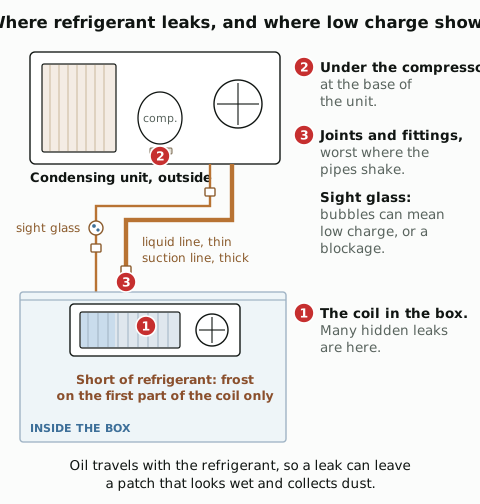
John Tomczyk, writing in ACHR News, says many leaks that go undetected are in the evaporator coil, hidden by its cabinet. He also points to joints and fittings, and to the base of the condensing unit under the compressor.
Some leaks open only while the unit runs, when pipes shake and pressures rise. ACHR News also notes that leaks can come and go. That makes some of them hard to find in a single visit.
Oil travels round with the refrigerant, so a leak can leave a patch that looks wet and collects dust. Tomczyk warns that oil marks can mislead: they can be old, or come from something else.
Low charge shows as a slow slide, longer runs and frost on part of the coil
Less refrigerant moves less heat. The box holds on cool days, then slips a little further each week. Each sign below has other causes too, so the troubleshooting pages list it among them.
"Why does being low on refrigerant cause the evaporator to freeze"
r/HVAC, thread title
The short answer: with too little refrigerant, only the first part of the coil gets cold enough to frost, and that part runs colder than it should. The rest stays bare, so the coil moves less heat.
Sign | What you see | Why it happens | Where it is covered |
|---|---|---|---|
A slow slide | The box holds on cool days and slips a little further each week | Less refrigerant moves less heat | |
Longer runs, or short cycles | The unit runs longer and longer, or clicks on and off | It moves less heat each hour. On some systems a low-pressure switch stops it, then it restarts | |
Frost on part of the coil | Frost or ice on the first part of the coil, the rest bare | Only the first part gets cold enough to frost | |
Bubbles in the sight glass | Only a technician sees this, on units that have one | Gas where there should be only liquid. It can also mean a blockage | A technician's reading |
Trips on hot days, after a repair | The unit stops on hot afternoons, soon after a service visit | Too much refrigerant, or air let in during the repair, raises the pressure |
Here is what a leak looked like in a customer's walk-in freezer
TemperatureWise caught this one in a customer's walk-in freezer: 2,000 sq ft, at a Philadelphia distribution center, cooled by two refrigeration systems. By July 2025, one system had a refrigerant leak, and the other a broken fan blade, motor and bracket.
TemperatureWise first warned of a developing problem on 10 June, nearly 30 days before repairs began. On 6 July it named refrigerant leakage. Here are three Wednesdays from that summer, on one scale.

On 4 June, before the first warning, the box averaged 5°F (-15°C). On 2 July it averaged 17°F (-8°C). After both repairs, on 6 August, it averaged 0°F (-18°C).
The bumps came at the same hours, and the box kept cycling. Short of capacity, it simply ran warmer, all day. That is easy to miss on a thermometer you glance at once a day.
Two faults shared the blame here, so read this as lost capacity, not a leak's exact signature. The early warning gave the team time to plan a staged repair and move $450,000 of frozen stock into a temporary reefer. The full record is in the dual-system freezer case study.
A technician confirms low charge with gauges, and should find the leak first
Checking the charge means fitting gauges and reading pressures and pipe temperatures. If the system is short, Heatcraft says to leak-test before adding refrigerant. Adding it without finding the leak only buys time.
Low charge has a look-alike. A blocked expansion valve starves the coil in the same way. A technician tells them apart with a reading called subcooling, as the expansion valve page explains.
Too much refrigerant is a fault too
Overcharging, or air let into the system during a repair, pushes up the pressure on the hot side. Heatcraft's troubleshooting chart lists both as causes of high discharge pressure. On a hot day, that can trip the unit on its high-pressure switch.
Ask three questions after a leak repair
- Where was the leak, and was it fixed? A top-up alone is not a repair.
- How much refrigerant went in? Keep the amount with your service records.
- Should someone come back to check? If the next visit adds more, the leak is still there.
Supermarkets track leaks the same way: the refrigerant added over a year, against the full charge.
You can watch for a leak four ways without touching the system
- Watch the trend. Note the box's temperature at the same time each day, or read it from your monitoring. A box a little warmer each week is the first sign.
- Notice how long it runs. A unit that used to rest and now runs almost all the time is moving less heat.
- Look at the coil from the floor. Frost on only the end where the pipes come in points to a starved coil. The evaporator coil page shows each pattern.
- Look under the condensing unit. An oily, dusty patch on the pad or on a pipe joint is worth pointing out to the technician.
Leave the pipes, valves and service caps to the technician. Many new reach-ins use R-290, a flammable refrigerant, and need a technician trained to work on it.
Reach-ins, prep tables, display cases and reefers lose charge in their own ways
Unit | What is different | More on this |
|---|---|---|
Walk-in cooler or freezer | Long pipes and many joints between the unit outside and the coil inside. A leak usually shows as a slide over weeks | |
Reach-in cooler or freezer | A small charge, sealed at the factory. Even a small loss shows up quickly. Many new ones use R-290 | |
Prep table | The same small machine as a reach-in, in the base | |
Display case | Self-contained cases are like reach-ins. Cases on a supermarket's central rack share one large charge. The EPA estimates a typical store loses about a quarter of it each year | |
Reefer | Thermo King's checks on the road include low refrigerant. Leave it to the dealer |
The simpler way: TemperatureWise watches for a refrigerant leak
Everything on this page takes time, and you have to know what to look for. TemperatureWise takes that complexity out:
- It learns each box. It uses machine learning on the full temperature history of each box, and learns that box's own pattern.
- It watches for a refrigerant leak. In the readings, that looks like a slow slide, with longer runs and a box that sits a little warmer every week.
- It names the likely culprits. When it sees that change, TemperatureWise tells you what has changed and the top three likely parts at fault, so you know where to look.
On the Philadelphia freezer, TemperatureWise gave a first warning on 10 June and a refrigerant leakage diagnosis on 6 July.
It does not replace your technician. It tells you which one to call, and when.
This is one of our walk-in refrigeration parts pages. The expansion valve page covers the part most often mistaken for low charge.