$450,000 concentrated in one room
The product load depended on two refrigeration systems serving the same 2,000 sq. ft. walk-in. Trouble on both sides removed the intended safety margin.
Enter your work email to continue through the incident data, diagnosis and results.
Return to all case studies
A 2,000 sq. ft. Philadelphia walk-in relied on two refrigeration systems. TemperatureWise exposed a month-long decline before separate leak and fan failures forced a staged repair.
A direct-to-home frozen smoothie brand used two refrigeration systems to serve a 2,000 sq. ft. walk-in at its Philadelphia distribution center. The room held about $450,000 in frozen inventory.
TemperatureWise communicated the first developing issue on June 10, 2025, while the freezer was still cycling near 6.8°F / -14°C. By July, service work identified a refrigerant leak along with a broken fan blade, motor and bracket across the two systems.

Separate faults reduced available cooling capacity while aging equipment made the final repair dependent on hard-to-find parts.
The product load depended on two refrigeration systems serving the same 2,000 sq. ft. walk-in. Trouble on both sides removed the intended safety margin.
The pattern changed on June 10, nearly a month before the July 7 to 8 initial repair. A threshold-only alarm would have exposed the team much later.
A replacement fan, motor and bracket were difficult to source. The team needed a staged repair and a temporary reefer before final work could begin.
TemperatureWise issued its first early warning of a developing issue on June 10. On July 6, it issued a more specific refrigerant leakage diagnosis. Initial work on July 7 and 8 restored part of the cooling capacity. Before final repairs from July 24 to 27, the team moved the frozen inventory into a temporary reefer.
“Part of the repairs were completed last week on one unit that brought the temperature down. Currently only one unit is running well.”Operations update, frozen smoothie brand
Real sensor data from June 1 to August 10, 2025. The developing event began around June 10 and continued through mid-July. The warm period from July 24 to 27 was a controlled repair window after inventory had been moved to a temporary reefer.
Evidence: view the exported sensor readings (CSV). The chart displays every third reading for readability.
Loading sensor data...
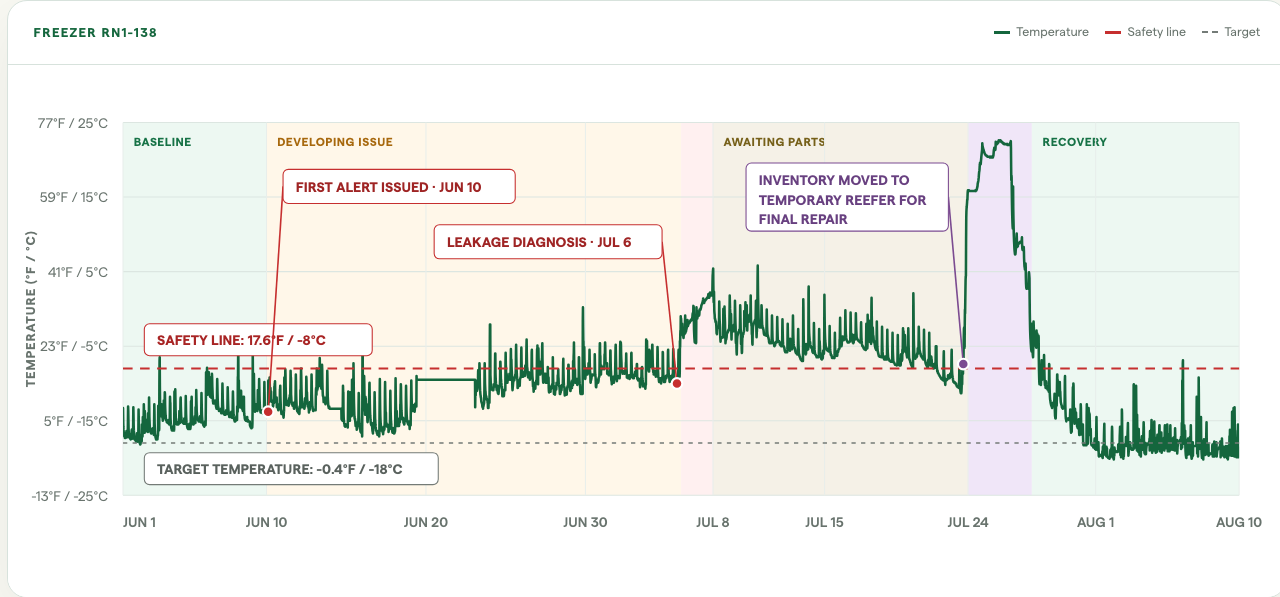
Baseline operation periodically approaches -0.4°F / -18°C.
TemperatureWise communicates a developing issue nearly 30 days before initial repair.
The AI issues a more specific refrigerant leakage diagnosis as performance worsens.
Initial repair work restores one part of the system. The second side still awaits parts.
The initial incident window closes, but cooling remains degraded and permanent work on the remaining equipment is still outstanding.
Inventory is transferred to a temporary reefer while the final repair is completed.
Stable cycling returns near the -0.4°F / -18°C operating target.
This team used early warning to plan repairs, source hard-to-find parts and move $450,000 in frozen product before final work began.