
Walk-in expansion valves: capillary tube, TXV and electronic, and how each fails
By Vimal Bhaya, Founder and Lead Systems Architect · Last reviewed 4 October 2026
This is a continuation of Walk-in refrigeration parts, a 2-part tutorial. You are on part 2 of 2.
The expansion valve meters liquid refrigerant into a walk-in's cold coil. Walk-ins use three kinds: a fixed capillary tube in many small packaged units, a thermostatic expansion valve (TXV) on most split systems, and an electronic valve on premium controls.
A fixed tube cannot adjust to the load; the two valves can. When any of them feeds too little, the box runs warm and only the first part of the coil frosts. Checking one is a technician's job, but knowing which kind you have helps you follow the diagnosis.
The expansion valve is where high-pressure liquid turns cold
Refrigerant reaches the coil as a warm liquid under high pressure. Squeezed through a tiny opening, its pressure drops, and at low pressure it boils at a very low temperature. That boiling, inside the coil's tubes, is what pulls heat out of the box.
Think of a spray can. Inside, the liquid is under pressure. Through the nozzle it comes out as a cold mist. The expansion valve is the nozzle.
The hard part is the amount. Too little, and the coil is starved: the first part of it does all the work and frosts, the rest stays bare, and the box runs warm. Too much, and liquid that has not boiled can reach the compressor, which is built to pump vapour, not liquid.
Where it sits in the whole system is on how a walk-in freezer works and how a walk-in cooler works.
Walk-ins use three kinds, and only two adjust to the load
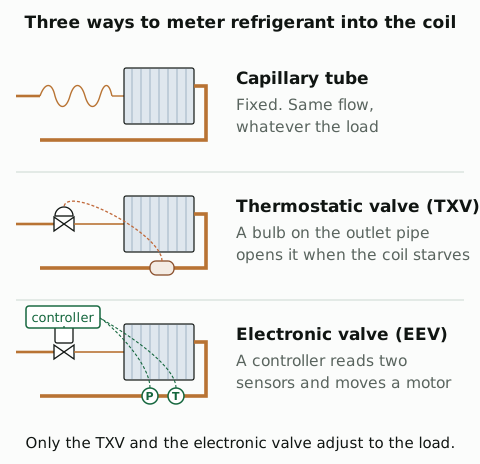
Kind | How it meters | Adjusts to the load? | Where you find it |
|---|---|---|---|
Capillary tube, or a fixed orifice | A long, very thin tube, or a single small hole, that lets refrigerant through at a set rate | No | Small packaged units |
Thermostatic expansion valve (TXV) | A valve driven by a sensing bulb clamped to the pipe leaving the coil | Yes, by itself | Most split-system unit coolers |
Electronic expansion valve (EEV) | A motor-driven valve, moved by a controller that reads a pressure sensor and a temperature sensor | Yes, most precisely | Premium controllers and newer systems |
A capillary tube is a fixed restriction
A capillary tube is a long copper tube with a bore not much wider than a pin, often coiled to save space. A fixed orifice does the same job with a single small hole. Either one lets refrigerant through at a rate set by its size and the pressure behind it.
That suits a small box with a steady load. It cannot open further when warm product goes in, or close down when the box is quiet. Danfoss puts it plainly: a fixed device will not open more when the load increases.
Systems with a capillary tube are charged to an exact amount. Add too much, and the extra backs up in the condenser and the coil runs warmer than it should. You find them in small packaged units: Daikin's SB ceiling monoblocks, for example, list expansion through a capillary tube.
A TXV feels the coil's outlet and adjusts itself
A thermostatic expansion valve has a small bulb clamped to the pipe leaving the coil, joined to the valve by a thin tube. The bulb holds a charge that swells as the pipe warms. A warm outlet means the coil is running short, so the valve opens. A cooler outlet means liquid is close to escaping, so it closes.
The target is called superheat: how many degrees the vapour has warmed past its boiling point by the time it leaves the coil. Heatcraft gives 6°F to 10°F (3°C to 6°C) for a typical walk-in design. Danfoss describes the TXV's job as holding a constant superheat as conditions change.
Most split-system unit coolers use one. Russell, for example, selects the TXV for each unit cooler from its operating conditions.
An electronic valve does the same job on a controller's command
An electronic expansion valve has a small motor where a TXV has its bulb. A controller reads a pressure sensor and a temperature sensor on the coil's outlet pipe, works out the superheat, and moves the valve to hold its target. Danfoss notes that electronic valves can be programmed to work with the rest of the system.
You find them on premium unit cooler controllers and newer systems. They are the most precise. They also add a controller, sensors and wiring, each of which can fail.
You can usually find out which one you have without opening anything
- A packaged unit, one box through the wall or roof: look up its model on the nameplate or spec sheet. Many small ones use a capillary tube.
- A split system, with a separate condensing unit: look up the unit cooler's model, or ask your technician. Most use a TXV.
- An electronic controller wired to the unit cooler and to sensors on its pipes may be driving an electronic valve. Ask your technician.
Do not open the unit cooler to look. Its panels hide live wiring and fan blades.
What goes wrong, and where it shows up
Each of these starves the coil or floods it. The troubleshooting pages show where each one appears among the other reasons for the same symptom.
Fault | Which kind | What you see | Where it is covered |
|---|---|---|---|
A plugged inlet screen | TXV | A warm box, and frost only where the refrigerant enters the coil | |
Moisture freezing inside the valve or tube | TXV, capillary tube | Cooling that fades, then comes back after the unit has been off | |
Wax or sludge after a compressor burnout | TXV, capillary tube | A warm box soon after a compressor was replaced | |
A bulb that has lost its charge | TXV | The valve closes and starves the coil: a warm box | |
A bulb that has come loose from its pipe | TXV | Nothing obvious to you. The technician sees the valve overfeeding | A technician's reading |
A failed sensor, driver or setting | Electronic | A box that runs too warm or too cold, often with a controller alarm |
A technician tells a blocked valve from a leak with two readings
A starved coil looks the same from outside whether the valve is blocked or the system is short of refrigerant: high superheat, low suction pressure and a warm box. The difference shows in the liquid line, in a reading called subcooling, which is how far the liquid has cooled below its condensing point.
John Tomczyk's column in ACHR News sets it out. An undercharged system has low subcooling. A restricted valve leaves subcooling normal, or a little high, because the refrigerant is all there, just stuck behind the valve.
Why this matters to you: if a technician says it looks like low charge but finds no leak, ask whether the valve and its screen have been checked. Adding refrigerant to a system with a blocked valve does not fix the block.
You cannot check an expansion valve yourself
Every test on this page needs gauges, or a thermometer clamped to a pipe. What you can do is describe what you see: where the coil frosts, whether the box is worse on hot afternoons, and when it started. That gets the technician to the right part faster.
This is one of our part pages. The others, from defrost timers to winter controls, are still being written.