
The thermostat, controller and pressure switches: how the controls decide when to cool, and how they go wrong
By Vimal Bhaya, Founder and Lead Systems Architect · Last reviewed 20 October 2026
This is a continuation of Walk-in refrigeration parts, a 14-part tutorial. You are on part 7 of 14.
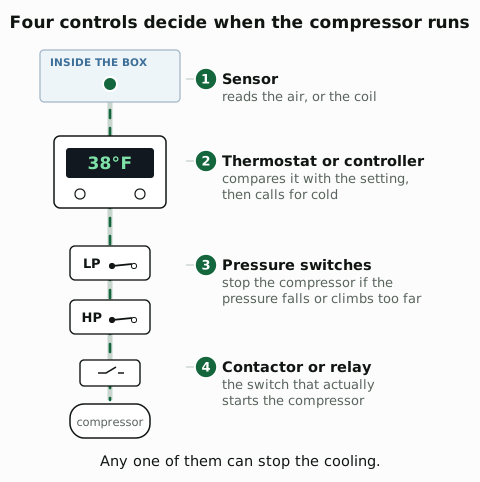
The controls decide when the compressor runs. A sensor reads the box. The thermostat or controller compares that reading with its setting and calls for cold. Two pressure switches stop the compressor if the refrigerant pressure goes too low or too high, and a contactor or relay does the actual switching.
When a control goes wrong, the machine does exactly what it is told. A setting bumped too cold freezes the food. A sensor that has drifted or moved holds the box at the wrong temperature. Pressure settings that are wrong make the compressor click on and off. You can check the setting and the sensor's reading yourself. The pressures and the wiring are a technician's job.
Four controls decide when the compressor runs
The controls do not make cold. They decide when the rest of the system runs, and they stop it when something is wrong. This is the loop they switch on and off:

A sensor reads the box. The thermostat or controller compares the reading with its setting. When the box is warm enough, it calls for cold. Two pressure switches stand guard, and a contactor or relay does the actual switching.
On most walk-ins, one cycle runs like this:
- The box warms a little past its setting, and the thermostat opens a valve on the liquid pipe.
- The pressure rises, and the compressor starts on its low-pressure switch.
- The box cools back down to its setting, and the valve closes.
- The compressor pumps the coil empty and stops on its low-pressure switch. That is called pump-down, and it is on purpose.
On reach-ins and many smaller units, the thermostat switches the compressor directly, through a relay.
The two pressure switches are safeties:
- The high-pressure switch stops the compressor if the pressure on the hot side climbs too far, as it does with a dirty condenser or a dead condenser fan.
- The low-pressure switch stops it if the pressure falls too far.
- Some reset themselves. Others stay off until a person resets them.
The thermostat itself comes in two kinds:
- A mechanical thermostat has a dial and a sensing bulb.
- An electronic controller has a display, sensors on wires and a menu of settings, often including defrost and the fans. It also protects the compressor. One maker's defaults: once started, the compressor runs at least 2 minutes, and once stopped, it rests at least 5 minutes before it can start again.
Controls go wrong in five common ways
In most of them, nothing is broken in the usual sense. The machine does exactly what it is told. The troubleshooting pages show where each sits among the other reasons for the same symptom.
What the readings show | What you see | Fault | Where it is covered |
|---|---|---|---|
The usual ripple, at the wrong level | A setting lower or higher than it should be. Frozen food, or an even coat of ice over a cooler's coil | A setting wrong, or bumped | |
A steady box, held at the wrong temperature | The controller shows a normal reading while a separate thermometer disagrees | A sensor failed, loose or moved | |
The ripple stops and the box keeps getting colder | The compressor never stops, and a warmer setting makes no difference | A relay stuck closed | |
A box that struggles to hold, often since it was installed or last serviced | The compressor clicks on and off every few minutes | Pressure settings that short cycle | |
The ripple stops and the box climbs, from a unit that has stopped | The unit stops on a hot afternoon. Some switches stay off until someone resets them | A high-pressure trip |
The setting matters for defrost too. A cooler clears its coil with its own air each time it rests, and Emerson's manual uses that only for rooms of 35°F (2°C) or warmer. Set a cooler at or near freezing and the frost cannot clear. ACHR News says even icing across the whole coil is normally a control issue.
A controller also runs defrost and the fans on many units, so its settings and its clock can cause defrost faults too:
- A clock reset by a power cut puts defrosts at the wrong time, on a reach-in freezer or a display case.
- A controller that stops calling for defrost lets the ice build, and an iced coil warms the cabinet. More on this.
- A controller stuck in defrost leaves the heater on.
- Too few defrosts cannot keep up with a busy door, and defrost settings that do not suit how a prep table is used ice its coil or its rail.
- A fan left running through defrost blows the heat away from the coil.
The defrost timer page covers the timers that do the same job on most walk-ins.
A healthy control draws a steady ripple
These are real readings from a two-door reach-in holding drinks in a restaurant, the same fridge as on how a reach-in cooler works. The door was shut all night.

Each ripple is one cycle. The air falls while the cooling runs and rises while it rests, about every 25 minutes here. The walk-in cooler on how a walk-in cooler works ripples about four times an hour on most nights. Both are well under the 10 to 12 starts an hour that one compressor maker sets as its limit.
Each control fault changes the ripple in its own way:
- A setting bumped, or a sensor moved: the ripple carries on, but at the wrong level. The controller's own display can still look normal.
- A relay stuck closed: the ripple stops, and the line keeps falling.
- A safety trip: the ripple stops, and the line climbs.
- Short cycling: the box struggles to hold. Counting the clicks with a phone is the quicker check.
You can check the settings yourself, and stop at the panel
- Check the setting against your manual, or against the setting you wrote down when the box was working well. Dials get bumped, and some controllers lose their settings.
- Compare the display with a thermometer near the food. The US Food Code asks for a thermometer in each unit, in its warmest part. If the two disagree, book a technician to check the sensor.
- Time the cycles with your phone. Clicks every few minutes mean the compressor is short cycling. Give your timings to the technician.
- Look at where the sensor sits. One controller maker puts it in the air returning to the coil, at least 8 inches from the coil's face. A sensor knocked into a warmer spot keeps asking for cold.
"Brewery walk-in cooler underperforming when cold"
r/refrigeration, thread title
The answer in that thread was the cut-in and cut-out settings on the low-pressure switch. That is a technician's adjustment.
Do not open the controller or the electrical panel. Never keep resetting a unit that trips again: the switch is telling you something.
Every unit has the same four controls, in a different box
Unit | The controls | What goes wrong | More on this |
|---|---|---|---|
Walk-in, split system | A thermostat or controller that opens the liquid line valve. The compressor follows on its low-pressure switch | Pressure settings that short cycle, a sensor moved, a dial bumped | |
Walk-in with an electronic controller | Sensors for the air and the coil. The controller also runs defrost and the fan delay | Wrong settings after a service or a power cut | |
Reach-in | A dial thermostat, such as Turbo Air's 1 to 7, or an electronic control, switching the compressor through a relay | A dial bumped, a relay stuck closed | |
Prep table | A control for the base and, on many, a separate rail control or switch | A rail switched off or on too late, or set too cold | |
Display case | A case controller, or the store's rack controller | A reset clock putting defrosts in shopping hours | |
Reefer | The unit's own controller, with start-stop and continuous modes | Start-stop mode on a load that needs air moving all the time |
The simpler way: TemperatureWise watches for a control gone wrong
Everything on this page takes time, and you have to know what to look for. TemperatureWise takes that complexity out:
- It learns each box. It uses machine learning on the full temperature history of each box, and learns that box's own pattern.
- It watches for a control gone wrong. In the readings, that looks like a ripple that carries on at the wrong level, stops, or comes too fast.
- It names the likely culprits. When it sees that change, TemperatureWise tells you what has changed and the top three likely parts at fault, so you know where to look.
Your controller watches one sensor against one setting, and cannot tell if that sensor drifts. TemperatureWise keeps its own record, independently of the equipment.
It does not switch anything, and it does not replace your technician. It tells you which one to call, and when. Our refrigeration controller article explains why the two disagree.
This is one of our walk-in refrigeration parts pages. The condenser coil and fan page covers the most common reason the high-pressure switch trips.