
The door gasket, closer, strip curtain and door heaters: how a door that does not seal warms and frosts the box
By Vimal Bhaya, Founder and Lead Systems Architect · Last reviewed 20 October 2026
This is a continuation of Walk-in refrigeration parts, a 14-part tutorial. You are on part 6 of 14.
The door is the biggest opening in any cold box. Six parts keep it sealed: the gasket, the sweep along the bottom, the closer, the hinges, the strip curtain, and on a freezer, a heater in the frame. When one fails, warm, wet air gets in all day. A cooler gets wet walls and runs longer. A freezer frosts round the door and, in time, ices its coil.
Most door faults are ones you can see and test yourself in two minutes. A torn or hard gasket, a door that does not swing shut on its own, and a cold freezer frame are all this-week fixes.
Six parts keep warm, wet air out of the box
Every time the door opens, warm, damp air rushes in. It brings heat, which the system has to pump back out. It also brings water, which lands as condensation on a cooler's walls and as frost in a freezer. The door's job is to let people through, then seal again all the way round.
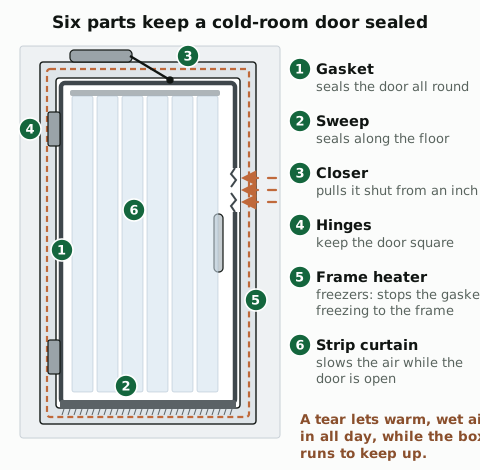
The numbers match the drawing:
- Gasket. The rubber seal round the sides and top of the door. On many walk-ins it has a magnet inside that pulls it onto the frame.
- Sweep. The seal along the bottom of the door, brushing the threshold.
- Closer. The arm at the top that pulls the door shut by itself.
- Hinges. They hold the door square, so it lands on its gasket every time.
- Frame heater, on a freezer. A heater wire runs round the frame, under the trim, so the gasket cannot freeze to the metal. Some coolers have one too: Norlake fits it to both, against condensation.
- Strip curtain. Overlapping plastic strips inside the opening. They slow the warm air while the door stands open.
Two more parts are not in the drawing:
- A heated pressure relief port, on a freezer. A small vent in the wall beside the door. Shutting the door traps warm air, which cools, shrinks and pulls the door in. The port lets air through, so the door is not hard to open just after it has been shut.
- An inside safety release, on every walk-in. A knob, button or bar on the inside of the door that opens it even when it is locked from outside. More on it below.
US federal rules require two of these parts on every walk-in built since 2009:
- An automatic closer that firmly shuts the door from within 1 inch of closed, on doors up to 3 feet 9 inches wide and 7 feet tall.
- A strip curtain, a spring-hinged door or another way to limit the air coming in while the door is open.
Every walk-in door must open from the inside
US workplace rules from OSHA say employees must be able to open an exit route door from the inside at all times, without keys, tools or special knowledge. Walk-in makers meet that with an inside safety release. Norlake lists one as standard with its locking handle. Bally's is a knob that opens the latch with a quarter turn. Everidge fits a push button, with a panic bar or a bump bar as options.
Check the inside release regularly: it must turn or push freely, with no ice on it. Show every new member of staff where it is and how it works, before they need it.
A door lets air in five common ways
Each one lets warm, wet air in for hours. The troubleshooting pages show where each sits among the other reasons for the same symptom.
What the readings show | What you see | Fault | Where it is covered |
|---|---|---|---|
The box runs longer and warmer than it used to, worst in busy hours | Gaps, tears or flat sections, often with a line of frost or water along them | A gasket gone hard, torn or loose | |
Nothing at first. Later, the slow rise of an iced coil | Frost or ice on the frame, trim that feels cold, a door that sticks or sweats | A failed frame heater, on a freezer | |
A rise after someone walks out, and a slow return | A door that does not swing shut by itself, or rubs the frame | A closer or hinge that leaves a gap | |
Big rises at deliveries, slow to come back down | Condensation worst after deliveries and busy service | A missing strip curtain, or a propped door | |
Nothing: it does not warm the box | A door hard to open just after it shuts, easier a minute later | An iced relief port, on a freezer |
Here is what a door that does not seal does to the rest of the refrigeration system
Air that gets in past the door brings two loads: its heat and its water. The rest of the system has to remove both, all day:
- The box runs warm, first in busy hours, then more of the time. It is among the main reasons a reach-in cooler or a reach-in freezer runs warm.
- The unit runs longer and may never rest, on a walk-in freezer, a walk-in cooler, a reach-in cooler or a reach-in freezer.
- The water lands on the coil as frost, faster than defrost can clear it. That is a common reason for ice on the coil of a walk-in freezer, a reach-in freezer or a reach-in cooler.
- The walls get wet in a cooler, and frost and ice build round the door in a freezer.
The two parts below show how a small fault grows.
In a freezer, one failed heater starts a chain
- The door-frame heater fails.
- The gasket freezes to the frame.
- It tears when someone pulls the door open.
- Warm, wet air gets in all day.
- The coil ices faster than defrost can clear it.
Bally's service manual names ice round a door as a sign of a leak or a failed heater. So a cold frame is worth a call this week, not next month.
The right gasket is the one made for your door
Walk-in doors seal in one of two ways:
- A magnetic gasket. A magnet inside the rubber pulls the gasket across the gap and onto the frame, the way a fridge door at home closes. Bally, Norlake and Hussmann all use them on the sides and top, with a sweep along the bottom. Reach-ins use them too.
- A bulb seal. A soft, hollow rubber bulb that the door squeezes shut against. Everidge's doors use one.
A magnet needs metal on the frame to grip, so a magnetic gasket only suits a frame built for one. Swapping a bulb seal for a magnetic one is a question for the door's maker, not a fix to try yourself.
Whichever kind your door has, these matter more than the brand:
- It must stay soft in the cold. Freezer gaskets have to. Generic ones can go hard and stop sealing.
- It must be the right size. Bally's manual says not to stretch a gasket to make it fit, and that a gasket that binds when the door closes is too wide. A gasket that holds the door off its frame can stop it closing by itself.
- It must lie flat, tapped into place, not forced.
"What am I doing wrong when I replace gaskets?"
r/refrigeration, thread title
Order the maker's gasket for your door's model, or have your technician fit one. True's manual treats gaskets as wear parts, to be replaced in time.
A door left ajar shows as a flat line, not a spike
These are real readings from a two-door reach-in holding drinks in a restaurant, the same fridge as on how a reach-in cooler works. Green is a normal night. Red is the same hours the night after.

Think of it as a tug of war:
- The cooling pulls the temperature down.
- Warm air coming in through the gap pulls it up.
- With the door shut, the cooling wins. It gets the box down to its setting, rests, then wins again. That is the ripple in green. A door opened and shut makes a spike that is back down within minutes.
- With the door ajar, nobody wins. The two settle into a draw at a steady temperature, well above the setting. The cooling runs nonstop and never gets to rest, so the ripple disappears. That is the flat red line.
On 24 July this fridge settled near 46°F (8°C) for about 15 hours, then dropped back around noon. It held drinks. In a fridge holding food, that is a working day above the 41°F (5°C) line the US Food Code sets for keeping food cold, long enough to put the food at risk.
A gasket that leaks a little makes no flat line. It makes the box run longer and warmer than it used to, most of all in busy hours. The whole night, and the rest of that month, are on reach-in cooler troubleshooting.
You can check a door in two minutes
- Look all the way round the gasket, including the sweep along the bottom. Look for tears, hard or flat sections, and gaps. A line of frost or water along one stretch shows where it leaks.
- Open the door a few inches and let go. It should swing shut and seal by itself. If it stops short, or rubs the frame, the closer or a hinge needs fixing.
- On a freezer, run your hand along the frame next to the gasket. It should feel warm. Thermo-Kool's manual says a working heater leaves the trim warm to the touch.
- Check the strip curtain is up and whole, with no strips missing.
- Watch the door during a delivery. A door propped open through a delivery undoes the rest.
- Test the inside safety release from inside the box, with the door held open by someone outside. It should turn or push freely.
Clean gaskets with warm soapy water and a soft cloth. Never scrape a gasket: True's manual says not to. A torn or hard gasket, a door that will not close, or a cold freezer frame is a this-week call.
Every cold box has the same door problem, in a different shape
Unit | What seals it | What goes wrong | More on this |
|---|---|---|---|
Walk-in cooler | Gasket, sweep, closer, hinges and a strip curtain. Some makers add a frame heater against condensation | Hard or loose gaskets, failed closers, curtains taken down because they are in the way | |
Walk-in freezer | The same, plus a heated frame and a heated relief port | A failed frame heater, then a torn gasket, then an iced coil | |
Walk-in with glass doors, a beer cave | Heated glass, rails and frames | Fogged glass when the heat is off or the seal leaks. Federal rules cap that heat at 3.0 watts per square foot of door on coolers and 7.1 on freezers, unless a control turns it down in dry air | |
Reach-in cooler | Magnetic snap-in gaskets and hinges. Traulsen's doors close by themselves from 90 degrees and stay open at 120 | Gaskets out of their groove, doors that drop on worn hinges, doors slammed so hard they bounce open | |
Reach-in freezer | Gaskets, plus door and frame heaters. On some models they sit on an energy-saver switch | A switch turned off, or a failed heater, lets the frame sweat or freeze | |
Undercounter and prep table | Drawer and door gaskets at knee height | Pans and carts damage drawer gaskets. Base doors get left ajar during service | |
Reefer | Seals round the rear and side doors | Worn seals leak all trip. Doors opened with the unit running pull warm air in |
The simpler way: TemperatureWise watches for a door that does not seal
Everything on this page takes time, and you have to know what to look for. TemperatureWise takes that complexity out:
- It learns each box. It uses machine learning on the full temperature history of each box, and learns that box's own pattern.
- It watches for a door that does not seal. In the readings, that looks like a warm, flat line in place of the usual ripple when a door is left ajar.
- It names the likely culprits. When it sees that change, TemperatureWise tells you what has changed and the top three likely parts at fault, so you know where to look.
On the fridge in the chart above, TemperatureWise alerted the site to a door left ajar.
It does not fix the gasket. It tells you which box to look at, and when.
This is one of our walk-in refrigeration parts pages. The evaporator coil page shows what the extra frost does to the coil.