
The compressor, contactor and starting parts: what starts the compressor, how it fails, and what you can check
By Vimal Bhaya, Founder and Lead Systems Architect · Last reviewed 20 October 2026
This is a continuation of Walk-in refrigeration parts, a 14-part tutorial. You are on part 10 of 14.
The compressor is the pump that moves the refrigerant round the loop. It cannot start itself. A contactor, the heavy switch the thermostat throws, gives it power. On a single-phase compressor, a start relay and a start capacitor give it a kick to get turning, and an overload cuts it off if it runs too hot.
Most compressor calls start with a part round it: a contactor stuck closed, a start part that fails so the compressor hums and clicks off, low voltage, or a lost phase. Do not keep resetting a unit that hums and trips, and do not open the electrical panel. Each failed start heats the motor.
The compressor pumps the refrigerant, and five parts start and protect it
The compressor squeezes the cool gas coming back from the box into a hot, high-pressure gas. That squeeze is what pushes the refrigerant round the loop:

On most units it is a motor and a pump sealed in one welded steel shell, so nothing inside it can be fixed on site. Some bigger ones are semi-hermetic: bolted together, so a technician can open them. Either way, it cannot start itself. The parts that start it and protect it sit outside, in the condensing unit's electrical box:
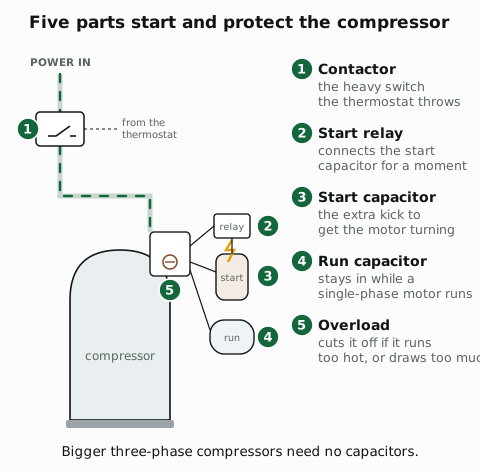
The numbers match the drawing:
- Contactor. The heavy switch that gives the compressor its power. The thermostat or controller throws it, and on Heatcraft's units the condenser fan starts at the same moment.
- Start relay. It connects the start capacitor as the motor starts, then lets go in under a second.
- Start capacitor. The extra kick that gets the motor turning. Tecumseh says it is built for a few seconds of work at each start, no more.
- Run capacitor. It stays connected while a single-phase motor runs.
- Overload. A heat-sensitive switch that cuts the motor off if it runs too hot or draws too much current. It resets itself once it cools, which Tecumseh says can take as long as an hour.
Bigger compressors run on three-phase power and start without capacitors. They need something else:
- All three phases. Lose one, and the motor stalls at start or overheats while running.
- In the right order. Heatcraft notes that a scroll compressor only runs one way round, and is noisy if the phases are swapped.
- At the right voltage. Heatcraft asks for three-phase power within 10% of the nameplate, and single-phase power within 10% over or 5% under.
Heatcraft's manual describes a phase loss monitor that guards against all three. One more part sits on the compressor itself: a crankcase heater that keeps its oil warm while it is off. It is covered on the winter controls page.
Walk-ins and reach-ins use piston, scroll or rotary compressors, and screws are for big plants
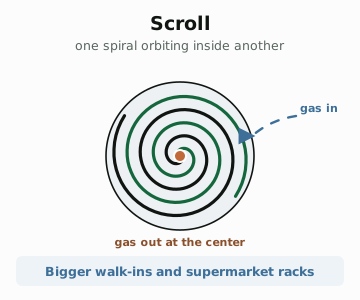
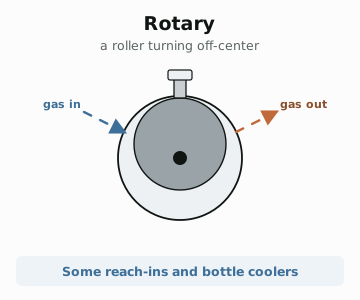
All four kinds squeeze the gas. They just do it in different ways:
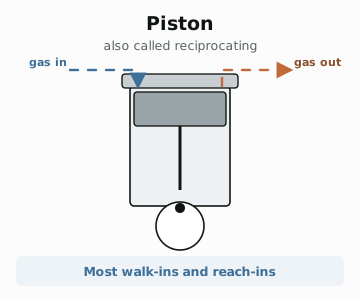
- Piston, or reciprocating. Pistons run up and down in cylinders, like a car engine, drawing the gas in and squeezing it out. ACHR News calls it a well-known, mature design.
- Scroll. One spiral orbits inside a fixed one, squeezing pockets of gas toward the center, where it leaves. ACHR News calls it the quietest kind.
- Rotary. A roller turns off-center inside a round cylinder and squeezes the gas against a blade. Tecumseh makes them for commercial refrigeration, including bottle coolers.
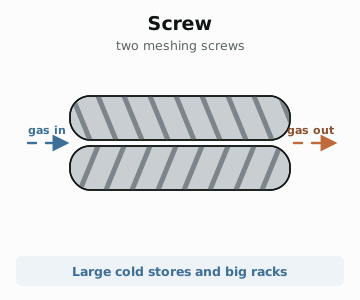
- Screw. Two meshing screws trap the gas between their lobes and squeeze it as it travels along them. They are built for very large systems.
Equipment | Usual compressor |
|---|---|
Reach-in, prep table, bottle cooler | A small sealed piston compressor, or a rotary one on some models |
Smaller walk-in | A sealed piston compressor. Danfoss puts the line at about 1 horsepower, ACHR News at about 2 |
Bigger walk-in | A scroll, or a semi-hermetic piston compressor that a technician can open |
Supermarket rack | Several compressors on one rack: sealed pistons on smaller racks, and mostly semi-hermetic pistons on larger ones |
Reefer | A piston compressor driven by the unit's engine, with six cylinders on Carrier's X4 |
Warehouse cold store | Screw compressors, often on ammonia. The warehouse in one Emerson case study runs four |
So a screw compressor belongs to the very largest systems. The rest of this page is about the piston, scroll and rotary compressors in walk-ins and reach-ins.
A compressor stops cooling in six common ways
Most of them start with a part round the compressor, not the compressor itself. The troubleshooting pages show where each sits among the other reasons for the same symptom.
What the readings show | What you see | Fault | Where it is covered |
|---|---|---|---|
The ripple stops, and the box keeps getting colder | The compressor never stops, and turning the thermostat up makes no difference | A contactor stuck closed | |
The box climbs from a unit that is not running | A hum for a few seconds, a click, then silence, over and over | A failed start part, or low voltage | |
The box climbs from a unit that is not running | A breaker or fuse that goes again soon after it is reset | A burned contactor, a failed motor or a wiring fault | |
The box climbs from a unit that is not running | A compressor that will not start, or trips on its overload | A lost phase, on three-phase power | |
Extra stops in the ripple, worst in the heat | It clicks off after a few minutes and tries again later, often on hot afternoons | A compressor running too hot | |
A slow loss of capacity, worst on warm days | It runs longer, and the box will not get as cold as it used to | A worn compressor |
On a reach-in, the same starting parts sit on the side of the compressor, and a relay stuck closed keeps it running whatever the setting says.
Here is what a failing compressor does to the rest of the refrigeration system
The compressor is what moves the heat. When it falters, everything downstream feels it:
- With the compressor stopped, nothing cools the box. By our failure-mode reference, a dead compressor can take a reach-in cooler past 41°F (5°C) in 2 to 4 hours.
- Each failed start heats the motor. A hum and a click, again and again, cooks the windings a little more each time.
- A compressor kept hot wears out. Heat breaks down its oil and wears its valves and rings.
- A worn compressor still cools, just not enough. John Tomczyk puts it plainly in ACHR News: it is still producing cooling, but not to its rated capacity.
- A motor that burns out can leave acid in the system, which is why a technician may need to clean the system out when replacing it.
A compressor is usually killed by something round it
"How long do compressors last?"
r/refrigeration, thread title
The answer that comes back from technicians is that compressors rarely just wear out. Something round them does the damage:
- Heat, from a dirty condenser, a dead condenser fan or a hot room.
- Bad power: low voltage, a lost phase, or phases out of balance.
- Hard starts, over and over, on a failing start part.
- Liquid refrigerant reaching it, from a coil fed too much, or a cold night with no crankcase heat. Heatcraft warns that liquid coming back washes out the bearings.
So when a compressor is replaced, a good technician also asks what killed the old one. Otherwise the new one goes the same way.
Hum, click, silence: leave it off
A compressor that hums for a few seconds and then clicks off has tried to start and failed. Its overload has tripped to protect it. A few minutes later it may try again.
Do not keep resetting it. Each failed start heats the motor. Reset a tripped breaker once at most, and if it goes again, leave it off and call a technician today.
A compressor fault shows in the ripple
Each ripple in a box's readings is one start and stop of the compressor, as the thermostat page's chart shows. Each fault changes it in its own way:
- Stopped, tripped or will not start: the ripple stops, and the box climbs steadily toward the temperature of the room.
- Stuck on: the ripple stops, and the box keeps falling.
- Too hot: extra stops and starts, most of all on hot afternoons.
- Worn: longer runs and a box that sits a little warmer every week. It looks the same as a system short of refrigerant, which the refrigerant leaks page shows in a real freezer.
A unit that stops and does not restart makes a straight climb, like the reefer on reefer troubleshooting that stopped on a weak battery.
You can check a compressor by ear and by eye, and stop at the panel
- Listen. A steady hum while it runs is normal. A hum for a few seconds, then a click and silence, points to a start part or low voltage.
- Count the starts. On and off every few minutes is short cycling. Time a few cycles with your phone. One compressor maker sets the limit at 10 to 12 starts an hour.
- Feel the air from the condenser grille, never the compressor. Warm is normal. Air hot enough to make you pull your hand away means the compressor is working too hard.
- Check whether it ever stops. A compressor that never stops while the box gets colder points to a stuck contactor or a control.
- Look at the breaker. If it has tripped, reset it once at most.
Do not open the electrical box, and do not touch the compressor: the shell and its pipes can burn. If any metal on the cabinet gives you a shock or a tingle, switch the unit off at its breaker and call a technician.
Every unit has a compressor, and what feeds it differs
Unit | Where it is and what drives it | What goes wrong | More on this |
|---|---|---|---|
Walk-in, outdoor or roof unit | In the condensing unit outside, with its contactor and starting parts in the unit's electrical box. Bigger ones run on three-phase power | Stuck contactors, start parts, lost phases, and hard starts after cold nights | |
Walk-in, indoor unit | On top of the box or in a back room | The same electrical faults, plus heat from a hot kitchen | |
Reach-in and prep table | A small single-phase compressor in the base or on top, with its start relay and overload on its side | Heat and dust, and a relay stuck closed | |
Display case | Self-contained cases carry their own. Supermarket cases share compressors in a machine room | A fault on a shared rack reaches every case on it | |
Reefer | Driven by the unit's own diesel engine, or by an electric motor on shore power | A weak battery that cannot restart the engine |
The simpler way: TemperatureWise watches for a failing compressor
Everything on this page takes time, and you have to know what to look for. TemperatureWise takes that complexity out:
- It learns each box. It uses machine learning on the full temperature history of each box, and learns that box's own pattern.
- It watches for a failing compressor. In the readings, that looks like a ripple that stops, extra starts on hot afternoons, or longer runs week by week.
- It names the likely culprits. When it sees that change, TemperatureWise tells you what has changed and the top three likely parts at fault, so you know where to look.
It does not replace your technician. It tells you which one to call, and when.
This is one of our walk-in refrigeration parts pages. The thermostat, controller and pressure switches page covers the controls that tell the compressor when to run.