
Probe types: thermistor, RTD, 4-20mA, and what they mean for you
By Vimal Bhaya, Founder and Lead Systems Architect · Last reviewed 7 September 2026
This is a continuation of The physical reality, a 6-part tutorial. You are on part 6 of 6.
For a walk-in cooler or freezer, almost always a thermistor. It is accurate enough, cheap enough and rugged enough, and the money you save is better spent elsewhere.
Two of these words are sensors and one is not. A thermistor and an RTD both measure temperature. 4-20 mA is not a sensor at all, it is a way of carrying a reading down a long cable without losing any of it, and mixing that up is the most common confusion in this whole subject.
Where an RTD earns its money is regulated storage, where you need a calibration certificate and years of stability. Everywhere else, the probe type is the smallest decision on the page. Where you put it matters about fifty times more.
Four sensors and one wire
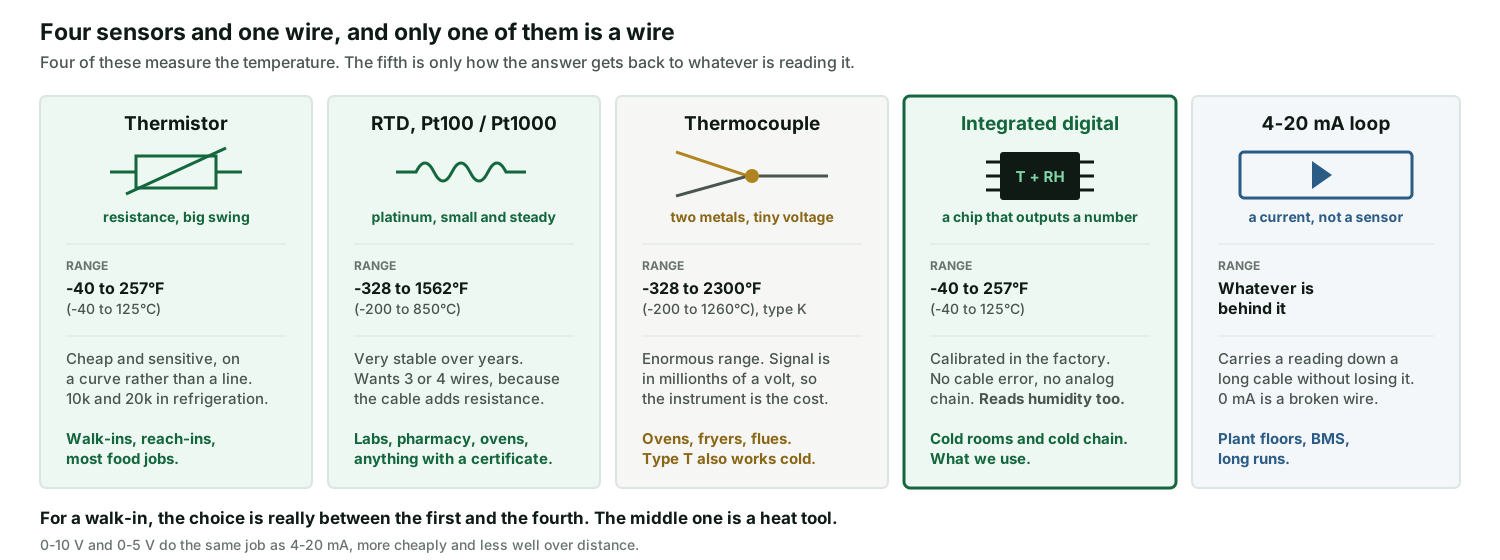
A thermistor is a resistor that cares about temperature
Everything that conducts electricity changes its resistance a little as it warms up. A thermistor is a lump of metal oxide engineered so that it changes a great deal.
That big change is the whole point. It means you can read it accurately without expensive electronics, which is why it is in almost every thermostat, appliance and refrigeration controller made. In refrigeration you will meet two: the 10k and the 20k, named for their resistance at room temperature.
The trade is that the change is not a straight line, so something has to convert the resistance into a temperature using a curve. Every device that uses one does this, and it is not a problem, it is just why two thermistors from different makers are not interchangeable.
An RTD is a coil of platinum that behaves itself
An RTD is a length of pure platinum, either wound as a fine coil or deposited as a film. Its resistance changes far less than a thermistor's, but it changes in a very nearly straight line, and it keeps doing so for years.
The two you will see are the Pt100 and the Pt1000, again named for their resistance at 0°C. The international standard, IEC 60751, sorts them into tolerance classes. A class A part is good to about ±0.19°C at -20°C (-4°F). A class B part is good to about ±0.4°C at the same temperature.
What you are really buying is stability. A platinum sensor drifts very little over years, which is why laboratory and pharmacy storage specifies it and why calibration certificates are written against it.
The catch is the wiring. Because the resistance change is small, the resistance of the cable itself is no longer negligible, and it adds straight onto your reading. That is why RTD probes are run with three or four wires rather than two, and why a long RTD run is a job rather than a connection.
A thermocouple is two metals having a disagreement
Join two different metals and the junction produces a tiny voltage that varies with temperature. That is a thermocouple, and it has an enormous range: some types read from cryogenic temperatures to well past the inside of a furnace.
It is not wrong for the cold. Type T, copper and constantan, is genuinely good at low temperatures. What makes it awkward for this job is that the signal is measured in millionths of a volt, and the instrument has to take a second reference measurement at its own end to make sense of it.
That is straightforward in a lab rig on mains power. It is a nuisance in a battery sensor stuck to a shelf. For a walk-in there is no reason to take on the complication.
An integrated digital sensor is a chip, not a component
The three above are passive components. Each changes some electrical property with temperature, and something else has to supply a current, measure the result and work out what it means.
An integrated digital sensor does not work that way. It is a silicon chip with the sensing elements and the measuring electronics on the same piece of silicon, calibrated at the factory, and it hands out a number rather than a resistance.
Two different things happen inside it. Temperature comes from a band-gap sensor, which reads the very predictable way the voltage across a junction in the silicon shifts as it warms and cools. Humidity comes from a capacitive polymer, a thin film whose capacitance changes as it takes up or gives off moisture from the air.
It is what almost every modern wireless cold room sensor contains, ours included.
4-20 mA is not a sensor
This is the one worth understanding properly, because people say it as though it were a kind of probe.
4-20 mA is a way of sending a number down a wire. The transmitter varies the current in the loop between 4 and 20 milliamps in proportion to the reading. Because it is a current rather than a voltage, resistance in a long cable does not change it, so the reading arrives at the far end of a factory exactly as it left.
The clever part is where zero sits. The bottom of the scale is 4 mA, not 0. So a reading of 0 mA is not cold, it is a broken wire, and the receiving end knows the difference. That single property is why plant floors have used it for fifty years.
This is the vocabulary a controls engineer will use with you. One controls technician on Reddit listed his options as "10k or 20k thermistors, 4-20ma 0-5 or 0-10vdc", which mixes two sensors and two signalling methods in one breath, and everybody in that conversation knew what he meant.
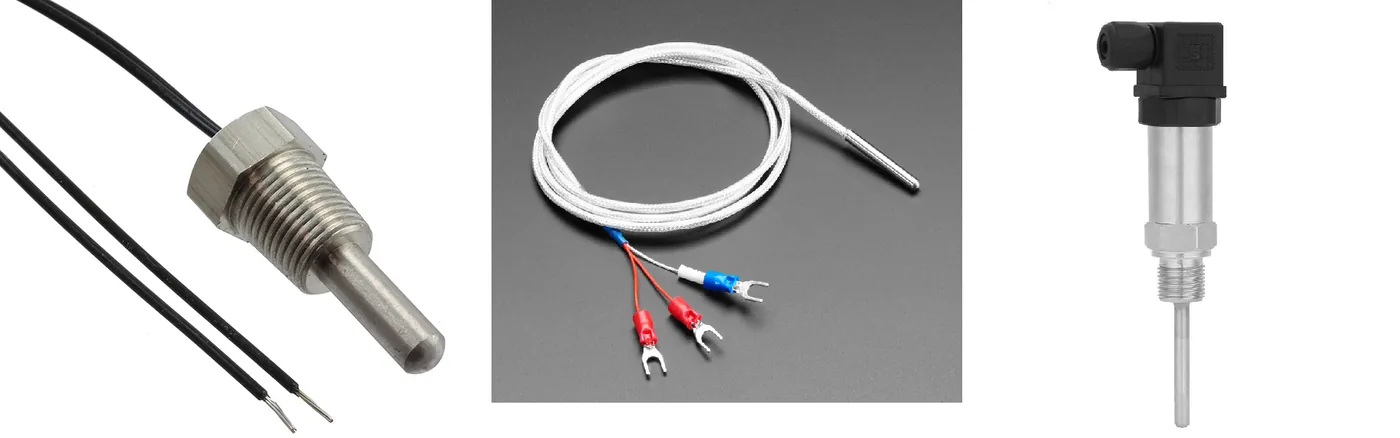
Why the chip is the right answer for a cold room
This is not a cheaper substitute for an RTD. For this particular job it removes most of the ways the other three go wrong, and every one of those is something we come back to later on this page.
- No cable in the measurement. A long two-wire RTD run puts the cable's own resistance straight onto your reading. A digital sensor measures at the die and sends a number, so the wiring cannot introduce an error at all.
- No analog chain to drift. There is no separate amplifier, reference or converter between the element and the number, because they are the same component.
- Calibrated once, at the factory, and it stays put. The calibration lives in the chip.
- Very little power. An RTD needs a current pushed through it to be read at all. A chip that wakes, reads and sleeps in milliseconds is what makes a five year battery possible in the first place.
- Humidity in the same package. A thermistor and an RTD cannot measure humidity at all, so on those you are installing a second sensor to get it.
The one thing it will not do is heat. Its range stops at 257°F (125°C), which covers every cold room on earth and no fryer. That is not a weakness, it is what a part designed for one job looks like, and it is the same reason nobody puts a platinum RTD rated to 1562°F in a domestic fridge.
What you will see bolted to the outside of a walk-in
Worth naming, because you have almost certainly looked at one. The digital display on the outside wall of a walk-in, the one showing the box temperature to anybody walking past, is traditionally driven by an RTD or a thermistor on a lead running through the panel. That is the classic arrangement and it works.
It is doing a different job from ours. It is a local readout wired to a controller, so it needs a probe on the end of a cable and something on the wall to read it. Ours is a self-contained sensor that sits inside the box and reports over the air, with no cable through the panel and no unit on the wall.
The two coexist perfectly well, and most sites we work on keep the wall display exactly where it is.
All five, side by side
| Type | What it is | Typical range | Accuracy near freezer temperatures | Where it belongs |
|---|---|---|---|---|
| Thermistor | A resistor with a big, curved response | -40 to 257°F (-40 to 125°C) |
A few tenths of a degree | Walk-ins, reach-ins, display cases, most food jobs. Cheap |
| RTD, Pt100 or Pt1000 | Platinum, small and very predictable | -328 to 1562°F (-200 to 850°C) |
±0.19°C class A, ±0.4°C class B at -20°C | Vaccines, blood, pharmacy, ovens, anything needing a certificate |
| Thermocouple | Two metals making a tiny voltage | -328 to 2300°F (-200 to 1260°C), type K |
Around a degree, type dependent | Ovens, fryers, flues, process heat. Type T also works cold |
| Integrated digital sensor | A silicon chip, not a passive component. Measures humidity too | -40 to 257°F (-40 to 125°C) |
±0.2°C typical | Cold rooms and cold chain. What modern wireless sensors use |
| 4-20 mA | Not a sensor. A way of carrying the reading | Whatever is behind it | Adds almost nothing over distance | Long cable runs, plant floors, building management systems |
Look at the range column and the pattern is obvious. The two that reach thousands of degrees are the two built for heat. If your problem is an oven, a fryer or a flue, an RTD or a thermocouple is the right answer and nothing else comes close.
If your problem is a cold room, every one of them has far more range than you will ever use, so range stops being the question. What is left is accuracy, stability, power, wiring, and whether you also want humidity, and on that list the digital sensor wins for this job.
A freezer swings 20°F, which makes probe accuracy the small argument
Here is the comparison nobody in this market puts on a page, because it makes the specification argument look small.
A freezer is not a stable place. On one of our own units, working perfectly, a scheduled defrost took the air from -0.4°F to 22.1°F and back, a swing of more than 20°F (11°C), four times a day. Against a box that moves 20 degrees on purpose, a tenth of a degree of probe tolerance is noise.
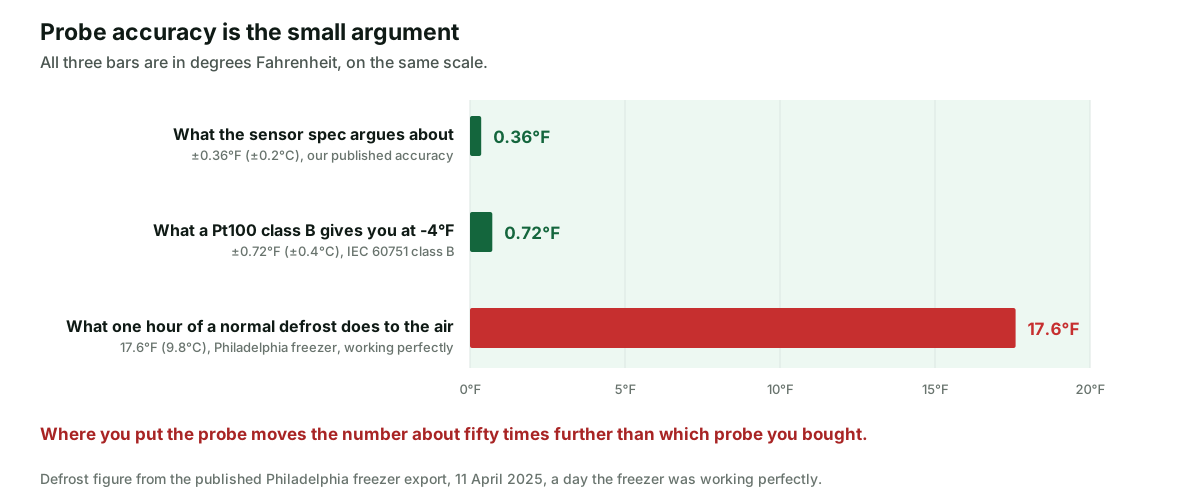
A tenth of a degree of sensor tolerance is irrelevant next to a probe hanging in the wrong airflow. On a freezer that was working perfectly, the air moved 17.6°F (9.8°C) in an hour during a scheduled defrost. No probe upgrade helps with that.
Two things fix it, and neither is the probe type.
First, put it in the right place. Out of the coil's discharge, at product height, at the warm end of the box. Where to place a sensor is the whole of that argument.
Second, buffer it. A probe sealed inside a small bottle of glycol stops reading the air and starts reading something that behaves like a package of food. It is the single cheapest improvement available to anyone monitoring a walk-in, and it works with whatever probe you already own. Glycol buffers and thermobuffers covers it in full, with the measured rates.
Put those together and the ranking is clear. Placement first, buffering second, probe type a distant third.
When the probe type genuinely does matter
When somebody will audit the sensor itself. Vaccine, blood and pharmaceutical storage do not only want an accurate reading, they want a traceable one, with a calibration certificate and a schedule for renewing it. That is platinum territory, and the paperwork is most of what you are paying for.
When you are feeding an existing building system. If a controller expects a 10k thermistor or a 4-20 mA input, that is what it expects, and the decision has been made for you.
When the cable run is long. Over any real distance, current wins. This is exactly the case 4-20 mA was invented for.
When it is going in something aggressive. Liquid, brine, cleaning chemicals or high pressure make the sheath and the seal matter more than the element inside them.
What a spec sheet accuracy figure does not include
This is worth knowing before you compare two numbers on two brochures, because they are not measuring the same thing.
The sensor is not the system. The stated tolerance is the element alone. The electronics that read it add their own error, and so does whatever converts the resistance into a number.
Reading a resistance means passing current through it, which warms it very slightly. It is small, and it is not nothing, and it is one reason a well-designed sensor reads in short bursts rather than continuously.
Cable resistance lands straight on an RTD reading in a two-wire hookup. Three and four wire connections exist to cancel it out, and a long two-wire RTD run is a quiet source of error.
Everything drifts. Thermistors drift more than platinum. That is not a defect, it is the reason regulated storage has a calibration schedule and a food walk-in does not.
Notice that the first three of those are problems of the chain rather than the element: the cable, the excitation current, the converter. That is exactly what an integrated digital sensor removes, by doing the whole chain on one piece of silicon. It is the quiet reason the category exists.
What we ship
The TemperatureWise LoRa sensor is an integrated digital sensor, the fifth row in the table above, rather than a thermistor or an RTD. The freezer version reads to ±0.3°C (±0.54°F) at 25°C (77°F) over an operating range of -40°C to 55°C (-40°F to 131°F). The cooler version reads to ±0.5°C (±0.9°F) over -20°C to 55°C (-4°F to 131°F). Both report humidity alongside temperature from the same unit, which a resistive probe cannot do at all.
There is a probe version for going into a liquid or a buffer bottle rather than sitting in the air. We supply the glycol buffer where it is needed and match its size to what you actually store, because the right buffer for cases of frozen protein is not the right one for a cooler of fresh produce.
Heat is somebody else's job. If you need to log a fryer, an oven or a flue, that is a thermocouple or a high-range RTD, and we will tell you so rather than sell you the wrong part.
It talks to your building management system, with the right gateway
If you already run a BMS or a BAS, you do not have to choose between it and us. With our BACnet gateway the readings appear as ordinary BACnet points, alongside everything else your facilities team already watches, so the cold rooms stop being the one system that lives in its own app.
That is worth knowing before you rip anything out. If your building system already reaches a box and reads it properly, keep it. Tell us what you have and where it does not reach, because the boxes a BAS never got to, the outlying cold store, the yard reefer, the freezer added after the system went in, are usually the ones that fail.