
Battery or wired: what actually survives -20°F (-29°C)
By Vimal Bhaya, Founder and Lead Systems Architect · Last reviewed 18 October 2026
This is a continuation of The physical reality, a 6-part tutorial. You are on part 4 of 6.
A battery sensor works perfectly well at -20°F (-29°C), on two conditions: it uses the right chemistry, and it does not talk too often. Get either of those wrong and you will be changing batteries in the cold every few months.
The alkaline AAA cells in your TV remote and the coin cell in an AirTag are both the wrong chemistry for this. Two kinds of cell are right. Lithium thionyl chloride, which is a different thing again from the lithium-ion in an electric car, is built for exactly this environment, passes with room to spare, and is what our LoRa sensor runs on. Energizer Ultimate Lithium, an ordinary AA or AAA rated to -40°F (-40°C), works too, and it is what our $25 Bluetooth sensor runs on.
The second half matters more than people expect. Sending a reading is the expensive part, so a sensor reporting every 2 minutes burns through seven and a half times as much battery as one reporting every 15. Fifteen minutes catches everything that actually happens in a walk-in.
The common complaint, and why it is fair
From a contractor who runs his own monitoring at 30 second polling, answering a question about which system to buy:
"Don't use battery sensors. You will get crap refresh times and be dealing with constantly replacing batteries."
Refrigeration contractor, r/HVAC
He is describing the products he has used, and about those he is correct. There is a whole shelf of cheap wireless thermometers that die in a freezer, and people have been burned by them.
What he is describing is not a law of physics. It is two design choices, and both of them can go the other way.
Why the coin cell is the wrong battery
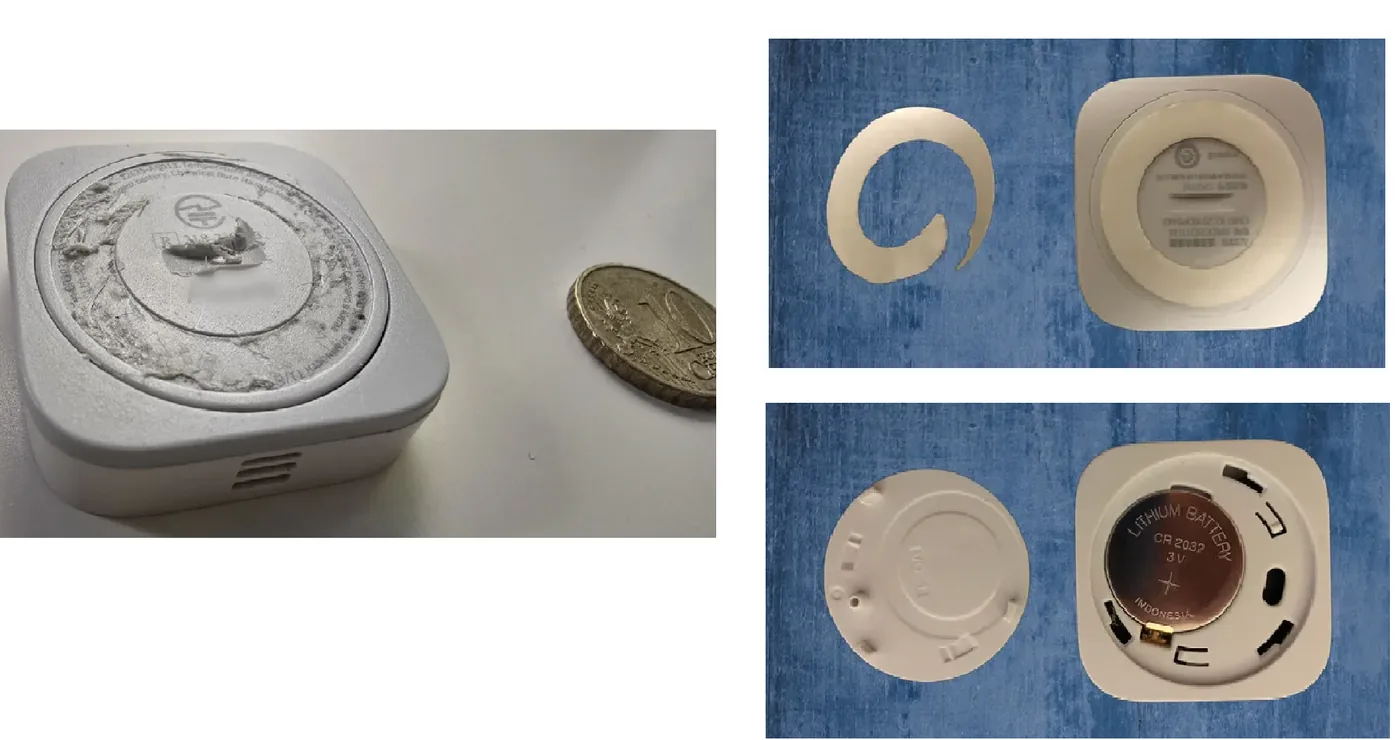
The CR2032 is the flat silver disc in an AirTag, a car key and half the cheap sensors on the market. Its datasheet says it works down to -22°F (-30°C), which is colder than your freezer. So why do they fail?
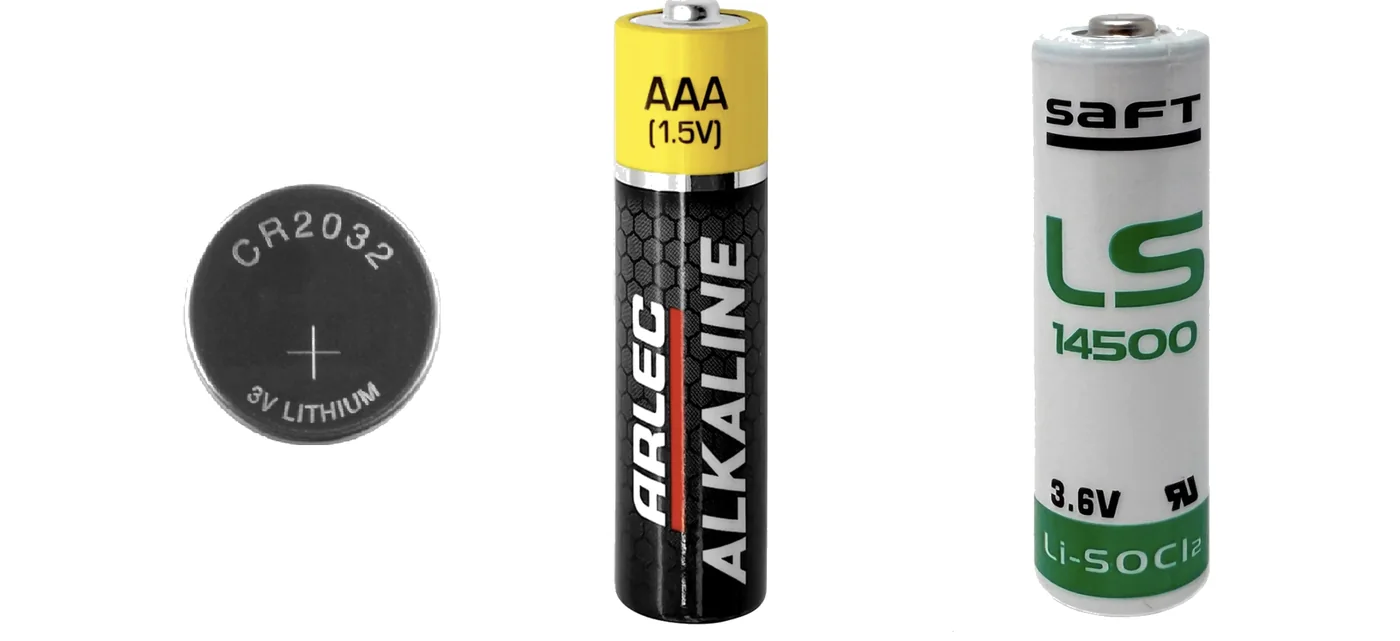
Because that rating is measured at a trickle. A CR2032 is rated at about 225 milliamp-hours drawn at 0.2 milliamps, which is a whisper. A radio transmitting is not a whisper. It is a burst of tens of milliamps, for a fraction of a second.
Cold thickens the chemistry inside the cell and slows the reaction, so the cell's internal resistance climbs. When the radio asks for its burst, the voltage sags under the load. If it sags far enough, the radio browns out, the reading is lost, and the device may simply reset.
The cell is not empty. It still has most of its energy in it. It just cannot hand it over fast enough while it is cold. This is why people take a dead freezer sensor back to the workshop, and it works fine on the bench.
There is a second problem underneath the first, and it is not about cold at all. A coin cell simply does not hold much. A CR2032 is 225 mAh at 3 volts, which is about 0.7 watt-hours. An AA lithium cell is 3,000 mAh at 1.5 volts, about 4.5 watt-hours, so roughly six times more energy before the cold has done anything to either of them.
Ordinary alkaline is worse, and there is a lithium AA that is not
Alkaline cells fail the same way and sooner. Energizer's own handbook recommends -18°C (0°F) as the bottom of the range, notes that below that "performance will be significantly lower", and explains why in a sentence worth quoting: no capacity is lost to the cold, it is simply harder to get at.
But there is an ordinary AA that does work down there, and it is worth knowing about because you can buy it in a supermarket. Energizer Ultimate Lithium, the L91, is a different chemistry again, lithium iron disulfide, and its datasheet gives an operating range of -40°C to 60°C (-40°F to 140°F). In a freezer it genuinely performs.
Two catches. It costs roughly $4 to $5 a cell against well under a dollar for alkaline, so almost nobody puts them in by default, and a $15 sensor certainly does not ship with them. And it is still a 1.5 volt consumer cell, so it is a good answer for a device that already works and a poor foundation for one designed to run unattended for years. We fit them in our $25 Bluetooth sensor, where they last about two years.
Lithium thionyl chloride is built for this
Lithium thionyl chloride, written Li-SOCl2, is the chemistry industrial sensors use. It is not exotic and it is not new. It is what has been sitting inside utility meters and pipeline sensors for decades.
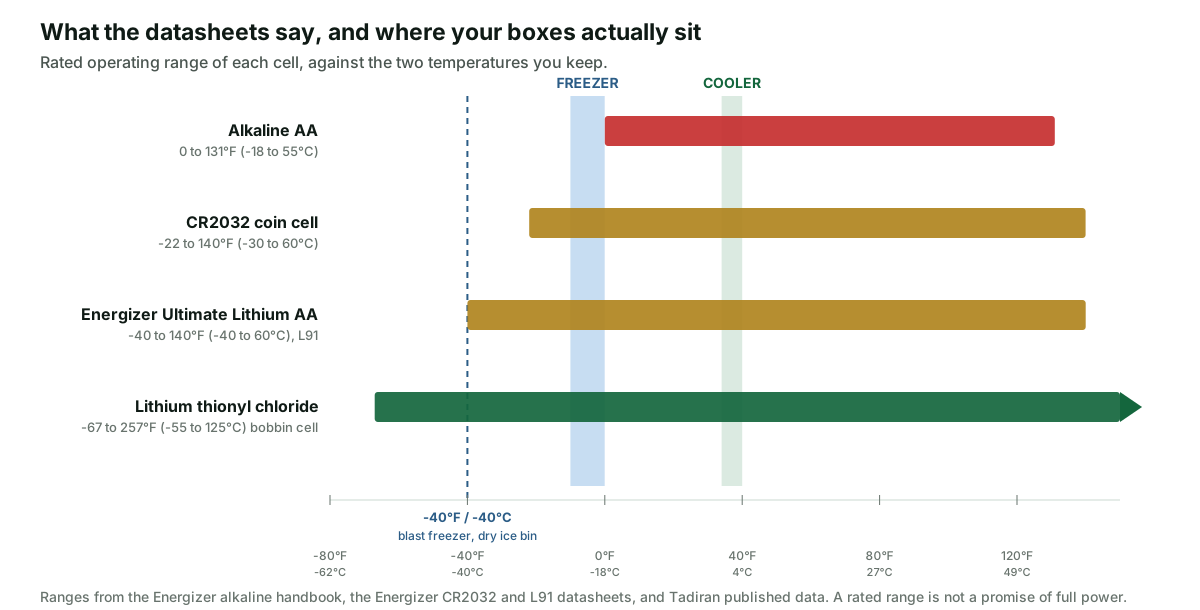
The published figures for a bobbin-type cell are -55°C to +125°C (-67°F to +257°F), self-discharge under 1 percent a year, and operating life claims up to 40 years. It comes in ordinary shapes: an AA-sized cell is an ER14505, a D-sized one is an ER34615.
That self-discharge number is the quiet one. A cell that loses 3 percent a year to nothing at all has given away a third of itself in a decade before your sensor has sent a single reading.
The other half of the answer is how often it talks
A sensor spends almost all its life asleep, drawing microamps. Waking up, taking a reading and transmitting is where the energy goes.
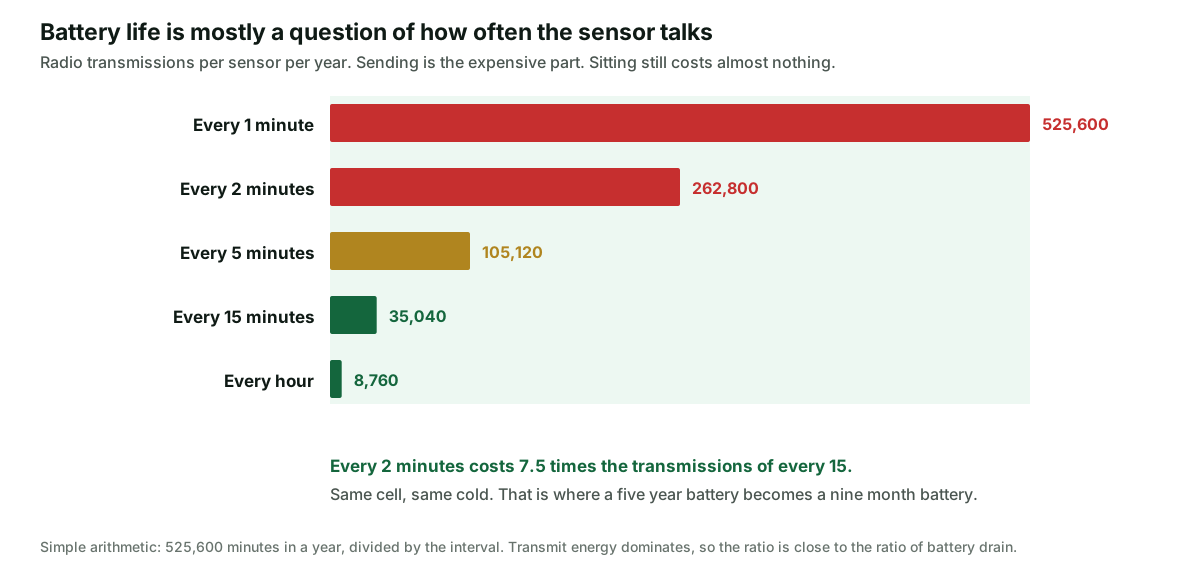
So when a vendor quotes you a battery life, the number is meaningless on its own. Ask what reporting interval it assumes and at what temperature. A five year claim at hourly reporting and a five year claim at 15 minute reporting are not the same product.
Does a 15 minute gap miss anything?
This is the fair objection, and there is a real complaint behind it. One operator told us his system updates every 5 to 8 minutes and he wants 1 to 2. Slow data feels like blind data.
So we checked it against our own published records rather than arguing about it.
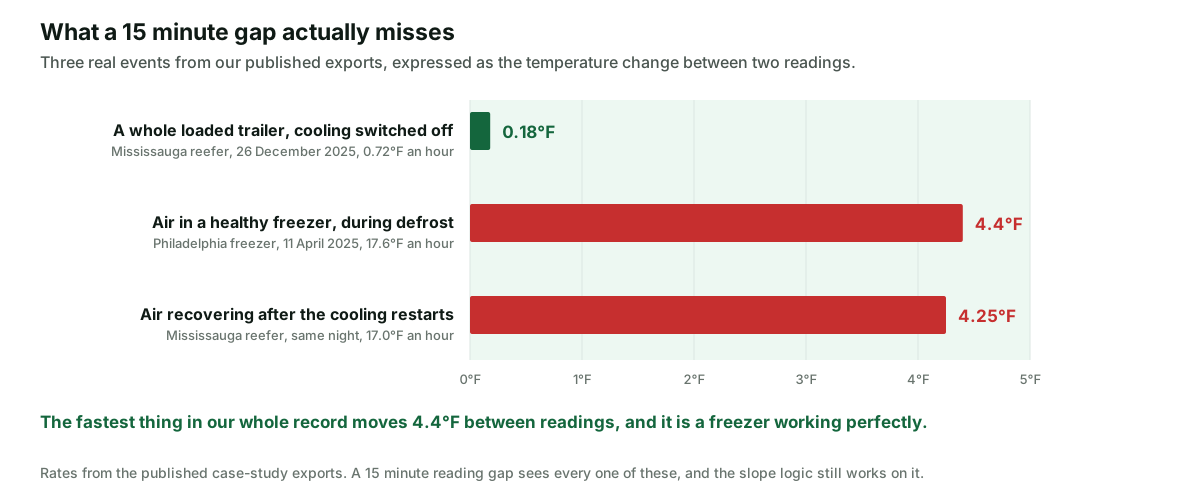
A whole loaded trailer with its cooling completely switched off warmed at 0.72°F (0.4°C) an hour. That is 0.18°F (0.1°C) between two readings a quarter of an hour apart.
The reason is thermal inertia, and you already trust it
You buy meat and milk, you put them in the car, and you drive for forty minutes on a warm day. Nothing has spoiled when you get home. The middle of that pack of mince is still cold.
Food is dense and wet, and changing its temperature takes real time and real energy. A loaded walk-in is that same effect at a thousand times the scale. It is a large cold mass in an insulated box, and it gives up its cold over hours, not minutes.
So a real emergency is slow. The thing you are trying to catch does not happen between two readings, because it physically cannot. That is the whole argument, and it is the same physics behind putting the probe in a glycol buffer: measure something with mass, and it stops jumping about.
What moves in minutes is air, and air is the thing you do not need to chase.
The fastest thing in our whole record is a freezer working perfectly, gaining 17.6°F (9.8°C) in an hour during a scheduled defrost. Even that only moves 4.4°F (2.4°C) between readings.
Fifteen minutes sees both. It also gives you a clean line to measure the slope from, which is what catches a failure hours before any threshold does.
When faster genuinely matters: diagnosing a compressor that is short cycling, watching a pull-down after a delivery, or proving a two-stage cooling process for a health inspector. Those are engineering and compliance jobs, not storage monitoring, and they are worth a mains-powered sensor.
When wired is the right answer
Wired does not usually mean a cable to the sensor. It means the pattern that three separate practitioners in our Reddit research describe, without knowing each other: put the radio outside the box and run the probe in.
"probe shot straight through the cabinet insulation into the cooler box"
Maintenance director running 160 coolers
It solves two problems at once. The radio never has to cross the panel, and the transmitter is on mains so the battery question disappears. ThermoWorks build their NODE exactly this way, and it is a sound design.
What it costs you in kind: a hole through the insulation, a cable that is a small cold bridge and a thing to be snagged, and a mains outlet within reach of each box.
What it costs you in money is easier to pin down than people expect, so here it is for a five-box site.
| Line | Working | Cost |
|---|---|---|
| Call-out, one visit | Minimum charge before anybody picks up a drill | $150 |
| Labour | 45 min to 1 hour a box, five boxes, at $100 an hour | $375 to $500 |
| Install total | If it all happens in one visit | $525 to $650 |
| Per box | Before the sensor, the transmitter or the cable | About $105 to $130 |
| If it takes more than one visit | Separate areas, or the line has to stop, so the call-out repeats | Up to $1,250 |
The $100 an hour sits in the middle of the $90 to $120 refrigeration labour rates operators report, and an hour a walk-in matches what technicians quote for service work. The call-out minimum is the figure we see most often. Your own contractor will have his own number, and it is worth asking for it before you choose an architecture rather than after.
For one critical freezer, five or six hundred dollars is a fair trade and we would tell you to do it. Across twelve boxes it is the reason a rollout stalls, and it is all spent before a single reading arrives.
| Approach | Life in a freezer | Install | Where it belongs |
|---|---|---|---|
| Coin cell or alkaline sensor | Weeks to months | None | Coolers at a push. Not a freezer, whatever the box says |
| Lithium thionyl chloride sensor | Years | Stick it on the shelf | Almost every walk-in cooler and freezer |
| Mains transmitter outside, probe inside | Indefinite | Drill, cable, electrician | One or two critical boxes, or anywhere you need fast polling |
What we ship, and what to ask anybody else
We ship two sensors. The LoRa sensor, for walk-ins and sites that sprawl, runs on two AA-size lithium thionyl chloride cells, the ER14505 described above, and reports every 15 minutes. On that interval we expect 5 to 8 years of battery in a deep freezer. It comes in two versions. The freezer version is rated -40°C to 55°C (-40°F to 131°F) and reads to ±0.3°C at 25°C. The cooler version is rated -20°C to 55°C (-4°F to 131°F) and reads to ±0.5°C.
The $25 Bluetooth sensor, for small kitchens with the boxes close to its hub, records every 5 minutes on Energizer Ultimate Lithium AAA cells and lasts about two years.
On the LoRa sensor we guarantee 4 years as a floor. If a battery does not make it, we replace it free. An expectation costs us nothing to print, so we would rather put a number underneath it that we have to honour.
Those figures belong together. Ask us for 2 minute reporting and the battery life falls a long way, and we will tell you what to instead of quietly leaving the old number on the page.
Three questions worth asking any vendor, including us:
- What chemistry is the cell, and what is it rated to? If the answer is a coin cell, you have your answer.
- At what reporting interval and what temperature is the battery life quoted? A number without those two is marketing.
- What happens when the battery does go? A sensor that goes quiet without telling anyone is worse than no sensor, because it looks like everything is fine.
What none of this fixes
A long battery life is not a promise about this particular battery. Cells vary, cold varies, and a bad one fails early. What you should insist on is being told when a sensor stops reporting, which is a different feature and the one that actually protects you.
The battery is not the only thing the cold attacks. Cheap hobby boards and consumer sensors are often not rated for long-term sub-zero use at all, whatever the cell inside them is. The plastic, the display and the seals matter too.
And a sensor that runs for eight years in the wrong place is eight years of the wrong number. Placement and buffering decide what the reading is about. The battery only decides whether it arrives.