
LoRa, LoRaWAN, 433MHz, Wi-Fi and Zigbee compared for cold rooms
By Vimal Bhaya, Founder and Lead Systems Architect · Last reviewed 18 October 2026
This is a continuation of The physical reality, a 6-part tutorial. You are on part 2 of 6.
For a cold room, LoRa, by a wide margin. Not because it does something clever with steel, but because it can afford to lose about 55 decibels more signal than Wi-Fi and still be read.
The reason that is allowed is that a temperature reading is a tiny thing. You are not streaming video out of your freezer. You are sending a number, a few times an hour. Once you stop paying for bandwidth you cannot use, you can spend everything on reach instead.
Wi-Fi and Zigbee sit at 2.4 GHz and have no margin to spare. Wi-Fi HaLow is the right idea and is real, but the products are thin on the ground. 433 MHz works and is legal in North America, on a very short leash.
Pick the radio by how far the boxes are from the receiver
Wi-Fi or LoRa is a question about distance more than about technology. Find where the receiver can sit, count the walls and the feet to each box, and the table below picks for you. The rest of this page explains why.
| Your site | Choose | Why |
|---|---|---|
| A reach-in or two, in the same room as the router | Wi-Fi | No extra hardware, and the router is close |
| A small kitchen, with walk-ins and reach-ins close together | Bluetooth, with a hub a few feet from the boxes | A short hop gets through one panel. This is our $25 sensor |
| Walk-ins and freezers spread across a kitchen, store or plant | LoRa, 902 to 928 MHz | One gateway reaches every box, through the panels and the walls between |
| Several buildings, a dock, or parked reefers | LoRa, with cellular if there is no site internet | Distance is what LoRa is for |
LoRa and LoRaWAN are not the same thing
One is the radio. The other is the rulebook written on top of it, and they come from different places: Semtech owns the first, the LoRa Alliance publishes the second.
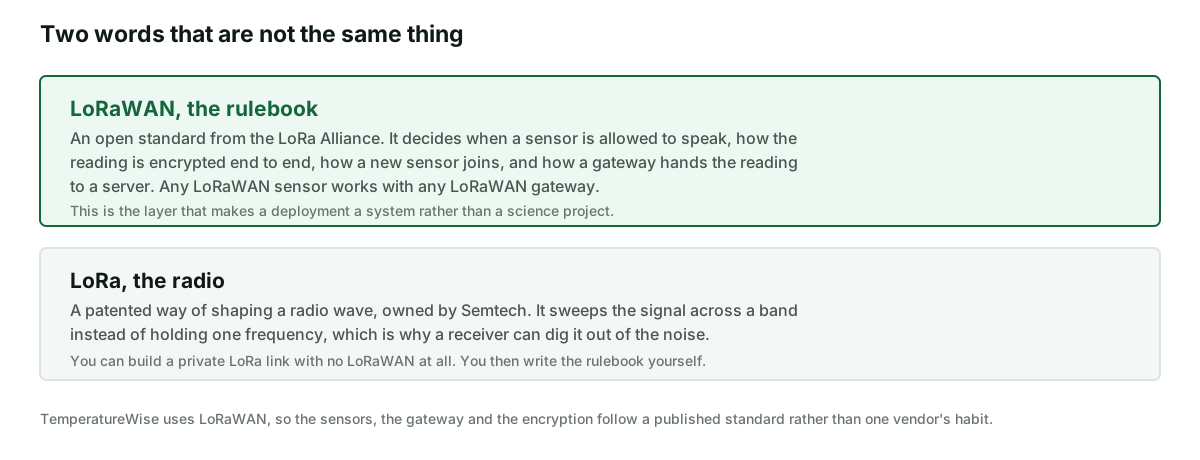
The practical difference is lock-in. A LoRaWAN sensor talks to any LoRaWAN gateway. A plain LoRa sensor talks to whatever its maker decided, and only that.
You are not streaming video out of your freezer
This is the part that gets skipped, and it is the reason the rest of the argument works.
A temperature reading is a handful of bytes. Temperature, humidity, battery level, a device address, and it is sent. At four readings an hour, one sensor produces something like 2 kilobytes a day. A single 1080p security camera produces roughly 20 gigabytes a day, which is about ten million times more.
Wi-Fi is built for the camera. It is a superb piece of engineering aimed at moving a great deal of data a short distance, quickly. Every design decision in it, including the choice of 2.4 and 5 GHz, follows from that.
You are asking it to do the opposite job: move almost nothing, a long way, through steel, on a battery, for years. It is the wrong tool, and it is the wrong tool by design rather than by accident.
So the whole of this page is one trade. You give up speed and bandwidth, which you were never going to use, and you buy reliability and reach with the change. Nothing is being invented. It is a dial, and every radio is set somewhere along it.
It is worth seeing how far that dial goes. In September 2023 a LoRaWAN tracker on a fishing boat off the coast of Portugal was received 1,336 km (830 miles) away. An earlier record covered 832 km (517 miles) on 25 milliwatts, which is roughly a fortieth of the power your phone uses to reach a cell tower down the road.
Those are open-water, line-of-sight stunts and nobody is promising you 800 miles across a factory. The point is what the dial is capable of once you stop paying for bandwidth. Your freezer is 200 ft away through ten walls, and that is a much easier problem than the one those records solved.
Link budget is the one number that decides it
Link budget is how much signal a radio can afford to lose between the transmitter and the receiver, and still be understood. It is simple arithmetic: how loudly the sensor shouts, plus how quietly the receiver can still hear.
A word about decibels, because the number means nothing otherwise
Decibels do not add up the way ordinary numbers do. Every 10 you add multiplies by ten, it does not add ten. It is the same trick as earthquake magnitudes: a magnitude 7 is not forty percent worse than a magnitude 5, it is a hundred times worse.
| Decibels | How many times |
|---|---|
| 10 dB | 10× |
| 20 dB | 100× |
| 30 dB | 1,000× |
| 40 dB | 10,000× |
| 55 dB | about 300,000× |
Keep that in your head for the chart below, because 55 decibels is not "a bit more than 50". It is the difference between hearing something and having no idea it was ever said.
For scale on the other side: a single walk-in wall costs somewhere in the region of 20 to 40 decibels, and every interior wall on the way costs a few more.
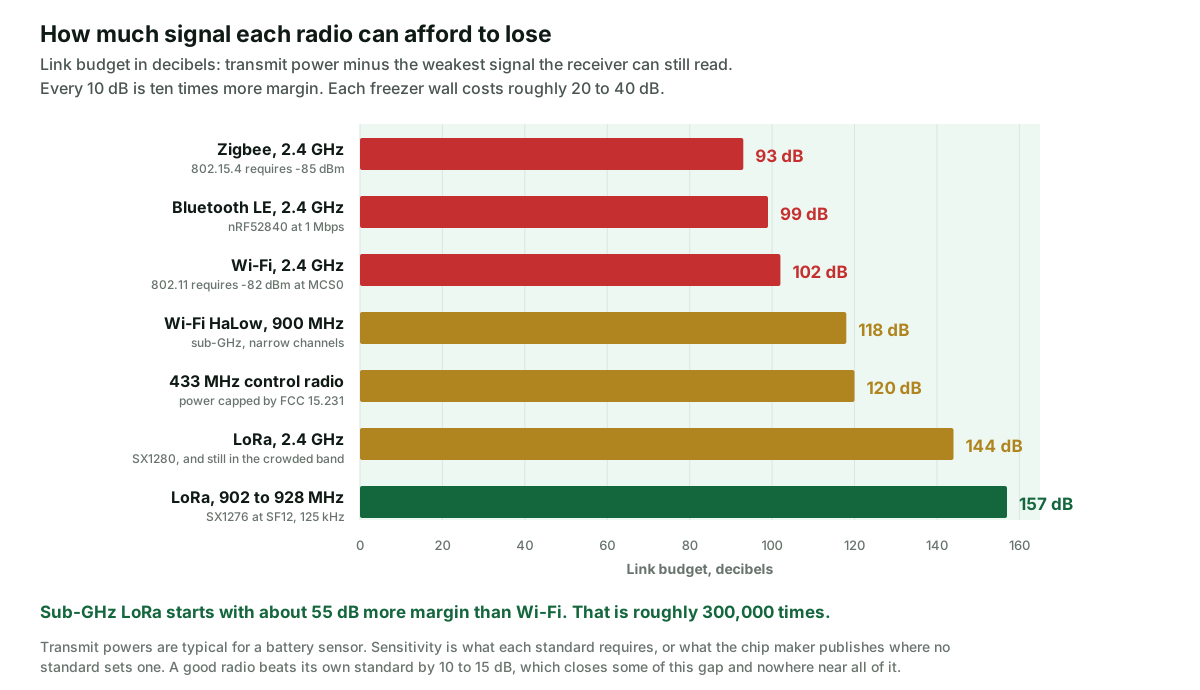
That gap is the whole answer, and everything else on this page is detail.
Every bit of that advantage is in the listening, not the shouting. Both radios transmit at about the same power, around 20 dBm. The difference is where each receiver gives up: a Wi-Fi receiver needs about -82 dBm, and a LoRa receiver, running slowly, reads down to about -137 dBm.
LoRa buys those ears by sweeping one slow chirp across the band instead of packing a fast signal into it. The receiver knows the exact shape of the sweep it is waiting for, so it can dig the signal out from under the noise. It is the difference between catching a sentence said quickly and catching one word drawn out slowly in a pattern you were expecting.
The cost is that it takes far longer to say far less, which is a trade you are happy to make for a number you need four times an hour.
Lower frequency helps a second time
Two radios shouting equally loudly across the same room do not arrive equally loudly. The higher frequency arrives weaker, simply because of how signal spreads out.
Going from 2.4 GHz down to 915 MHz is worth about another 8 decibels over the same distance, before anything is in the way. Lower frequencies also lose less passing through ordinary building materials, and bend more usefully around large objects like a pallet rack.
None of that is dramatic on its own. It is 8 decibels on top of 55, and it points the same way.
Wi-Fi HaLow is the new one worth knowing about
There are two recent Wi-Fi developments and they point in opposite directions. It is worth knowing which is which before someone tells you your new access points will fix this.
Wi-Fi HaLow, the standard called 802.11ah, is the one that matters here. It runs in the same 902 to 928 MHz band as LoRa in North America, reaches about a kilometre, and is built for exactly this kind of low-rate sensor traffic. The Wi-Fi Alliance began certifying it in November 2021.
It is a genuinely good idea. It is real Wi-Fi, so it inherits normal IP networking and normal security, which LoRaWAN has to provide separately. It sits between LoRa and ordinary Wi-Fi on both range and speed, at roughly 100 kilobits a second on a typical channel.
| Wi-Fi HaLow (802.11ah) | LoRaWAN | |
|---|---|---|
| Band in North America | 902 to 928 MHz | 902 to 928 MHz |
| Link budget | About 118 dB | 157 dB |
| Reach | About a kilometre | Across several buildings from one gateway |
| Data rate | Roughly 100 kilobits a second | A few hundred bits a second at long range |
| Battery | 1 to 3 years | 5 to 10 years |
| Network | Normal IP networking and Wi-Fi security, on an access point you run | A gateway and a network server, with its own encryption |
| What you can buy today | Very little for refrigeration | Many sensors and gateways |
The catch is availability. In commercial refrigeration monitoring today there is very little you can actually buy, and being early on a radio standard means being early on the spare parts too. Watch it. Do not wait for it.
Wi-Fi 6E and Wi-Fi 7 added the 6 GHz band, and that is the newest band in Wi-Fi. It goes the wrong way for you. Higher frequency means more bandwidth and shorter reach, and it is worse through walls than 5 GHz, which is already worse than 2.4. New Wi-Fi is faster Wi-Fi. It is not longer Wi-Fi.
Yes, there is a 2.4 GHz LoRa, and no, it is not the one you want here
This catches people out, so it is worth saying plainly. LoRa is a modulation, not a frequency. Semtech make the SX1280, which runs the same chirp trick up in the 2.4 GHz band.
It exists for good reasons, and neither of them is wall penetration. 2.4 GHz is licence-free almost everywhere, so a manufacturer can build one product and sell it worldwide instead of a European version, a North American version and an Asian version. It also does precise distance ranging, which the sub-GHz parts do not.
For a cold room it gives up both of its advantages at once. Its published sensitivity is about -132 dBm against -137 dBm for the sub-GHz part, so it is 5 dB behind before it starts. Then it is in the 2.4 GHz band, so it pays the same higher path loss as Wi-Fi, loses the same amount in walls, and shares the air with every phone, laptop, microwave and Bluetooth speaker on site.
We use sub-gigahertz LoRa, in the 902 to 928 MHz band. If somebody offers you "LoRa" for a walk-in, that is a fair question to ask them: which band. The answer changes the argument completely.
Why 433 MHz is a European answer to a North American question
433 MHz turns up constantly in the Reddit threads we researched, and the people recommending it are not wrong. It is sub-gigahertz, it gets through walls, and it works.
The problem is the rules. In Europe, 433 MHz is a proper licence-free band. In North America it is not. Devices there run under FCC Part 15.231, which allows periodic control signals only, forbids continuous transmission outright, and caps the field strength hard.
So a 433 MHz sensor sold in Canada or the United States is perfectly legal, and it is running on a much shorter leash than the same product in Europe. That is why serious North American sensor products land on 902 to 928 MHz, where the rules allow far more power.
Every radio, side by side
| Radio | Band in North America | Link budget | Through a freezer panel | Battery years | The honest verdict |
|---|---|---|---|---|---|
| Wi-Fi | 2.4 and 5 GHz | 102 dB | Rarely | Months | Right for cameras and laptops. Wrong for this, and it also puts your monitoring on the network IT reconfigures |
| Zigbee | 2.4 GHz | 93 dB | Rarely | 1 to 2 | The most commonly reported failure in a walk-in. Good in a house, where it can hop from device to device |
| Bluetooth LE | 2.4 GHz | 99 dB | With a hub close by | 1 to 2 | Built to cross a room. A hub a few feet outside the box reads it through the panel, which is how our $25 sensor works, but it cannot cross a site. The Long Range mode does better, and almost no cheap sensor ships it |
| Wi-Fi HaLow | 902 to 928 MHz | ~118 dB | Usually | 1 to 3 | The right idea, properly standardised. Almost nothing to buy yet in this market |
| 433 MHz | 433 MHz, restricted | ~120 dB | Usually | 2 to 5 | Works, and is legal, on a tight power leash in North America. Stronger in Europe |
| LoRa, 2.4 GHz | 2.4 GHz | ~144 dB | Sometimes | 2 to 5 | Same modulation, wrong band. Exists so one product can be sold worldwide, not to get through steel |
| LoRa and LoRaWAN, sub-GHz | 902 to 928 MHz | 157 dB | Yes | 5 to 10 | Built for exactly this shape of problem. Slow, and you do not need it to be fast |
Battery figures are the usual claims for a sensor reporting every few minutes to a quarter of an hour. They move enormously with how often the sensor talks, which is a subject of its own.
What LoRa is bad at
Every one of these is real, and none of them is disqualifying for temperature. They would be disqualifying for other jobs.
It is slow, deliberately. A few hundred bits a second at long range. You cannot send a photograph, you cannot stream anything, and you should not expect a reading every ten seconds. If you want to watch a compressor start up in fine detail, this is the wrong radio.
Airtime is rationed. The rules cap how long any one transmission may hold a channel, and networks limit how much airtime a device may use. That is what keeps the band usable for everyone, and it is a hard limit on how chatty a sensor can be.
Talking back to the sensor is harder than listening to it. The uplink is the strong direction. Sending settings or firmware down to a sensor is slow and constrained, which is a genuine operational annoyance.
The gateway is a single point. If it loses power or its connection, every sensor behind it goes quiet at once. Any honest vendor tells you what happens then, and what we do about it is on the record rather than in a sales conversation.
The radio layer is one company's. LoRaWAN above it is an open standard, but the chip underneath comes from Semtech. That is a supply chain fact worth knowing rather than a reason to avoid it.
What we use, and what it buys you
For walk-ins and any site that sprawls, TemperatureWise uses LoRaWAN in the 902 to 928 MHz band, and everything in this list follows from that one choice.
For a small kitchen with its boxes close together, we also sell a $25 Bluetooth sensor, read by a hub a few feet from the boxes. The panel costs the same signal either way, and a short hop survives it. What LoRa buys you is the whole site.
- The sensor goes inside the box and nothing is drilled. No hole through the panel, no cold bridge, no contractor, no day with the box emptied.
- One gateway, anywhere on site with power. Not one per zone. It reaches across several buildings from a single point.
- It is not on your plant network. Your monitoring does not go quiet because somebody rotated a Wi-Fi key or re-segmented a VLAN on a Sunday.
- Encrypted from the sensor, not from the gateway. Diffie-Hellman key exchange with AES-128 CBC, end to end.
- Rated for the cold it is going into. The freezer version runs from -40°C to 55°C (-40°F to 131°F) and reads to ±0.3°C at 25°C. The cooler version runs from -20°C to 55°C (-4°F to 131°F) and reads to ±0.5°C.
- 5 to 8 years of battery in a deep freezer, at readings every 15 minutes. Why those two numbers belong together is the next part of this tutorial.
- It mounts with a magnet, adhesive or one screw. No electrician, so you can put it where the temperature is rather than where the signal is.
- A probe version for liquids and glycol buffers, where you want the food temperature rather than the air.
- A continuous record, kept. Every 15 minutes, retained for audits.
When we would tell you not to bother
If every one of your boxes is a reach-in in the same room as the router, none of this matters. A $40 Wi-Fi sensor will serve you honestly, and we would rather say so than sell you a gateway you do not need.
Ask us anyway and we will tell you which ones are worth buying and where to get them. We have read the threads. We know which of the cheap ones people are still happy with a year later and which ones are landfill, and we would rather be the people who gave you a straight answer than the people who quoted you.
The argument on this page starts to pay when there is a steel wall, a long span, or a second building involved. And when the arithmetic changes shape.
Here is that arithmetic. A single freezer holds thousands of dollars of stock, and on a bad night a site loses far more. One operator in our research inventoried $1,200 of product that would have sold for $7,000. A pharmacy in the same corpus lost close to $500,000 in one outage.
So the question is not whether $40 is cheaper than $200. It is whether you want a $5 part shipped from AliExpress standing between you and that. For a reach-in of soft drinks, honestly, yes. For a freezer holding a week of production, it is a strange place to economise. That is also why we sell two sensors: $25 Bluetooth for boxes close to one hub, and $200 LoRa for the freezer you cannot afford to lose.
And a radio that reaches is only half of it. It still has to be in the right place in the box, and the reading still has to be interpreted properly before anyone should be woken up by it.