
Will wireless work through a walk-in freezer wall? The honest answer
By Vimal Bhaya, Founder and Lead Systems Architect · Last reviewed 18 October 2026
This is part 1 of 6 in The physical reality, a short tutorial on the physics of monitoring a cold room.
Sometimes. It depends almost entirely on which radio the sensor uses, and hardly at all on how good the app is.
Wi-Fi and Zigbee both run at 2.4 GHz, and a walk-in freezer is a metal box with insulation in the walls. Those two facts together are why so many people buy a cheap wireless sensor, get nothing, and decide wireless does not work in a freezer.
Radios down at 900 MHz, such as LoRa, get a reading out and carry it across a whole site. So does the old trick of putting the radio outside the box and running a wired probe in. A 2.4 GHz sensor gets out only on a short hop, to a hub a few feet from the box. Aimed at a router across the building, it is a bet you will lose more often than you win.
How well do your phone calls go in an elevator?
Think about the last call you tried to hold on the way up. The bars drop, the other person breaks into pieces, and you tell them you will ring back.
Nobody blames the phone for that, and nobody blames the phone company. An elevator car is a steel box, and radio does not pass through metal. It bounces off, and the small part that does not bounce turns into a trace of heat in the steel. Whatever signal you had left came in through the door gap.
A walk-in freezer is the same box. It is colder, and there is nobody standing in it to notice that the bars have gone.
So when a wireless sensor goes quiet in a freezer, the sensor is usually not the thing that is broken. The radio inside it is the wrong radio for a steel box.
What a walk-in wall is actually made of
Most people picture the wall as a slab of foam. As far as a radio is concerned, that is the wrong picture.
A standard walk-in panel is a 4 inch (100 mm) insulation core with a sheet of metal on each face. One of the larger North American manufacturers publishes the finishes as 26 gauge galvalume, 26 gauge painted steel or stucco stainless, on both faces, for coolers and freezers alike. Freezer panels are the same build, rated R-32 rather than R-28.
The foam is nearly invisible to a radio. The two metal skins are not. You did not build an insulated room. You built a metal box and put the insulation inside the walls.
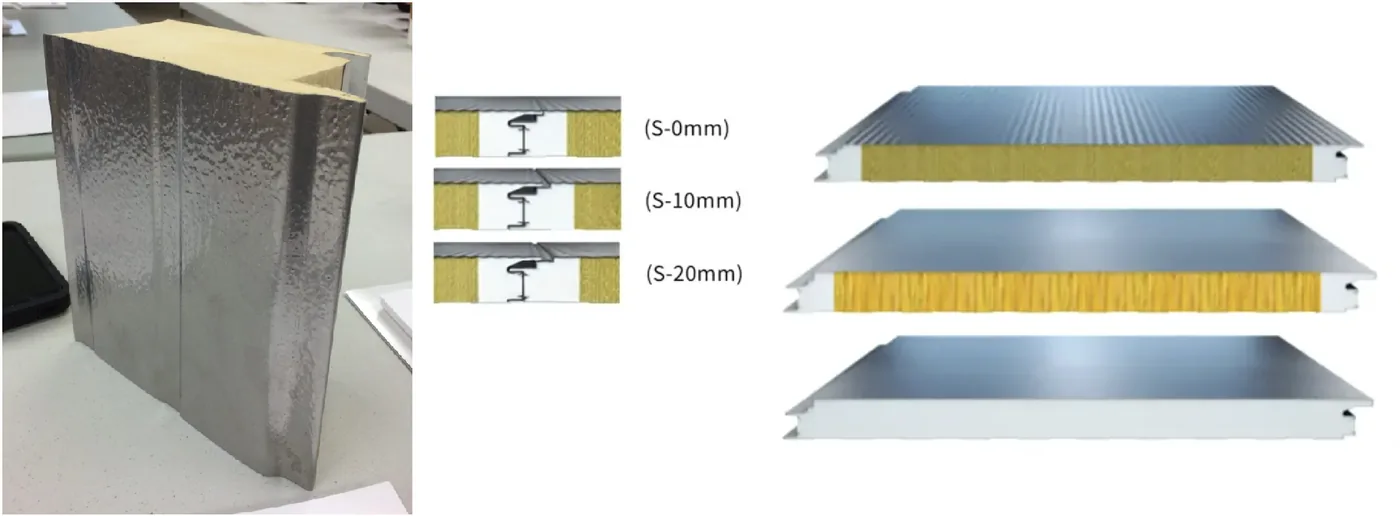
Then there is everything else. The floor is usually panelled the same way. The door is a metal slab on a magnetic gasket. Inside there is steel shelving and stacked product, and outside there is often a steel rack, a compressor, and the next cold room.
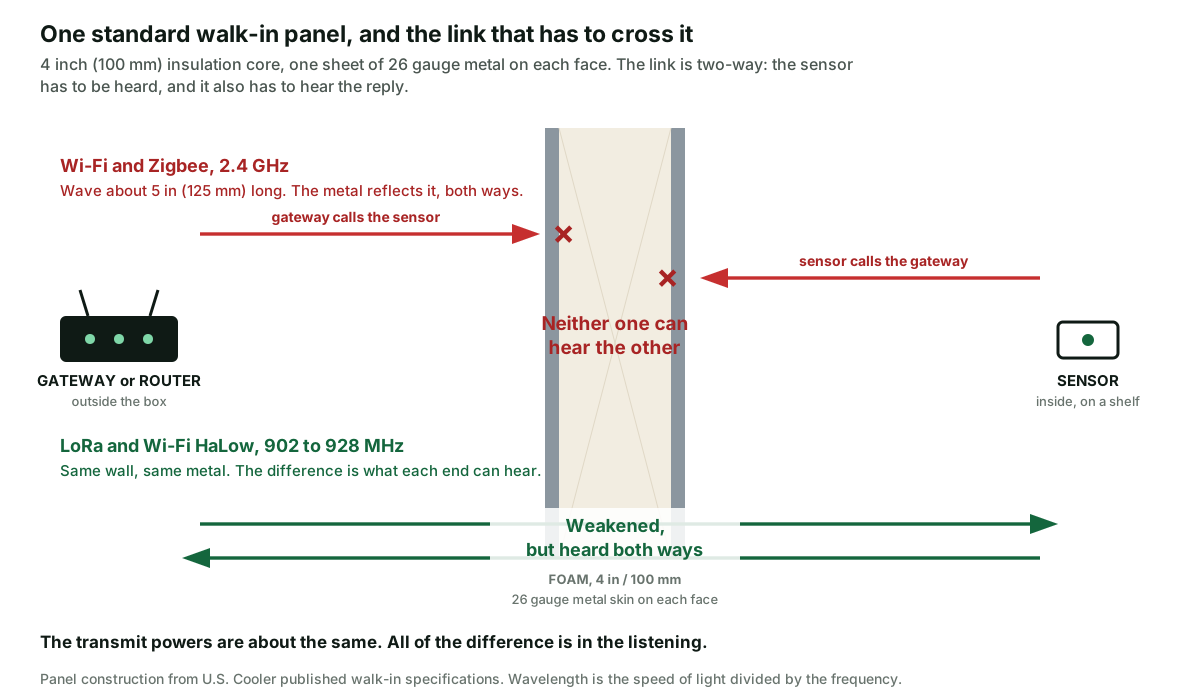
One thing to hold on to before the picture below. This link runs both ways. The sensor inside has to be heard by the gateway outside, and it also has to hear the gateway answer. Both of those crossings happen at the same piece of metal, so when it fails, it fails in both directions at once.
A metal box that blocks radio is called a Faraday cage
Wrap something in metal and the metal takes the hit. The electric field spreads itself over the shell instead of reaching what is inside. Michael Faraday showed this in the 1830s with a room covered in foil, and the effect has carried his name ever since.
The version in your kitchen is the microwave oven door. The mesh has holes you can see straight through, because light has a very short wave and slips between them. The microwave energy has a much longer wave and cannot. That is why the door works and why you can still watch your dinner turn.
A freezer is not a perfect cage. It has a door gasket, panel joints, a drain line and cable entries, and some signal does find its way through those and around the outside of the box.
Both radios lose most of their signal at the metal. The difference is what each one has left afterwards. One of them can still be heard. The other cannot.
So why does one of them still get through?
Not because it shouts louder. This is the part people usually get backwards. A LoRa sensor and a Wi-Fi sensor transmit at about the same power. The whole difference is in the listening.
Wi-Fi says a full sentence, quickly. You either catch it or you do not. LoRa says one word, drawn out over a second or more, rising in a pattern the receiver already knows to expect. A listener who knows the pattern can pick that out of the racket long after a fast sentence would have turned to mush.
That is worth about 55 decibels of extra margin, which is another way of saying the LoRa receiver can hear something roughly three hundred thousand times fainter. Same voice, far better ears.
What it costs is speed. LoRa takes much longer to say much less. For a temperature reading a few times an hour, that costs you nothing at all, and the next part of this tutorial puts real numbers on all of it.
The wall is only the last four inches
Before the signal reaches the freezer at all, it has to cross the building. Here is a real food production floor, 190 ft by 95 ft (58 m by 29 m), with the distances measured on it.
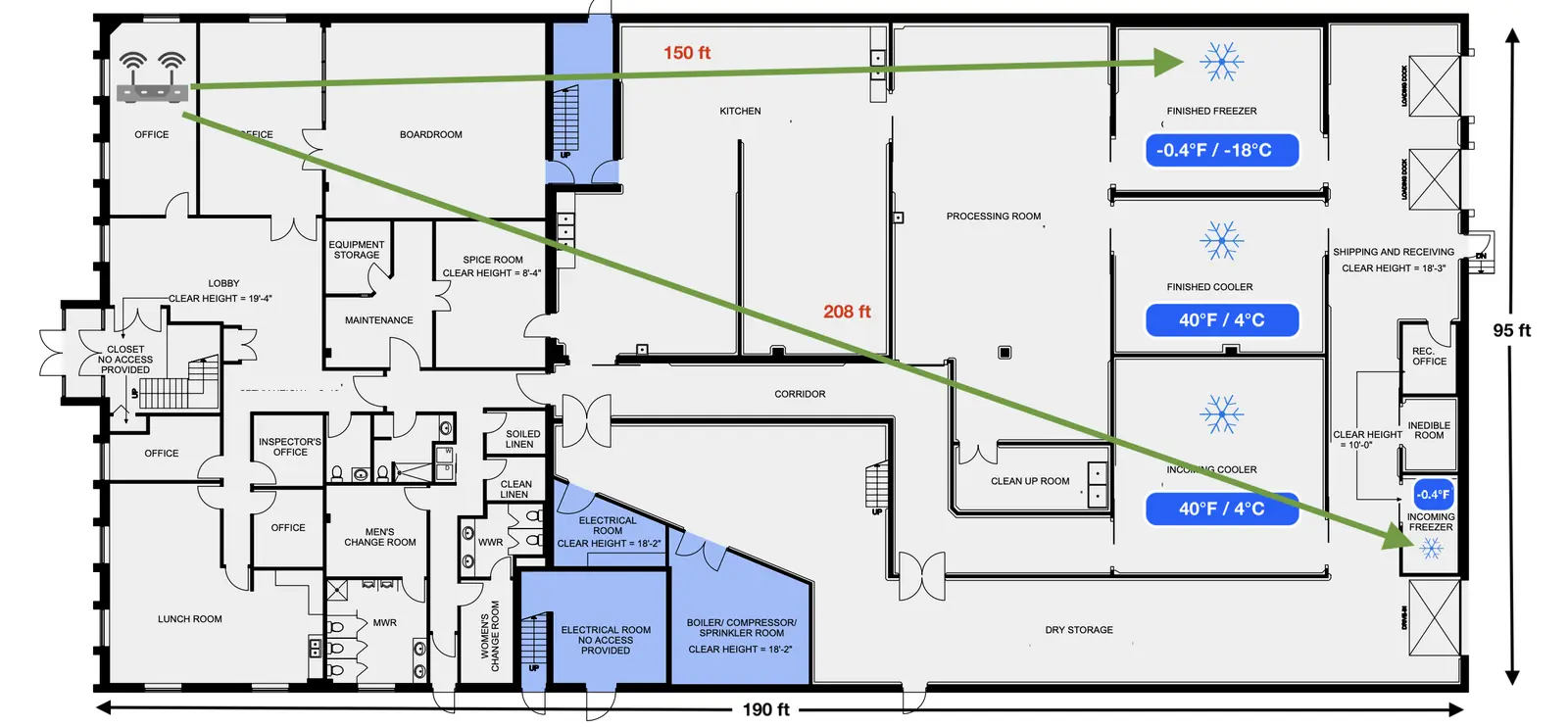
From the cabinet it is 150 ft (46 m) to the finished freezer, through six interior walls. It is 208 ft (63 m) on the diagonal to the incoming freezer, through ten.
Ten walls, and then the freezer panel. A 2.4 GHz radio has spent almost everything it had before it arrives at the box it is meant to be reporting from.
Sites like this are the reason the objection exists at all, and why adding more access points does not fix it is its own article later in this tutorial.
What actually works, and what does not
This is settled in the field, not a matter of opinion. We read 363 Reddit threads across 86 subreddits for this, and operators, integrators and technicians report the same results independently, without knowing each other.
| What you might try | Does a reading come out | Why |
|---|---|---|
| Wi-Fi sensor inside the box | Rarely | 2.4 GHz, and the transmitter has little in reserve once the metal has taken its share |
| Zigbee sensor inside the box | Rarely | Same band, and less transmit power again. This is the most commonly reported failure |
| Bluetooth sensor inside the box | With a hub close by | Same band and low power, so it fails when the receiver is across the room. A hub a few feet outside the box hears it through the panel, which is how our entry sensor works |
| Wi-Fi repeater aimed at the box | Sometimes | A real fix people use, but it is one more mains device that has to stay working and stay on the network |
| LoRa or LoRaWAN sensor inside the box | Yes | 900 MHz, and a receiver that can read a far weaker signal |
| 433 MHz sensor inside the box | Yes | Also sub-gigahertz. Tightly power-limited in North America, so range is shorter than LoRa |
| Any radio outside, wired probe inside | Yes | The radio never has to cross the wall. The probe cable does |
Three quotes from people with nothing to sell. All of them come from our own research into Reddit discussions, where operators, technicians and integrators are talking to each other rather than to a vendor:
"I'm finding that the wireless zigbee one I tried didn't work at all through the freezer. I can run a wire or even a network drop if I have to."
Volunteer running monitoring for a walk-in, r/homeassistant
"The LoRa signal from the hub can reach into the nearby deep freezer and through various walls. Signal permeates the freezer wall just fine."
r/smarthome
"Put a repeater directly on the other side of the freezer and pointed all antenna into the steel cage."
r/HomeNetworking, on making Wi-Fi work anyway
How to settle it for your own box in a week
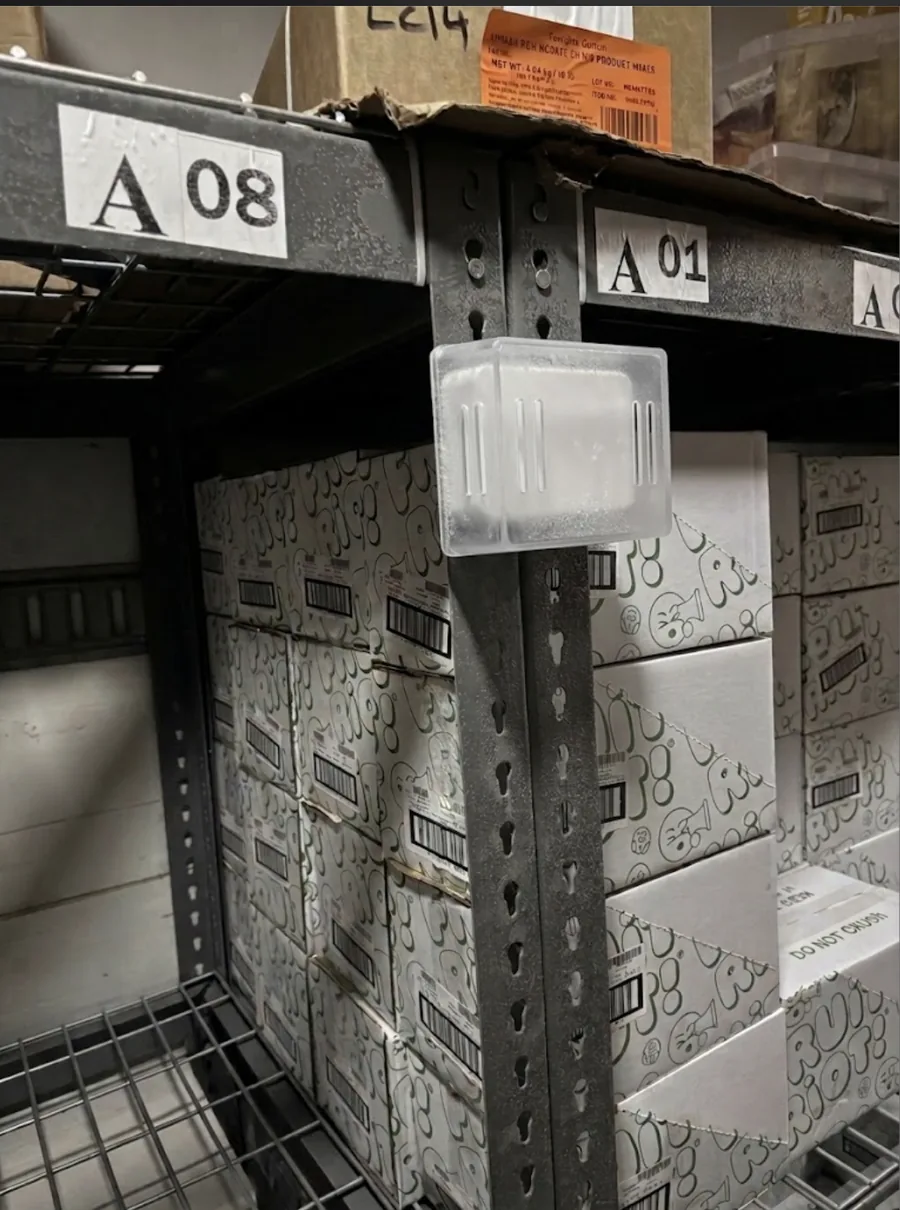
Do not take anyone's word for this, including ours. Radio is site-specific and your box is not the box in the photograph.
- Ask the vendor to send one sensor, and put it in your worst box. The far one, the full one, the one behind the rack.
- Shut the door and leave it for a week. Do not stand next to it during a demo.
- Then look at the record, and count the missing readings rather than looking at the ones that arrived.
Gaps in the data are the answer. A radio that reaches nine times out of ten looks fine on a dashboard and will still be quiet on the night it matters.
What this does not solve
Sub-gigahertz is not magic. A deep cold store racked to the ceiling, a freezer inside a freezer, or a plant room in a basement can still need a second gateway. We would rather add one than promise you a number that holds everywhere.
Getting a signal out is not the same as measuring the right thing. A sensor that reports perfectly from the wrong place is a well-connected wrong answer. Where the sensor goes and whether it is buffered matter at least as much as whether it reaches.
The radio is not the only thing that has to survive the cold. The battery has to as well, and that is a separate problem with a separate answer.
What we do, and the honest alternative
TemperatureWise uses LoRaWAN for walk-ins and for any site that sprawls. The sensor sits inside the box, the gateway sits anywhere on site with power, and nothing is drilled through the panel. That choice comes from the physics above, not from sub-gigahertz sounding impressive.
For a small kitchen with its boxes close together, we also sell a $25 Bluetooth sensor, read by a hub placed a few feet from the boxes. The panel costs a fixed amount of signal, and then every foot of distance costs more. A short hop to a hub next to the box survives the panel. A hop to a gateway 150 ft away, across six walls, does not. LoRa is what buys you the whole site, not what gets you through the panel.
The honest alternative is the wired probe, and it works. You mount the transmitter outside the walk-in and run the probe through the wall. ThermoWorks ships their NODE this way and people are happy with it. Three separate practitioners in our Reddit research describe doing exactly the same thing by hand, one of them across 160 coolers.
What it costs you is a hole in the insulation, a cable that is now a small cold bridge and a thing that can be snagged, and a mains outlet within reach of each box.
It also stops being something you can do yourself. Drilling through a walk-in panel is an outside contractor, which means a quote, a schedule, a day when the box has to be emptied or the line stopped, and a bill per box. That is money, and it is weeks of delay before anything is being monitored at all.
For one critical freezer, that is a fair trade and we would tell you to do it. Across a site of twelve it is usually the reason a rollout stalls. And if you already own one of these and it works, there is no reason to change it.