
Polling interval: how fast does it need to check?
By Vimal Bhaya, Founder and Lead Systems Architect · Last reviewed 9 September 2026
This is a continuation of What if the monitoring fails?, a 6-part tutorial. You are on part 3 of 6.
As a simple answer: fast enough, and both numbers are published so you can check them. The TemperatureWise Bluetooth sensor reads every minute and stores a reading every 5 minutes. The TemperatureWise LoRa sensor reports every 15 minutes. For comparison, the CDC requires vaccine fridges, the most tightly regulated cold storage there is, to record at least every 30 minutes.
That 15 minute figure was checked against real recorded failures rather than argued about. At the fastest sustained warming in the TemperatureWise record, a 15 minute gap lets a box get 2.2°F (1.2°C) past your limit before you can possibly know. An hourly check lets it get 9°F (5°C) past.
Before you compare any two products on this, know that "refresh" means four different things and vendors quote whichever of the four is smallest. The four are below, with real examples and the TemperatureWise numbers for each.
The complaint is real, and the number people shop on is the wrong one
Two operators, in different threads, describing the same frustration:
"We currently have TempTrak and it is super slow, our computer only updates the temperature every 5-8 minutes. I'm looking for an update maybe every 1-2 minutes. Or even real time."
Facilities technician
"You will get crap refresh times."
Refrigeration contractor, r/HVAC
Both of them are describing something real. A system that feels slow is annoying, and slow data genuinely is worse data.
Where the reasoning goes wrong is in assuming that the fix is a smaller number on the same specification. It usually is not, because the number being quoted is rarely the one that decides when your phone rings.
Four numbers, and all of them get called the refresh rate
This is worth two minutes because it is the whole trick.
| Number | What it is | What it decides |
|---|---|---|
| Sample rate | How often the sensor measures | Almost nothing on its own. Cheap to make small |
| Report rate | How often it sends what it measured | Battery life, and how much you can miss |
| Dashboard refresh | How often the screen redraws | How live it feels. Nothing else |
| Alert latency | Crossing the line, to your phone ringing | Everything. This is the one you are buying |
Now look at what that does to real specifications.
ThermoWorks publish that their NODE checks every 5 minutes by default and transmits every 30 minutes by default, both adjustable. So "five minute" and "thirty minute" are both honest descriptions of the same device, and only one of them tells you when you would find out.
MarCELL, the cellular monitor people buy when a site has no Wi-Fi, publish that they log every 30 minutes and upload six times a day when nothing is alarming. That is a sound design for battery and data cost, and it means the record is four hours behind the box most of the time.
TemperatureWise gives two different answers, on purpose, and it is worth seeing why.
| Bluetooth sensor | LoRa sensor | |
|---|---|---|
| Sample rate | Every 1 min | Every 15 min |
| Into the record | Every 5 min | Every 15 min |
| Battery | About 2 years | 5 to 8 years |
| Reach | A hub near the boxes, sometimes two per site | One gateway for the whole site |
| Price | $25 + $50 hub | $200 + gateway |
Read that table again, because it is the opposite of what you would expect. The cheap sensor is the fast one. The expensive sensor is three times slower into the record.
That is not a mistake and it is not a compromise we are hiding. A radio that crosses a whole site costs far more energy per message than one talking to a hub in the same room, and that energy is what buys the 5 to 8 year battery and the coverage. With the LoRa sensor you are paying for range and battery life, not for speed.
Both sit inside the CDC's 30 minute floor, which is the only published requirement anybody in food or pharma has to meet.
Ask for all four numbers. A vendor who can only give you one is quoting marketing, not a specification.
What an interval actually costs you
There is a clean way to think about this that needs no argument. If the box is warming at some number of degrees an hour, then between two readings it can get that far past your limit before anybody can possibly know. Longer gap, further past.
So the only question is how fast a box actually warms, and we have that measured rather than guessed.
| What was happening | Over | Rate |
|---|---|---|
| Loaded reefer, cooling completely off | 12 hours | 1.3°F (0.7°C) / h |
| The same trailer, its worst stretch | 4 hours | 2.1°F (1.2°C) / h |
| Walk-in in total summer failure, doors in use | 4 hours | 9.0°F (5.0°C) / h |
| A perfectly normal scheduled defrost | 1 hour | 17.6°F (9.8°C) / h |
| The same defrost, its steepest half hour | 30 min | 26.3°F (14.6°C) / h |
Read the bottom two rows again. The fastest temperature changes in our entire record are freezers working perfectly. The failures are the slow ones. That inversion is the single most useful thing on this page and we come back to it below.
Taking 9.0°F (5.0°C) an hour as the fastest real emergency we have on file, here is what each interval buys you.
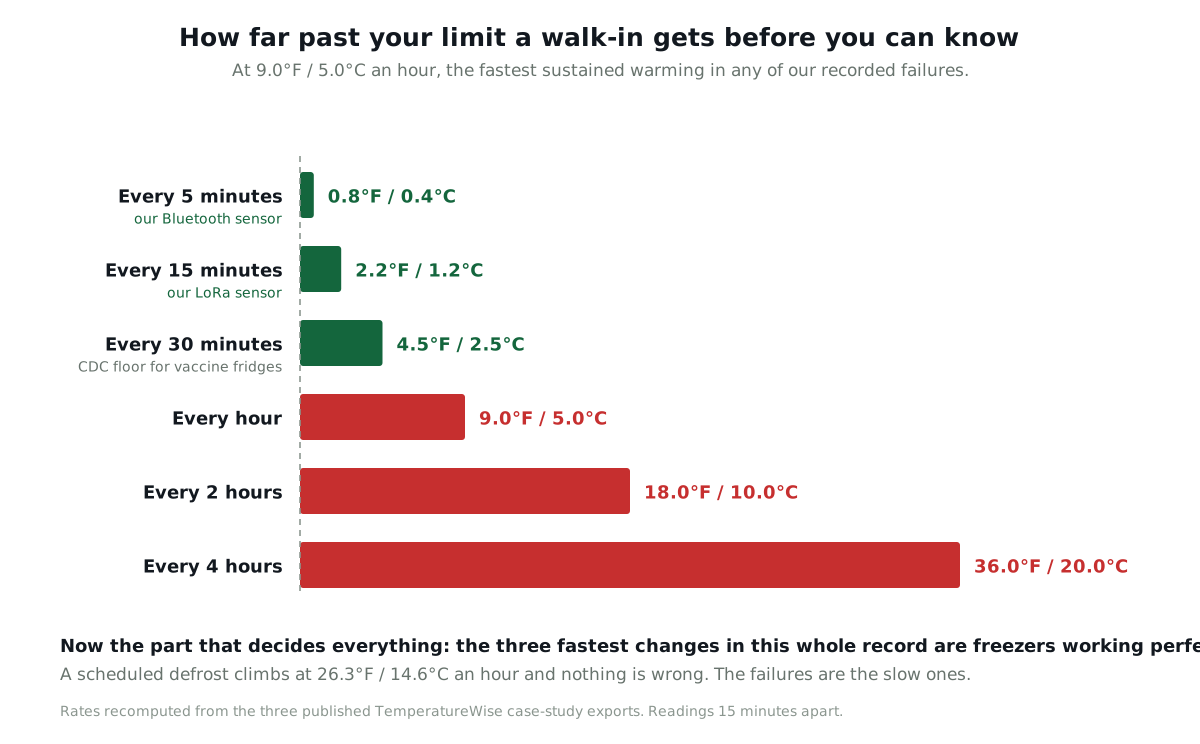
The first two bars are our own two sensors, and the distance between them is 1.4°F (0.8°C). That is a real difference in the same way that a stopwatch reading to a hundredth is a real difference when you are timing a train journey. It is not nothing, and it is not what decides whether you lose a pallet.
The rules already say how often: 30 minutes by machine, 2 to 3 hours by hand
Vaccine storage is the most tightly specified cold storage there is. A dose that has been warm is not visibly different from one that has not, and the consequence is a person who thinks they are protected.
The CDC's requirement for a digital data logger is a "logging interval (or reading rate) that can be programmed to measure and record temperatures at least every 30 minutes".
Half an hour, for vaccines. The TemperatureWise LoRa sensor is twice that rate and the Bluetooth sensor is six times it, on a walk-in full of frozen chips.
Now the number nobody quotes, and it puts all of this in proportion. A HACCP plan typically asks for a manual temperature check every 2 to 3 hours, because that is what a person walking round with a clipboard can realistically do, and those plans were written when that was the only option.
So the standard your own food safety plan is written to is a reading every two or three hours. A monitoring system reading every 5 or 15 minutes is between 8 and 36 times ahead of it, and a data gap shorter than a couple of hours is not a gap by the plan's own measure.
That is worth remembering the next time your internet drops for forty minutes and you wonder whether it mattered. By the standard on your own wall, it did not.
A loaded freezer changes temperature slowly
The reason the numbers come out this way is thermal inertia, and you already trust it every week: you buy frozen food, drive home for forty minutes, and nothing has thawed.
The physics is set out in full in battery or wired at -20°F, which answers whether battery power forces you to accept a slow interval. This page is the other half: how to choose an interval on purpose.
The short version is that food is dense and wet, and moving its temperature takes real time and real energy. What moves in minutes is air, and air is the thing you do not need to chase, which is also the argument for putting the probe in a glycol buffer.
Faster polling produces more false alarms, not fewer
This is the part that surprises people, and it follows directly from the table above.
The fastest movements in a freezer are defrost cycles, which are supposed to happen. A freezer deliberately warms its coil on a timer to melt the frost off it, the air near the sensor jumps, and the food does not move at all. We take that apart in why temperature alarms cry wolf.
Sample fast enough and you see every one of them. On a plain high-temperature alarm, that means more alerts, all of them wrong.
In our own April export, a check every hour stepped straight over a 30 minute defrost peak that a 15 minute check caught. The hourly system did not miss a failure. It missed a false alarm.
So a faster interval only helps if the system does something intelligent with the extra readings. On a threshold alarm it actively hurts.
Early detection needs the shape of the line, not just the number
Alert latency is not why we chose the interval. This is.
Catching a refrigerant leak weeks out, or a compressor degrading over a month, means measuring how the box behaves rather than where it is. The daily floor creeping up half a degree. The pull-down after each defrost taking eleven minutes longer than it did in March. Those are slopes, and a slope needs points.
An hourly line through a freezer that defrosts every six hours is mostly a record of whether you happened to sample during a defrost. A 15 minute line has the shape in it, so the defrost can be identified, measured and compared with last week's. A 5 minute line has more of it again, which is one reason the cheap sensor is not the poor relation it looks like on price.
That is what makes early warning possible at all, and it is the subject of threshold versus rate-of-change alerting.
When you genuinely do need minutes
There are real jobs that need a fast interval, and they have something in common: they are all about food or equipment in motion, not food in storage.
- Proving a cooling process to a health inspector. Getting a hot product from 135°F (57°C) to 70°F (21°C) inside two hours is a fast change with a hard deadline, and you want minutes.
- Blast chilling and blast freezing. The whole cycle can be shorter than one storage reading interval.
- Diagnosing a compressor that is short cycling. You are counting events, not watching a temperature.
- Watching a pull-down after a delivery, a repair or a door left open, when somebody is standing there waiting to know whether it is recovering.
All four want a mains powered sensor, because the battery arithmetic does not survive them. Sending a reading is the expensive part of a sensor's life, and reporting every 2 minutes uses about seven and a half times the energy of reporting every 15.
Renergy supplies that too, and it is a different product rather than a faster setting. Watching what a compressor or a motor is doing is equipment monitoring rather than cold chain monitoring, and it is what EcoWise is for: mains powered, and sampling fast enough to count events rather than track a temperature. It is fitted alongside TemperatureWise on the same sites, as an additional service.
So this is not a reason to refuse. It is a reason to put the fast sensor where the fast question is, and leave the storage sensors alone.
Four questions to ask any vendor, with the TemperatureWise numbers
These are fair questions to put to us as well, so here are the answers rather than a promise to supply them.
| Ask this | Bluetooth sensor | LoRa sensor |
|---|---|---|
| Sample rate | Every 1 min | Every 15 min |
| Into the record | Every 5 min | Every 15 min |
| When the alert goes out | On the reading that crosses the line | On the reading that crosses the line |
| Battery, and at what interval | About 2 years at 5 min | 5 to 8 years at 15 min, in a deep freezer |
| Cells fitted | Energizer Ultimate Lithium, rated -40°F (-40°C) | Energizer Ultimate Lithium, rated -40°F (-40°C) |
| Worst case overshoot at 9°F (5°C) an hour | 0.8°F (0.4°C) | 2.2°F (1.2°C) |
- Give me all four numbers. Sample rate, report rate, dashboard refresh, and time from crossing to phone ringing. The first two are in the table above.
- At what interval is the battery life quoted, and at what temperature? A life figure without those two is not a figure. TemperatureWise quotes 5 to 8 years at 15 minute reporting in a deep freezer.
- Can I mix fast and slow sensors on one site? On TemperatureWise the interval is a property of which sensor you fit, so a box you want watched closely takes a Bluetooth sensor at 5 minutes while the rest of the site runs on either.
- What do you do with the readings between the alarms? If the answer is store them, the interval is only about latency. TemperatureWise measures the shape, which is how a refrigerant leak shows up one to two months before the box fails.
What this does not settle
Fifteen minutes on the LoRa sensor is a choice, not a law. We picked it to get 5 to 8 years out of a cell in a deep freezer on a radio that has to cross a site. If you want faster we will tell you what it does to the battery figure rather than leaving the old number on the page.
A lightly loaded box moves faster than anything in that table. The measured rates come from loaded walk-ins and a loaded trailer. A small, half empty display case in a hot kitchen has far less thermal mass, and the margin in the chart above gets thinner. If that is your situation, say so when you are comparing systems.
And interval decides how much you can miss, not whether the reading means anything. A sensor reporting every 30 seconds from the wrong place is 2,880 wrong readings a day. What the number is about is decided by where you put it and what it is sitting in, and that matters more than the interval by a wide margin.