
What happens when the internet goes out
By Vimal Bhaya, Founder and Lead Systems Architect · Last reviewed 9 September 2026
This is a continuation of What if the monitoring fails?, a 6-part tutorial. You are on part 2 of 6.
As a simple answer: your freezer is fine and you will be told. This is a different failure from a power cut. The compressor is running, the box is cold, and the only thing that has broken is your ability to watch it.
Does it alert? Yes. TemperatureWise sensors check in on a schedule and the servers watch for the check-ins that do not arrive. The alert is raised in the cloud, so it does not travel over the connection that just failed, and it escalates like any other: email, then SMS, then a phone call.
Does it backfill? No. There are no readings for the period you were offline, and the TemperatureWise chart joins the last reading before the outage to the first one after it, which draws a flat line across a stretch nobody measured. With the TemperatureWise cellular backup package, at $125 once plus $50 a year per location, the record stays continuous instead.
Three different failures get the same one line answer, and they should not
Ask a vendor what happens in an outage and you usually get one sentence covering all of it. There are three cases and they are not alike.
| What failed | What the box is doing | Your problem |
|---|---|---|
| Internet out, power on | Cooling normally | You are blind. Nothing is wrong yet. This page |
| Power out, internet on | Not cooling | Rare, and it means somebody put the router on a battery and not the fridge |
| Both out | Not cooling | The common one. Covered in what happens when the power goes out |
Most internet outages at a restaurant or a small plant are not the provider. They are a router that needs restarting, a cable somebody moved, or a guest network that was reconfigured on Friday afternoon. Short, local, and nobody notices until something depends on it.
The cloud detects that the gateway is offline and alerts your site team
This is the requirement an owner spelled out before a holiday:
"I'm also hoping to find something that will alert if it disconnects to the internet."
Restaurant owner, planning for a vacation
The mechanism matters more than the promise. TemperatureWise sensors report on a fixed schedule, so the servers know exactly when the next reading is due. When readings stop arriving, that silence is the alert.
It is raised in the cloud and goes out over email, SMS and the phone network. None of those run through your building, which is the whole point.
TemperatureWise treats it exactly like a temperature alert, with the same escalation. Email first, then SMS, then a phone call until somebody answers.
The alert names the site and the device that went quiet, so somebody can go and look at the right thing. Most of the time the fix is a restart of the router or the gateway and the readings resume on their own. That is worth knowing before anybody drives anywhere.
That last part is where most systems quietly fail. A grey dot next to a device name on a dashboard is not an alert. It is a fact you have to go and look for, and the whole reason you bought monitoring is so that you do not have to go and look.
TemperatureWise waits long enough to know it is real
You do not want to be woken at 2am because a router rebooted for ninety seconds. You also do not want to find out on Monday.
TemperatureWise judges when an alert is worth sending rather than firing on the first missed reading. A short drop out is a short drop out, and a site that has genuinely gone is a different thing. Getting that judgement wrong in the twitchy direction is how a system ends up sending a thousand alarms a day and being ignored, which is the whole subject of why temperature alarms cry wolf.
TemperatureWise does not recover readings taken while a site is offline
TemperatureWise sensors talk to a hub or gateway on your site, and that talks to the TemperatureWise cloud over your internet. When it cannot get through, those readings are not held and they are not recovered afterwards.
There is one wrinkle worth knowing because it is the kind of thing that sounds like a solution and is not. The TemperatureWise Bluetooth sensor does keep readings in its own memory. The interface we have to that sensor will not hand them over, so the readings exist inside a device on your shelf and we cannot get them into your record. In practice the gap is the same gap.
That is a real limitation, it is the honest answer, and we would rather you read it here than discover it during an audit.
The TemperatureWise chart draws a line across the gap
This is the part almost nobody publishes about their own product, so read it carefully, because it applies to most systems in this market and not only ours.
When there are no readings for a period, a chart has to do something with the empty space. Ours joins the last known reading to the next one that arrives. The result is a clean flat line across hours that nobody measured.
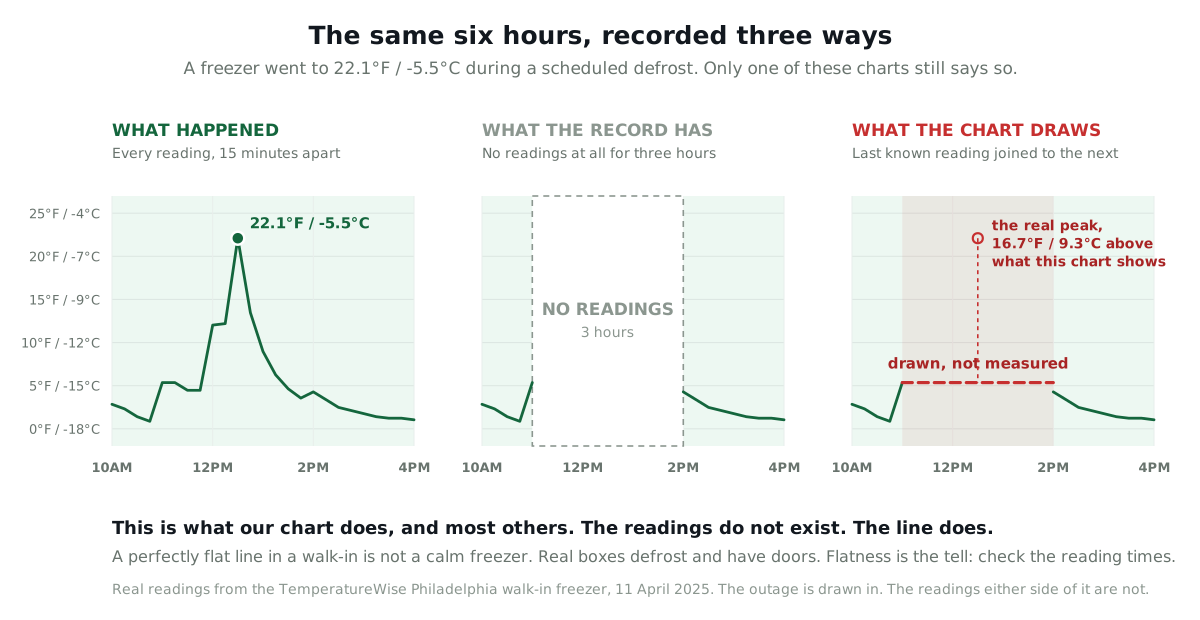
The chart on the right is the one you would actually see. It is wrong by 16.7°F (9.3°C) at that afternoon's worst moment, and it is wrong in the direction that makes the freezer look better than it was.
As it happens nothing was wrong that day. The peak was a scheduled defrost, which is normal and which we explain in the alarm page. That is what makes it a fair example rather than a scary one: on the day it did not matter, and either way you would never have known from the chart.
How to tell a drawn line from a measured one
Look at the readings, not the line. A real stretch of data has a reading every few minutes. A drawn line has two endpoints and nothing in between, and any export or detailed view shows you that immediately.
The practical rule is short: a perfectly flat line in a walk-in is not a calm freezer, it is usually missing data. Real boxes are never that steady. They defrost, doors open, deliveries land. A healthy freezer TemperatureWise monitors swings up to 23.8°F (13.2°C) in a single day, which we show on the accuracy page. Flatness is the tell.
We would rather print that than have somebody find it out in front of an inspector. It is also the question to put to every other vendor you are considering: show me a real record from a period when you had no data, and ask them what the chart drew.
The endpoints are real even when the line is not
Here is the reassuring half, and it is the reason a short outage is usually a non-event.
The line across the gap is drawn. The reading at each end of it is measured. And the reading on the far side is the one that tells you what you need to know, because a box that has been cooling normally the whole time is a box that is fine.
If the internet came back and the freezer is sitting at 0°F (-18°C) where it always sits, nothing happened while you were blind. Nothing could have: the refrigeration never stopped, and a working freezer does not wander off and come back.
That is the difference between this failure and a power cut. In a power cut the box was warming the whole time and the far-side reading tells you how far it got. Here the box was never in danger, and the far-side reading just confirms it.
What the gap costs you is not safety. It is the record, and only if somebody asks for exactly those hours.
Onboard memory is a better answer, and TemperatureWise does not have it yet
Storing readings on the device and uploading them when the link returns is the best of the available answers, and we do not do it today.
ThermoWorks publish that their NODE holds up to 70,000 readings in its own memory. If a continuous record through a local internet outage is a hard requirement for you, and you are not going to buy a cellular connection, that architecture answers your question better than ours does. We would rather say so than have you find out later.
What that memory does not do is get the reading to you while it matters. A buffered record is a good audit trail and it is not an alarm. Those are two different jobs and it is worth being clear which one you are buying.
The TemperatureWise cellular package solves this
Cellular takes your building out of the path entirely. The hub reaches the TemperatureWise cloud over a mobile network instead of your router, so a router reboot, a moved cable, a reconfigured guest network and a provider fault all stop mattering. With the cellular backup package the record stays continuous through an outage that would otherwise have left a gap.
It is $125 once for the hardware, then $50 a year per location. If you supply the internet yourself, connectivity is free, so this is the one line on the TemperatureWise price list you are choosing to add.
Two honest limits. A carrier outage still takes you offline, and it is rarer than a site outage rather than impossible. And a site with poor signal in the room where the hub has to live is a real problem worth checking before you buy, not after.
Cellular is also what makes the backup power option work, because a battery on the gateway is pointless while your router is dead. The pair of them is covered on the power outage page.
The one case where being blind is genuinely dangerous
Everything above assumes your internet failing and your refrigeration failing are unrelated events. Usually they are, and that is why the odds are so strongly in your favour.
They are not always unrelated. A storm, a brownout, a surge or a substation fault can take the router, the compressor and the site all at once. So the outage most likely to hide a real failure is the one that shares a cause with it, and that is exactly the one where the far-side reading will not be reassuring.
That correlation is the argument for cellular, and it is a better argument than any uptime percentage anyone will quote you. You are not buying nines. You are buying a second path that fails for different reasons than the first one.
Four questions to ask any vendor, with the TemperatureWise answers
- When the device cannot reach you, what raises the alert and where? If the answer is anywhere on the site, there is no answer. TemperatureWise raises it in the cloud and escalates email, then SMS, then a phone call.
- Show me a real record from a period with no data, and tell me what the chart drew. TemperatureWise draws a straight line from the last known reading to the next one, and this page shows exactly what that looks like.
- How soon am I told? TemperatureWise waits long enough to be sure the site has really gone rather than firing on a ninety second router reboot.
- If it buffers on the device, can you actually get the readings out? Storing them and retrieving them are two different things. The TemperatureWise Bluetooth sensor stores them and the interface will not return them, so they do not reach your record.
What none of this fixes
TemperatureWise does not recover the readings. Saying it a third time because it is the thing people skim past. If a continuous record through internet outages is your hard requirement, add the cellular backup package or buy a system that buffers on the device and can hand the buffer back.
An offline alert tells you nothing about the box. It says we have stopped hearing from the sensor. It does not say the freezer is fine, and it does not say it is failing. You are being told you are blind, which is useful and is not the same as being told what is happening.
Reaching the internet is not the same as reaching you. A wrong number, a full inbox, a phone on silent, one recipient on holiday. That whole class of failure is covered in alerting more than one person and what a good alert looks like at 3am.