
What you need to buy, and what it costs
By Vimal Bhaya, Founder and Lead Systems Architect · Last reviewed 9 September 2026
This is a continuation of What if the monitoring fails?, a 6-part tutorial. You are on part 6 of 6.
As a simple answer: a sensor for each box, one hub or gateway for the site, and a yearly fee. TemperatureWise starts at $25 a sensor plus a $50 hub, and goes to $200 a sensor for the version built for a cold store. Monitoring is $250 per sensor per year on either.
The thing to understand before you compare anything is that you cannot remove infrastructure from a monitoring system. You can only move it. A "no hub" Wi-Fi sensor is not hub free. It is using your router as the hub, and your router is the thing that dies in a power cut.
Every quote in this market contains the same six line items, itemised or not: the sensor, the thing that collects it, the connection to the internet, the software, the alerting, and the install. If a price looks like it is missing one, it has been moved onto a bill you already pay.
Two different fears wearing one objection
The search that brings people here is short and blunt:
"Freezer temp sensor without a hub"
A search, and a thread title, many times over
And its companion, from an owner pricing up an alarm after a close call:
"The Marcell and level sense devices are $100+ and money is tight right now. Are there any cheaper options?"
Restaurant owner
There are two separate fears in there. One is "I do not want another box on my network to look after." The other is "I do not want a bill that never ends." Both are reasonable, and both usually get answered with a marketing sentence instead of a list.
The six line items, and where they hide
Any system that gets a temperature from inside a cold box to a phone in somebody's pocket has to do six things. Every quote pays for all six. The difference between quotes is which ones are printed.
| Line item | What it does | Where it hides when it is not itemised |
|---|---|---|
| The sensor | Measures the temperature | Nowhere. This one is always priced |
| The collector | Gets the reading off the sensor and onto the internet | Inside "works with your Wi-Fi". Your router is doing this job |
| Connectivity | The path out of the building | Inside your existing broadband bill, or a SIM you pay for |
| Software and storage | Dashboard, history, export | Inside a "free app", which is free until a retention limit or a plan tier |
| Alerting | Email, SMS, phone calls | Inside a plan. Email is nearly free. Texts and calls are not |
| Install and setup | Mounting, joining, configuring, tuning | Inside your own time, which is the most commonly hidden cost of all |
So "no hub, no subscription" is not a lie. It means line items two and four have been moved onto things you already pay for. That is a legitimate choice and sometimes the right one. It is only a problem when you did not know you were making it.
What "no hub" costs, in the two ways it actually bites
Nuisance. A sensor leaning on your router is usually leaning on a marginal signal, because the router was placed for laptops and not for the inside of a steel box. A marginal link drops out. Every drop out is an offline alert, so you get told the sensor is unreachable at nine in the morning, again at two, and again on Sunday. Within a fortnight nobody looks at them, and the one that mattered goes past unread.
Loss. The other outcome is quieter and more expensive. The link goes down, nothing tells you loudly enough, and the freezer fails during the gap. One walk-in of frozen product is worth more than every hub you were avoiding, several times over.
Cheap is expensive, and it is expensive in a way that does not show up until the year you needed it.
"No subscription" usually means the recurring cost moved, not vanished
Software has to be paid for. A dashboard, an alerting service that sends real texts and real phone calls, and history kept for years all cost money every month, whoever is selling them.
So when a product is advertised without a subscription, the money is somewhere else. The common versions are a much higher purchase price with the software folded into it, a multi-year term billed up front, or a free tier that becomes a paid one once you have more than a couple of devices or want more than a few months of history.
None of that is dishonest. It is just worth finding out which one you are buying, and the question that gets you a straight answer is: what do I pay in year three? Add the purchase price and three years of everything else, for the number of sensors you will actually have by then, and compare those totals rather than the headline.
What "no hub" quietly costs you in a walk-in
Here is the part that matters, and it is specific to cold rooms rather than a general grumble about Wi-Fi.
If the sensor talks Wi-Fi, your router is the collector. That router has two properties that matter here.
It is on mains. So in a power cut it stops, along with your modem and your provider's street cabinet, and the sensor is left talking to nobody. That whole chain is drawn out on what happens when the power goes out.
It is usually a long way from the box. Wi-Fi has to cross an insulated panel with steel skins on both faces and then carry on to wherever the router lives, often at the other end of the building. It is the second half of that journey that kills it, which is the subject of will wireless work through a freezer wall.
So for a walk-in, the Wi-Fi answer is usually to mount the transmitter outside the box and run a probe through the wall. Which means a hole in an insulated panel, a cable, a mains outlet near every box, and a technician's visit at a call-out charge plus about an hour per box.
Avoiding a $50 hub by drilling five walk-ins costs $525 to $650 in labour. The hub did not disappear. It turned into a tradesman. We costed that out properly on how long installation actually takes.
TemperatureWise sells two sensors, and you get what you pay for
This is the part most vendors will not print, so here it is.
| Bluetooth sensor | LoRa sensor | |
|---|---|---|
| Sensor | $25 | $200 |
| Collector | $50 hub, sometimes two | $100 to $450 gateway, one per site |
| Into the record | Every 5 min | Every 15 min |
| Battery | About 2 years | 5 to 8 years |
| Reach | Hub near the boxes. Extra hubs where a site spreads out | One gateway, across buildings if needed |
| Monitoring | $250 per sensor a year | $250 per sensor a year |
| Where it belongs | A restaurant. Reach-ins, prep fridges and a walk-in or two | A cold store, a plant, or any box whose contents are worth more than the system |
The Bluetooth version works, and it works in walk-ins as well as reach-ins, given sensible placement and an extra hub where a site spreads out. It is the honest answer for a restaurant, and we built it because a restaurant that is quoted $200 a box buys nothing at all.
The LoRa version is better and it costs more. One gateway covers a whole site with no dead corners, the battery lasts three times as long, and nothing about the layout of your building is a problem. If one freezer holds $250,000 of finished goods, that is not a close call.
You get what you pay for is true here, and we would rather sell you the cheap one than lose you to a spreadsheet. What you are paying the difference for is range and battery life, not accuracy of the alert and not the quality of the detection. Both tiers feed the same system.
One free tip if you have already bought a cheap sensor
Put lithium cells in it. Energizer's own handbook puts the bottom of the alkaline range at 0°F (-18°C), which is about where a freezer sits, so the cells most consumer sensors ship with are struggling exactly where you need them.
Energizer Ultimate Lithium is rated to -40°F (-40°C) and drops into the same slot: the L91 in AA, the L92 in AAA. It is what TemperatureWise fits in its own sensors. It costs a few dollars a cell and almost nobody who buys a sensor off a marketplace ever hears about it.
That tip is free and it is worth more than this whole page if you are running a cheap sensor in a freezer today.
What the market actually charges
A word on how to read this table, because it is the reason it is worth anything.
Two of these came off the vendor's own page. The rest are what operators reported paying, in public, in their own words. We mark which is which, because publishing a competitor's price you have not checked is how you end up being corrected in public, and because a user-reported figure is still worth more than no figure at all.
| Product | What is paid | Source |
|---|---|---|
| TemperatureWise | $25 or $200 a sensor, $50 to $450 for the collector, $250 per sensor a year | Ours, published |
| ThermoWorks NODE | $92 to $115 for the base unit, $132 to $341 for probe kits. Cloud beyond the free tier is quote only | Their own page |
| Consumer Wi-Fi sensor | About $12 to $15 each | Reported |
| Build your own, Pi or ESP32 | $15 to $30 a point, plus your weekends | Reported |
| Room Alert 3E | $185, plus $65 for a power sensor | Reported |
| Sensaphone | About $800 base, about $80 a probe, about $80 a year | Reported |
| Lab freezer monitoring, one big brand | $2,600 quoted for a single freezer | Reported |
| Enterprise foodservice platform | Described as "thousands" a year. The same user wanted single digits per sensor per year | Reported |
That spread, from twelve dollars to twenty-six hundred for one freezer, is why the question is impossible to answer with a number. It is answerable with a list, which is what the six line items are for.
The TemperatureWise price list, all of it
| Item | One time | Per year |
|---|---|---|
| Bluetooth sensor | $25 each | None |
| Bluetooth hub | $50, one or two per site | None |
| LoRa sensor | $200 each | None |
| LoRa gateway, one per location | $100 small, $250 mid, $450 large | None |
| Monitoring, either tier | None | $250 per sensor |
| Your own internet | None | Free |
| Cellular, if you want it | $125 per location | $50 per location |
| Backup power pack, needs cellular | $125 per location | None |
| Dashboard, alerts, SMS, phone calls, setup, reporting, history | $0 | $0 |
Three real shapes. A small restaurant with three reach-ins and its own Wi-Fi, on the Bluetooth tier: $175 up front, $750 a year. A mid-sized restaurant with two walk-ins on the LoRa tier: $1,050 up front, $1,000 a year. A large site with three walk-ins, cellular and battery backup: $2,500 up front, $2,300 a year.
For your own sites rather than these three, the TemperatureWise pricing calculator takes your number of locations, boxes and sensors and gives you the up-front and yearly figures, along with what the same checks would cost you in wages if a person did them.
So, plainly: there is a hub, and there is a recurring fee. The hub covers a site rather than a room, which is the difference that matters, and the fee is per sensor rather than per site so it scales with what you are actually protecting.
What the $250 a year buys
It pays for four things, and it is worth naming them so you can decide whether you want them.
- The record, kept indefinitely, and exportable when somebody asks for two years of it on a Tuesday morning.
- The texts and the phone calls. Email costs almost nothing. Every SMS and every voice call costs real money to send, everywhere, for everyone.
- The detection. Watching the shape of the data to catch a refrigerant leak weeks out is the genuinely expensive part to run, and it is the reason the product exists rather than being a thermometer with an app.
- Somebody to call when a sensor stops reporting and you cannot work out why.
Here is the difference that number is really buying, and it is not the thermometer.
A consumer sensor tells you the freezer is warm. It tells you at the moment it is already warm, which is the moment the product is already at risk and the only question left is how much of it you throw away.
TemperatureWise watches the pattern instead of the number. An evaporator fault or a failing defrost timer shows up 4 to 5 days out. A compressor losing capacity shows up about a month out. A refrigerant leak shows up 1 to 2 months out. None of those look like a high temperature on the day they start, which is exactly why a threshold alarm cannot see them.
What that changes is the phone call you make. You book a technician for Tuesday morning at his normal rate, instead of calling one out at 2am on a Sunday with a room full of stock going soft. The repair is the same repair. Everything around it is cheaper and calmer.
Every other option in this market tells you after it has hit the fan. This one is built for prevention rather than cure, and that is the whole of the $250.
The cost that is on neither price list
Doing it by hand.
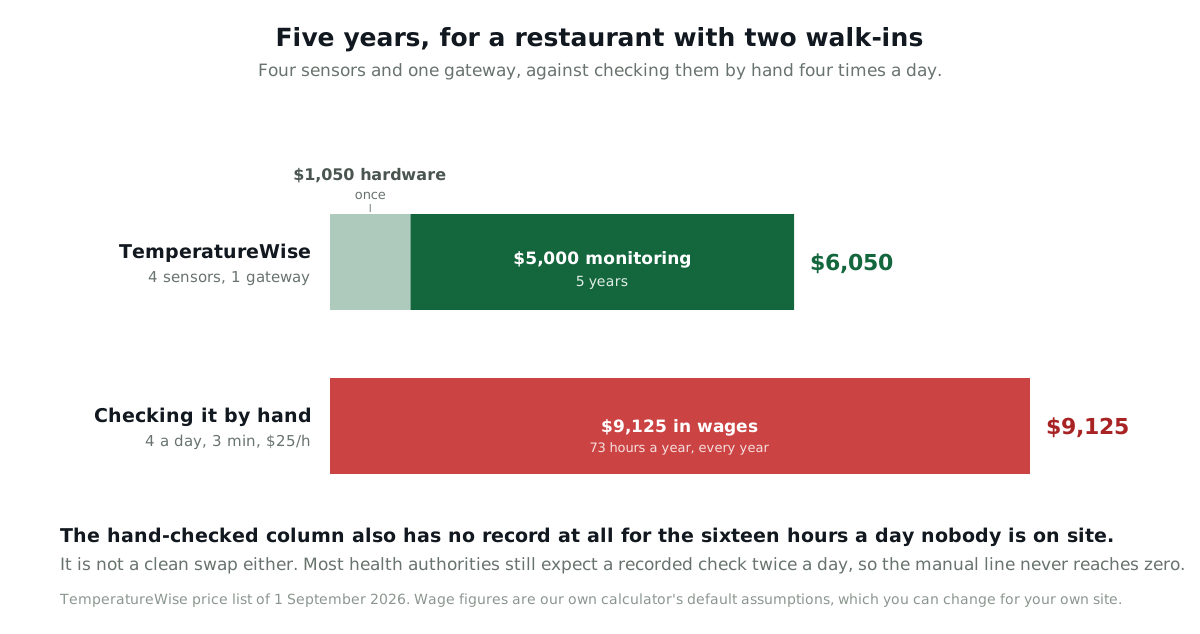
Those wage figures are our own calculator's defaults: four checks a day, three minutes each, at $25 an hour. Change any of them for your own site and the number moves, which is the point of putting the assumptions on the page.
The honest caveat, which matters: nobody stops doing manual checks entirely. Most health authorities still expect a recorded check at least twice a day, so this is not a clean swap. What continuous monitoring replaces is the pretence that a twice-daily signature covers the sixteen hours nobody was there, which is when most failures start.
Four questions to ask any vendor, with the TemperatureWise answers
- Walk me through all six line items.
TemperatureWise: every line is in the price list above. If one is missing from anybody's quote, ask what is doing that job and who is paying for it. - What do I pay in year three?
TemperatureWise: $250 per sensor per year, on either tier, with no site fee and no tiers to climb. This is the question that gets a straight answer out of a "no subscription" price. - Are SMS and phone alerts included, or metered?
TemperatureWise: included at $0, along with the dashboard, setup, reporting and the full history. Metered alerting quietly discourages you from adding recipients, which is exactly backwards. - What happens to my data if I stop paying?
TemperatureWise: ask for the export and you will get it. Get that answer in writing from anybody, us included, before you sign.
What this does not solve
Genuinely no subscription means genuinely no cloud. A local controller with a display, or something you build yourself, has no recurring bill and it works. What you give up is remote alerting, off-site history, and anybody but you caring whether it is still running. For a single box you check every day, that can be a fair trade.
The collector is a single point of failure per site. One box covering a site is the thing that makes this cheap to install, and it is also a thing that can fail. What protects you is that TemperatureWise notices its silence from the cloud within one reporting interval, which is the mechanism on the internet outage page.
And a price list is not a quote. How many sensors a box needs depends on its size and how it is loaded, and which tier suits you depends on what is in the boxes. That is a conversation with a floor plan rather than a number we can put on a page.