
TemperatureWise vs Temp Stick: no subscription, or a system that still calls
By Vimal Bhaya, Founder and Lead Systems Architect · Last reviewed 14 September 2026
This is a continuation of TemperatureWise vs Competitors, a 12-part tutorial. You are on part 12 of 12.
Temp Stick is a Wi-Fi temperature and humidity logger at about $149, with no subscription. Texts, email, app alerts and unlimited history are in that price for the life of the device. That claim is real, and it is why they can buy ads against commercial queries.
TemperatureWise is $25 or $200 a sensor, a hub, and $250 per sensor per year. That fee is the phone calls, the pattern detection, the fleet view, and a path that does not die with your router.
For a house, an RV, a wine fridge, or one reach-in with Wi-Fi you control, buy Temp Stick. For a walk-in, a freezer wall, a power cut, or more than a couple of boxes, the missing hub is the thing that fails.
What Temp Stick gets right, and why the ads work
Google surfaces Temp Stick next to commercial freezer queries. That is earned. The product is easy to explain, and operators who try it say it does the simple job:
"Temp stick works great in my experience. Alerts rather quickly and can be customized."
RV owner, r/RVLiving
Four things it genuinely does well.
No subscription is not a trick on this one. Their published FAQ says unlimited logging and alerts stay free for the life of the sensor. Add as many units as you want. Email, SMS and push go to a group, with optional daily, weekly or monthly report mails.
A month of onboard storage fills in if Wi-Fi drops, then uploads when it returns. If you stop paying TemperatureWise you lose the live system. If you buy a Temp Stick, year three costs a pair of AA cells.
The thermometer is not the weak part. They publish ±0.15°C (±0.27°F) on the ambient sensor. That sits inside the Food Code's ±1.5°C for air, and is tighter than our factory figure of ±0.2°C.
Accuracy was never going to be the wedge. We said the same about cheaper consumer sensors on consumer sensors or commercial monitoring.
The PRO architecture is the correct radio answer for a walk-in. Unit outside, probe through the wall, 6.5 ft lead. 2.4 GHz never has to cross the steel. Probe range they put at -238°F to 500°F (-150°C to 260°C) depending on the thermocouple. Listed at about $199.
The cost of that answer is a hole in the panel. That is the next section.
It samples often. Their own pages say every few seconds, with an alert the moment a threshold trips. Check-in while things are normal is something you set in the app. For a cabin pipe or a kegerator, that feels live.
A probe through a walk-in wall is a hole in the vapour barrier
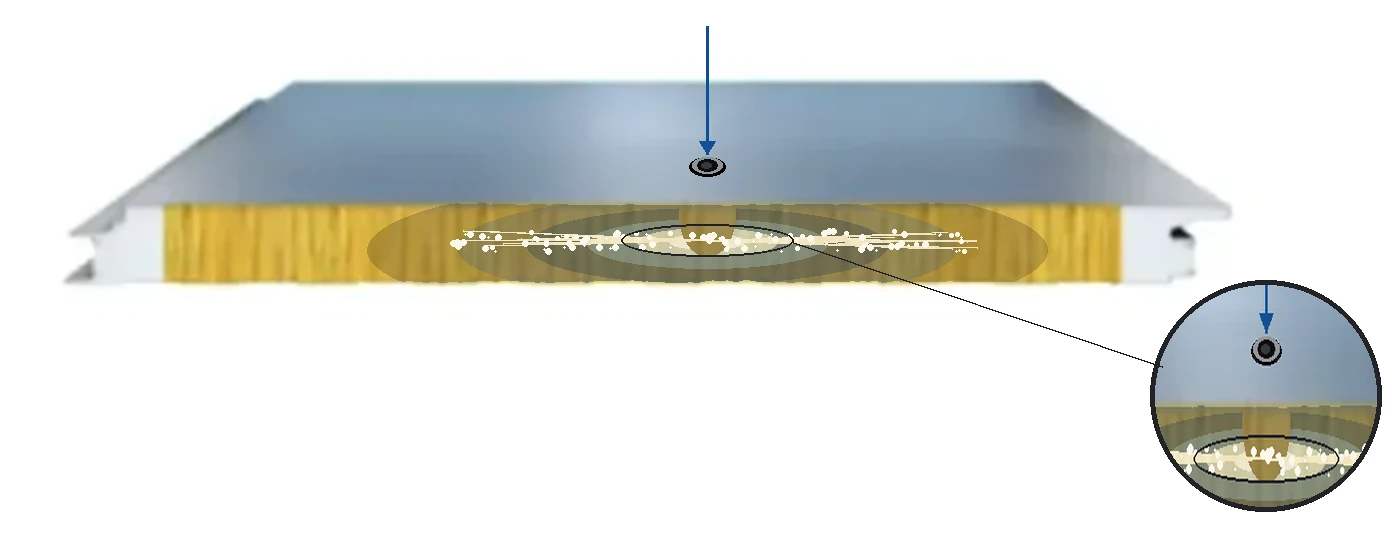
Temp Stick PRO puts the transmitter outside and a probe through the wall. That is the right radio answer. It is also a puncture through both metal skins and the foam between them.
A walk-in panel is two metal skins with foam between them. The metal is the vapour barrier. The foam is not. Drill the skins and moist kitchen air enters the core. Ice then forms in the foam and wrecks the insulation. That is a panel replacement, not a sensor swap.
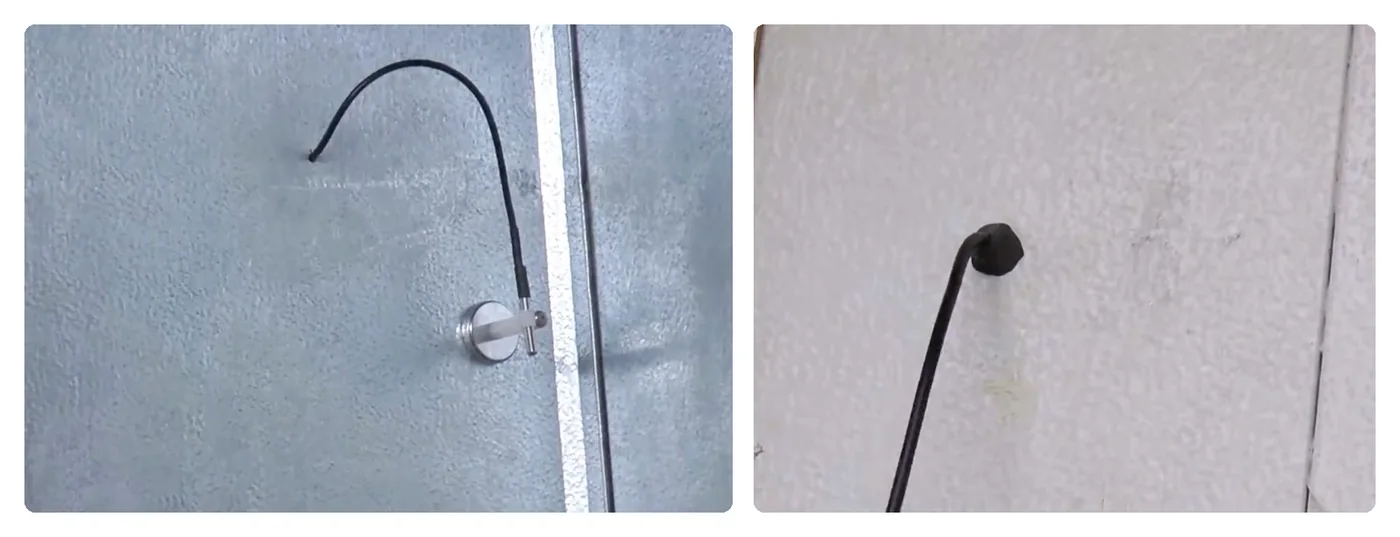
Install videos for through-wall probes show anti-leak putty around the lead. Putty is not a vapour barrier. On installs we have seen, it is already failing inside three to six months. A walk-in is supposed to stay sealed for years.
TemperatureWise puts a battery sensor in the box. Nothing is drilled. The radio is built to cross the panel. That is the whole point of the designs on will wireless work through a freezer wall.
Temp Stick has no hub because your router is the hub
This is the cost that does not appear on the Amazon listing.
Temp Stick is 2.4 GHz Wi-Fi only. There is no Ethernet port and no 5 GHz. Their own help pages say it is not for public or guest networks at RV parks, hotels or coffee shops.
Range is published at 300 to 400 ft unobstructed, then doors and walls do what doors and walls do. If the stick cannot see the router from inside the freezer, they tell you to buy a range extender or the PRO probe.
So the collector is the access point you already own. That access point is on mains. In a power cut it dies, along with the modem, which is the chain on what happens when the power goes out. The AC-powered Temp Stick can flag a power loss at the outlet it is sitting on. It cannot send that flag if the router is dark.
TemperatureWise puts a $50 hub near the boxes, or one LoRa gateway for the site. Cellular is $125 plus $50 a year if the internet is not yours. The "no hub" objection, and what it quietly costs in a walk-in, is the rest of what you need to buy.
TemperatureWise catches a failing unit before Temp Stick's threshold fires
This is why you pick TemperatureWise. Temp Stick fires when a number you set is crossed. That is a threshold. By then the machine has already failed.
Getting a temperature alert after the machine fails is like driving with the rear-view mirror. You see the wreck. You do not see the road.
TemperatureWise uses a proprietary mix of machine learning on the full temperature history, not just the current reading. That is a proactive equipment-health alert. A unit losing gas changes the shape of the record. So does a dirty condenser, or a defrost that no longer recovers. Those shifts show up days before any threshold fires. That is a weekday tech call, not warm food on a Sunday night.
Temp Stick can still be a useful logger if all you want is the number. TemperatureWise is the one that tries to tell you the compressor is dying while the box still looks fine. We showed the difference, with real data, on threshold vs rate-of-change alerting.
TemperatureWise and Temp Stick side by side
| TemperatureWise | Temp Stick | |
|---|---|---|
| Hardware | $25 (BLE) or $200 (LoRa), plus $50 to $450 for the hub | $149 ambient. $169 with AC power. $199 PRO with probe. Sale prices the week we checked |
| Ongoing | $250 per sensor per year. Texts, calls and all features in | None. Alerts and history included for the life of the device |
| Radio | BLE to a hub, or LoRa across a site | 2.4 GHz Wi-Fi only, to your router |
| How it detects | A proprietary mix of machine learning on the full temperature history, not just the current reading | Thresholds you set. Multiple bands. Anti-false-alarm tools in the app |
| Alerts | Email, text, phone call. Keeps going until someone picks up | Text, email, app. Multiple people. No phone call on the spec sheets we read |
| Power cut | Sensors on cells. Cloud sees the silence. Cellular plus backup pack if you buy it | Device can keep running on AA. Router still dies. AC model flags its own outlet |
| Offline buffer | None. TemperatureWise does not buffer on Bluetooth or LoRa. A gap stays a gap | Up to one month stored, uploaded when Wi-Fi returns |
| Accuracy they publish | Factory ±0.2°C (±0.36°F). NIST-traceable calibration available | ±0.15°C ambient. PRO probe ±0.5°C. NIST not listed |
| Who it was built for | Commercial cold rooms | Home, RV, cabin, wine, and light commercial |
| Walk-in install | Battery sensor in the box. No hole in the panel | PRO: probe through the wall. Ambient: the puck inside, if 2.4 GHz reaches |
Our prices are on the TemperatureWise page. Temp Stick prices and specs from Ideal Sciences product and FAQ pages, checked September 2026. No competitor-domain link.
Temp Stick will not call the night manager
A text at 3am is only useful if somebody reads texts at 3am. TemperatureWise steps from email to SMS to a phone that keeps ringing, for as many people as you name. That sequence is in the $250. We walked through a Boxing Day case where nobody picked up on alerting more than one person.
Temp Stick's published alert methods are text, email and the app. Unlimited texts is a real advantage against gadgets that meter SMS. It is still a message on a lock screen. For an RV fridge that is enough. For a walk-in of protein it is the gap.
The five-year number, honestly
One Temp Stick: about $149, then batteries. Five years, still about $149 plus cells.
One TemperatureWise Bluetooth sensor and hub: $75 up front, $1,250 of monitoring. About $1,325. That is not close, and we will not pretend it is.
The $1,325 is a proactive equipment-health alert. TemperatureWise uses a proprietary mix of machine learning on the full temperature history, not just the current reading. Phone calls, a hub that is not your router, and NIST-traceable calibration on request sit in the same fee. If you do not need those, you are overpaying us, and Temp Stick is the better tool.
At four walk-ins the comparison changes shape. Four Temp Sticks are $600 and four separate Wi-Fi clients fighting the same panel. Four TemperatureWise sensors are $100 plus a hub plus $1,000 a year, on one collector, with one call list. The physics of that panel is on will wireless work through a freezer wall.
The quick pick
| If you... | Pick |
|---|---|
| Want a proactive equipment-health alert before the box goes warm, not an alert after the machine has already failed | TemperatureWise. Getting the alert after the failure is the rear-view mirror |
| Want one logger, no yearly fee, and you control the 2.4 GHz Wi-Fi | Temp Stick. $149, and the accuracy is real |
| Are outfitting an RV, a cabin, a wine fridge or a spare freezer at home | Temp Stick. Built for that |
| Have a walk-in and will drill the panel for a probe | Temp Stick PRO if the Wi-Fi is yours. TemperatureWise if you do not want the hole |
| Need a phone that rings, not only a text | TemperatureWise |
| Have several boxes, a steel panel, or internet you do not control | TemperatureWise |
| Need NIST-traceable calibration or a record for an inspector across every box | TemperatureWise |
| Want the cheapest thing that basically works | Neither. A $12 to $15 consumer sensor, and accept the babysitting |
Where TemperatureWise falls short in this match-up
They have no yearly fee, and we do. $250 a sensor a year is the whole argument against us on this page. If the site is simple and the Wi-Fi is yours, that fee is buying things you will not use.
Their ambient accuracy figure is tighter than our factory figure: ±0.15°C against ±0.2°C. For a walk-in that difference does not decide a loss. For a buyer comparing spec sheets, they win the line.
We still offer NIST-traceable calibration, which their pages do not list.
They buffer a month on the device. When Wi-Fi returns, the gap fills in. TemperatureWise does not buffer on Bluetooth or LoRa. A gap stays a gap. Their one-month buffer is a true edge for a cabin that loses internet for a week.