
Cold holding, hot holding and the danger zone
By Vimal Bhaya, Founder and Lead Systems Architect · Last reviewed 25 October 2026
This is a continuation of Temperature log basics, a 7-part tutorial. You are on part 5 of 7.
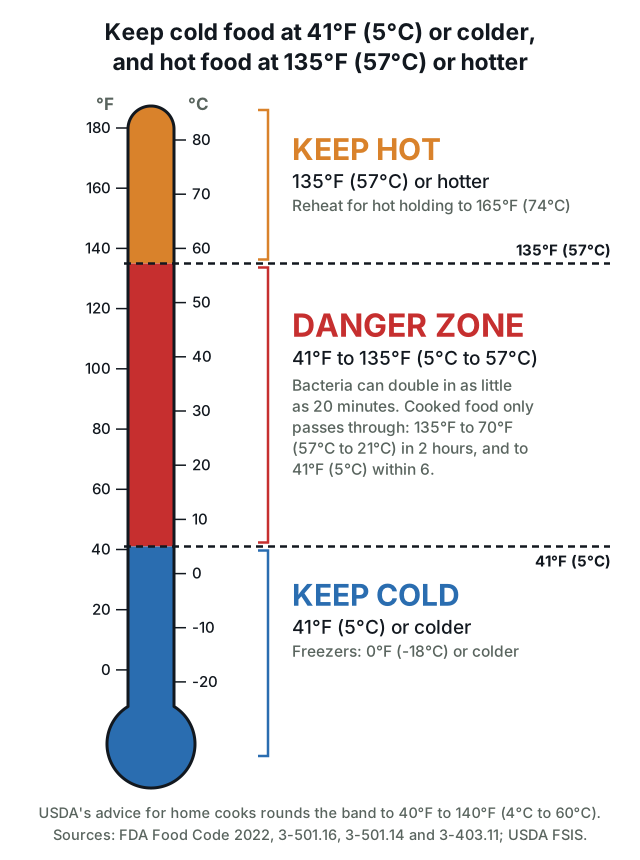
The danger zone is the range of temperatures where bacteria grow fastest. Under the FDA Food Code, cold food is held at 41°F (5°C) or colder and hot food at 135°F (57°C) or hotter, so in a US kitchen the danger zone runs from 41°F to 135°F (5°C to 57°C).
USDA's advice for home cooks rounds it to 40°F to 140°F (4°C to 60°C). Inspectors work to the Food Code numbers. Food can pass through the danger zone while it cools or reheats, but only for a set time.
The danger zone runs from 41°F to 135°F (5°C to 57°C) in a US kitchen
The danger zone is a range of temperatures, not a place in the kitchen. Below it, cold slows bacteria down. Above it, heat stops them. In between, they grow fast: USDA says bacteria in this range can double "in as little as 20 minutes".
TCS food is the food these temperature rules cover
TCS stands for time/temperature control for safety. The FDA Food Code uses it for food that has to be kept cold or hot, or used up within a set time, to stop germs growing in it. Older codes and some inspectors still call it potentially hazardous food (PHF). It is the same thing.
- TCS food: raw and cooked meat, poultry and fish, dairy, eggs, cooked rice, beans and vegetables, cut melons and cut leafy greens, among others.
- Not TCS food: food that stays safe on a shelf, such as bread, crackers and whole, uncut fruit.
Whenever this page, or an inspector, says cold food or hot food, it means TCS food.
Cold holding means 41°F (5°C) or colder, measured in the food
FDA Food Code 3-501.16 says cold TCS food is held at 41°F (5°C) or colder. The limit is about the food, not the air in the box.
- Set the box below the limit. Reach-in coolers usually run at 35°F to 38°F (2°C to 3°C), so the food stays under 41°F (5°C) when the door opens. See how a reach-in cooler works.
- Put the cooler thermometer in the warmest spot. The Food Code asks for it in "the warmest part" of the unit, usually near the door.
- Probe the food, not only the box. An inspector marks cold holding on food temperatures, taken with their own thermometer. See what health inspectors look for.
- Keep freezers at 0°F (-18°C) or colder. USDA says food kept constantly at that temperature stays safe, although its quality drops over time.
Hot holding means 135°F (57°C) or hotter
The same Food Code section says hot TCS food is held at 135°F (57°C) or hotter.
- Heat it first, then hold it. Food that was cooked and cooled is reheated for hot holding so every part reaches 165°F (74°C) for 15 seconds. The time from 41°F (5°C) to that temperature may not be more than 2 hours.
- Check hot food on a schedule. One county's sample procedure checks hot food at least every 2 hours. See how often to log temperatures.
Hot holding goes wrong less often than cold holding, but it still goes wrong. In FDA's restaurant study, hot food was out of temperature at least once in 18.5% of fast food and 26.3% of full-service restaurants.
The Food Code says 41°F (5°C) and USDA's home advice says 40°F (4°C)
Two sets of numbers show up on charts and posters. Both are right for the reader they were written for.
| Source | Cold limit | Hot limit | Written for |
|---|---|---|---|
| FDA Food Code, 3-501.16 | 41°F (5°C) or colder | 135°F (57°C) or hotter | Restaurants, stores, schools and the inspectors who check them |
| USDA FSIS | 40°F (4°C) | 140°F (60°C) | Home cooks |
If you run a food business in the US, use the Food Code numbers. They are the ones on the inspection report.
In Canada, Health Canada gives the danger zone as 4°C to 60°C (40°F to 140°F). That is why some posters you find online show 4°C and 60°C.
Food may pass through the danger zone for 2 to 6 hours, depending on the rule
Food passes through the danger zone when it cools down, heats up or sits out. Each case has its own clock.
| Situation | Time limit | Rule |
|---|---|---|
| Cooling cooked food | 135°F to 70°F (57°C to 21°C) in 2 hours, then to 41°F (5°C) within 6 hours in total | Food Code 3-501.14 |
| Reheating for hot holding | 41°F to 165°F (5°C to 74°C) within 2 hours | Food Code 3-403.11 |
| Food held on time instead of temperature | Used or thrown out within 4 hours, or 6 hours for cold food that never goes above 70°F (21°C) | Food Code 3-501.19 |
| Home cooking | 2 hours out of the fridge, 1 hour above 90°F (32°C) | USDA FSIS |
Time as a public health control needs written procedures your health department accepts. Without them, the temperature limits apply.
Food found in the danger zone needs a decision, and the decision gets written down
When cold food reads above 41°F (5°C), the question is how long it has been warm. School kitchen guidance from the Institute of Child Nutrition sets out the steps.
- Probe the food. Take the temperature in the thickest part.
- Find the last good reading. Look in the log for the last time the food or the box read 41°F (5°C) or colder.
- Within the last 2 hours: chill it fast. Move it somewhere colder, in shallow pans, and check it again.
- Longer, or nobody knows: throw it out.
- Write it down. The reading, the time, what you did and your initials. See how to do temperature logs correctly.
This is where the log earns its place. Without the last good reading, the only safe answer is the bin.
Cold holding is the temperature rule US restaurants miss most
FDA sent trained staff into hundreds of US restaurants in 2017 and 2018 and recorded what they found. Cold holding was out of compliance at least once in most of them.
| Item | Fast food | Full-service |
|---|---|---|
| Cold holding, TCS food at 41°F (5°C) or colder | 62.2% | 79.8% |
| Hot holding, TCS food at 135°F (57°C) or hotter | 18.5% | 26.3% |
In full-service restaurants, no item in the study was out of compliance more often than cold holding. FDA names improper holding time and temperature as one of the two most common risk factors, with poor personal hygiene.
A box that drifts at 2 AM is often cold again by the morning check. One reach-in in our own readings sat near 46°F (8°C) for about 15 hours after a door was left ajar. See reach-in cooler troubleshooting.
Want to know your coolers stayed under 41°F (5°C) all night?
TemperatureWise watches every cooler and freezer, day and night. It records each box at least every 15 minutes and keeps the record indefinitely. When a box drifts out of its normal pattern, TemperatureWise emails, then texts and calls up to 3 people per sensor until someone answers.
It measures the air where the sensor sits. To read closer to the food, add TemperatureWise glycol buffer bottles (an optional add-on). The sensor sits in a bottle of liquid that warms and cools slowly, the way food does, so the reading follows the food and not every opening of the door. More on how they work: temperature buffers and glycol bottles.
TemperatureWise does not watch hot holding or cooling. Those still need a probe thermometer and a log.