
Long weekend and holiday closure checklist for walk-in coolers and freezers
By Vimal Bhaya, Founder and Lead Systems Architect · Last reviewed 28 October 2026
This is a continuation of Food spoilage insurance and claims, an 8-part tutorial. You are on part 5 of 8.
Before you close, have the boxes serviced, run the stock down, leave them running, and put a named person on call who will hear about a problem the same day. Otherwise a walk-in that fails on a Friday night is found on Monday or Tuesday, after every hour of the warming happened with nobody there.
That is how one frozen food brand lost $125,000 of stock in a single freezer over a long weekend. When you open again, check every box before any food is used.
A closure turns a small fault into a total loss
On a normal day, a warm box is noticed within a shift. When you are closed, nobody opens the door for 3 days over a long weekend, or 2 weeks over a school break. A fault that would have been a service call becomes a full box of food in the bin.
- $125,000 in one freezer. A frozen food brand lost that much over a long weekend, with nobody there to catch the fault.
- "Walked in after a day closed and the freezer was at 50 degrees." A cook, throwing away $1,000 of inventory. That is 50°F (10°C).
- "Closed for 4 days, walk in cooler ~43F." Another kitchen, after a long closure. That is about 6°C, above the 41°F (5°C) line.
Holidays also empty the phone list. On 26 December 2025, a parked reefer holding up to $125,000 of frozen stock stopped and did not restart, with nobody on site. TemperatureWise caught it: an alert at 4 PM, 4 hours after the stop and 5 h 45 min before the stock reached its safety line. The team had it running again at about 10 PM. The reefer case study has the full readings. Here is how the day went:
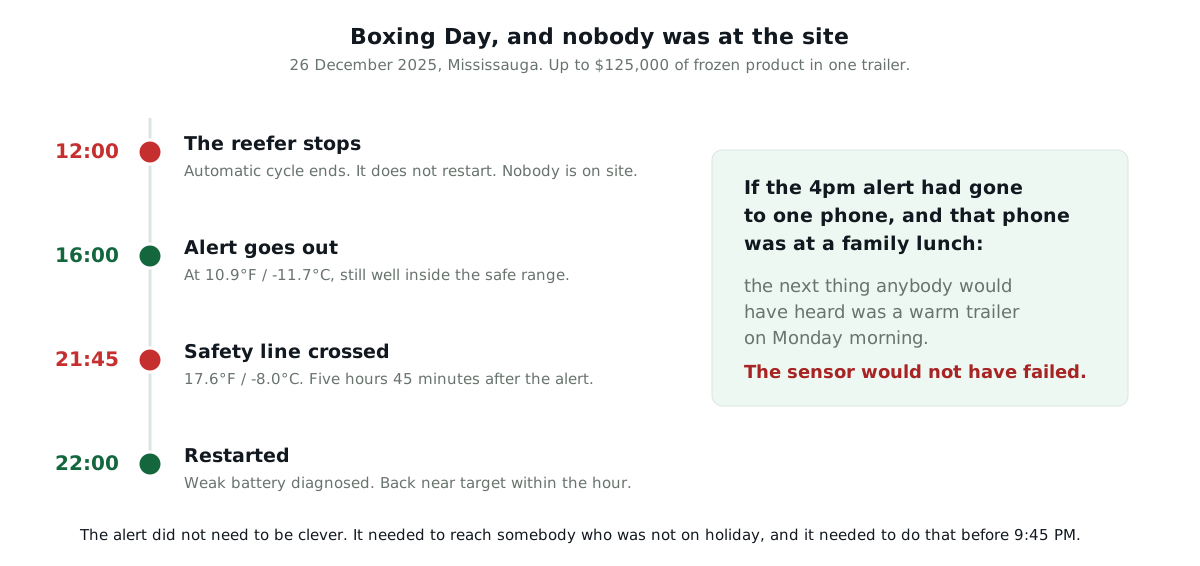
It was caught because the alert reached someone who could act. The same failure, with nobody listening, is a Monday morning loss.
Ten checks before you close
A week before:
- Book a service visit. Have the condenser coils cleaned and the door gaskets, closers, defrost and drains checked. School kitchens use their breaks for planned maintenance for the same reason.
- Run the stock down. Order less and use up what you can, so less food sits in the boxes while nobody is there.
- Name who is on call, and give them your refrigeration contractor's number and your power company's.
- Test your alarm or alerts. Make sure they reach a person who will answer over the holiday, not an empty building or one phone at a family lunch.
On the last day:
- Leave the walk-ins running. Switching them off saves little. Ice in the panels melts into the insulation, and gaskets dry out. If a box must go off, empty it, clean it and prop the door open.
- Label the breakers and plugs "Do not switch off". Cleaners and contractors work during closures. In one well-known case, a cleaner switched off a research freezer because its alarm was annoying.
- Check each door closes and seals by itself. Open it a few inches and let go. Should be: it swings shut and seals all the way round.
- Clear the air path. Should be: nothing stacked against the evaporator or in front of its fans.
- Write down each box's temperature and the time as you leave. Should read: 41°F (5°C) or colder in a cooler, 0°F (-18°C) or colder in a freezer.
- Check the backup. Generator fuel, or the plan for dry ice or a rented refrigerated trailer if the power goes. The storm steps in what to do before a forecast storm apply here too.
While you are closed, someone has to look
Either a person checks the boxes in person, or the boxes report to a person. One state's summer guidance for school kitchens asks for temperatures at least weekly. A box full of food needs more than that, because a stopped freezer can cross its safety line in under 10 hours.
If a box is found warm:
- Write down the time and the reading.
- Move the food to a working box if one is cold.
- Call your refrigeration contractor, and keep the door shut until they arrive.
- Decide the food by the rules below, and photograph anything that has to go. Your insurer will want it listed, as how to build a spoilage inventory explains.
When you open again, check every box before any food is used
- Read each box's thermometer before you open the door. Should read: 41°F (5°C) or colder in a cooler, 0°F (-18°C) or colder in a freezer.
- Look at the whole closure, not only this morning. A box can fail and recover while you are away. Only a record shows that.
- Probe the food in the warmest part of each box.
- Decide by the food rules, below.
| Food | Rule |
|---|---|
| Cold TCS food above 41°F (5°C) | Throw it out after 4 hours, under the most common rule. Some places allow longer if the food stayed in the mid-40s °F (about 7°C) and you wrote a plan in advance. Some are stricter: one New York county allows 2 hours above 45°F (7°C) |
| Cold food nobody measured | Treat it as unsafe. "When in doubt, throw it out!" |
| Frozen food still solid or nearly solid | Can be refrozen, if the packages are not damaged |
| Frozen food partly thawed | Can be refrozen or cooked only if its outside stayed at 41°F (5°C) or below and its core is still frozen |
Do not put food back into a box that has not come back to 41°F (5°C) or colder.
Worried about the boxes while you are away? Let them call you
TemperatureWise watches every box through the whole closure and calls a person the moment one starts to drift. It emails first, then texts and calls up to 3 people per sensor until someone answers. If a sensor or gateway goes quiet, that raises an alert too.

It works for the long breaks as well as the short ones, such as a school kitchen closed for weeks over summer. Most failures show up days ahead: TemperatureWise flags a failing defrost timer or evaporator at least 4 to 5 days before failure, so the service call happens before you close.
When you open again, the whole closure is on one chart, so you know whether the food stayed cold. The frozen food brand that lost $125,000 over one long weekend now runs TemperatureWise at all three of its sites.
TemperatureWise still needs someone to answer. Name the people before you close.