
How to clean a commercial ice machine
By Vimal Bhaya, Founder and Lead Systems Architect · Last reviewed 5 November 2026
This is part 1 of 5 in Commercial ice machine maintenance, a short tutorial on keeping a cube ice machine clean, safe and making ice.
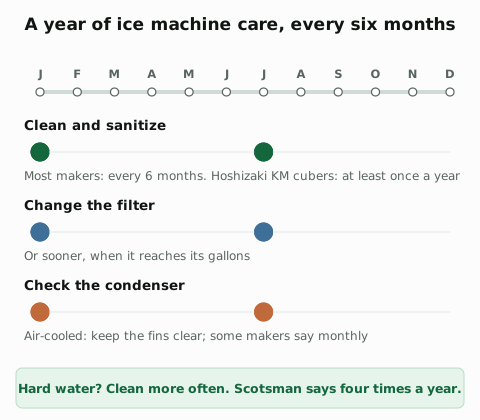
Empty the bin, run the machine's clean cycle with the cleaner its manual names, rinse, run the sanitize cycle, wash the bin, and throw away the first batches of ice. Do it every six months. Manitowoc, Scotsman and Ice-O-Matic all give that interval. Hoshizaki's minimum for its KM cubers is once a year, and more in poor water.
Cleaning and sanitizing are two jobs. The cleaner is an acid that dissolves scale. The sanitizer kills slime, mold and bacteria. Never mix them.
A cube machine freezes water on a cold plate, then warms the plate to drop the ice
Most commercial cube machines work the same way. Water comes in through the filter and the inlet valve, into a trough at the back, under the plate. A pump lifts it to a tube at the top, and it runs down a cold metal plate, the evaporator, behind a hanging water curtain, and freezes on it in layers. When the ice is thick enough, the plate warms for a short time. The slab of cubes lets go, pushes the curtain open and drops into the bin.

The water that does not freeze runs back to the trough, and the pump sends it round again. The minerals in it do not freeze either. Many machines flush the water left in the trough to the drain at each harvest, but some minerals always stay behind, and over months they coat the plate, the trough and the tubes as scale. That is why every machine needs cleaning, even on good water.

Two parts are easy to miss. Behind a dividing wall, in its own compartment, sits the warm side: the compressor and, on an air-cooled machine, the condenser and its fan, usually at the back or the side. And in the bin, the bin control stops the machine when the ice reaches it. On some machines it is a thermostat probe, on others a lever, and on many cube machines the water curtain itself: when ice holds the curtain open, the machine stops. A float or a probe in the trough sets the water level.
Cleaning removes scale, and sanitizing kills what grows
The makers use two words for two jobs. Manitowoc's manual puts it simply: the cleaner removes lime scale and mineral deposits, and the sanitizer disinfects and removes algae and slime. Some labels call the cleaner a scale remover or a descaler. It is the same job.
- Clean first. The cleaner is an acid. It dissolves the scale the minerals leave behind.
- Rinse. Get the cleaner out before the next step. Ice-O-Matic says to rinse it out thoroughly before sanitizing.
- Then sanitize. The sanitizer kills slime, mold and bacteria on the surfaces the water and ice touch.

Slime and mold grow where the machine stays wet. Look in the trough, on the curtain and the distribution tube, and inside the bin, on its door and around its drain. Pink, black or brown slime you can see means a sanitize is overdue. Scotsman says to sanitize more often where yeast is present, and the FDA Food Code asks for bins to be cleaned often enough to prevent mold when the maker gives no interval.
Never mix the cleaner and the sanitizer. Manitowoc's manual says so in those words. Run them one after the other, with a rinse between.
Every six months is the usual interval, and hard water means more often
Three of the four big makers say every six months. Hoshizaki's sheet for its KM cubers says at least once a year, and its ice dispenser sheet twice a year. Hard water, a dusty kitchen or heavy use calls for more.
Maker | How often | Notes |
|---|---|---|
Manitowoc | Every six months | Its S-series, Q-series and undercounter manuals |
Hoshizaki | At least once a year (KM cubers) | At least twice a year on its DCM ice dispensers; more in poor water |
Scotsman | About twice a year | The Prodigy Elite's reminder comes on every 6 months. Four times a year where the water is highly mineralized (SCE170) |
Ice-O-Matic | Every six months | But no more than once a month |
The FDA Food Code treats ice as food. It does not set its own number: it says ice machines are cleaned at the frequency the maker specifies, or, without one, often enough to stop soil or mold building up. Your state adopts the Code, so the maker's interval is the one an inspector reads.
Thin cubes, slow batches and cloudy ice mean a clean is due
Scale on the plate slows the freeze, so each batch takes longer and the cubes come out thinner. Some stick to the plate at harvest. Manitowoc's manuals list a dirty machine among the causes of soft or cloudy ice, with poor water, poor filtering and a dirty screen at the water inlet.
- Cubes thin or missing on one side. The small holes in the distribution tube scale up too. When they narrow, the water runs unevenly over the plate, and the cubes come out thin, or not at all, where less water reaches.
- Slime or mold you can see, pink, black or brown, in the trough, on the curtain or in the bin. The machine is overdue for a sanitize, and the bin for a wash.

If you see these signs before the next clean is due, clean early. If they come back soon after a clean, look at the water: ice machine water filters, and when to change them.
The cleaning steps, in order
This is the sequence every maker's instructions follow. Your machine's manual, or the cleaning label inside it, gives the exact buttons, amounts and times, and it comes first.
- Read the label or the manual. Find the cleaner and sanitizer it names, and the amounts. Scotsman's bulletin says the right strength is critical.
- Put on rubber gloves and eye protection. Scotsman's instructions warn that the cleaner is an acid that can cause burns.
- Empty the bin. Take out all the ice, so none of it meets the cleaner.
- Start the clean cycle. On a Manitowoc Indigo NXT you press CLEAN. On a Hoshizaki KM you set the control switch to WASH. On a Scotsman Prodigy you press Clean. On an Ice-O-Matic Elevation you hold POWER for a harvest, then press CLEAN.
- Add the cleaner when the machine asks. Pour in the amount the manual gives. Hoshizaki's sheet for the KM-340 to KM-901, for example, says 14 fluid ounces (414 ml) of Scale Away, into the water tank.
- Let it run, then rinse. The machine circulates the cleaner, then drains and rinses. Manitowoc's Indigo NXT clean runs up to about 35 minutes.
- Sanitize. Run the sanitize cycle with the sanitizer the manual names. On the Indigo NXT that is CLEAN again, for about 24 minutes.
- Wash the bin. Scotsman's manual has you wash the bin's inside with the sanitizer. Hoshizaki's sheet uses a neutral cleaner, such as dish soap, then a thorough rinse. Mold grows in the bin too, so wash its door, its corners and around the drain, and look in the trough and on the curtain: slime still there after the cycle means those parts come out for cleaning by hand, as the manual says.
- Make ice, and throw away the first batches. Ice-O-Matic says to discard the first two batches after cleaning, and again after sanitizing.
If the manual's steps take panels off or parts out, switch off and unplug the machine first, and follow the manual exactly, or have a trained person do it.
Each maker does it slightly differently. Manitowoc, Hoshizaki, Scotsman and Ice-O-Matic each have their own cycle and amounts.
Five mistakes damage the plate, void the warranty or spoil the ice
- Vinegar or a household descaler. None of the four makers name them. Manitowoc warns that another maker's descaler can cause damage its warranty does not cover. Technicians in public threads say vinegar strips the nickel plating on a plated plate.
- The wrong strength. Too strong can damage the plate; too weak leaves scale. Measure it.
- Mixing cleaner and sanitizer. Never. One, rinse, then the other.
- Bleach where the maker warns against it. Hoshizaki's sheets use plain chlorine bleach, with no additives, as the sanitizer. Scotsman's bulletin says bleach will damage the evaporator, and names Nu-Calgon IMS. Use what your manual names.
- Keeping the first batches. Ice made during or just after a clean is not for use. Throw it away.
Which cleaner to buy has its own page: ice machine cleaner, nickel-safe or not.
The ice machine PM schedule, as a template
Copy this into your own system, or download it below. The rows come from the makers' manuals; your own manual's figures take priority.
Task | How often | Who | Notes |
|---|---|---|---|
Clean and sanitize the water system | Every 6 months for most makers (Hoshizaki KM: at least yearly), or the manual's interval. More often with hard water | Trained staff or a service company | Use the cleaner and sanitizer the manual names. Never mix them |
Wash the bin | At each clean | Trained staff | With the solution the manual gives. Look for slime or mold in the trough, on the curtain and around the bin's door and drain |
Throw away the first batches after a clean | At each clean | Trained staff | Ice-O-Matic says the first two batches after cleaning, and again after sanitizing |
Change the water filter cartridge | On its date or its gallons, whichever comes first | Trained staff | Write the date on the cartridge |
Check and clean the air-cooled condenser | At each clean, or as the manual says (some makers say monthly) | Trained staff, power off | Vacuum or soft brush |
Check the condenser air filter, where fitted | Twice a month (Hoshizaki KM-255BAH) | Anyone | Rinse or replace as the manual says |
SiteWise keeps the ice machine's PM on schedule and the history in one place
A clean every six months is easy to forget, because nothing breaks the day it is missed. The machine just makes slower, thinner ice until someone notices.
And this is one machine, with a list already: a clean, a sanitize, the bin, the filter and the condenser, each on its own interval. A kitchen or a site often has 10 to 15 machines like it, each with a list of its own. A paper checklist on the wall cannot keep that many dates, and it cannot tell anyone when one is missed.
SiteWise keeps all of it on your phone, in a free app. Yes, really free: the free plan has unlimited work orders (100 open at a time), 20 locations and 250 assets, far more than 15 machines.


Or open renergytech.com/download/sitewise on your phone.
SiteWise is a CMMS (a computerized maintenance management system): software that holds the assets, schedules the PMs, issues the work orders and keeps the history.

- The PM. Set the clean every 6 months, or the interval your manual gives. SiteWise creates the work order a set number of days before it is due, or schedules the next one from when the last was done.
- The procedure. Attach the maker's steps, with photos, to the PM, so whoever does the clean uses the right cleaner at the right amount.
- The parts. Keep cleaner, sanitizer and filter cartridges as parts with a minimum per storeroom. SiteWise reserves the parts for a planned PM 30 days ahead.
- On the phone. Technicians create, update and close work orders and PMs offline, on every plan, add photos and videos up to 30 seconds, and scan the machine's QR code to open its history.
Download the PM schedule above as a spreadsheet: ice machine PM schedule (CSV). The plans are on the SiteWise page.