Ice machine cleaner: nickel-safe or not, and which kind to use
By Vimal Bhaya, Founder and Lead Systems Architect · Last reviewed 5 November 2026
This is a continuation of Commercial ice machine maintenance, a 5-part tutorial. You are on part 2 of 5.
Use the cleaner your machine's manual names. If it names none, use a nickel-safe cleaner on a plated evaporator. On a stainless one, such as a Hoshizaki cuber, any commercial ice machine cleaner works. Never use vinegar, and never mix the cleaner with the sanitizer.
Hoshizaki says its stainless evaporators do not need a nickel-safe cleaner. It names its own Scale Away, and Lime-A-Way. Its tech tip adds that a nickel-safe cleaner can be used on a Hoshizaki. It just loosens scale less well.
An ice machine cleaner is an acid that dissolves scale
As water freezes on the plate, its minerals stay behind and build up as scale. An ice machine cleaner is a food-grade acid that dissolves that scale. Labels also call it a scale remover or a descaler.

A sanitizer is a different product for a different job: it kills slime, mold and bacteria after the cleaner is rinsed out. How to clean a commercial ice machine covers both, in order.
Plated and stainless evaporators need different cleaners
The evaporator is the cold plate the ice forms on. Some are plated, with a thin layer of nickel over copper. Others are stainless steel all through, as on Hoshizaki cubers. The plating is why nickel-safe cleaners exist.
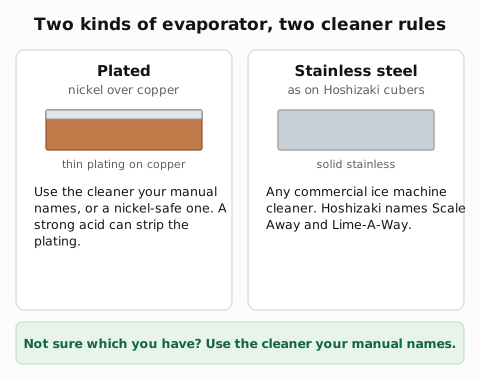
- Nickel-safe cleaners are milder. Their acid is weaker than a standard cleaner's, to protect plated surfaces.
- Plated plates need one. Ice-O-Matic requires a nickel-safe cleaner. Scotsman says its Clear 1 is safe on all ice machines, nickel-plated evaporators included.
- Stainless plates do not. Hoshizaki: any commercial ice machine cleaner can be used on its stainless evaporator, and a nickel-safe type is not required.
Each maker names its own cleaner and sanitizer
These are the cleaners each maker typically names. Check your machine's manual for the exact cleaner and sanitizer before you buy or pour.
Maker | Cleaner | Sanitizer | Note |
|---|---|---|---|
Manitowoc | Manitowoc Ice Machine Cleaner (94-0546-3), or 000000084, a clear metal-safe cleaner | Manitowoc Ice Machine Sanitizer (94-0565-3) | Another maker's products risk damage the warranty does not cover |
Hoshizaki | Scale Away or Lime-A-Way; any commercial ice machine cleaner | Chlorine bleach with no additives, at the sheet's amount | Stainless evaporator on its cubers; some models need a specific cleaner, so check the manual |
Scotsman | Scotsman Clear 1 | Nu-Calgon IMS | Says bleach will damage the evaporator |
Ice-O-Matic | A nickel-safe cleaner, such as Nu-Calgon Nickel-Safe | A nickel-safe sanitizer, such as Nu-Calgon IMS-III | The wrong products can void the warranty |
Pick the cleaner in three questions
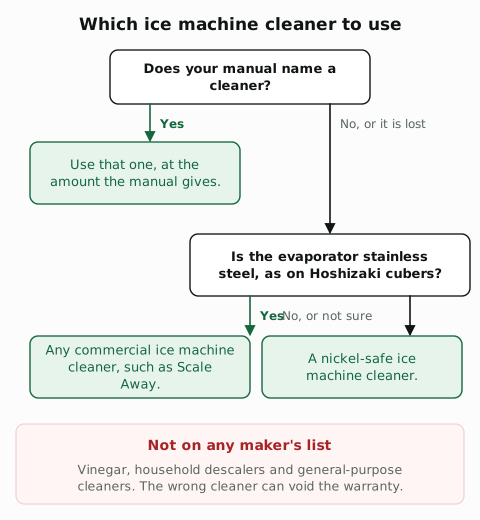
If the manual is lost, the maker's site has it by model number. Ice machine maintenance by brand lists each maker's manuals.
The amount matters as much as the brand
Scotsman's bulletin says the correct strength is critical. Too strong can damage the plate; too weak leaves the scale behind. The amounts differ by product and model:
- Hoshizaki Scale Away: 14 fluid ounces (414 ml) into the water tank on the KM-340 to KM-901; 6 fluid ounces in a gallon of warm water on the DCM-270BAH ice dispenser.
- Manitowoc undercounters: 2 ounces (60 ml) of de-scaler on the U0140; 5 ounces (150 ml) on the U0190, U0240 and U0310.
- Nu-Calgon Nickel-Safe: 3 ounces per gallon of warm water, by Nu-Calgon's service tip.
- Scotsman Clear 1: full strength, poured in when the display blinks A d 1, on the Prodigy Elite; 5 ounces in 2.5 quarts of warm water on the CU0415, CU0715 and CU0920.
- Your machine: the amount on its cleaning label or in its manual.
Vinegar is not on any maker's list
Vinegar comes up often in owner threads about cleaning ice machines. But none of the four makers name it, and technicians report that it strips the nickel plating on plated plates. Manitowoc warns that another maker's descaler can cause damage its warranty does not cover, and Ice-O-Matic that the wrong cleaner can void the warranty.
This page is about commercial machines. A countertop home ice maker has its own manual; follow that one.
The cleaner is an acid: gloves, eye protection, and never mixed
- Wear rubber gloves and eye protection. Scotsman warns that scale remover contains acids that can cause burns.
- Never mix the cleaner and the sanitizer. Run one, rinse, then the other.
- Empty the bin first, and throw away the first batches of ice after the clean.

SiteWise keeps the ice machine's PM on schedule and the history in one place
The right cleaner is the one written on the job, so nobody grabs the wrong bottle from the shelf.
SiteWise is a CMMS (a computerized maintenance management system): software that holds the assets, schedules the PMs, issues the work orders and keeps the history.

- The PM. Set the clean every 6 months, or the interval your manual gives. SiteWise creates the work order a set number of days before it is due, or schedules the next one from when the last was done.
- The procedure. Attach the maker's steps, with photos, to the PM, so whoever does the clean uses the right cleaner at the right amount.
- The parts. Keep cleaner, sanitizer and filter cartridges as parts with a minimum per storeroom. SiteWise reserves the parts for a planned PM 30 days ahead.
- On the phone. Technicians create, update and close work orders and PMs offline, on every plan, add photos and videos up to 30 seconds, and scan the machine's QR code to open its history.
Keep each machine's cleaner as a part in SiteWise, with a minimum per storeroom, and the bottle is reserved before the PM comes due.
Download the PM schedule above as a spreadsheet: ice machine PM schedule (CSV). SiteWise's free plan has posted limits; the plans are on the SiteWise page.