Proof, dated

The TemperatureWise saves log

A dated list of what TemperatureWise caught for customers: when cooling went wrong, when the alert went out, what the readings showed and what was done. Real alerts only, newest first. Four saves so far, from April 2025 to January 2026, on stock worth $850,000 in all.

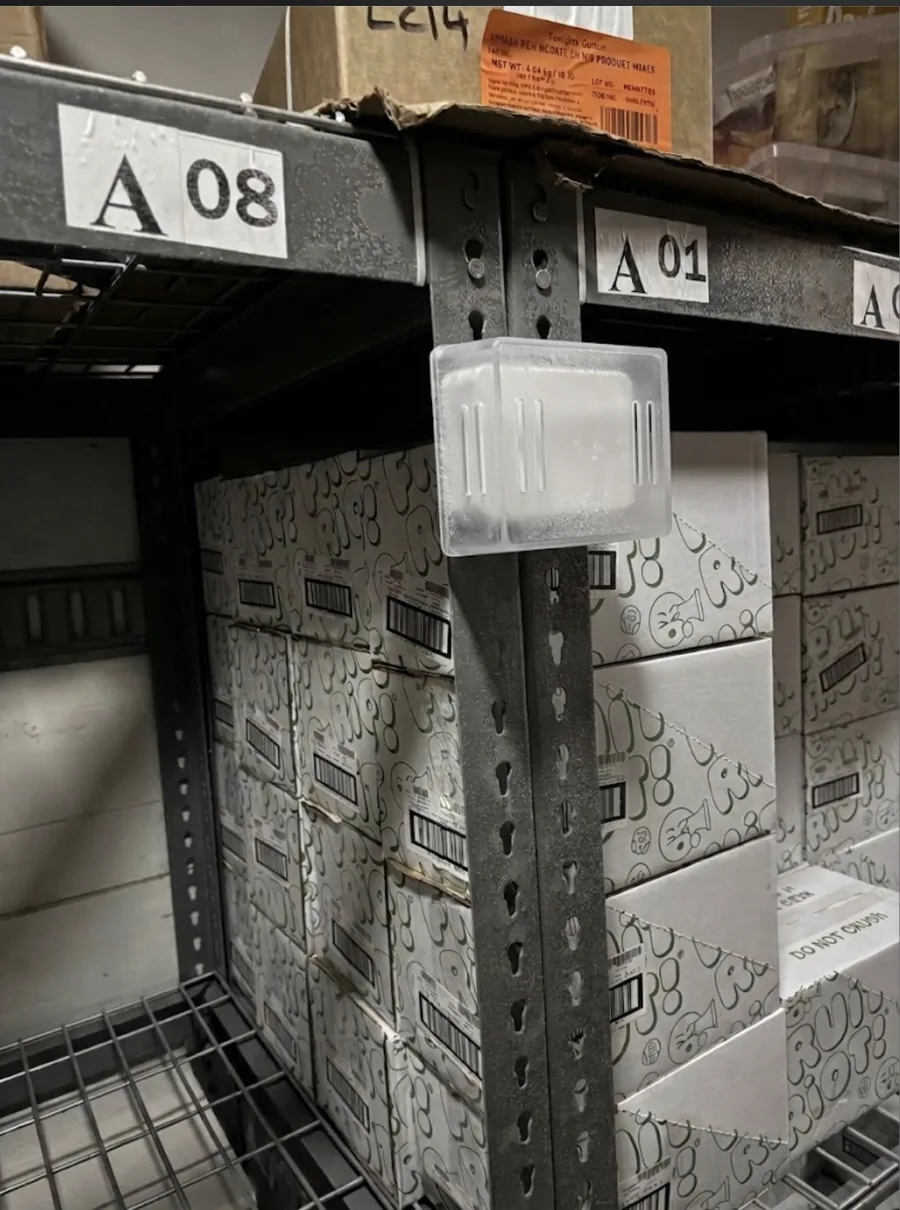
A TemperatureWise sensor clipped to the upright of a pallet rack inside a loaded freezer, covered in frost.
27 daysthe earliest warning so far, before a $450,000 repair
4 saveseach with its alert time and its readingsApril 2025 to January 2026
$850,000of stock behind the four alerts, by the customers' own figuresPhiladelphia and Mississauga
27 daysthe longest warning, on a slow refrigerant leakPhiladelphia, 2025

How this log works

Only real alerts, with the times as they were

An entry goes in when a TemperatureWise alert reached a customer before a fault cost them their stock. Each one gives the date, the place, the equipment, when the cooling went wrong, when the first alert went out, what the readings showed and what the customer did.

The times come from the alert record and the readings. Stock values are the customer's own figures. Where the readings are published, the entry links them, so you can check every number here yourself.

Entries are not tidied up. In January the first alert came about seven hours after the reefer stopped, and nobody could get to it before morning. That is on the log too, because it is what happened.

The log

Four saves, newest first

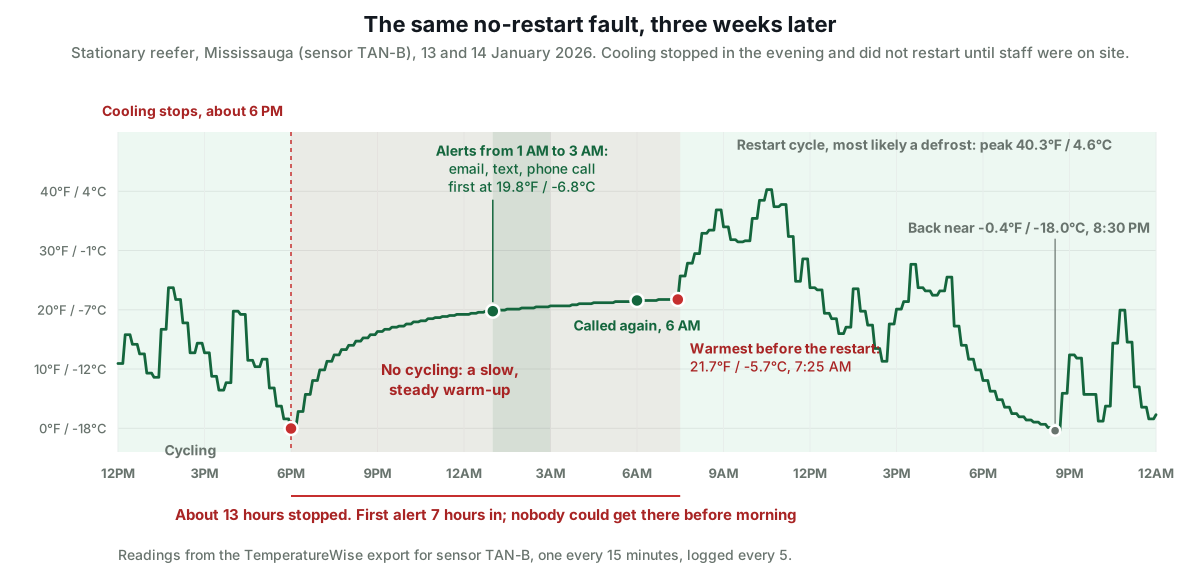
Temperature of a stationary reefer in Mississauga from noon on 13 January to midnight on 15 January 2026. It cycles until about 6 PM, when cooling stops at 0°F (-17.8°C), then warms slowly with no cycling. Alerts went out from 1 AM to 3 AM, when the box was at 19.8°F (-6.8°C), and again at 6 AM. The warmest reading before the restart was 21.7°F (-5.7°C) at 7:25 AM. After the restart a short rise to 40.3°F (4.6°C) is the restart cycle, most likely a defrost. The reefer is back near -0.4°F (-18°C) by 8:30 PM on 14 January.
13 to 14 January 2026 · Mississauga · stationary reefer

The same no-restart fault came back, three weeks later

A parked reefer used as frozen storage at a frozen food brand's Mississauga production site stopped at about 6 PM on 13 January and did not restart. It was the same reefer and the same weak-battery fault as on 26 December, and it had not been fixed yet. TemperatureWise ran its escalation ladder from 1 AM to 3 AM, by email, text and phone call, and called again at about 6 AM. Nobody could get to the site overnight. Staff restarted the unit at about 7:30 AM, and the battery was replaced that week. The short rise to 40.3°F (4.6°C) after the restart is the unit's start-up cycle, most likely a defrost, not the stock warming.

Cooling stopped
About 6 PM, 13 January
First alert
1 AM, at 19.8°F (-6.8°C), about 7 hours in
Warmest before the restart
21.7°F (-5.7°C)
Back near -0.4°F (-18°C)
About 8:30 PM, 14 January

The readings, 11 to 17 January 2026 (CSV)

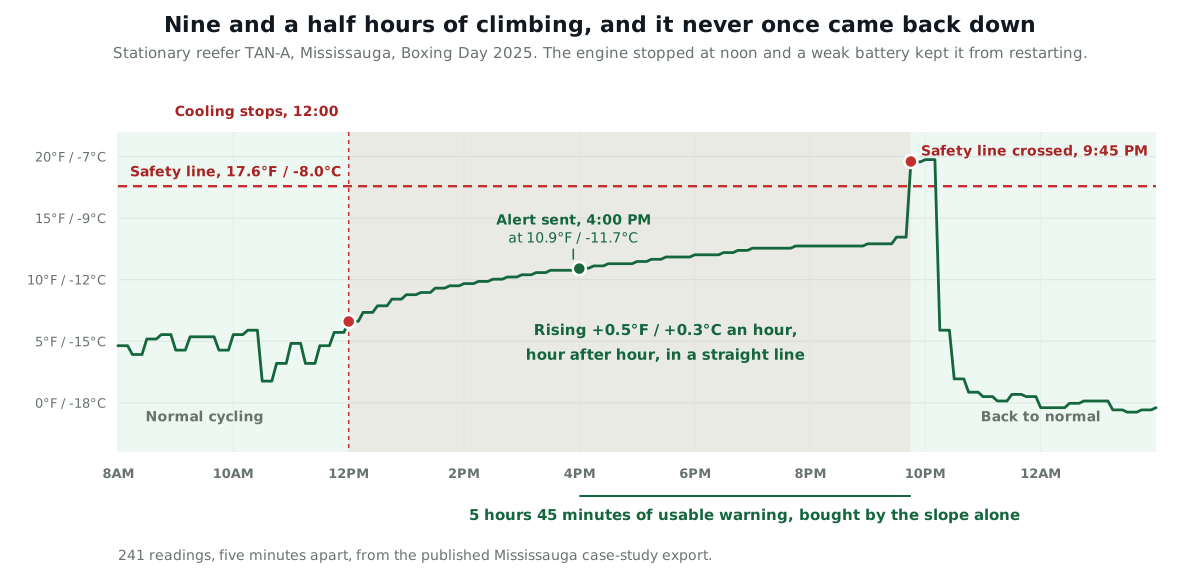
Temperature of a stationary reefer in Mississauga from 8 AM on 26 December 2025 to 2 AM the next morning. It cycles near 5°F (-15°C) until noon, when cooling stops, then climbs in a straight line. An alert was sent at 4 PM at 10.9°F (-11.7°C). The 17.6°F (-8°C) safety line was not crossed until 9:45 PM. After a restart around 10 PM the temperature falls back to normal.
26 December 2025 · Mississauga · stationary reefer

A reefer stopped on Boxing Day and did not restart

At noon on 26 December the reefer stopped during an automatic engine-off period, and a weak battery kept it from starting again. Nobody was on site. TemperatureWise alerted the team at 4 PM, while the box was still at 10.9°F (-11.7°C), 5 hours 45 minutes before it crossed the 17.6°F (-8°C) safety line. The reefer was restarted at about 10 PM and was back near target within an hour. Up to $125,000 of frozen stock was inside.

Cooling stopped
About noon
First alert
4 PM, at 10.9°F (-11.7°C), 4 hours in
Safety line crossed
9:45 PM
Stock
Up to $125,000, estimated

The full case study, with the readings

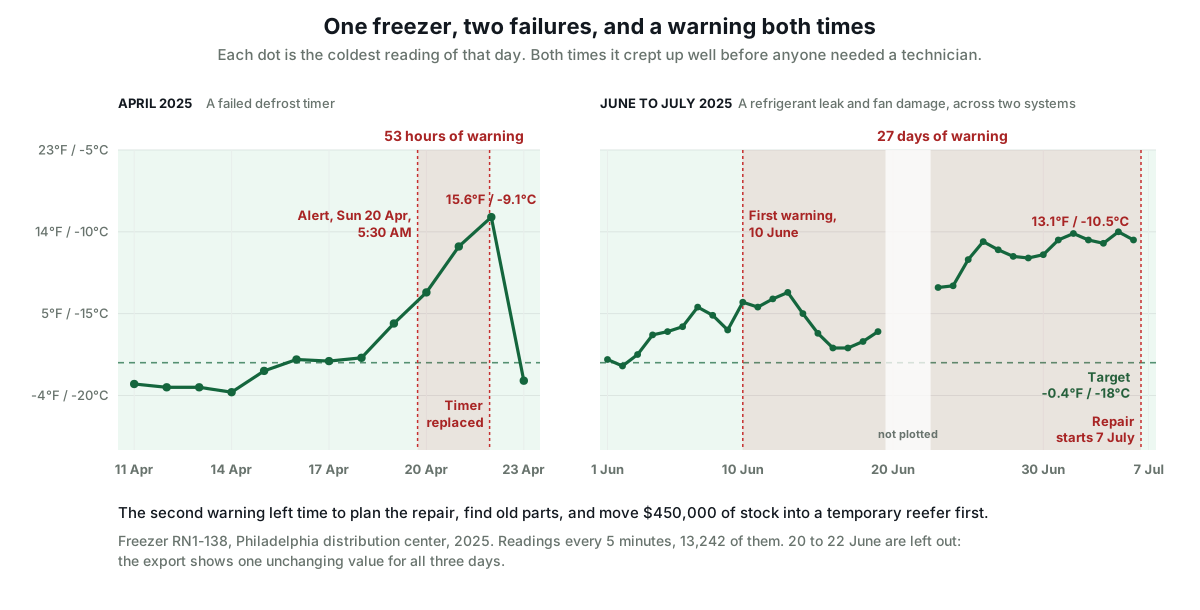
Two charts of the coldest reading each day in the same Philadelphia distribution freezer. Left, April 2025: the daily low climbs from 15 April and an alert is sent on 20 April, 53 hours before the failed defrost timer was replaced. Right, June and July 2025: the daily low climbs from about 0°F (-18°C) to about 13°F (-10.5°C), and the first warning came on 10 June, 27 days before repair work began on 7 July.
10 June to 10 August 2025 · Philadelphia · distribution freezer

Both refrigeration systems on one freezer were failing, and a slow leak gave 27 days

On 10 June TemperatureWise alerted the team to a developing problem: the freezer could still only reach about 6.8°F (-14°C). On 6 July its AI diagnosed a refrigerant leak. The first repair on 7 and 8 July brought one of the two systems back. Before the final repair, $450,000 of stock was moved to a temporary reefer, and the freezer was stable again near -0.4°F (-18°C) from 1 August.

First warning
10 June
Diagnosis
Refrigerant leak, 6 July
Warning before the first repair
27 days
Stock
$450,000, moved to a reefer first

The full case study, with the readings

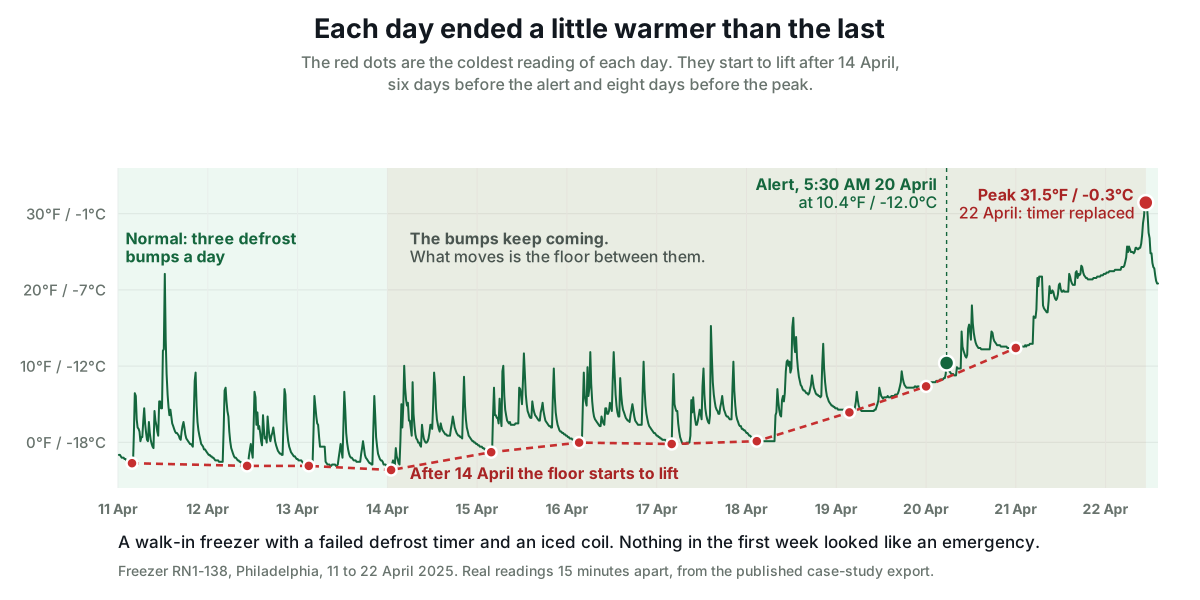
A line chart of a Philadelphia walk-in freezer from 11 to 22 April 2025. The coldest reading of each day is flat near -3°F (-19°C) until 14 April, then lifts day after day to 12.4°F (-10.9°C) on 21 April. An alert is marked at 5:30 AM on 20 April at 10.4°F (-12°C), and the peak at 31.5°F (-0.3°C) on 22 April, when the defrost timer was replaced.
11 to 22 April 2025 · Philadelphia · walk-in freezer

A failed defrost timer, caught 53 hours before the peak

From 14 April the coldest reading of each day crept up, as frost built on a coil whose defrost timer had failed. TemperatureWise flagged a likely fault on the evaporator side at 5:30 AM on Sunday 20 April, at 10.4°F (-12°C). One technician visit found the failed timer and the iced coil. Nothing was lost.

First alert
5:30 AM, Sunday 20 April
Warning before the peak
53 hours
Fix
One visit: the defrost timer
Stock
$150,000, nothing lost

The full case study, with the readings

What the four have in common

What the log says so far

Slow faults give the most room

A refrigerant leak gave 27 days and an iced coil gave 53 hours. Both were caught while the box still held, which is when a repair is cheapest.

A fault that is not fixed comes back

The Mississauga no-start happened twice in three weeks, because the weak battery waited for the right technician. The second time, the alert came in the night and the site could not act until morning.

An alert needs someone who can act

Every save here came down to a person who could get there. Name more than one on the escalation list, and for a site nobody can reach at night, a contractor's on-call line.

Common questions

What counts as a save?

A TemperatureWise alert that reached the customer before a fault cost them their stock, with the alert record and the readings to show it. A save is logged even when the alert came later than we would like, as in January 2026.

Can I see the readings behind each entry?

Yes. Every entry links its readings: the three case studies each publish their export, and the January 2026 export is linked from its entry. Each is a CSV with a reading every 5 minutes.

Who are the customers?

A national frozen smoothie brand runs the Philadelphia distribution freezer and the Mississauga production site. We name the places and the equipment, not the company.

Find out what your own readings would have shown

Send us your history from any system. We will read it the way we read these, for faults that are starting now and repairs that were needed before. Free, and no purchase needed.

Sources for every figure on this page
  1. The three case studies, with their published exports: Philadelphia freezer, April 2025, Philadelphia dual-system freezer, June to August 2025 and Mississauga reefer, December 2025
  2. January 2026: the TemperatureWise export for sensor TAN-B, the second of the two sensors in the same reefer, 11 to 17 January 2026, published here, and the customer's alert record and repair as reported to Renergy. From 3 PM on 17 January the export repeats one value, -10.6°C, for seven hours: the sensor stopped reporting, and the chart ends before then
  3. The $850,000 total: the four stock figures above, as on the TemperatureWise page, with the Mississauga figure of up to $125,000 counted once for each save

Last reviewed 16 November 2026